- Created for Electric Sheep FutureKind Fellowship Summer 2026
AI disclosure
I used AI tools in producing this post, and I want to be transparent about how. The research question, the argument, the positions I defend, and the editorial judgment throughout are my own. I identified the literature through my own searching and reading, including Consensus, and the sources and claims reflect that work.
I used Claude (Anthropic) as a writing and editing partner: to help draft and structure the prose, to synthesize my notes and the gathered literature into connected sections, to produce the two figures, and to revise the piece across several rounds against my own edits and against external reviewer feedback. Every claim, framing choice, and final wording was reviewed and approved by me.
As the epistemic-status note above says, this is a legal and policy synthesis rather than original empirical research, and I welcome corrections.
Summary
AI de-extinction runs on genetic data drawn largely from the Global South and other historically colonized regions, and almost nobody is asking what is owed for it. My argument is short. There is a duty to compensate. It reaches the whole chain of value, from the raw data through the trained model to the patents and the living animal, not just the moment the data was accessed. And it should be paid as a flat contribution into a shared multilateral fund rather than chased product by product. The part I think is most useful is not the fund. A fund like this already exists on paper. It is that de-extinct animals may slip through a definitional gap in that fund, and closing that gap looks like the higher-leverage move. The literature connecting de-extinction to any of this is thin, close to a single paper in my own search, which is part of why the corner seems worth working on now, while the field is still small enough to shape the norms before they set.
Epistemic status. This is a legal and policy synthesis, not original empirical research. I am fairly confident that AI-enabled de-extinction raises a real benefit-sharing problem. I am less confident that a flat levy is the best available mechanism, and least confident about the precise legal boundaries of the current COP16 framework. I would especially welcome corrections from people working in biodiversity law, Indigenous data governance, or access and benefit-sharing.
The routing of a resurrection
In April 2025, in a lab outside Dallas, Colossal Biosciences announced that it had brought back the dire wolf. Picture that lab. Bright, sterile, expensive, floated on more than 225 million dollars of venture capital. Now picture where its raw material comes from. Ancient DNA is not made in Texas. It is scraped out of permafrost, pulled from museum drawers filled by old colonial collecting expeditions, recovered from savanna and bush a long way from where the profit will land. The distance between those two pictures, the clean lab and the muddy dig, is the subject of this post.
Some quick background, since this sits where two fields cross. De-extinction is the attempt to recreate extinct or vanishing animals through genetic engineering, increasingly guided by AI models trained on DNA. Benefit-sharing is the older idea, written into the United Nations Convention on Biological Diversity and its Nagoya Protocol, that when someone profits from a country's genetic resources, the country and the communities those resources came from should share in the gains. The rules for that are called access and benefit-sharing, or ABS, and once the genetic material is turned into data, that data is called digital sequence information, or DSI. The argument of this post is that de-extinction is quietly pushing all three of these ideas into territory they were not built for.
The animals were not quite dire wolves. They were grey wolves carrying about twenty edited genes, made larger and paler to resemble the originals. Most of the coverage argued about whether that counts as resurrection, or whether we should be playing at it at all. Those are fair questions, but they are not the ones I want to ask, because I want to follow the supply chain instead.
The genomes these projects depend on, and the sequences their AI models train on, have to come from somewhere. Mammoth tissue comes out of the Siberian permafrost. Northern white rhino cells trace back to Kenya. Thylacine material sits in collections tied to Tasmania. The sequencing, the model training, and the databases sit in the United States, Europe, and Australia.
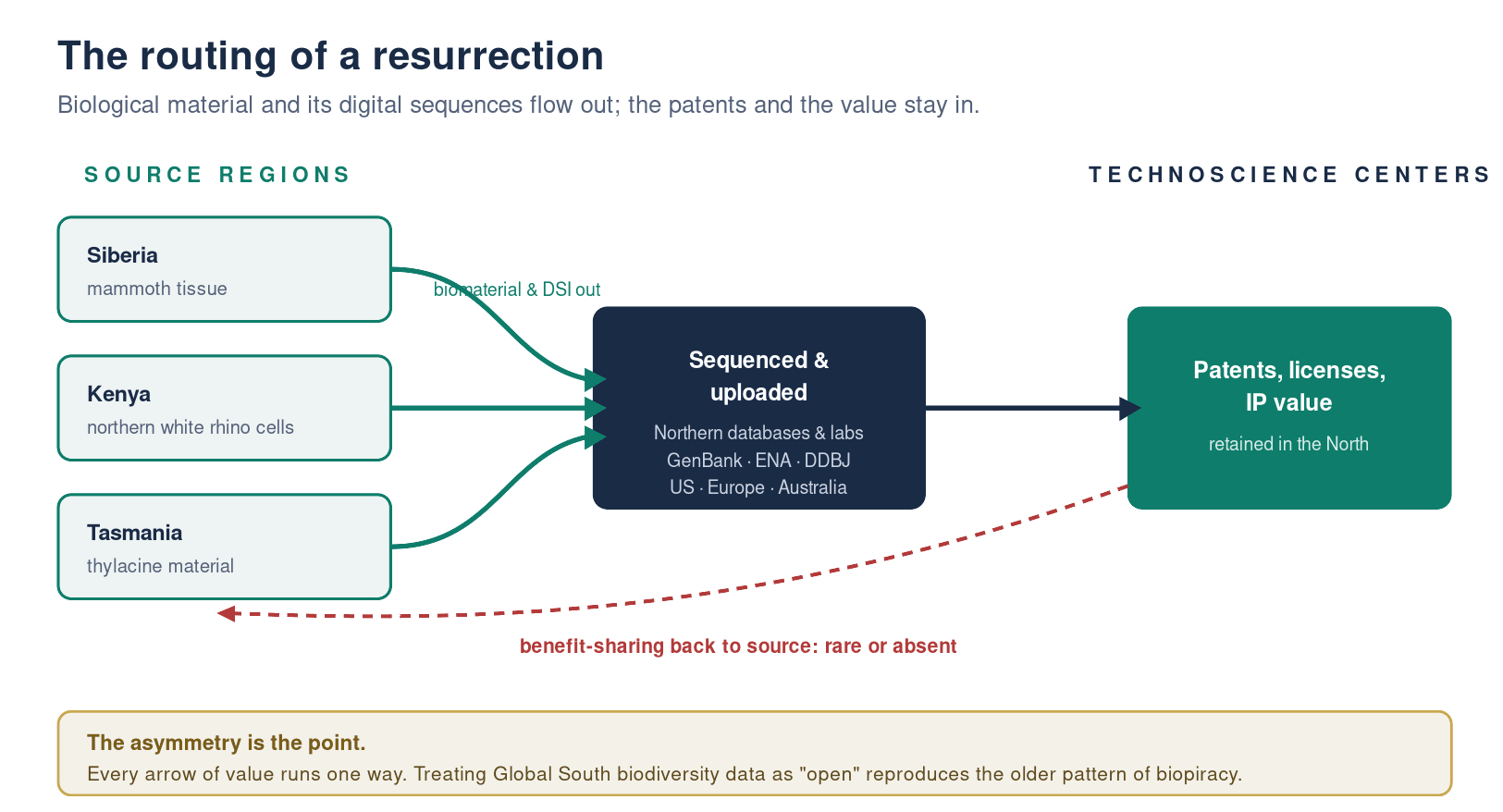
Figure 1. The neocolonial biomaterial economy behind AI de-extinction. Routing after Hoffman et al. (2026) and the project notes.
As the figure shows, the biological material and the data taken from it leave regions that have long been marginalized, while the patents and the money stay in the North. In the cases I could trace, the source communities appear to have had little say in how the material was used, and I found little evidence of meaningful benefit-sharing.
One note on framing before I go further. Siberia and Tasmania are not the Global South in the economic sense of the term. I use Global South as the headline because it is the clearest and most common name for the pattern, and because a large share of the biodiversity data at stake really does come from Global South ecosystems. But the deeper thing here is a pattern of extraction, and that pattern also runs through Indigenous Siberia and colonized Australia. I want to hold both in view: the familiar headline, and the wider history it stands for.
The debt, and how far it runs
When an AI de-extinction venture profits from genetic data taken from these regions, does it owe anything? And if it does, how far does the debt run? Only to the moment the data was accessed? Or to everything built on top of it: the trained model, the patents, the living animal and whatever it earns?
My answer, which the rest of this post defends, is that yes, there is a duty to compensate, the duty runs the whole way downstream, and it should be paid as a flat contribution into a shared fund rather than tracked product by product. The lever for making that real turns out to be smaller and more specific than "build a fund." It is a definitional gap that may let these animals slip past the fund the world has already built, and I come back to it below.
It is worth pausing on why anything is owed at all, because the claim is easy to assert and harder to ground. I am not saying a community owns a strand of DNA the way it owns a plot of land. Genetic material is a poor fit for that kind of property, and treating it as owned outright creates as many problems as it solves. The claim is narrower. When value is built out of a resource and the knowledge attached to it, and both came from a particular people who were not asked and not compensated, those people have a fair claim on part of that value. This is not a new principle; it is the one already written into the Convention on Biological Diversity, that profit drawn from a country's biological resources should be shared with that country. De-extinction does not escape the principle by copying the resource into a database. It only makes the principle harder to enforce.
And you do not have to think de-extinction is a good idea to think this matters. Whether reviving species is wise or reckless, the data it runs on still comes from somewhere, and that is the question here.
Small field, outsized stakes
Why should an EA audience concerned with much larger risks care about a handful of charismatic animals? Because of what the handful sets in motion.
Start with precedent. De-extinction is an early and unusually visible case of AI systems consuming biological data from low-resource regions. The rules we write here, or fail to write, will not stay with the wolves. The same questions are already live for crop genetics, drug discovery, and health data. The field is small enough to steer and loud enough to set norms that travel.
This is not hypothetical, and it is not really about one company. The pattern is old. Madagascar's rosy periwinkle is the case most often cited: a plant long used in local traditional medicine became the basis for two cancer drugs, vincristine and vinblastine, developed and patented in the North in the mid-twentieth century. They reshaped treatment for childhood leukemia and Hodgkin's disease and earned large returns for their maker, while Madagascar and the communities whose plant and knowledge were the starting point saw almost none of it (Bakshi, 2025). That happened with a single physical plant, before anyone could copy a genome into a database and train a model on it. De-extinction is the same extraction with the friction taken out. Colossal is only the most visible case; the reason to write rules now is that the machinery for repeating the periwinkle at data scale already exists.
Then there is scale. The tools at the center of this are genomic foundation models: AI systems trained on huge libraries of DNA so they can predict how genes behave and design new sequences. They are data-hungry by design. Evo 2, one of the largest, was trained on nine trillion base pairs drawn from across the living world (Brixi et al., 2026). A model that big needs biological material from everywhere, and the richest, least-catalogued biodiversity happens to sit in Global South ecosystems, which is also where the data gaps are widest (Pollock et al., 2025). So the demand for new genetic data points hardest at the regions with the least power to set the terms on which it is taken.
And there is the money, which flows North, and not through the animals. The main return in de-extinction is the patents and licenses on the AI, the bioinformatics, and the gene-editing methods developed along the way, which carry profitable downstream uses in human medicine and agriculture. The work is funded almost entirely by private venture capital and philanthropy rather than public conservation budgets; Colossal alone has raised more than 225 million dollars. When the value sits in IP held in the North, the source communities are written out of the upside by default, without anyone having to decide to exclude them.
The empty space
Here is the part that surprised me most when I went looking. Two mature bodies of research bear directly on this question, and they barely talk to each other.
On one side is the technical literature on AI and genomics. It is large, fast-moving, and almost entirely silent on where its training data comes from in any moral sense. Provenance appears as a data-quality concern, not a consent one. Whose sequences these are, and under what terms they were gathered, are simply not questions these papers are built to ask.
On the other side is the benefit-sharing literature: decades of careful work on access and benefit-sharing for genetic resources, anchored in the Convention on Biological Diversity and its Nagoya Protocol. It is deep and useful. It was also built for pharma, agriculture, and biobanking, not for de-extinction and not for AI. A third body of work, on data colonialism and Indigenous data sovereignty, has already built much of the vocabulary this problem needs, but it grew up around language, music, and health data, and speaks in the terms of those fields.
In the search behind this post, one paper connected de-extinction directly to colonial data extraction: Hoffman et al. (2026), a short commentary written in response to the dire wolf. Even the strongest conservation-AI horizon scan names AI colonialism as a top risk and then gives it a single paragraph before moving on (Reynolds et al., 2024).
There is even a language barrier inside the problem. The environmental-law side talks about access and benefit-sharing, digital sequence information, the Nagoya Protocol, and biopiracy. The critical-data-studies side, looking at much the same conduct, talks about extractivism, digital colonialism, and data sovereignty. One field will call a database built from un-consented samples a Nagoya compliance failure; the other will call it digital colonialism; and neither cites the other. I may have missed relevant work, but the lack of cross-citation itself seems significant rather than an artifact of my search. The combination is what matters here: the stakes extend beyond a few animals, the relevant fields rarely speak to one another, and there is a comparatively concrete first intervention available.
The part I am not arguing with
None of this is an argument against the technology. AI is doing real work in this field. Genomic language models read millions of fragmented ancient-DNA reads in hours and predict which edits produce which traits (Wang et al., 2025; Turner et al., 2025), and once animals are in the field, AI paired with camera traps, bioacoustics, and environmental DNA makes monitoring possible at a scale no team could match by hand.
My argument is about the data feeding that work, not the work itself. One adjacent worry I will name and set aside: heavy compute and Northern-trained models can pull funding and authority away from local, field-based conservation. That is real, and it belongs to a different paper. The question I want is narrower and almost unwritten: where the data came from, whether anyone consented, and what is owed for it.
Two ways to share the benefits
There is a genuine disagreement in the literature about how far a compensation duty should reach, and both sides are worth stating at full strength before I take one.
First, the strongest version of the view I do not hold. Digital sequence information, the argument goes, is just the digital shadow of a physical sample. If taking the physical sample from a country creates an obligation back to that country, as the Nagoya Protocol says it does, then the digital copy should create the same obligation. The data is the resource. Follow it back to its people. This position (Akpoviri et al., 2023) has real force. It keeps the tie between a resource and its community intact, and it refuses the move by which "we only copied the information" quietly becomes "so we owe nothing."
Now the competing view, also at full strength. A modern model does not use one sequence. It ingests hundreds of millions of data points at once and produces outputs that no single input can be traced through. Trying to attribute a given product back to a given dataset is not just hard, it is close to meaningless, and the cost of trying would swallow whatever benefit you meant to share. So decouple. Stop tracing individual uses, have everyone who draws on the shared pool of sequence data pay into a shared fund, and distribute from there (Halewood et al., 2023). This is roughly what CBD parties adopted at COP16 in 2024, a multilateral mechanism rather than a chain of bilateral traces (Maia et al., 2025). It is administrable, and administrability is not a small virtue in international law.
De-extinction complicates both. The general debate assumes the output of all that data is diffuse. De-extinction ends in a single, identifiable, ownable thing: the animal. When there is one clear product with one clear owner, the flat-rate camp's best argument, that you cannot trace the value, looks weaker. You can point at the wolf. The honest response is not to wave the tangibility away but to sit with it, because it is exactly what tempts everyone toward a direct royalty.
Broad duty, simple mechanism
The two camps look like they disagree. I think they are mostly answering different questions, and once you separate the questions the disagreement shrinks. Two questions hide inside "does compensation attach to the data or to the products." One is about scope: how far does the duty reach? The other is about mechanism: how should payment be collected and distributed? Running them together is what keeps the debate stuck, because "trace it all the way downstream" sounds like a claim about mechanism, and a hard one, when it is really a claim about scope.
On scope, I side with the downstream view. The value of the data does not stop at the point of access. It carries into the trained model, into the patents, into the animal and whatever it earns. If the duty to compensate exists because value was taken, then the duty reaches as far as the value does (Schulz et al., 2026, which braids ABS with the CARE and OCAP principles from Indigenous data governance). Compensation, and some measure of control, should attach across the lifecycle rather than only at the door.
On mechanism, I side with the flat rate, and here the intuitive answer runs the other way. Say we tried the fair-sounding thing. A thylacine is revived from material traced to Tasmania, so we route a royalty on that animal straight back to Tasmania. Now try to actually run that, and the first problem is deciding which sequences count as the thylacine's. The genome was assembled, edited, and gap-filled by a model trained on millions of other sequences. To cut the check, someone would have to prove exactly which genes, from which samples, ended up in the final animal, and defend that division against everyone else with a claim. The tracing is close to impossible, and the cost of attempting it is the whole cost of the system.
That difficulty is not a problem the company minds; it works in its favor. A per-product royalty charges only for the visible output, the one animal you can point at, and says nothing about the diffuse mass of genetic data the model drew on to learn how to build any animal at all. Think of a producer who samples one recognizable scream. Pay the estate for that scream and you might feel square, but the model did not sample a scream; it ingested the whole back catalogue of a genre to learn how to generate a new one. Pay only for the single audible sample and you have taken the rest of the archive for free. This is why a flat contribution currently looks more promising to me than a per-product royalty: a percentage of revenue paid by de-extinction ventures into a multilateral fund, with consent handled where the money is collected, is better able to account for the whole archive on which the visible animal depends.
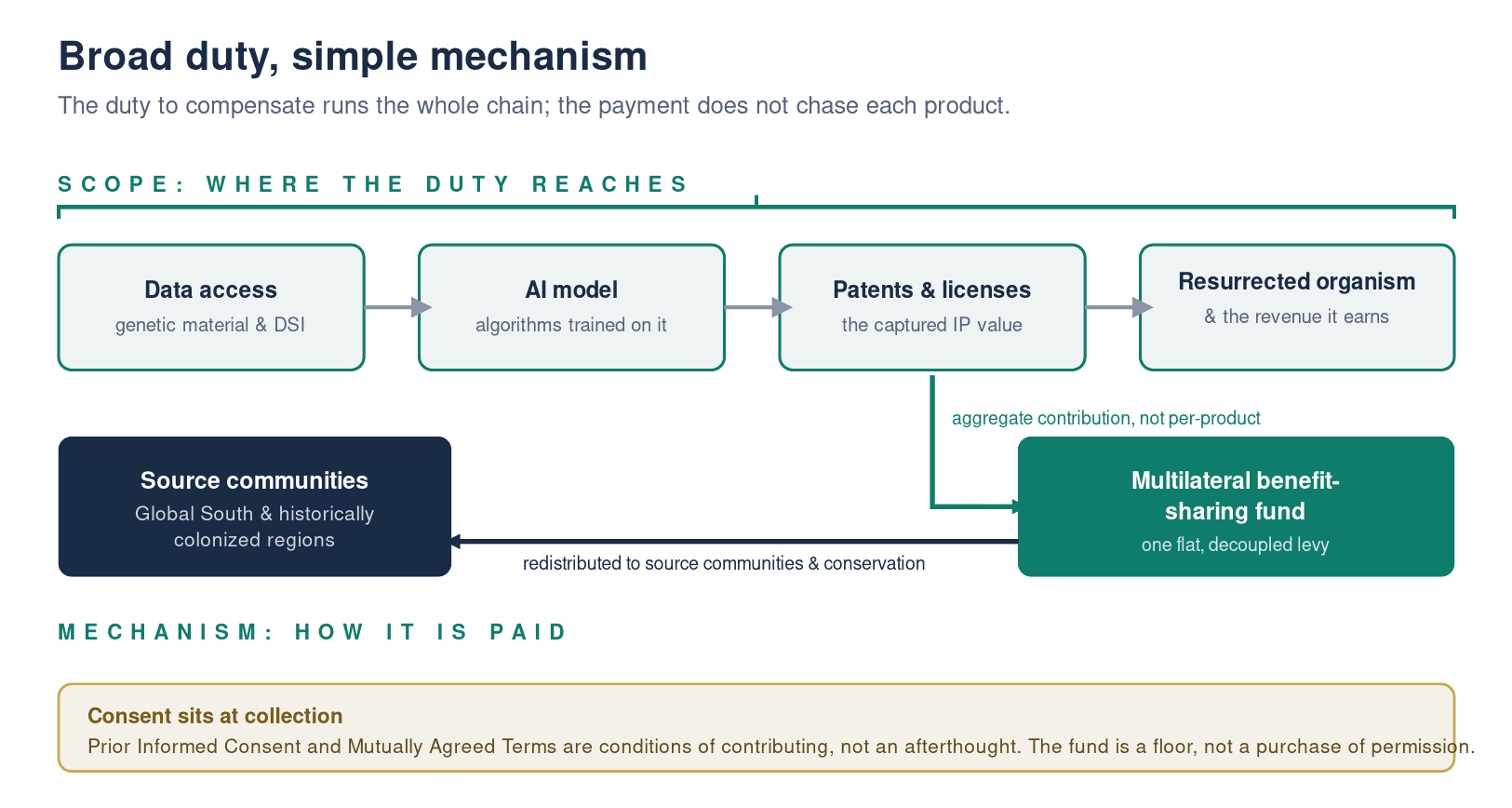
Figure 2. Separating the scope of the duty from the mechanism of payment. Scope follows Schulz et al. (2026) and the CARE/OCAP tradition; the flat mechanism follows Halewood et al. (2023) and CBD COP16 (2024).
The figure sets this out. The bracket is the scope. The single arrow is the mechanism.
A word on the number. I have used one percent of revenue as an illustration, and it is only an illustration. The right number is whatever is reasonable and equitable: an amount that reflects the duty of care and the benefit taken, including future benefits, monetary and otherwise. Set it too low and the levy becomes a small fee you pay to be left alone. That level should be argued on its own terms, ideally with the source communities in the room. What I am firm on is the shape. The duty is broad, and the payment is simple.
The gap worth closing
By now a sharp reader has an objection ready. If the answer is a multilateral fund, did the world not already build one? It did. At COP16 in 2024, parties to the Convention on Biological Diversity set up exactly this kind of fund for digital sequence information (Maia et al., 2025). So am I just describing a treaty that already exists?
No, or at least not obviously, and the reason is the useful part. The existing fund does not appear to address de-extinct organisms explicitly.
Here is the gap as I read it. A revived dire wolf or thylacine is engineered in a lab, which arguably makes it, legally, a synthetic organism, and the existing categories fit it poorly. Wildlife law may not treat it as a natural population. GMO law tends to reach it only as an environmental-release risk, not as a question of whose data it was built from. And the COP16 mechanism was written for sequence data flowing into ordinary research and industry, not obviously for a company that turns that data into a living, ownable, patentable product. The precise position will vary by jurisdiction, and I have not found a regime that squarely addresses the full chain from source genetic data to an engineered, commercially owned organism. Earlier I called this ontological ambiguity. In plainer terms, the rules do not clearly say how these animals should be treated, which may let the value built from them move without triggering an obligation. That ambiguity is the space de-extinction ventures can operate in.
So the proposal is not "invent a fund." It is to close the gap the fund already has. Four moves would do most of the work:
- Extend the COP16 mechanism so it explicitly names synthetic and de-extinct organisms, so they can no longer fall between definitions.
- Resolve the ontological ambiguity in law, so an engineered proxy is covered by something, whether wildlife law, GMO law, or a new category, rather than escaping all three.
- Give a standing body real review authority over de-extinction projects, with the IUCN Species Survival Commission the obvious candidate, in place of the voluntary 2016 guidelines it works from now.
- Make consent and fund-contribution a condition of patenting resurrected sequences, so the patent system stops being the exit through which the obligation escapes.
Enforcement is a separate and unsolved problem. The genomic databases that hold this data, GenBank, the ENA, and the DDBJ, are repositories, not regulators, and firms can pick jurisdictions with lax rules. A fund without teeth is only a suggestion. But that is true of most international governance, and it is not a reason to leave the gap open. Close the definition first; enforcement is the second fight, and you cannot have it until the first is settled.
Objections, and what would change my mind
I am arguing a position I could be wrong about, so here are the objections I find hardest, and what would move me on each.
The flat levy could become a license to extract: pay the fee, skip the consent, treat the fund as the price of doing whatever you want. This is the objection I worry about most in practice, and the answer has to be structural. Consent is a condition of contributing, not something the contribution buys out. The fund is a floor, not a purchase of permission. If a scheme cannot hold that line, it is worse than nothing, because it launders the extraction and calls it fair.
Compensation could entrench the very thing it means to check. This is the deepest version of the worry, and it is Arora's (2024): paying for inputs still treats them as inputs. A cheque can be a way of keeping a relationship extractive while feeling settled about it. I do not have a full answer. The best I have is that "some control across the lifecycle" is meant to carry weight that money alone cannot, and that source communities have already put forward their own proposals for how such funds should run (de Souza de Lima et al., 2024). Those proposals should lead the design, not follow it.
Maybe de-extinction is too niche to matter, since current revenues are small. But the value is precedent, not present income. This is where the rule can be written early, before the stakes grow large enough to make writing it expensive and contested.
And the honest objection: the evidence is thin. What would change my mind is more empirical data. A study comparing what source communities actually receive under a fund model versus a royalty model would move me on mechanism. Willingness-to-pay data specific to de-extinction, rather than adapted from the general genetic-resources case (Coltman et al., 2025), would move me on the number. Right now I am reasoning by analogy from neighboring fields, and I would rather say that plainly than pretend the case is closed.
The rules get written now, by default or on purpose
The thing I keep coming back to is that the gap is not neutral. I have not found a regime that squarely governs the full use of genetic data in de-extinction, and an absence like that is not a blank page waiting to be filled fairly. It is a default, and the default favors whoever owns the sequencers. Doing nothing is itself a decision, and it is already being made.
The window is short, and it is open now, while the field is small enough to steer. The work that would matter is not mysterious. Someone needs to run the empirical comparison of fund versus royalty outcomes. Someone needs the de-extinction-specific willingness-to-pay numbers. Someone needs to do the legal drafting to name synthetic organisms inside COP16. None of that requires a breakthrough, only attention, early, to a corner of AI governance that is neglected, tractable, and precedent-setting. The museum exhibit is lit and labeled and beautiful. The job now is to make people look at the mud it came from.
References
Akpoviri, F. I. et al. (2023). Digital Sequence Information and the Access and Benefit-Sharing Obligation of the Convention on Biological Diversity. NanoEthics.
Arora, P. (2024). Creative data justice: a decolonial and indigenous framework to assess creativity and artificial intelligence. Information, Communication & Society.
Bakshi, B. (2025). Piracy of the Periwinkle: Extraction of Madagascar's Traditional Indigenous Knowledge. Critical Debates in Humanities, Science and Global Justice. https://criticaldebateshsgj.scholasticahq.com/post/3401-piracy-of-the-periwinkle-extraction-of-madagascar-s-traditional-indigenous-knowledge-by-babiha-bakshi
Brixi, G. et al. (2026). Genome modelling and design across all domains of life with Evo 2. Nature.
Coltman, T. et al. (2025). Benefit sharing on genetic resources: modelling data access, control and willingness-to-pay for digital sequence information. Ecological Solutions and Evidence.
de Souza de Lima, A. et al. (2024). Proposals of indigenous peoples and local communities from Brazil for multilateral benefit-sharing from digital sequence information. Nature Communications.
Halewood, M. et al. (2023). New benefit-sharing principles for digital sequence information. Science.
Hoffman, A. et al. (2026). In Dire Straits: The Resurrection and Extraction of the Dire Wolf, and the Current Colonial Basis of De-extinction Science. Ethnobiology Letters.
Maia, B. G. et al. (2025). Analysis of the Working Group's Recommendations and COP-16 Decision 16/2 on Digital Sequence Information. Global Policy.
Pollock, L. J. et al. (2025). Harnessing artificial intelligence to fill global shortfalls in biodiversity knowledge. Nature Reviews Biodiversity.
Reynolds, S. A. et al. (2024). The potential for AI to revolutionize conservation: a horizon scan. Trends in Ecology & Evolution.
Schulz, M. et al. (2026). Preventing AI extractivism: the case for braiding indigenous data justice with ABS for stronger AI data governance. AI & SOCIETY.
Turner, S. D. et al. (2025). De-extinction technology and its application to conservation. The Journal of Heredity.
Wang, S. et al. (2025). De-extinction and beyond: trait design powered by generative AI. Trends in Biotechnology.
**Citations verified and sources located via CiteMe.com, July 29, 2026**

I'm psyched to see someone writing about this on the EA Forum! I think it will become really important over long time horizons, and it's good to see attention on the precedent being set.
That being said, I don't think the overall frame is accurate.
I don't think it makes moral sense to compensate local peoples for the future usefulness of the species they live next to. It might be a practical solution to a redistribution problem, but not a great one. Think of it acting in reverse: would we compensate colonial nations for living near valuable species? Relatedly, I think the CBD was mostly making it explicit that countries can and will pull up the drawbridge on the biological value contained within their borders — not necessarily recognizing their moral due for hosting it.
Where the value comes from
I think you might have missed something here. The majority of the value does not come from the individual species or even the dataset. The majority of the value comes from the search, and from the comparison between datapoints. Most of the value doesn't exist before the research makes sense of the data and brings value into existence. Saying it's "meaningless" to compensate the individual data points isn't just saying it's hard, it's saying the data isn't the source of most of the value.
It's like saying the value of a staircase comes from the rocks used to build it. The rocks were not valuable laying strewn about before. The value comes from the work of taking valueless rocks and arranging them into something useful.
The value is in the life-saving medicine. It comes from the delivery drivers, the factories, the human testing, the shelf life testing, the dosage measuring, the production line specialization, the model training, isolating the compounds, the data storage, the sequencing, and the specimen collecting (the data access). The value doesn't just come from the species itself and its caretakers. This article makes it sound like it's about a short "distance between ... the clean lab and the muddy dig." Indigenous knowledge that performed this search is hugely valuable as I go into a bit later. But a great deal of value comes from converting the original compound to something that can be used as a cure.
Biodiversity is not very valuable relative to the work to extract it
Bioprospecting pharmaceutical companies previously got to keep 100% of the revenue, and they stopped bioprospecting because it was not paying for itself with jackpot medicines. That said, I expect revenue for bioscience and bioprospecting to grow a lot soon, so it's a good idea to anticipate that and set up proper regulation and compensation, potentially in the form of benefit sharing.
Nothing is being taken
The species is still there and the current indigenous inhabitants were not going to start a business to produce medicine in their lifetime (they did not lose out on the IP). The species knowledge (is usually?) published and made available to them.
The communities of Madagascar got the existence of treatments for childhood leukemia and Hodgkin's disease, and documentation on their local species. This is not valuable to them now, but it will be valuable to them in the future. (similar to the lost IP opportunity) I'm not trying to claim this is fair, just pointing out that there is some benefit flow in reverse: in the future the local people can also benefit from the public databases and medical advancements. "Future value" applies both ways.
I'm failing to get at the central issue that knowledge is highly valuable but isn't traded in the same way as goods...
I think I'm overarguing my actual stance. To be clear, I think we should compensate for stewardship and sharing of knowledge more than we are.
Compensation for value
Indigenous knowledge is the right target for compensation: When local knowledge points at the one plant that does something, it has already done the work that costs a fortune. That is value creation, same as training the AI models. And the evidence is there too: pharmaceutical companies pursue bioprospecting when they have a lead from indigenous knowledge.
Ambiguous negotiation requirements
A flat rate is important. It avoids imposing large costs on many barely affordable public-good-generating scientific excursions. (Which I believe are a great source of un-compensated value in aggregate.) But adding ambiguous requirements about consent and fund contribution removes the benefits of a flat rate! Ambiguous requirements cause ratcheting and perpetual re-negotiations. Even though they sound free and don't carry a price tag, they are far more costly than the fees themselves, and more costly than the extractive value gained from studying species in the vast majority of cases.
Three repurcussions from vagueness harm the people they are supposed to be providing benefit sharing to: Process costs are cheaper per project for whoever can industrialize them, so the rules favor large lawyered-up ventures over small field teams. Documented provenance becomes a liability, so the rewarded behavior is to obscure it — the honest researcher who records where a sample came from takes on an obligation that evasive one isn't burdened by. And field sites get chosen for legal clarity, so the places with the least capacity to write clear rules get less science rather than more benefit sharing. It hits non-centralized societies the hardest: it is much harder to negotiate with a whole village than with a pre-structured bureaucratic papertrail.
This harms the people it's meant to help
From what I understand, the majority of current benefits come from cooperation: local hiring, field assistants, researchers present and spending, species described before they're gone, and local capacity built so a place can start doing its own research.
All of that requires researchers showing up. A lone researcher can't be a one-person diplomatic corps in every country without a simplified published procedure for hosting an expedition, so they go somewhere that has one. The species go undescribed, and value flows less in both directions.
De-Extinction:
De-extinction is also not going to be profit generating. Colossal is about the hype of doing something for the first time; businesses won't make money continuing to de-extinct entire species. In fact conservation stands to gain from these early hype projects, because the expensive research steps will be paved for the conservation managers who will take over the work.
Extinct species also typically have less surviving knowledge and less stewardship, so those reasons for compensation are weaker.
What I agree with
It's hard to track who stewarded, but that doesn't change the altruistic behaviour and the world's benefit. Keeping species alive instead of eradicating them is costly, and that should be compensated. Probably by a fee for use of datasets? (Not for gathering and building datasets, which are community-good-generating exercise...)
Compensation for knowledge is often paid lower than its true value, and individuals/communities aren't empowered to negotiate for its true worth. This is wrong.
There should be a transfer of wealth from rich, biodiversity-impoverished nations to poor, biodiversity-abundant nations.
Research and publication should be encouraged in far-flung, un-centralized places — it's too hard, and it's neglecting entire regions of the globe.
I emphatically agree we need to see what communities actually receive under a fund model, a royalty model, and no compensation at all (where lower friction might increase research and thereby local hiring, field assistants, species described before they're gone, and local capacity built).
Forgive me for some flaws in my response, I struggled a bit with how the arguments were presented and am imperfectly attempting to disentangle some points.