Comments
Giving Green’s 2025 Top Climate Nonprofits, regranting fund updates, and 2026 research priorities

7 min readDec 12, 2025
49
Climate action looks very different today than it did just a year ago. A new administration in the White House has reshaped the landscape, and climate donors face both setbacks and opportunities.
We at Giving Green have spent the past year mapping out how smart donations can maintain (and accelerate) momentum under these new circumstances, both in the U.S. and globally. Our year-end climate giving guide, published in November, distills this work.
In this post, we will cover:
Giving Green’s goal is to maximize donors' impact per dollar by identifying fundable climate solutions that decrease warming. Our research has led us to believe that this will come through a focus on systems change: efforts such as policy advocacy, technology innovation, and market-shaping mechanisms that change the rules of the game.
Traditional impact evaluation methods tend to favor short-term outcomes, quantitative data, and linear theories of change, as noted by the Shifting Systems Initiative, a multi-year effort led by major philanthropies.
In climate, this might look like prioritizing projects that can point to a concrete number of trees planted over policy-advocacy efforts that reduce the incentives for deforestation at the national or global scale.
When Giving Green launched in 2019, we evaluated carbon offsets, a natural fit if you value certainty and clear metrics such as dollars per ton of CO₂ reduced. As we dug deeper, however, we found many offset projects overpromised and underdelivered. And even considering the terrific performance of cookstoves like BURN, backed by randomized controlled trials, we wondered: could we reduce climate change at scale with a blanket of cookstove projects?
So we shifted strategy. Today, we recommend climate donors focus on systems change—by supporting philanthropic initiatives that shift incentives and actions far beyond the immediate project—to maximize their impact.
Our systems-change lens recognizes that some of the most impactful climate interventions—those pulling the policy, technology, and market levers—are inherently difficult to measure using standard cost-effectiveness analyses (CEAs).
While CEAs can be a valuable tool, we view them as one part of a broader evaluative process rather than a definitive measure of impact.
In practice, we use quantitative modeling to pressure-test our assumptions and assess the plausibility of impact, particularly in high-uncertainty areas.
We recognize that this is a departure from the norms in more near-termist effective altruist contexts, where cost-effectiveness estimates are more readily used and accepted, and we are learning how to better communicate our research with clarity and nuance.
While mainstream awareness of climate change is high, less than 2% of global philanthropy goes to climate change mitigation, and many areas within climate remain badly underfunded relative to their expected impact.
For instance, aviation currently contributes to around 2.5% of global CO₂ emissions, but under business-as-usual conditions could exceed 20% by 2050. Non-CO₂ effects, such as those from contrails, result in at least as much warming as CO2 emissions. Yet philanthropic funding to mitigate aviation’s non-CO₂ emissions is tiny, at less than USD $15 million per year, according to our estimates[1].
In our report on how effective climate donations can decarbonize aviation, we found that actions such as rerouting around 5%-10% of flights could cut 80% of contrail emissions, at a cost around USD $1.75/tCO₂e[2].
Using the criteria of Scale, Feasibility, and Room for More Funding, and following our five-step research process, we have identified the following giving strategies as high-leverage (in no particular order):
To see the reasoning by which we chose these strategies and not others we considered, take a look at our research dashboard. For each of these high-level strategies, the linked reports detail the specific giving opportunities that we think offer the most cost-effective impact.
The next step in our five-step research process is to identify high-impact nonprofits that execute these strategies.
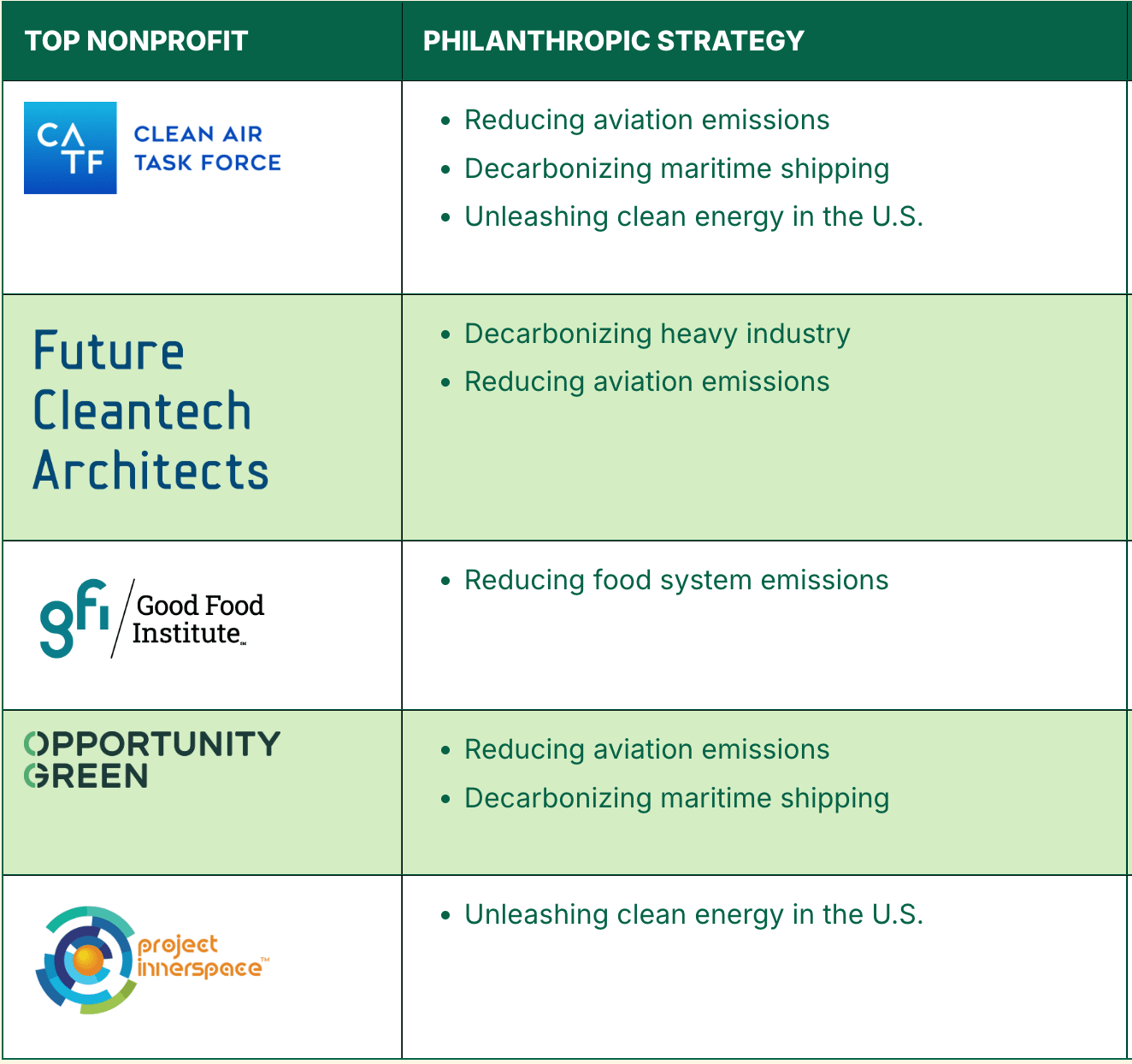
Here are Giving Green’s 2025-2026 Top Climate Nonprofits:
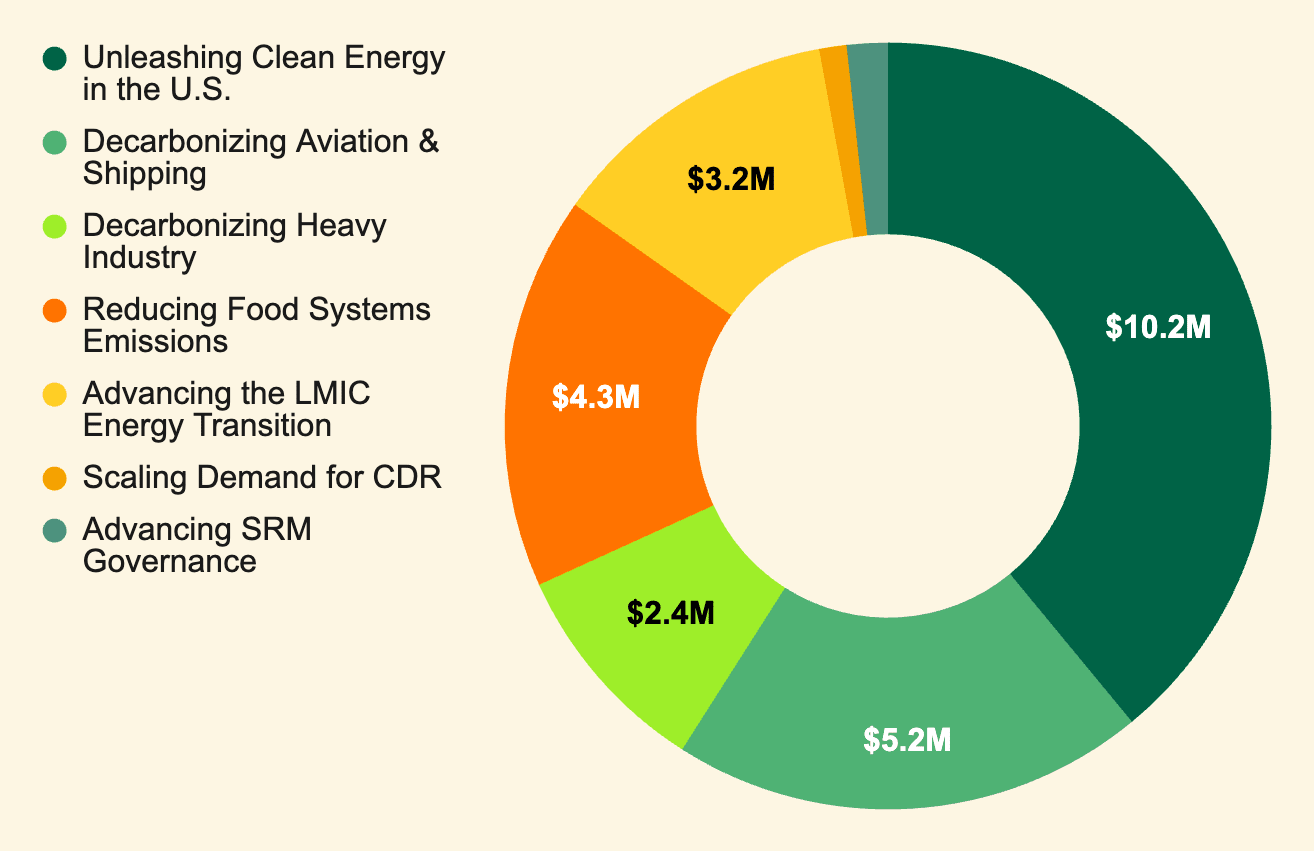
For the Q4 2025 disbursement of the Giving Green Fund, our regranting fund, we recommended USD $26 million to 29 climate nonprofits working on high-impact strategies—our largest grant cycle to date.
Explore our past grant disbursements by year, by sector, and by grant type here.
Heading into 2026, here are some of our tentative research interests. We will finetune them in Q1 and publish a final list of 2026 research priorities in Q2.
Entrusted by a donor, we embarked on a consulting project in 2025 to identify high-impact philanthropic strategies to protect biodiversity and the ecosystem services it supports. This work is designed to move beyond fragmented efforts and target the systemic drivers of biodiversity loss.
We have narrowed our research to two promising areas:
We expect to recommend a list of Top Biodiversity Nonprofits in early 2026.
In late 2025, Giving Green left our fiscal sponsor, IDinsight, and officially became an independent nonprofit. We now host the Giving Green Fund ourselves. We also took the opportunity to refresh our brand identities and revamp our website.
With these growth milestones, we hope to offer more dynamic grantmaking through the Giving Green Fund, more responsive advisory services to our partners and donors, and stronger, clearer offerings for the public on our website.

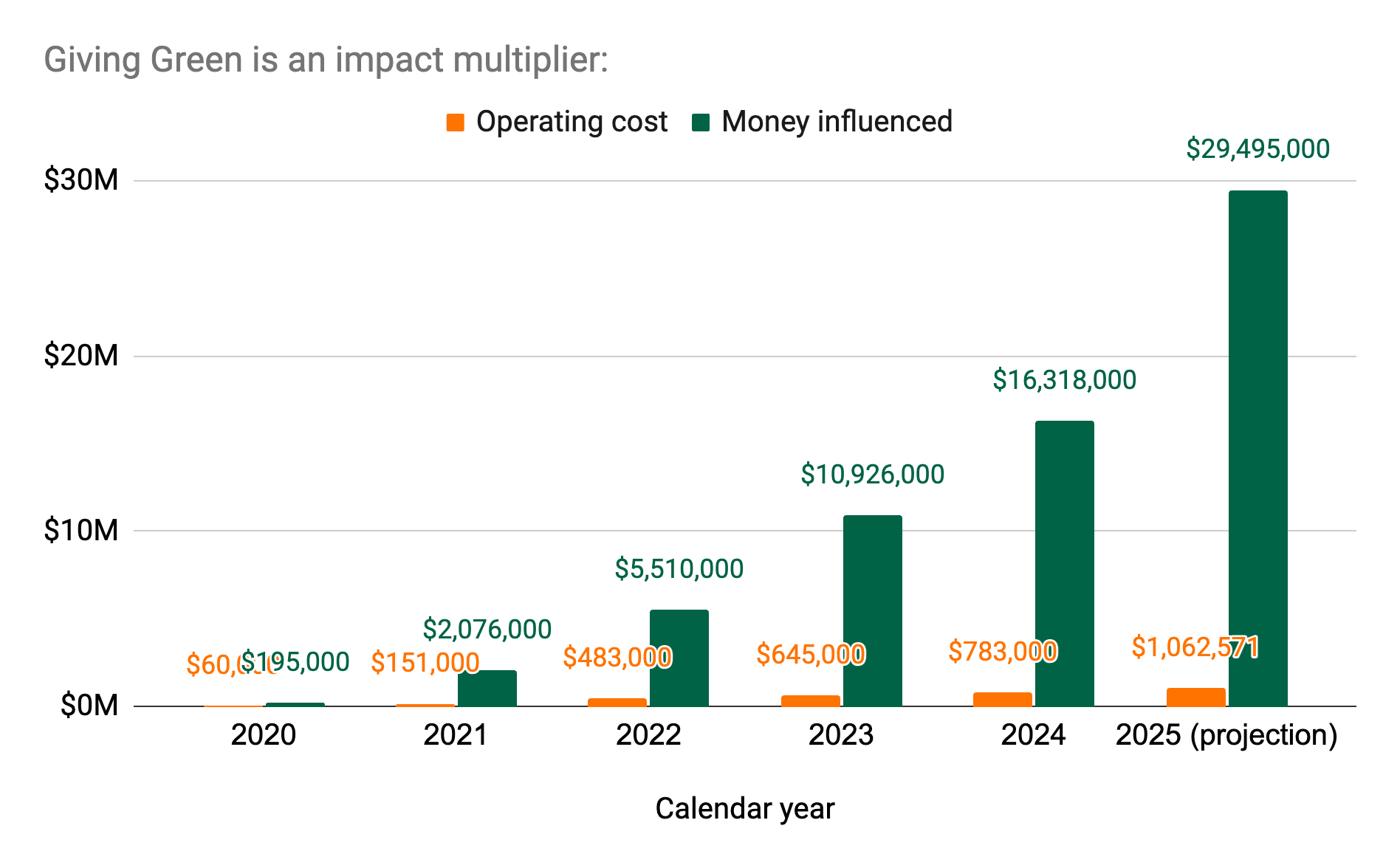
Since 2019, donors who use Giving Green’s research have given over $56 million to effective climate solutions. It means for every dollar donated to Giving Green’s operations, we drive an additional $20 to high-impact climate nonprofits.
You can read more about our impact in our annual impact reports.
We are grateful to donors who have supported our operations, which allow us to hire more researchers to increase the depth and breadth of research, as well as more communications and development professionals to spread effective climate-giving guidance more widely.
We are currently hiring for an operations generalist role. In the new year, we will add a growth position, for which we will consider candidates with communications and/or development experiences.
In line with our values of truth-seeking, humility, transparency, and collaboration, we keep our mistakes page updated.
As a charity evaluator, we rely on effective-giving partners who work in specific countries and with particular audiences to spread our climate-giving guidance. Thanks to thoughtful coordination within the effective giving ecosystem, we have had the privilege of collaborating on donor advisory, consulting projects, and events with partners such as Doneer Effectief, Effektiv Spenden, Mieux Donner, Ellis Impact, High Impact Athletes, Effectief Geven, and many more.
If you are an effective giving organization and would like to chat about how to engage donors interested in climate, please reach out.
While Giving Green is primarily focused on climate mitigation, we also recognize that donors came to Giving Green with their unique values and motivations. We are here to support them to explore the intersections that touch on climate, such as animal welfare and global health and development, and we are keen to collaborate with the many partners in the space.
We welcome feedback at [email protected].
Our previous estimate, published in November 2025, showed less than USD $5 million per year going towards contrail mitigation. It was based on aggregating data from nine of the largest funders in aviation. Since then, we have learned of another major funding source of around $10 million per year, so we have revised our estimate.
Our previous estimate, published in November 2025, quoted a different figure (<$1/tCO2e) from contrails.org. Since then, contrails.org has released more detailed information specifying that the <$1/tCO2e figure is the lower bound estimate and $1.75/tCO2e is their central estimate.

Executive summary: The post outlines Giving Green’s updated research approach, its 2025–2026 philanthropic priorities and Top Climate Nonprofits, recent regranting decisions totaling $26 million, and plans to expand climate and biodiversity work as an independent organization.
Key points:
This comment was auto-generated by the EA Forum Team. Feel free to point out issues with this summary by replying to the comment, and contact us if you have feedback.