Comments
More from the author
Curated and popular this week
Note: This post was crossposted from the Coefficient Giving Farm Animal Welfare Research Newsletter by the Forum team, with the author's permission. The author may not see or respond to comments on this post.
Subtitle: On vegan advocacy, effective altruism, and FIFA
I turn 40 today. Here are some hot takes.
On factory farming
1. Our biggest challenge is salience. If factory farming led the evening news, it wouldn’t last lo...
78
On October 22nd starting at 10:00am Pacific Time, Every.org is matching donations to select animal welfare organizations at a 2:1 rate, up to $2,000 per donor per nonprofit (so if you give up to $2,000, they will contribute up to $4,000 and the nonprofit will get up to $6,000). The first donation a donor makes to each eligible nonprofit will be matched, and donors can get the match for multiple $2,000 donations. So, you can get more than $2,000 matched by donating $2,000 one time to multiple...
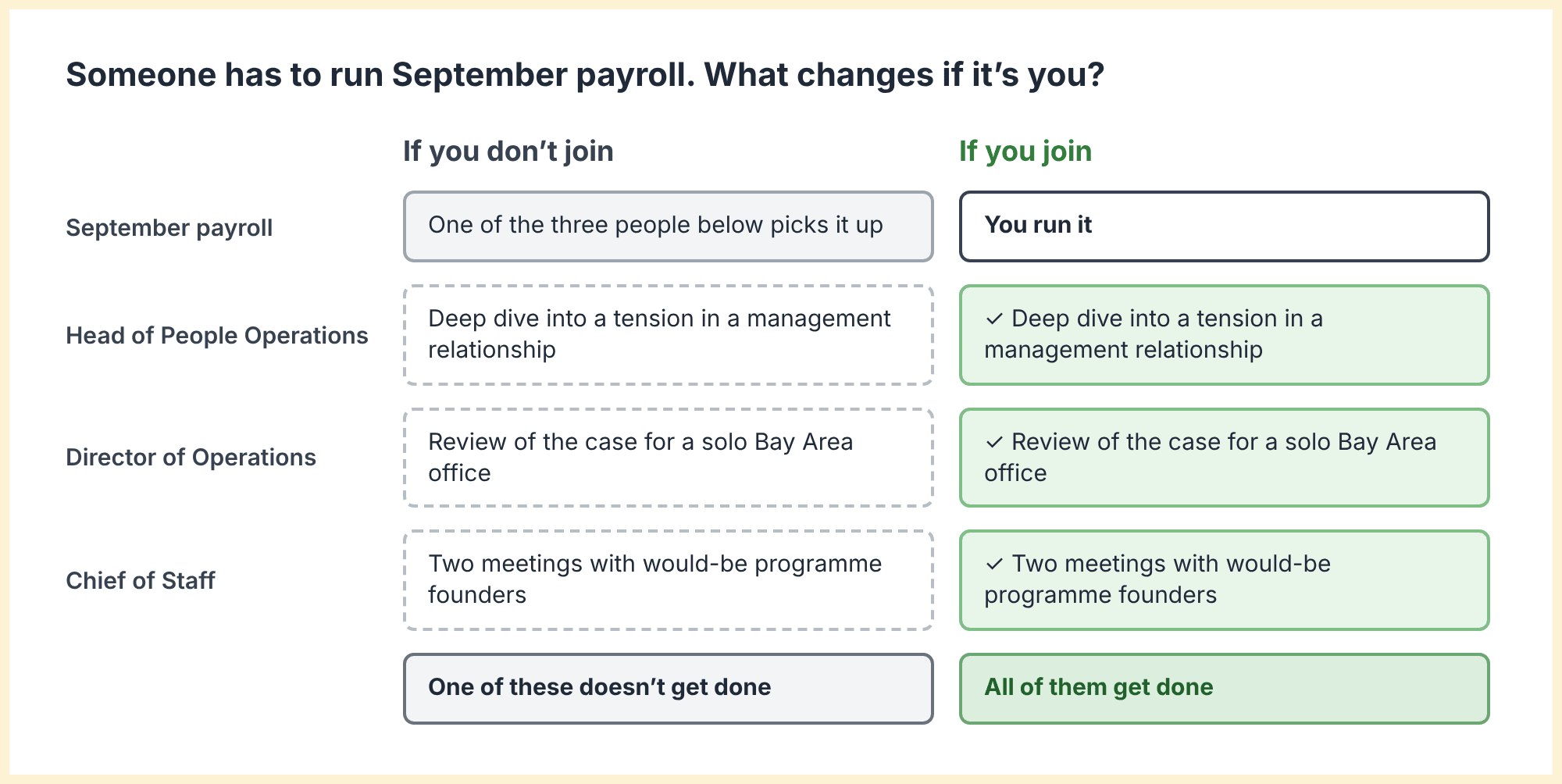
When speaking to candidates who are considering working with us at 80,000 Hours, I often hear people worry about replaceability.
The familiar version of the worry is about whether the organisation will hire someone else in your place. If it will, then the difference you make by taking the job is only the difference between you and them.
There are a couple of well-known answers to that. The person hired in your place probably cares about the world too, and would go on to do somethi...
Recent opportunities to take action
Zero-bounded vs negative-tail risks
(adapted from a comment on LessWrong)
In light of the FTX thing, maybe a particularly important heuristic is to notice cases where the worst-case is not lower-bounded at zero. Examples:
Not that you should definitely not do things that potentially have large-negative downsides, but you can be a lot more willing to experiment when the downside is capped at zero.
Indeed, a good norm in many circumstances is to do lots of exploration and iteration. This is how science, software development, and most research happens. Things get a lot tricker when even this stage has potential deep harms -- as in research with advanced AI. (Or, more boundedly & fixably, infohazard risks from x- and s-risk reduction research.)
In practice, people will argue about what counts as effectively zero harm, vs nonzero. Human psychology, culture, and institutions are sticky, so exploration that naively looks zero-bounded can have harm potential via locking in bad ideas or norms. I think that harm is often fairly small, but it might be both important and nontrivial to notice when it's large -- e.g., which new drugs are safe to explore for a particular person? caffeine vs SSRIs vs weed vs alcohol vs opioids...
(Note that the "zero point" I'm talking about here is an outcome where you've added zero value to the world. I'm thinking of the opportunity cost of the time or money you invested as a separate term.)