Summary
- Mal Graham, strategy director at Wild Animal Initiative (WAI), described 4 approaches to deal with uncertainty about effects on non-target beneficiaries. One is identifying ““ecologically inert” interventions that don’t affect population dynamics or have cascading effects”. “Examples might include stunning wild-caught fish before slaughter or replacing rodenticides with fertility control on islands”.
- In this post, I illustrate that replacing rodenticide with fertility control bait may change the welfare of soil animals much more than increase the welfare of rodents. Different baits require a different amount of cropland for full depopulation. So the replacement affects soil animals given the density of these varies by biome. I look into the change in the living time of soil ants, termites, springtails, mites, and other soil arthropods. I neglect differences in the population of rodents between the 2 depopulation methods for simplicity, and underestimating the effects on soil animals.
- I determine that full depopulation with fertility control instead of rodenticide bait decreases cropland by 0.413 m2-year per initial rodent. Depending on the biome replacing the cropland, my estimates for the change in the living time of soil animals per initial rodent range from:
- 15.2 to 437 soil-ant-years.
- 94.6 to 685 soil-termite-years.
- 651 to 30.0 k soil-springtail-years.
- 1.34 k to 50.7 k soil-mite-years.
- 4.66 k to 80.1 k soil-arthropod-years.
- I conclude controlling the fertility of rodents instead of killing them can easily increase or decrease welfare. I believe it may impact soil animals way more than rodents, and I have very little idea about whether it increases or decreases the welfare of soil animals.
- I recommend research on i) the welfare of soil animals and microorganisms, and ii) comparisons of (expected hedonistic) welfare across species. I think progress on ii) is difficult, but necessary to find interventions which robustly increase welfare. I also see lots of room for progress on ii) to change funding decisions even neglecting soil animals and microorganisms.
- I am sceptical that targeting non-soil animals is a great way to build capacity to increase the welfare of soil animals later. I believe the most cost-effective ways of building capacity to help any given group of animals will generally be optimised with such animals in mind. I would also expect much more investigation of the extent to which interventions targeting non-soil animals are building capacity to increase the welfare of soil animals if this was key to whether they are increasing or decreasing animal welfare.
Context
Mal Graham, strategy director at WAI, described 4 approaches to deal with uncertainty about effects on non-target beneficiaries. One is identifying ““ecologically inert” interventions that don’t affect population dynamics or have cascading effects”. “While this is quite difficult, it’s not clear to me [Mal] that it’s totally intractable. I (and several others) think we could reasonably view a handful of interventions as worth pursuing under this mindset. Mostly, these sorts of interventions change how humans kill animals or control populations, such that suffering is decreased without changing the net population outcome. Examples might include stunning wild-caught fish before slaughter or replacing rodenticides with fertility control on islands”.
Mal said on 17 November 2025 that WAI was “trying to fundraise” for work related to replacing rodenticide with fertility control. The Center for Wild Animal Welfare (CWAW) announced on 18 November 2025 that, “Next year [2026], as well as continued engagement on urban infrastructure, we’ll work on new policy areas such as fertility control and pesticide policy”, which they describe as “realistic, robust and helpful”. In this post, I illustrate that replacing rodenticide with fertility control bait may change the welfare of soil animals much more than increase the welfare of rodents. Different baits require a different amount of cropland for full depopulation. So the replacement affects soil animals given the density of these varies by biome. I look into the change in the living time of soil ants, termites, springtails, mites, and other soil arthropods. I neglect differences in the population of rodents between the 2 depopulation methods for simplicity, and underestimating the effects on soil animals.
Calculations
Here are my calculations.
Mass of rodenticide
I assume full depopulation requires 56.6 g of rodenticide bait per initial rodent. I get this from the ratio between 0.283 kg of bait, and 5 rodents. From the New York City Health Department (NYC Health), “Most rat baits state that 4 to 16 ounces [oz] of bait can be applied to rat burrows at a spacing of 15 to 30 feet”. I use the mean between the lower and upper bounds for the mass of bait of 10 oz, which is 0.283 kg. From the New York City Department of Health and Mental Hygiene (DOHMH), “NYCHA [New York City Housing Authority] calculates its overall estimate by multiplying the DOHMH’s burrow county by five, which represents the average number of rats per burrow according to DOHMH”.
I rely on the mean composition of the 3 bait formulations in Table 1 of a patent for “rodenticidal soft bait composition”. I consider the bait’s land footprint comes from the use of maize oil (mass fraction of 2.50 %), wheat flour (9.42 %), oat flour (61.0 %), icing sugar (10.7 %), refined palm oil (14.0 %), and poppy seeds (0.500 %).
Mass of rodent fertility control
I suppose full depopulation requires 56.3 g of fertility control bait per initial rodent. I obtain this from the density of ContraPest of 0.99 g/mL, 99 % of the maximum density of water, and 56.9 mL per rodent. I get this from the ratio between 237 mL/month for 3 months, and 12.5 rodents. From Ratology, “Isolate tanks [with ContraPest] are for populations of 10-15 rats or less. It is best to have a fresh tank every month for at least 3 months”. I use the mean between the lower and upper bounds for the number of rats of 12.5 rodents, and 3 months. Each tank has “8 fl oz”, which is 237 mL.
I consider the bait’s land footprint comes from the use of palm oil (36.8 %) and sugar (10 %), as ContraPest “is a sweet, fatty liquid formula”. I set the mass fraction of sugar to a guess from Gemini 3.1 Pro. I infer the mass fraction of palm oil from that of sugar, and the density of ContraPest (0.99 g/mL, 99 % of the maximum density of water), water (0.997 g/mL), palm oil (0.890 g/mL), and sugar (1.59 g/mL). The mass fractions of water (53.2 %), palm oil, and sugar add up to 100 %.
Cropland and soil animals
I use the cropland requirements from Poore and Nemecek (2018), and Clark et al. (2022).
I rely on the density of soil arthropods by biome from Rosenberg et al. (2023). I use values equal to the means across sites of each biome, but there is significant uncertainty (see Table S4 of the Supplementary Materials).
Results
I estimate full depopulation with rodenticide and fertility control bait increase cropland by 0.481 and 0.0673 m2-year per initial rodent. As a result, I determine that full depopulation with fertility control instead of rodenticide bait decreases cropland by 0.413 m2-year per initial rodent.
Change in the living time of soil arthropods
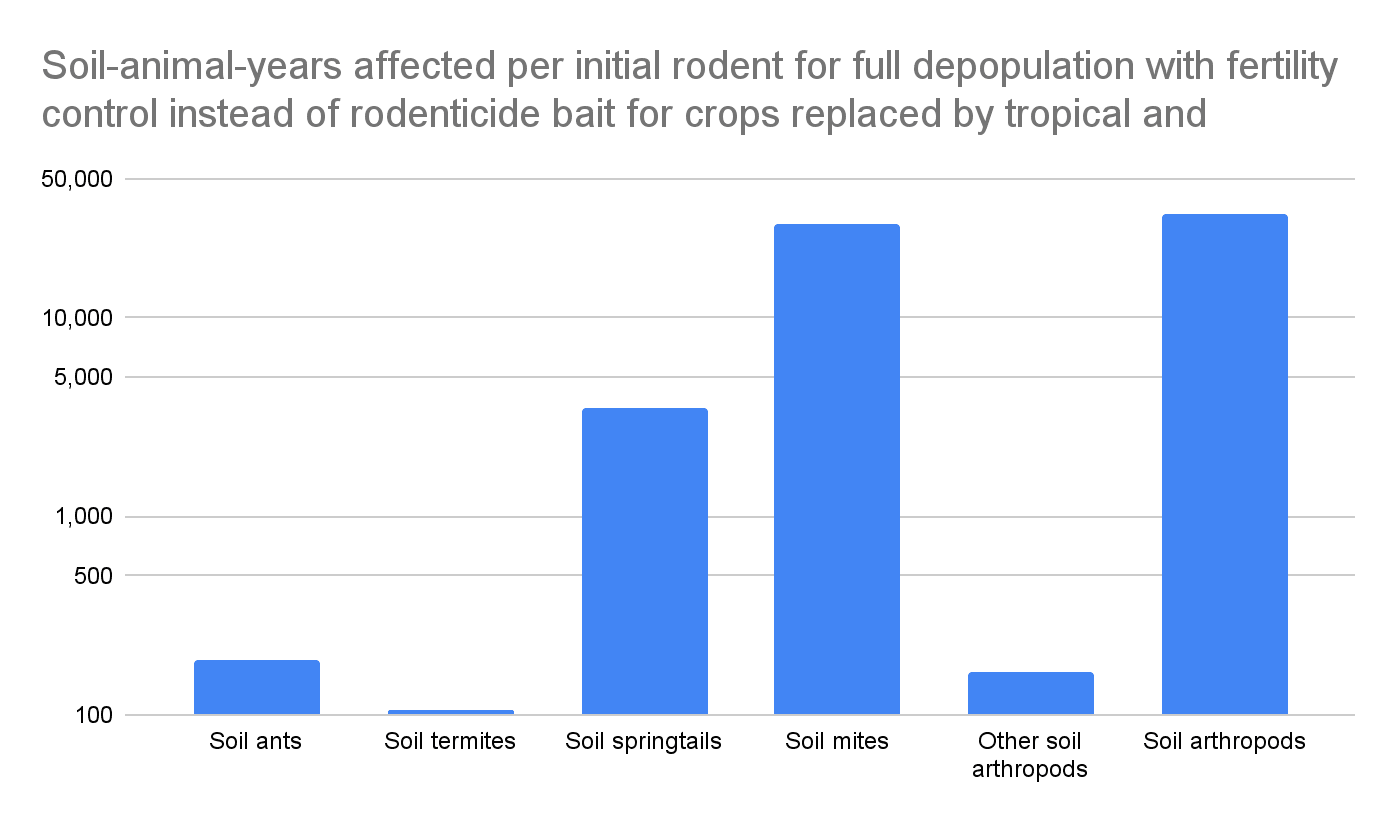
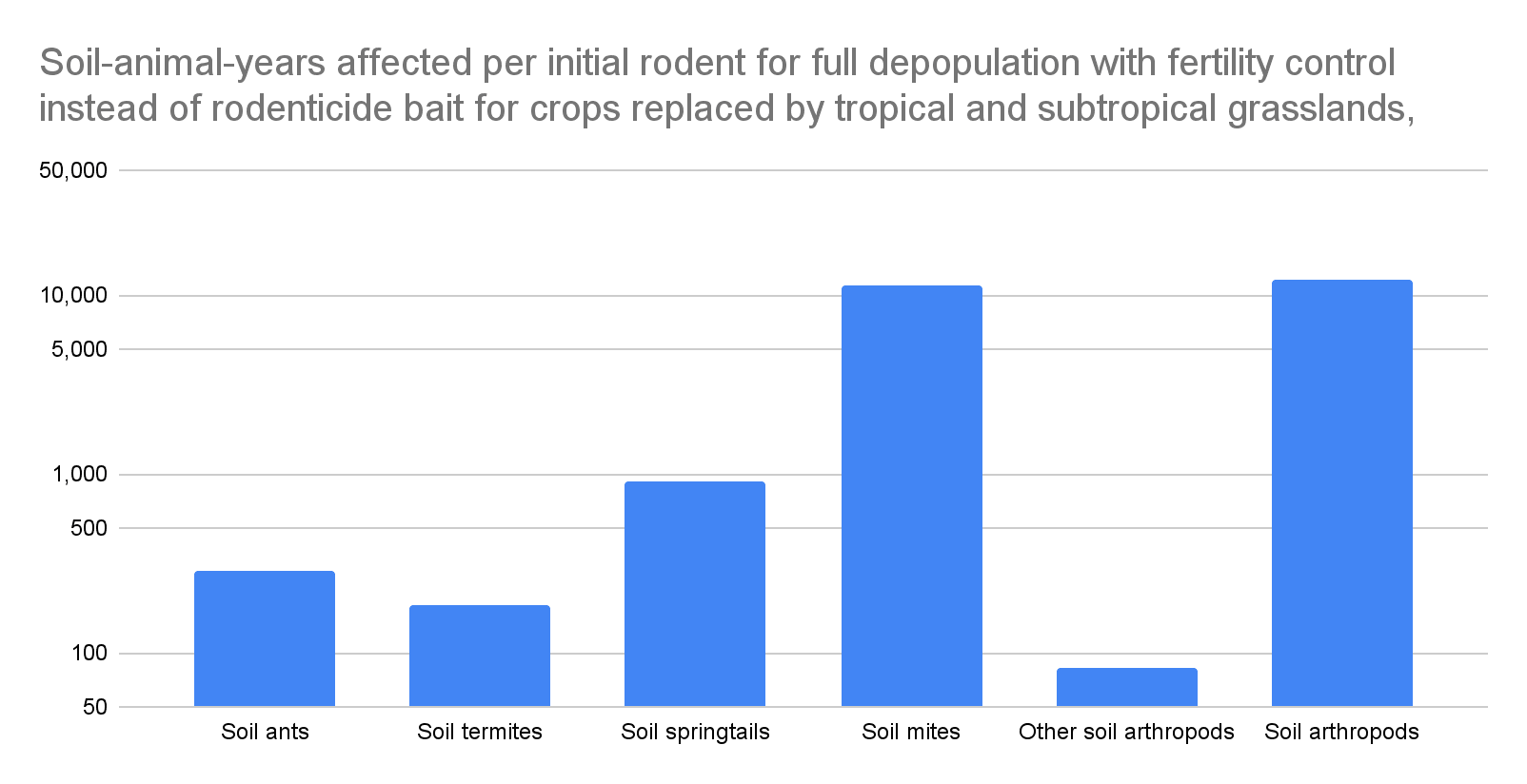
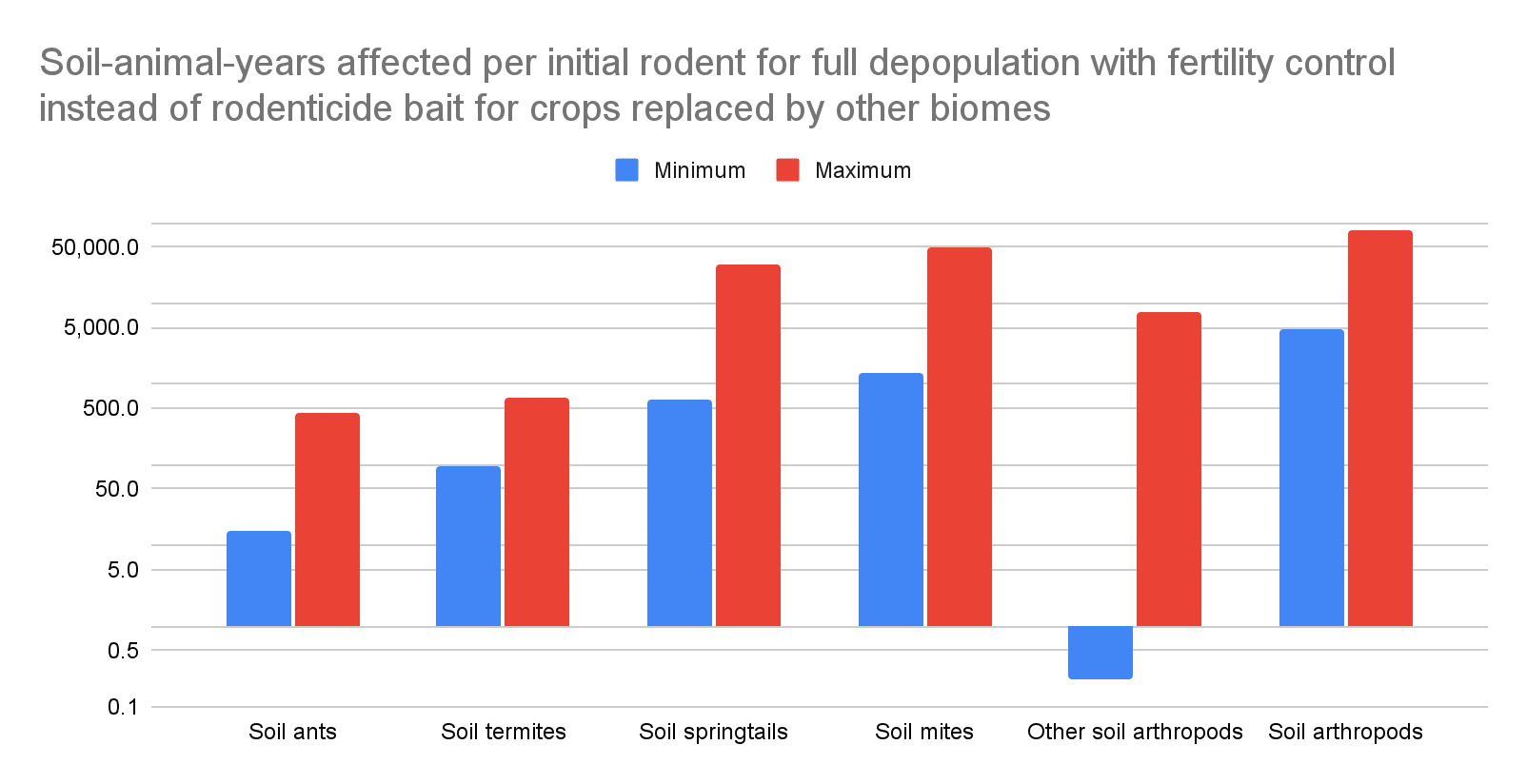
I present the results below for cropland replaced by i) tropical and subtropical forests, and ii) tropical and subtropical grasslands, savannas, and shrublands. In addition, I present the range of results across all the 9 possible land use changes (I have data for 10 biomes, and therefore analysed the replacement of cropland with 9 different biomes). By “Soil-animals-years affected”, I mean an increase or decrease in the living time of soil animals in years.
Discussion
Controlling the fertility of rodents may impact soil animals much more than rodents
Depending on the biome replacing the cropland, my estimates for the change in the living time of soil animals per initial rodent for full depopulation with fertility control instead of rodenticide bait range from:
- 15.2 to 437 soil-ant-years.
- 94.6 to 685 soil-termite-years.
- 651 to 30.0 k soil-springtail-years.
- 1.34 k to 50.7 k soil-mite-years.
- 4.66 k to 80.1 k soil-arthropod-years.
My intuition based on the numbers above alone is that controlling the fertility of rodents instead of killing them may change the welfare of soil ants and termites much more or less than increase the welfare of rodents. I explore this further below, but ultimately arrive at the same conclusion.
It is worth looking into the reduction in rodents’ pain. For anticoagulants like Brodifacoum, which “has become one of the world’s most widely used pesticides”, and “is typically used as a rodenticide”, “some studies conclude it takes 1-3 days for rats to die, while others have found it takes 4-8 days, and other research shows it can take up to 11 days for mice to die. Animals typically remain conscious until close to the time of death”. So I guess the increase in the welfare of rodents is smaller than that resulting from decreasing disabling pain in rodents by 11 days, and excruciating pain in rodents by 3 min. Cynthia Schuck-Paim, scientific director at the Welfare Footprint Institute (WFI), clarified “Excruciating pain can’t be sustained for long (e.g., hours, as opposed to minutes) without neurological shutdown”. I guess excruciating pain is 10 k times as intense as disabling pain. I feel like I am roughly indifferent between 1 s of excruciating pain, and 10 ks of disabling pain, 2.78 h (= 10*10^3/60^2). So I infer 3 min of excruciating pain are as painful as 20.8 days (= 3/60/24*10*10^3) of disabling pain. As a consequence, I determine that the increase in the welfare of rodents is smaller than that resulting from decreasing disabling pain in rodents by 31.8 days (= 11 + 20.8), 0.0871 years (= 31.8/365.25). This is an overestimate because rodents could spend some time sleeping, and some time awake in annoying or hurtful pain (WFI’s pain categories with the lowest intensity), or with positive welfare. For the impact on soil ants or termites to be larger than that on rodents considering the upper bound for the reduction in the pain of rodents, and the geometric mean between the lower and upper bounds above for the change in the living time of soil ants and termites, the absolute value of the welfare of 936 soil-ant-years (= (15.2*437)^0.5/0.0871) or 2.92 k soil-termite-years (= (94.6*685)^0.5/0.0871) has to exceed that of 1 rodent-year of disabling pain.
One can clarify the comparison above using the tentative (expected) welfare ranges in Bob Fischer’s book about comparing welfare across species. Welfare range is defined there as the difference between the maximum and minimum welfare per unit time among “realistic biological possibilities”. That of pigs is 6.03 (= 0.44/0.073) times that of black soldier flies (BSFs). I expect the welfare range of rodents to be less than 6.03 times that of soil ants or termites under the methodology of Bob’s book. I would be surprised if the welfare range of pigs was smaller than that of rodents, or if that of BSFs was significantly different from that of ants or termites. Domestic pigs have 22.2 billion neurons, brown rats have 200 M, Godfrey et al. (2021) estimated 90 k neurons for a desert ant, and 92.5 k for a fruit fly (“vinegar fly”), and “individual number of neurons”^0.188 explains pretty well the welfare ranges in Bob’s book, as illustrated below. I think it is reasonable to assume that the welfare of 1 animal-year of disabling pain is roughly proportional to the welfare range of the animal. So I suppose 6.03 soil-ant- or soil-termite-years of disabling pain are more painful than 1 rodent-year of disabling pain under the methodology of Bob’s book.
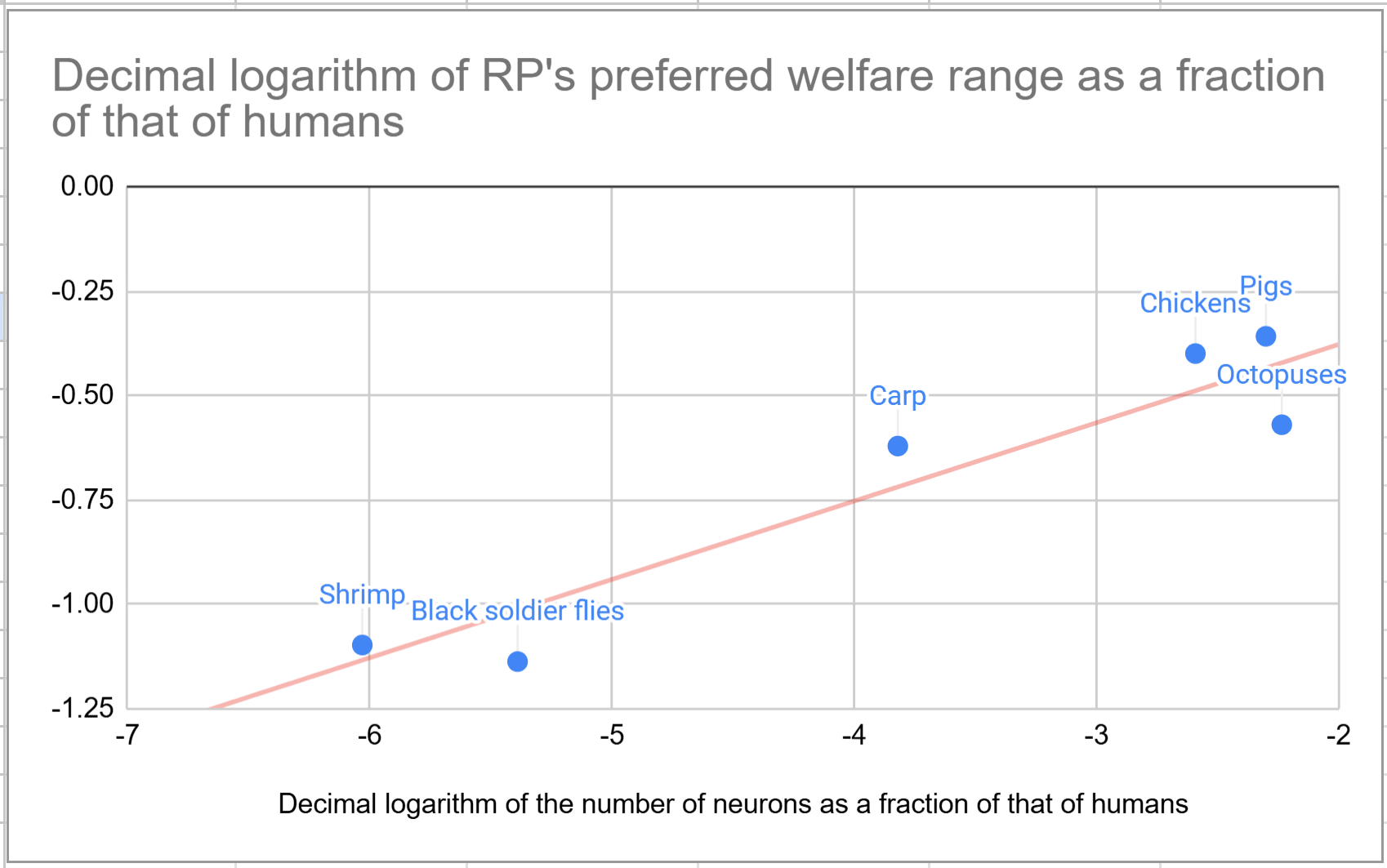
For the impact on soil ants or termites to be larger than that on rodents given the above, the absolute value of the welfare of 155 soil-ant-years (= 936/6.03) or 484 soil-termite-years (= 2.92*10^3/6.03) has to exceed that of 1 soil-ant-year or soil-termite-year of disabling pain. This would hold if soil ants or termites were in disabling pain more than 0.645 % (= 1/155) or 0.207 % (= 1/484) of their lives, and had neutral experiences during the remaining time. I can easily see soil ants and termites having a welfare further away from 0 than suggested by this. It is plausible to me that soil ants and termites live in relatively worse conditions (have a lower welfare relative to that of fully healthy animals) than hens in cage-free aviaries, and the cumulative time in disabling pain for these is 1.32 % (= 156/(11.8*10^3)) of their lifetime according to WFI (which is higher than 0.645 % and 0.207 %). I get this for WFI’s estimate for their cumulative time in disabling pain of 156 h, and lifetime of 11.8 kh (= (60 + 80)/2*7*24) representing “60 to 80 weeks”.
My practical conclusion is that controlling the fertility of rodents instead of killing them may change the welfare of soil ants and termites much more or less than increase the welfare of rodents. I think the final comparisons above suggest the effects on soil ants and termites are not very different from those on rodents. Nonetheless, there is large uncertainty in the change in the living time and conditions of soil animals, reduction in the pain of rodents, effects on potential changes in the population of rodents, and welfare comparisons across species. On this last point, for welfare range proportional to “individual number of neurons”^“exponent”, and “exponent” from 0 to 2, which covers the best guesses that I consider reasonable, I calculate the welfare range of desert ants is 2.03*10^-7 (= (4.50*10^-4)^2) to 1 times that of brown rats, as desert ants have 0.0450 % (= 90*10^3/(200*10^6)) as many neurons as brown rats based on the estimates I presented above.
Controlling the fertility of rodents can easily increase or decrease welfare
I conclude controlling the fertility of rodents instead of killing them can easily increase or decrease welfare. I believe it may impact soil animals way more than rodents, and I have very little idea about whether it increases or decreases the welfare of soil animals. I do not know which species of soil animals are the most important to determine the change in the welfare of soil animals given the large uncertainty in welfare comparisons across species. I can see the most important soil animals being ants, termites, springtails, mites, nematodes, or any combination of these. To make matters worse, I have almost no clue about whether any species of soil animals has positive or negative lives in a given biome. I am also very uncertain about which soil animals become more or less abundant as a result of increasing cropland.
What now?
I recommend research on i) the welfare of soil animals and microorganisms, and ii) comparisons of welfare across species. I think progress on ii) is difficult, but necessary to find interventions which robustly increase welfare. For instance, ones that focus on the greatest sources of suffering across all species. I also see lots of room for progress on ii) to change funding decisions even neglecting soil animals and microorganisms. In Bob’s book, the tentative welfare range of shrimps is 8.0 % of that of humans. However, for welfare range proportional to “individual number of neurons”^“exponent”, and “exponent” from 0 to 2, the welfare range of shrimps is 10^-12 (= (10^-6)^2) to 1 times that of humans, as shrimps have 10^-6 times as many neurons as humans.
I would prioritise the above research over the “ecologically inert” interventions which have been proposed so far. I suspect interventions decreasing the pre-slaughter pain of farmed invertebrates are the closest to robustly increasing welfare (in expectation). However, I still do not know whether electrically stunning farmed shrimps increases or decreases welfare due to potentially dominant effects on soil animals and microorganisms. Furthermore, I would say such interventions may increase welfare only negligibly due to their target invertebrates having a super narrow welfare range, as it would be the case if shrimps had a welfare range equal to 10^-12 times that of humans.
Targeting non-soil animals is a great way to build capacity to increase the welfare of soil animals later?
I am sceptical. I believe the most cost-effective ways of building capacity to help any given group of animals will generally be optimised with such animals in mind. I would also expect much more investigation of the extent to which interventions targeting non-soil animals are building capacity to increase the welfare of soil animals if this was key to whether they are increasing or decreasing animal welfare.

Thanks for pointing out that the production mechanism might have an influence on land use. I think that's interesting and will reflect on it.
Unfortunately I think this post is otherwise not very relevant, mainly because no one uses Contrapest -- the liquid bait formulation doesn't work in any context where water is readily available because rats don't drink it, it's extremely messy and hard for people to use. If you wanted to do this comparison more seriously, I'd encourage you to focus on Evolve, which has a more similar profile production-wise (it's a solid bait, like most rodenticides) and conservationists have proven more willing to try it (whether it works outside the lab is still unclear, the company has not made its test data particularly accessible for review and no independent test runs have been published yet).
To clarify, the reason I viewed (at time of writing of the previous post) that rodenticide replacement on islands might be approximately ecologically inert is that conservationists use products until rats are entirely eradicated and then stop. This means any ecological impact differences between product 1 for eradication and product 2 for eradication are essentially transient. You have this short duration of time during the eradication, and then a long period after where conditions on the island are basically the same. On reflection, you're probably right that this is not sufficient to mean they are ecologically inert in the strict sense.[1] Overall I suppose I was imagining that people might have degrees of commitment to the ecologically inert concept, but I could have written more carefully.
A few other notes, not comprehensive:
although I do wonder if the limited duration of these eradications and amount of use for island conservation relative to overall production is high enough to make a meaningful impact on land use? I don't think these things are continuous so a small enough demand shift signal might not have any impact? Just speculating...
Thanks for the comment, Mal.
Do you agree replacing the rodenticide bait with ContraPest may impact soil animals much more than rodents for my estimate that it decreases cropland by 0.413 m2-year per initial rodent? If so, how much smaller do you think the change in cropland would have to be for replacing the rodenticide bait with Evolve to robustly increase animal welfare (in expectation, and accounting for all animals)?
Here is an illustration of how to quickly estimate the effects on soil animals for other fertility control baits. Imagine replacing the rodenticide bait with Evolve increases or decreases cropland by 10 %. I estimate full depopulation with the rodenticide bait increases cropland by 0.481 m2-year per initial rodent. So replacing the rodenticide bait with Evolve would increase or decrease cropland by 0.0481 m2-year per initial rodent (= 0.10*0.481). This means the effects on soil animals would be 11.6 % (= 0.0481/0.413) as large as for replacing the rodenticide bait with ContraPest. For effects on soil animals 10 % as large (a round fraction to simplify the calculations), depending on the biome replacing the cropland, my estimates for the change in the living time of soil animals per initial rodent for full depopulation with fertility control instead of rodenticide bait would range from:
Lorenzo Buonanno's comment made me update the post in agreement with the 1st paragraph above, although I only read this paragraph after my update. I am now using the amount of rodenticide and fertility control bait for full depopulation per initial rodent instead of the amount needed to kill one rodent, and prevent one rodent birth.
I neglect differences in the population of rodents between the 2 depopulation methods for simplicity, and underestimating the effects on soil animals.
I agree cropland changes in steps, but I do not think this changes the overall picture. Relatedly, it may naively seem that decreasing the consumption of chicken by 0.1 kg does not change the production of chicken if this can only be adjusted by multiples of e.g. 1 k kg. However, in this case, a better model would be that decreasing the consumption of chicken by 0.1 kg would increase by roughly 0.01 pp (= 0.1/(1*10^3)) the probability of the production of chicken decreasing by 1 k kg. So the expected reduction in the production of chicken would still be roughly 0.1 kg (= 1*10^-4*1*10^3).
Accounting for considerations like these would increase uncertainty. However, the final conclusion would still be that controlling the fertility of rodents instead of killing them can easily increase or decrease welfare, even on islands?
I agree.