Hide table of contents


Farmkind is currently running a Forget Veganuary campaign, directly proposing offsets as an alternative to veganism for members of the public wishing to participate in the farmed animal movement.

This has raised sharp questions about the relationship between animal welfare and veganism, both philosophically and strategically. For a summary of many different reactions to the Farmkind campaign, my post here might be useful.

This poll is meant as a place to discuss the broader strategic questions raised. 

First, a few things that are not the primary question:

  • Whether a vegan world is the goal:  most contributors would love to press a button making the whole world vegan. The question is whether insisting on veganism will result in our desired outcome sooner than an alternative strategy.
  • Welfare vs. diet change: the charities funded by Farmkind's campaign include both welfare campaigners and institutional diet change efforts.
  • "Forget Veganuary" framing: let's set aside particular questions about the execution/tone of Farmkind's campaign, unless you feel they are inextricably tied up in the larger questions.

I suggest you start by answering the poll, then engage with other views in the comments, and you can easily update your vote at any time.

We should present veganism as commendable, and offsetting as a legitimate stopping point for individual supporters.
S
J
AK
M
B
LW
DS
AV
KM
J
L
BS
P
S
DC
EM
C
FM
H
MS
R
BN
A
C
PB
SR
AA
MSJ
R
T
JLG
No, veganism is required
Yes, offsetting is valid

A few extra things to consider:

A soon-to-be-released section of Rethink Priorities' Pulse survey on behalf of Farmkind found (this is just one survey so update modestly):

  • Donations to farmed animal charities were seen as a significantly easier ask than diet change.
  • A message specifically framing donations as an easier alternative to diet change was not more effective than one just asking for donations.
  • Neither message negatively affected sentiments towards diet change.

If the framing of the poll doesn't make sense, this is a second post you might find thought-provoking. Summary of the arguments from the post:

  • With meat consumption skyrocketing and rates of veganism stagnant, strategies focused on individual veganism appear to offer only limited potential for animal advocates.
  • The small fraction who are vegan act as a symbolic vanguard, living out our vision for a world without animal exploitation. They also serve as the movement’s crucial activist base.
  • We must find a way to expand the movement beyond the small vegan population without alienating our most dedicated supporters.
  • The solution is to treat vegans as a priestly class, an elite cadre making a deep personal commitment to live out transformational values on behalf of a wider community, and deserving the utmost respect.
  • To achieve this, we must let go of the idea that veganism is for everyone. We must offer a low-commitment way for animal lovers to align themselves with the vegan movement.
  • Farmkind’s “offset” framing is the most general solution yet proposed, and it matches a rich historical precedent: the relationship between priestly/monastic elites and the lay communities that support them.

25

0
0
1
1

Reactions

0
0
1
1
New Answer
New Comment

2 Answers sorted by

I will write a few more posts on this. But my current, still uncertain, thoughts are:

-The main identity we promote in animal advocacy should be "animal advocate".

-"Animal advocate" should be more vaguely defined and primarily refer to a political commitment similarly to "feminist" and "socialist".

-We should abandon veganism as an identity and stop promoting it.

-We should separately push for different norms for animal advocates. Eating plant-based, avoiding animal-tested products etc. should each be advocated as separate norms.

-Priesthood(people working in animal advocacy) and laymen(mere members of the "animal advocate" identity) should be subject to different expectations.

-We should strongly push for norms against eating meat. Individual diet change should still be pursued.

-Consuming animal products shouldn't disqualify someone from identifying as an animal advocate. I'm not sure what the status of meat should be. I suspect a few countries like Germany might get to 10% vegetarian within my lifetime so I believe restricting our base to vegetarians might be viable in some places.

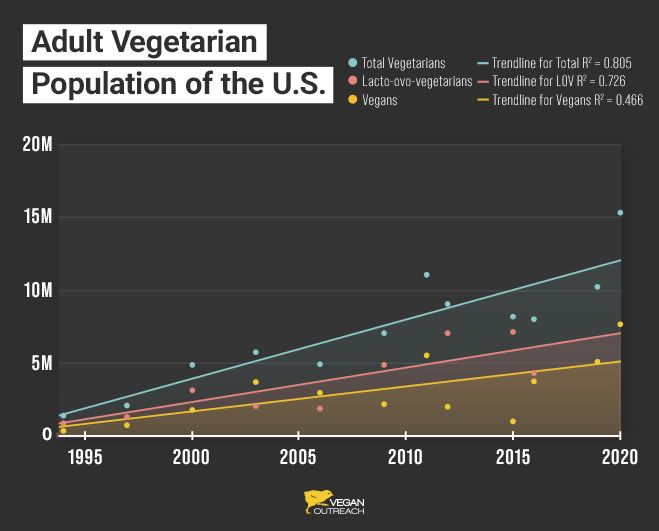
I agree with all your points, except the one about abandoning veganism as an identity. I used to agree with this point, too. What moved me is the fact that veganism as an identity is a massive, organic phenomenon that isn't going away– at 2% of the US, we should expect around 7 million vegans who don't care a spec whether the formal/organized part of the movement decide to jettison veganism.

I argue that this organic spread of veganism is the only part of animal advocacy that deserves to be called a "movement," and that we should think hard about how to mak... (read more)

3
emre kaplan🔸
I agree that veganism is the strongest identity in the animal movement at the moment. It's a powerful meme, a very salient identity for many. I don't think any other animal advocacy related identity has more mentions in Twitter bios. Plant-based people or vegetarians don't tend to refer to that in their social media profiles. I disagree that vegans are 2% in the US. 2% is the figure you get when you lump plant-based and vegan together. When you ask specifically for "vegan", only 1% identify as vegan in 2023 Gallup survey. I think plant-based people are also around 1% in the US. Google searches for veganism have also been globally declining since 2020. And I think the leadership of major animal advocacy organisations are amenable to the idea that we should stop mentioning veganism. So I think there is some possibility for change.

Oh, also, the idea that a 10% threshold for vegetarianism might be enough to shift to stigmatizing meat is super intriguing! I could see that backfiring without much obvious (to me) benefit and I'd love to hear more about your reasoning there.

An interesting question I have regarding offsetting is whether it should just be measuring the negative aspects of contributing to animal suffering by increasing demand for factory farmed products, or whether it should also be considering the positives avoided by not being vegan (signaling value, increasing the demand for vegan products, other possible things).

Because if one were considering whether or not to be vegan or to donate $X dollars, they should probably consider the full counterfactual (positives foregone as well as negatives caused).

I think it's very important we (try to) consider the full counterfactual – what's the reason not to?

3
Brad West🔸
I agree. But current offsetting focuses on just negating the negatives.    The reason not to is it may accord more with the psychological reasons for offsetting to focus on just the harm negation. The measure we're discussing may go beyond what makes sense to call "offsetting". 
1
Alistair Stewart
Thanks. To be clear, is your original question asking about a) whether the animal movement should take into account the positives avoided by offsetting non-veganism when deciding whether or not to promote offsetting to non-vegans, or b) whether the animal movement should tell non-vegans about the positives avoided by offsetting? I think definitely yes to a), and we shouldn't lead with it whilst remaining transparent for b).
2
Brad West🔸
Sorry if I haven't been clear. I agree that the animal movement, individually, and collectively, should take into account the entire counterfactual difference between someone being vegan and someone being an omnivore. This would include the harm caused by being an omnivore by increasing the demand for factory farmed meat as well as the absence of positive effects of being a vegan (such as normalizing being vegan and increasing demand for vegan products). Ideally, in deciding one's dietary choices, one who was concerned with animal welfare would consider the the harm avoided by being vegan and the good that is caused. They would then quantify the cost for animal welfare charities to both commensurately decrease the harm caused and effectuate the good that is not realized. This would probably a better measure and one could say, "OK I'm donating 10% to effective charities already. Is it easier for me to pay the cost of the whole counterfactual difference in addition to this which I would otherwise donate? Or is it easier for me to be vegan?" The other frame for offsetting, however, would be to make it match the psychological appeal of undoing the harm one caused. If this is what is motivating people to donate to animal welfare charities, then it would make more sense to only include the harms that are caused by being an omnivore (i.e., contributing demand for factory-farmed meat). People may not feel morally obligated to make the positive difference, just not to cause the harm (or to undo it).  So, definitely for decision making of individuals and within the movement, considering the positives as well as the negatives avoided of veganism is important. Whether having "offsetting" include it is a prudential question that would really depend on the psychologies that cause people to offset.
1
Alistair Stewart
Nice, got it. If we're going to promote offsetting, I reckon these kinds of considerations will not be interesting to the vast majority of the target audience, and they wouldn't expect to have them explained. Just do the maths, taking into account positives avoided as well as negatives caused, and tell people how much they need to donate to offset those impacts of their non-veganism. (I say this as someone who is pretty sceptical of offsetting non-veganism, for both moral/deontologically-flavoured reasons and strategic/consequentialist ones.)
3
Brad West🔸
It might make sense to have the ability to toggle a "harm negation" and a "total counterfactual expected difference" calculation. But you're right that a lot of people who offsetting might appeal to may not want to investigate these distinctions.
Comments27
Sorted by Click to highlight new comments since:
Aidan Alexander
14
6
0
50% ➔ 70% agree

I don't think this is the right question, as we should be just trying to encourage everyone to do more good rather than telling everyone to get to one "good enough" point and then stop. Also, being vegan is not the biggest thing someone can do for animals, so focusing our commendations on that seems like setting the wrong norm/incentive

We should present veganism as commendable, and offsetting as a legitimate stopping point for individual supporters.

I’m highly concerned by a) the stagnant levels of veganism over the past few decades (between 1%-5%, rarely more, even with the growth of alt proteins), and b) high to very high levels of vegan recidivism.

It seems quite clear to me that we badly need alternative ways for people to support the animal movement beyond 100% diet change. I think it's possible 100% diet change (i.e. veganism) may be holding us back as a movement. 

I don’t think the philosophical consistency around offsetting your diet matters as much as some think it does — veganism is philosophically consistent; it’s also remarkably unpopular! If donating can be a valid way for people who would not meaningfully consider diet change to support the animal movement, I think that's great, particularly given we're a cash strapped movement right now. 

Some caveats: 

  1. Veganism still seems important as an end goal, and as a position that those who are v committed can take if they want to. I do think that having a strong and committed base of animal advocates who live out these principles is great, and that veganism as a practice/culture/identity can help to bring talent into the movement. In an ideal world, it can also serve as a positive and laudable symbol of taking pro-animal sentiment to its logical conclusion.
  2. I'm concerned by movement infighting and think we should try not to upset/anger grassroots activists with a shift to donation-based (or other alternative forms of) advocacy. This is probably a hard balance to strike, but worth considering carefully.
  3. Donation-based advocacy won't be worth prioritising forever. At some stage, we may have enough donations/resources that other pro-animal actions will be more impactful.
  4. I haven't seen much data on the extent to which garnering donations from groups unreceptive to diet change works. Can we actually convince these groups to donate, and continue donating? V curious to learn more about this. 

We should present veganism as commendable, and offsetting as a legitimate stopping point for individual supporters.

I like the concept here, though I'm a little sceptical that it'll lead to the best consequences because Veganism might just be a simpler idea than Offsetting. 

AFAIK the idea of offsetting was first shared in reference to emissions from flights. My (non quantitative) take is that this wasn't very successful. A lot of flights offer some sort of charity donation at the end of the purchasing process, but they don't usually make the claim that you are offsetting your specific flight, and I don't think it would commonly be accepted by people who care about the climate that it is morally neutral to take a flight if you offset it. If anything it would generate more ire - you are covering your ass. 

I'm hopeful that this could go better with Veganism, but this scepticism (and my falsifiable take on the non-success of offsets for flights) mean I'm only a weak agree. 

Would you say your skepticism is mainly tied into the specific framing of "offsetting" as opposed to just donating? How would your answer change if the offset framing was dropped and it was just a plain donation ask?

I was surprised (and I assume Farmkind was too) that the Rethink survey found specifically contrasting donations against diet change didn't have any positive effect. If that pans out in the real world and the Veganuary offsetting campaign doesn't have better results than Farmkind's normal donation asks, I wonder how different it would seem to folks to just have an identity around donating as "membership" in the movement, similar to the NRA, Sierra Club, and other mass membership movement organizations.

Would you say your skepticism is mainly tied into the specific framing of "offsetting" as opposed to just donating? How would your answer change if the offset framing was dropped and it was just a plain donation ask?

I think if it is just donating then there isn't anything very revolutionary here... animal welfare charities don't only market to vegetarian/vegans. 

I both take it to be true that offsetting is the new and exciting angle here, and that common sense morality doesn't have much of a place for offsetting. 

On the identity thing - I think there is something there, though for 'membership' to work we'd need to somehow change the identity of members quite a bit. A non veggy/vegan farm animal welfare member is a bit like an NRA member who doesn't allow guns in the house, or a Sierra Club member who drives a gas guzzler and doesn't recycle. Consequentially not that contradictory, but identity-wise, a bit dissonant. 

Alistair Stewart
6
0
0
60% disagree

For veganism:

  1. To me, veganism seems like a moral obligation in the same way that not torturing puppies for chocolate seems like a moral obligation
  2. Veganism is a costly signal that is important for movement-building and motivating animal advocates
  3. Seems intuitive and plausible to me that there is some kind of social tipping point for veganism, where you go slowly from 1 to 25% of the population being vegan, then quickly from 25 to 99%

Against veganism:

  1. It makes entry to the animal movement demanding, perhaps unnecessarily and growth-stuntingly so: "[the animal movement] is one of the only social justice causes whose point of entry is entirely negotiated by real, quantifiable, fundamental behavior change [veganism]." Source
  2. Perhaps social tipping points are overrated

I tend to want a big, diverse animal movement with people trying different approaches –from "holding non-vegans accountable"-style vegan outreach, to FarmKind's offsetting approach (minus their criticism of Veganuary/veganism). That diversity will appeal to different audiences and bring in different resources (allies, committed activists, money, political attention). The diversity does trade off against movement unity, though, but I think it's worth it if we learn from experimenting and retain some level of movement solidarity.

Shaileen
3
0
0
30% agree

We should present veganism as commendable, and offsetting as a legitimate stopping point for individual supporters.

I'm geared towards pragmatism, so my vote leans this way. I voted this way becuase I see this as valid for the same general reason I believe supporting flexitarianism / reducitarianism instead of only veganism - it can help lower the (perceived) barriers to trying to do more 'good' for farmed animals... and maybe it'll nudge people to also try veganism / reducitarianism / flexitarianism. 

Re: your poll, I'd say neither. Veganism and offsetting are both 'rearranging furniture on the Titanic'. The button I'd press wouldn't be to make everyone vegan in an instant, but to get cultivated meat on supermarket shelves at a competitive price point, in an instant. 

Nothing else (bar x-risks for humans) is going to end factory farming. As you say, meat consumption is skyrocketing, yet in animal advocacy we act like there isn't a viable alternative that is, or rather could be, on the table. 

So strong is my view on this that I'd go as far as to say that the way funding is allocated in animal advocacy is extremely ineffective. It should basically all be going towards scale-up grants or policy advocacy or whatever cultivated meat businesses need. 

But yeah the findings of the Pulse survey you mentioned don't surprise me. In the end I think this campaign was a load of hot air, probably not particularly helpful nor damaging either way. 


I don’t think we should spend an overwhelming majority of our resources on any one theory of change. We should spread our bets.

I think that should depend on what the bets are. 

Alternative proteins don’t seem like an overwhelmingly good bet. How much will the marginal $ to R&D bring forward the development of cost-competitive cultivated chicken? What’s the trade off between the broiler lives prevented, and the broiler lives improved if we spent that marginal $ on broiler welfare advocacy instead? If cost-competitive cultivated chicken is developed, will that really displace all chicken meat (and how quickly)? (I mostly mean these questions rhetorically, and just mean that it's hard to answer to answer them confidently)

But also: even the best intervention might not be the best to fund at the margin. Not every marginal resource is fungible. And going all-in on one theory of change might take us to odd places for movement dynamics. 

Good questions. R&D isn’t the only lever. Given the relatively small amount of money that would be coming from EA, I’d direct the funding towards policy advocacy, comms/educating the market, and lobbying for governments to invest more in scale up funding.

I’m not in favour of intervention plurality for its own sake. Even if cultivated meat would only displace 50%, 25%, 10% of demand for broiler chickens, that would already be hugely beneficial compared to what we spend on currently.

And you wouldn’t have to be vegan to support it, which would open the movement up to others in the way FarmKind have tried to do. Just imagine: vegans, non vegans, environmentalists, investors, and businesses all united under one common, commercially viable goal of giving consumers another choice that has almost no trade offs compared to what they eat currently. Most other interventions and meta debates seem trivial by comparison if you think that cultivated meat is inevitable… which I do.

I think the main problem from a movement dynamics point of view is that it would undermine much of what people spend their energy on now. 

If we made everyone vegan in an instant, how would that not end factory farming?

Because a large proportion of vegans revert to eating animals at some point in their lives. Moreover, it isn't going to happen in any timeframe, unfortunately. 

I think pressing a button to make everyone (ethically) vegan would be a much more robust way to end factory farming (and all forms of animal exploitation) than pressing a button to get cultivated meat on supermarket shelves at a competitive price point.

  • If everyone is ethically vegan: the social/cultural pressure to remain vegan is much stronger –>  ex-veganism is heavily stigmatised –> far fewer ex-vegans –> not enough demand for factory farming to survive or return
    • Even before that, presumably factory farming would be undermined from every angle: lawmakers would ban it, employees would quit/strike, consumers would boycott
  • As far as I know, cultivated meat faces a number of cultural barriers

Clearly it's much much harder to make everyone vegan than to get affordable cultivated meat on supermarket shelves! That's one reason why I think cultivated meat is currently a more powerful tool at our disposal than vegan outreach for helping animals.

But I want the vegan outreachers to continue doing their work. One reason is I think that veganism is, deontologically, a moral obligation; another is that I think veganism is a costly signal that binds the animal movement together, which can serve to keep advocates motivated.

Ok, you’ve convinced me on the theoretical button-pushing. In reality those aren’t the options we’re presented with. 

We should present veganism as commendable, and offsetting as a legitimate stopping point for individual supporters.


 The pro-animal movement should be a bigger tent than veganism. We should welcome different ways of being pro-animal including donations and civic engagement, like attending a protest or voting for a pro-animal candidate.

I’m tentatively excited about “offsetting” as a specific instance of donating, but I’m cautious about presenting offsetting as enough.

Veganism will remain an important part of many people’s political identity, including mine. (I like the priestly class comparison; it’s also sort of like political lesbianism). In my experience, veganism has helped me see animals as fellow creatures and unlearn my speciesism. 
I don’t want to put anybody off experimenting with veganism, especially because I want the committed “priestly” class to be as big and strong as possible.

For those (like me) who don't know what political lesbianism is:

Political lesbianism asserts that sexual orientation is a political and feminist choice, and advocates lesbianism as a positive alternative to heterosexuality for women[1] as part of the struggle against sexism... Heterosexual behavior is seen as the basic unit of the patriarchy's political structure, and therefore lesbians who reject heterosexual behavior are disrupting the established political system.

https://en.wikipedia.org/wiki/Political_lesbianism

Though I'm not sure I follow why veganism is like political lesbianism Ben, can you explain?

As I understand it (and I'm not anything like an expert), the political lesbians rejected heterosexual sex, and perhaps relationships with men more broadly, as (a) a way to challenge the patriarchy, and (b) a way to cultivate feminist values within themselves. To me, this seems somewhat similar to vegans who reject meat consumption as (a) a way to challenge speciest norms, and (b) a way to cultivate anti-speciesism within themselves. Both philosophies create a political critique of personal desire.

Of course, it's an imperfect comparison, and there are important criticisms of political lesbianism.

Super interesting. I think I'd say that sexual orientation and meat cravings (if that's what you mean by "personal desire") are sufficiently different that this analogy doesn't really hold.

They are clearly different but Ben's point is interesting because historically, the movement for political lesbianism treated sexual orientation like meat craving.

Yeah, I think that's reasonable. I also think they're very different

MatthewDahlhausen
2
0
0
40% ➔ 60% disagree

I think the question is quite similar to the case of a doctor killing a healthy patient to use their organs to save five other sick patients.

Or as another comparison, using trafficked people for personal ends but donating enough to reduce human trafficking elsewhere.

People, and non-human animals, are not simply reducible to means to serve utilitarian ends.

But there are important consequentialist reasons that make the doctor killing patients fail in the real world. Once you live in a world in which people are being killed and the organs are being repurposed when they go to hospitals, people cease going to hospitals.

On the other hand, the differences in treatments in farmed animals are not going to trigger responses from said farmed animals that lead to such knock-on effects. You can simply look at the welfare consequences.

I think of it from the perspective I would have if I knew I would die and immediately be reborn as a chicken. Would I rather there be more Georges in the world who are vegan and do not contribute directly to the demand which causes my torture or Henrys who are omnivores and thus contribute directly to the torture, but donate an amount that neutralizes the effect and then some more?

If we actually care about welfare of animals more than we care about moral purity, we would rather there are more Henrys than Georges. 

A common qualification added to the healthy patient case is that the killing and distribution could be done in a way with plausible deniability, or it is done in a remote setting where the doctor is the only one who would know what happened. The central challenge of the case is on means versus ends, so make whatever adjustments you need to avoid the evasive rejoinder that not killing is in fact the more utilitarian option.

But lets turn to the other case I gave: would you be ok with others engaging in human trafficking if they donated enough to reduce human trafficking elsewhere? Would this absolve the morally blameworthy acts they commit? If not, then you are drawing a distinction not on the quality or quantity suffering, but simply on who is doing the suffering. If you seek to change my mind rather just reaffirming your own position, you are going to need a make a case that the who (human vs. non-human animal) is sufficiently metaphysically different to warrant using beings as means in one case but not the other.

I'm not drawing a metaphysical distinction between humans and animals. I care about welfare, full stop.

The difference is empirical, not metaphysical. Human suffering triggers compensatory responses from other humans that multiply the costs. People who learn hospitals might harvest organs stop going to hospitals. Communities that tolerate trafficking erode the trust structures enabling cooperation. Social fabric frays. These system-level effects make the total harm enormous and difficult to quantify. You can't reliably offset what you can't measure.

Farmed animals don't generate these dynamics. A chicken doesn't know some humans eat chickens while others donate to reduce chicken suffering. There's no institutional trust to erode, no behavioral adaptation that cascades through society. The welfare calculus is direct and measurable.

On the organ case: if you modify it enough to truly eliminate the systemic effects (no fear, no institutional erosion, no social knowledge of what occurred) then yes, I bite the bullet. Saving five lives at the cost of one is better than letting five die to keep one alive. If that conclusion seems monstrous, I'd suggest your intuition is tracking the systemic costs you've stipulated away, not the raw welfare math.

But we don't need to resolve exotic hypotheticals here. You're arguing from analogy to human cases where offsetting fails. It fails because of empirical features those cases have, not because human suffering can never be weighed against animal suffering.

Ultimately, for me, it all cashes out in the experiences of beings, whether human, chicken, or digital consciousness. That's what matters.

Liz Flynn
2
1
4
80% disagree

I don’t think animal consumption can be offset by donating. A life isn’t something you can compensate for — it’s either taken or it isn’t. Treating it like a balance sheet misses the point.

Veganism matters as a baseline because it rejects animals as commodities. If people believe they can keep eating animals as long as they donate, animals remain products — just with a price attached. If demand continues, exploitation continues.

Curated and popular this week
Relevant opportunities