(Cross-posted from my website. Podcast version here, or search for "Joe Carlsmith Audio" on your podcast app.
This essay is part of a series that I'm calling "Otherness and control
in the age of AGI." I'm hoping that the individual essays can be read
fairly well on their own, but see
here
for brief summaries of the essays that have been released thus far.
Warning: spoilers for Yudkowsky's "The Sword of the
Good.")
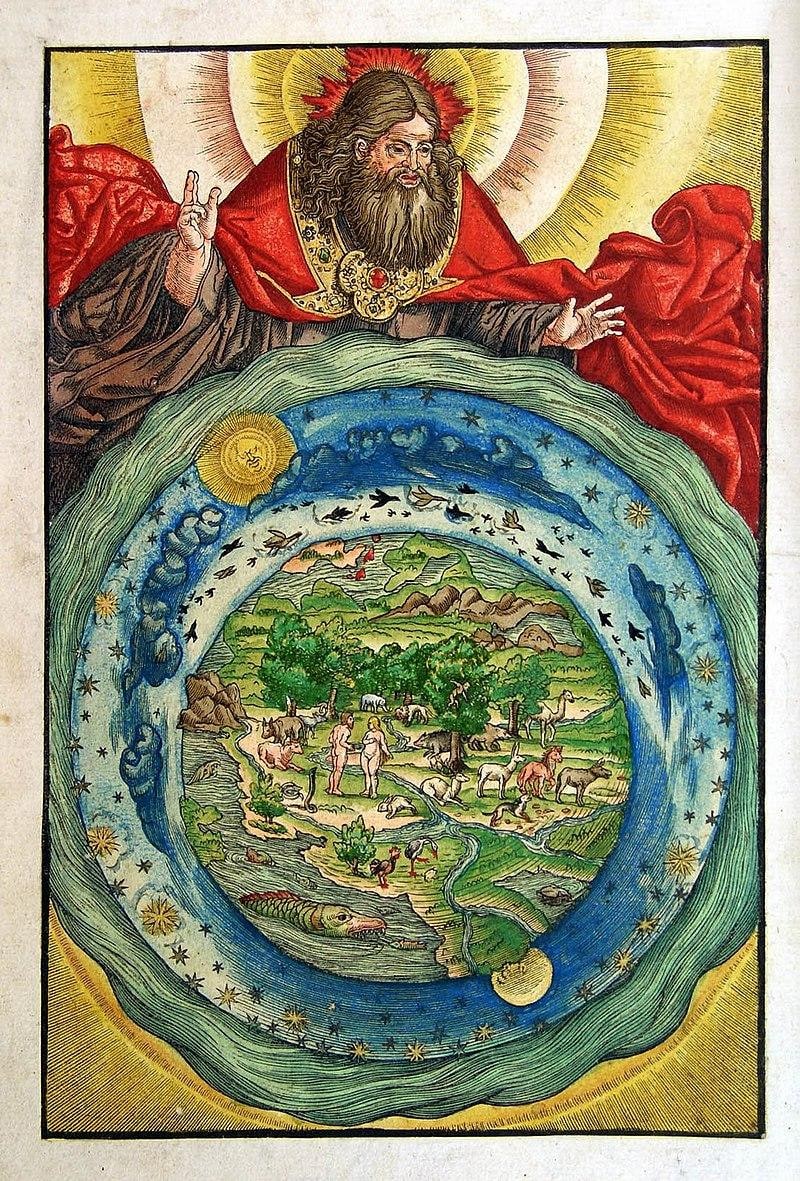
"The Creation" by Lucas Cranach (image source
here)
The colors of the wheel
I've never been big on personality typologies. I've heard the
Myers-Briggs
explained many times, and it never sticks. Extraversion and
introversion, E or I, OK. But after that merciful vowel—man, the
opacity of those consonants, NTJ, SFP... And remind me the difference
between thinking and judging? Perceiving and sensing? N stands for
intuition?
Similarly, the
enneagram.
People hit me with it. "You're an x!", I've been told. But the faces
of these numbers are so blank. And it has so many kinda-random-seeming
characters. Enthusiast, Challenger, Loyalist...
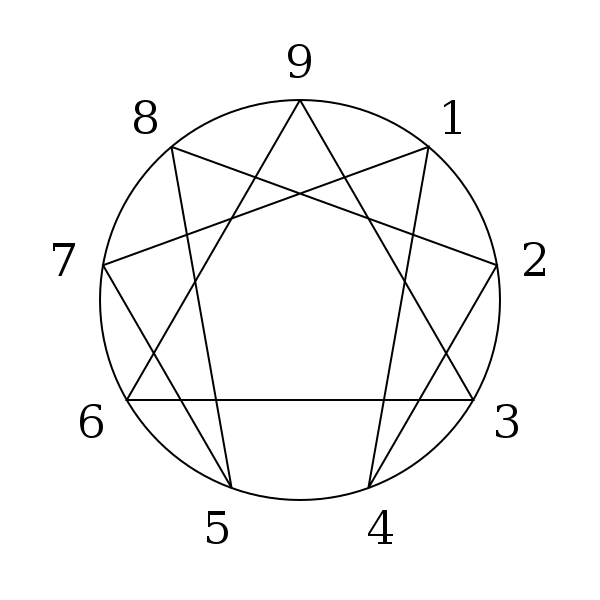
The
enneagram.
Presumably more helpful with some memorization...
Hogwarts houses—OK, that one I can remember. But again: those are our
categories? Brave, smart, ambitious, loyal? It doesn't feel very
joint-carving...
But one system I've run into has stuck with me, and become a reference
point: namely, the Magic the Gathering Color Wheel. (My relationship to
this is mostly via somewhat-reinterpreting Duncan Sabien's presentation
here,
who credits Mark
Rosewater
for a lot of his understanding. I don't play Magic myself, and what I
say here won't necessarily resonate with the way people-who-play-magic
think about these colors.)
Basically, there are five colors: white, blue, black, red, and green.
And each has their own schtick, which I'm going to crudely summarize as:
To be clear: this isn't, quite, the summary that Sabien/Rosewater would
give. Rather, that summary looks like this:
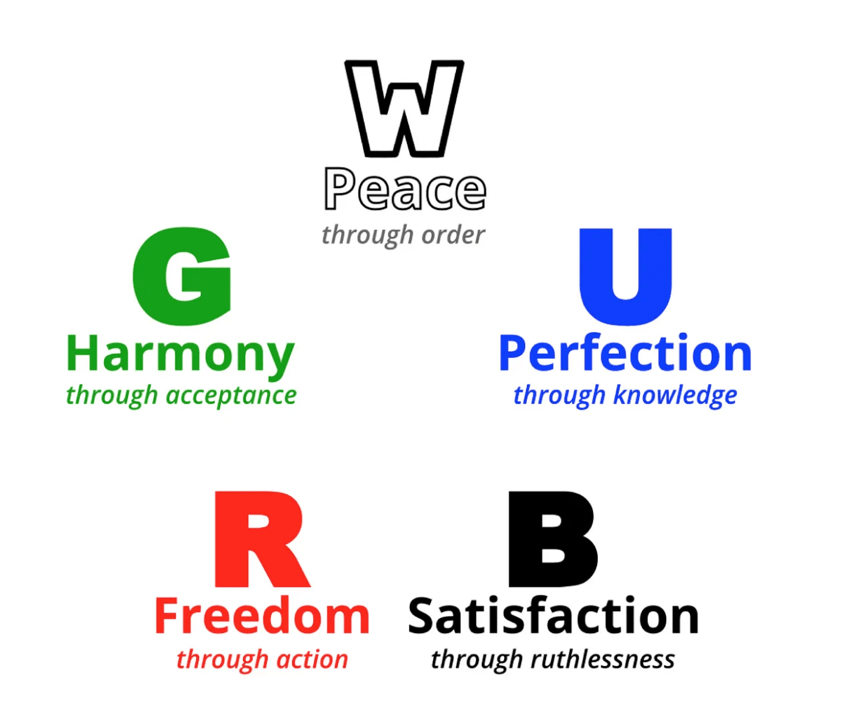
(Image credit: Duncan Sabien
here.)
Here, each color has a goal (peace, perfection, satisfaction, etc) and a
default strategy (order, knowledge, ruthlessness, etc). And in the full
system, which you don't need to track, each has a characteristic set of
disagreements with the colors opposite to it...
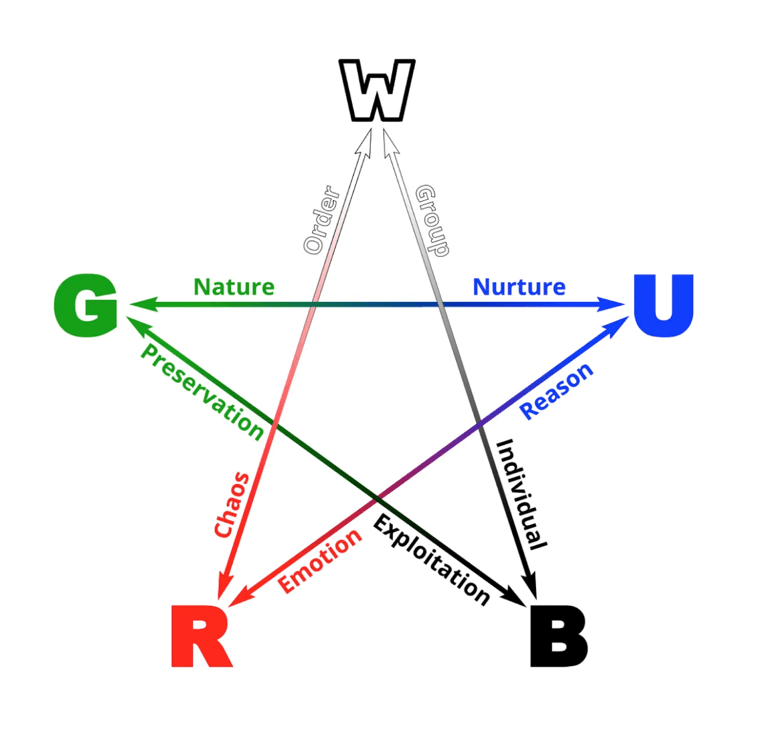
The disagreements. (Image credit: Duncan Sabien
here.)
And a characteristic set of agreements with its neighbors...[1]
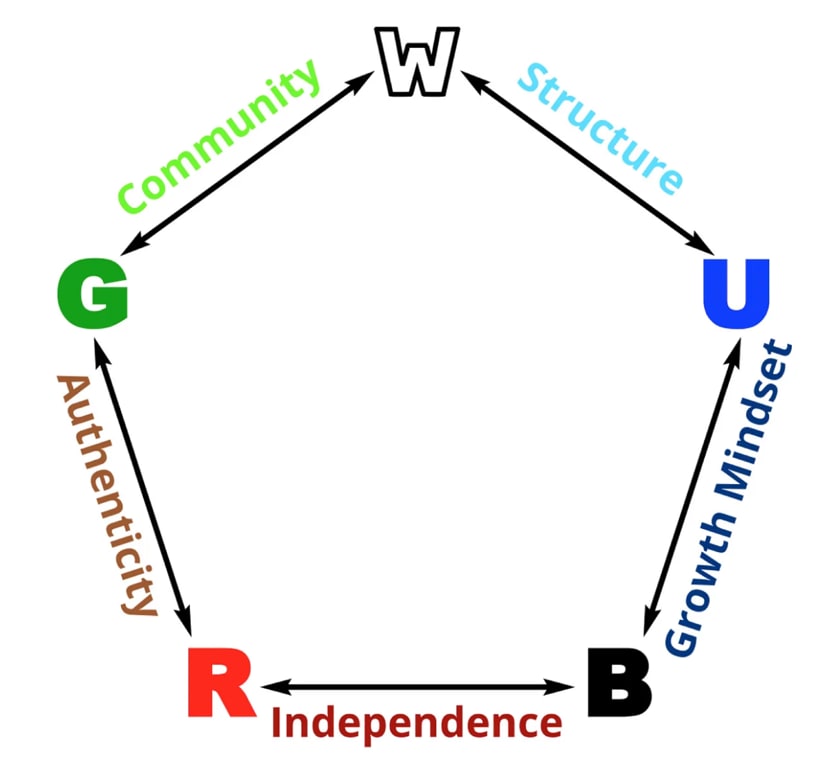
The agreements. (Image credit: Duncan Sabien
here.)
Here, though, I'm not going to focus on the particulars of Sabien's (or
Rosewater's) presentation. Indeed, my sense is that in my own head, the
colors mean different things than they do to Sabien/Rosewater (for
example, peace is less central for white, and black doesn't necessarily
seek satisfaction). And part of the advantage of using colors, rather
than numbers (or made-up words like "Hufflepuff") is that we start,
already, with a set of associations to draw on and dispute.
Why did this system, unlike the others, stick with me? I'm not sure,
actually. Maybe it's just: it feels like a more joint-carving division
of the sorts of energies that tend to animate people. I also like the
way the colors come in a star, with the lines of agreement and
disagreement noted above. And I think it's strong on archetypal
resonance.
Why is this system relevant to the sorts of otherness and control issues
I've been talking about in this series? Lots of reasons in principle.
But here I want to talk, in particular, about green.
Gestures at green
"I love not Man the less, but Nature more..."
~ Byron
What is green?
Sabien discusses various associations: environmentalism, tradition,
family, spirituality, hippies, stereotypes of Native Americans, Yoda.
Again, I don't want to get too anchored on these particular
touch-points. At the least, though, green is the "Nature" one. Have you
seen, for example, Princess Mononoke? Very green (a lot of Miyazaki is
green). And I associate green with "wholesomeness" as well (also:
health). In children's movies, for example, visions of happiness—e.g., the family at the end of Coco, the village in Moana—are
often very green.
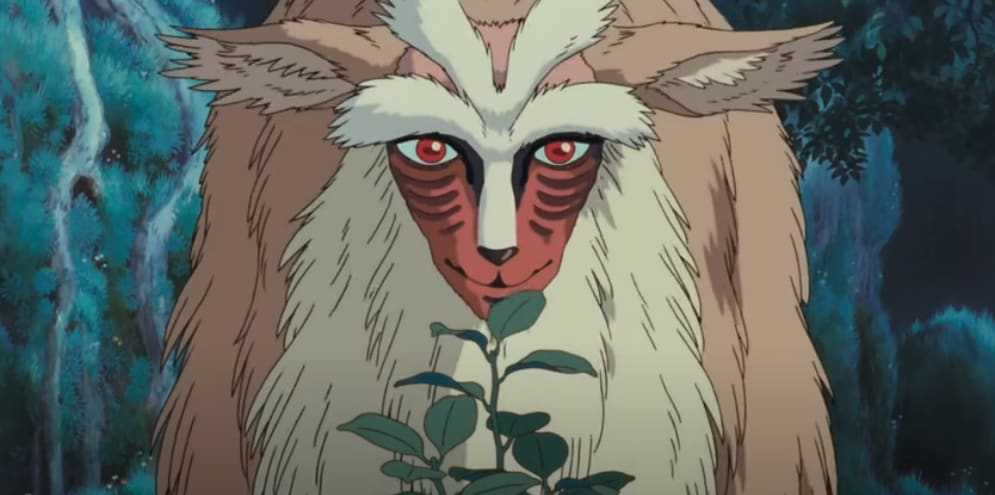
The forest
spirit from
Princess Mononoke
But green is also, centrally, about a certain kind of yin. And in this
respect, one of my paradigmatic advocates of green is Ursula LeGuin, in
her book The Wizard of Earthsea—and also, in her lecture on Utopia,
"A Non-Euclidean View of California as a Cold Place to
Be,"
which explicitly calls for greater yin towards the future.[2]
A key image of wisdom, in the Wizard of Earthsea, is Ogion the Silent,
the wizard who takes the main character, Ged, as an apprentice. Ogion
lives very plainly in the forest, tending goats, and he speaks very
little: "to hear," he says, "you must be silent." And while he has deep
power—he once calmed a mountain with his words, preventing an
earthquake—he performs very little magic himself. Other wizards use
magic to ward off the rain; Ogion lets it fall. And Ogion teaches very
little magic to Ged. Instead, to Ged's frustration, Ogion mostly wants
to teach Ged about local herbs and seedpods; about how to wander in the
woods; about how to "learn what can be learned, in silence, from the
eyes of animals, the flight of birds, the great slow gestures of trees."
And when Ged gets to wizarding school, he finds the basis for Ogion's
minimalism articulated more explicitly:
you must not change one thing, one pebble, one grain of sand, until
you know what good and evil will follow on that act. The world is in
balance, in Equilibrium. A wizard's power of Changing and of Summoning
can shake the balance of the world. It is dangerous, that power. It is
most perilous. It must follow knowledge, and serve need. To light a
candle is to cast a shadow...
LeGuin, in her lecture, is even more explicit: "To reconstruct the
world, to rebuild or rationalize it, is to run the risk of losing or
destroying what in fact is." And green cares very much about protecting
the preciousness of "what in fact is."
Green-blindness
"There'll be icicles and birthday clothes
And sometimes there'll be sorrow... "
~ "Little Green," by Joni Mitchell
By contrast, consider what I called, in a previous essay, "deep
atheism"—that fundamental mistrust towards both Nature and bare intelligence
that I suggested underlies some of the discourse about AI risk. Deep
atheism is, um, not green. In fact, being not-green is a big part of the
schtick.
Indeed, for closely related reasons, when I think about the two
ideological communities that have paid the most attention to AI risk
thus far—namely, Effective Altruism and Rationalism—the non-green
of both stands out. Effective altruism is centrally a project of white,
blue, and—yep—black. Rationality—at least in theory, i.e.
"effective pursuit of whatever-your-goals-are"—is more centrally,
just, blue and black. Both, sometimes, get passionate, red-style—though EA, at least, tends fairly non-red. But green?
Green, on its face, seems like one of the main mistakes. Green is what
told the rationalists to be more OK with death, and the EAs to be more
OK with wild animal suffering. Green thinks that Nature is a harmony
that human agency easily disrupts. But EAs and rationalists often think
that nature itself is a horror-show—and it's up to humans, if
possible, to remake it better. Green tends to seek yin; but both EA
and rationality tend to seek yang—to seek agency, optimization
power, oomph. And yin in the face of global poverty, factory farming,
and existential risk, can seem like giving-up; like passivity, laziness,
selfishness. Also, wasn't green wrong about growth, GMOs, nuclear power,
and so on? Would green have appeased the Nazis? Can green even give a
good story about why it's OK to cure cancer? If curing death is
interfering too much with Nature, why isn't curing cancer the same?
Indeed, Yudkowsky makes green a key enemy in his short story "The
Sword of the Good." Early on, a wizard warns the protagonist of a
prophecy:
"A new Lord of Dark shall arise over Evilland, commanding the Bad
Races, and attempt to cast the Spell of Infinite Doom... The Spell of
Infinite Doom destroys the Equilibrium. Light and dark, summer and
winter, luck and misfortune—the great Balance of Nature will be,
not upset, but annihilated utterly; and in it, set in place a single
will, the will of the Lord of Dark. And he shall rule, not only the
people, but the very fabric of the World itself, until the end of
days."
Yudkowsky's language, here, echoes LeGuin's in The Wizard of Earthsea
very directly—so much so, indeed, as to make me wonder whether
Yudkowsky was thinking of LeGuin's wizards in particular. And
Yudkowsky's protagonist initially accepts this LeGuinian narrative
unquestioningly. But later, he meets the Lord of Dark, who is in the
process of casting what he calls the Spell of Ultimate Power—a spell
which the story seems to suggest will indeed enable him to rule over the
fabric of reality itself. At the least, it will enable him to bring dead
people whose brains haven't decayed back to life, cryonics-style.
But the Lord of Dark disagrees that casting the spell is bad.
"Equilibrium," hissed the Lord of Dark. His face
twisted. "Balance. Is that what the wizards call it, when some live
in fine castles and dress in the noblest raiment, while others starve
in rags in their huts? Is that what you call it when some years are of
health, and other years plague sweeps the land? Is that how you
wizards, in your lofty towers, justify your refusal to help those in
need? Fool! There is no Equilibrium! It is a word that you wizards
say at only and exactly those times that you don't want to bother!"
And indeed: LeGuin's wizards—like the wizards in the Harry Potter
universe—would likely be guilty, in Yudkowsky's eyes, of doing too
little to remake their world better; and of holding themselves apart, as
a special—and in LeGuin's case, all-male—caste. Yudkowsky wants us
to look at such behavior with fresh and morally critical eyes. And when
the protagonist does so, he decides—for this and other reasons—that actually, the Lord of Dark is good.[3]
As I've written about
previously,
I'm sympathetic to various critiques of green that Yudkowsky, the EAs,
and the rationalists would offer, here. In particular, and even setting
aside death, wild animal suffering, and so on, I think that green often
leads to over-modest ambitions for the future; and over-reverent
attitudes towards the status-quo. LeGuin, for example, imagines—but
says she can barely hope for—the following sort of Utopia:
a society predominantly concerned with preserving its existence; a
society with a modest standard of living, conservative of natural
resources, with a low constant fertility rate and a political life
based upon consent; a society that has made a successful adaptation to
its environment and has learned to live without destroying itself or
the people next door...
Preferable to dystopia or extinction, yes. But I think we should hope
for, and aim for, far
better.
That said: I also worry—in Deep Atheism, Effective Altruism,
Rationalism, and so on—about what we might call "green-blindness."
That is, these ideological orientations can be so anti-green that I
worry they won't be able to see whatever wisdom green has to offer; that
green will seem either incomprehensible, or like a simple mistake—a
conflation, for example, between is and ought, the Natural and the
Good; yet another not-enough-atheism problem.
Why is green-blindness a problem?
"You thought, as a boy, that a mage is one who can do anything. So I
thought, once. So did we all. And the truth is that as a man's real
power grows and his knowledge widens, ever the way he can follow grows
narrower: until at last he chooses nothing, but does only and wholly
what he must do..."
~ From the Wizard of Earthsea
Why would green-blindness be a problem? Many reasons in principle. But
here I'm especially interested in the ones relevant to AI risk, and to
the sorts of otherness and control issues I've been discussing in this
series. And we get some hint of green's relevance, here, from the way in
which so many of the problems Yudkowsky anticipates, from the AIs, stem
from the AIs not being green enough—from the way in which he expects
the AIs to beat the universe black and blue; to drive it into some
extreme tail, nano-botting all boundaries and lineages and traditional
values in the process. In this sense, for all his transhumanism,
Yudkowsky's nightmare is conservative—and green is the conservative
color. The AI is, indeed, too much change, too fast, in the wrong
direction; too much gets lost along the way; we need to slow way, way
down. "And I am more progressive than that!", says
Hanson.
But not all change is progress.
Indeed, people often talk about AI risk as "summoning the
demon."
And who makes that mistake? Unwise magicians, scientists,
seekers-of-power—the ones who went too far on black-and-blue, and who
lost sight of green. LeGuin's wizards know, and warn their apprentices
accordingly.[4] Is Yudkowsky's warning to today's wizards so different?
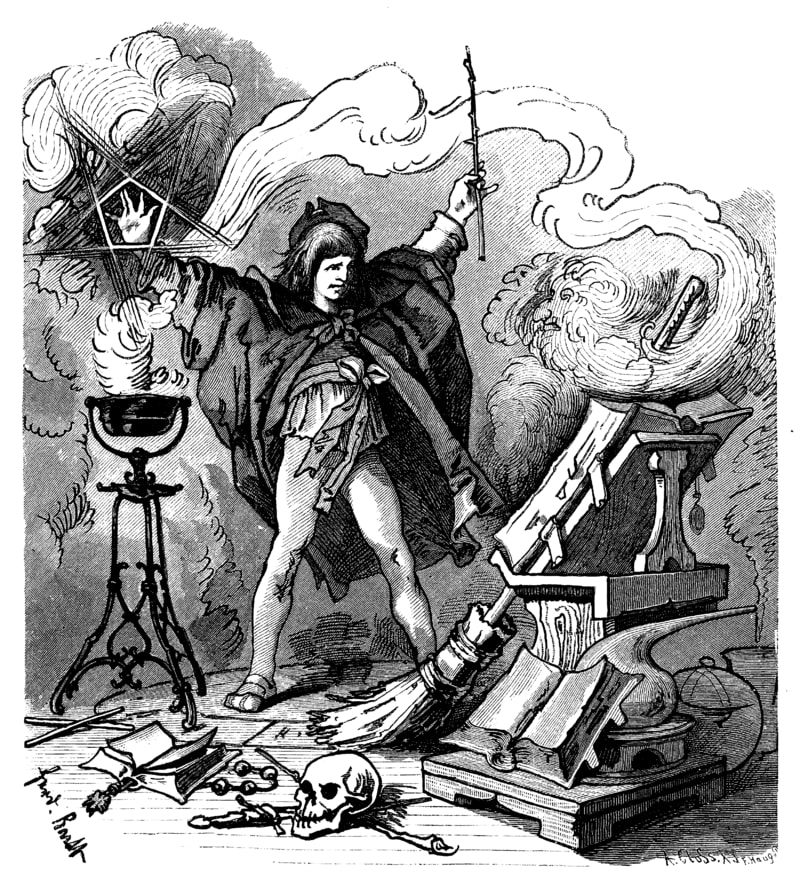
Careful now. Does this follow knowledge and serve need? (Image source
here.)
And the resonances between green and the AI safety concern go further.
Consider, for example, the concept of an "invasive species"—that
classic enemy of a green-minded agent seeking to preserve an existing
ecosystem. From
Wikipedia:
"An invasive or alien species is an introduced
species
to an environment that becomes
overpopulated
and harms its new environment." Sound familiar? And all this talk of
"tiling" and "dictator of the universe" does, indeed, invoke the sorts
of monocultures and imbalances-of-power that invasive species often
create.
Of course, humans are their own sort of invasive species (the worry is
that the AIs will invade harder); an ecosystem of
different-office-supply-maximizers
is still pretty disappointing; and the AI risk discourse does not,
traditionally, care about the "existing ecosystem" per se. But maybe
it should care
more?
At the least, I think the "notkilleveryone" part of AI safety—that
is, the part concerned with the AIs violating our boundaries, rather
than with making sure that unclaimed galactic resources get used
optimally—has resonance with "protect the existing ecosystem" vibes.
And part of the problem with dictators, and with top-down-gone-wrong, is
that some of the virtues of an ecosystem get lost.
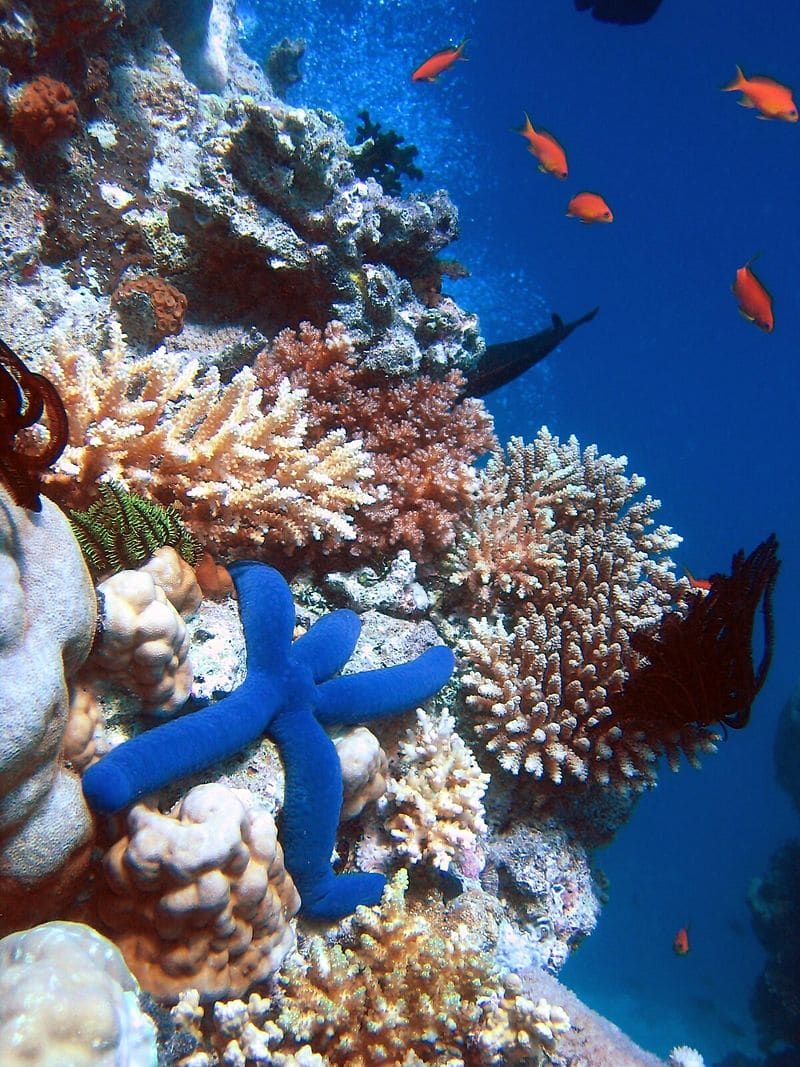
Maybe we could do, like, ecosystem-onium? (Image source
here.)
Yet for all that AI safety might seem to want more green out of the
invention of AGI, I think it also struggles to coherently conceptualize
what green even is. Indeed, I think that various strands of the AI
safety literature can be seen as attempting to somehow formalize the
sort of green we intuitively want out of our AIs. "Surely it's
possible," the thought goes, "to build a powerful mind that doesn't want
exactly what we want, but which also doesn't just drive the universe off
into some extreme and valueless tail? Surely, it's possible to just, you
know, not optimize that hard?" See, e.g., the literature on "soft
optimization,"
"corrigibility,"
"low impact agents,"
and so on.[5] As far as I can tell, Yudkowsky has broadly declared
defeat on this line of research,[6] on the grounds that vibes of this
kind are "anti-natural" to sufficiently smart agents that also
get-things-done.[7] But this sounds a lot like saying: "sorry, the sort
of green we want, here, just isn't enough of a coherent thing." And
indeed: maybe not.[8] But if, instead, the problem is a kind of
"green-blindness," rather than green-incoherence—a problem with the
way a certain sort of philosophy blots out green, rather than with green
itself—then the connection between green and AI safety suggests value
in learning-to-see.
And I think green-blindness matters, too, because green is part of what
protests at the kind of power-seeking that ideologies like rationalism
and effective altruism can imply, and which warns of the dangers of
yang-gone-wrong. Indeed, Yudkowsky's Lord of Dark, in dismissing green
with contempt, also appears, notably, to be putting himself in a
position to take over the world. There is no equilibrium, no balance of
Nature, no God-to-be-trusted; instead there is poverty and pain and
disease, too much to bear; and only nothingness above. And so,
conclusion: cast the spell of Ultimate Power, young sorcerer. The
universe, it seems, needs to be controlled.
And to be clear, in case anyone missed it: the Spell of Ultimate Power
is a metaphor for AGI. The Lord of Dark is one of Yudkowsky's
"programmers" (and one of Lewis's "conditioners"). Indeed, when the pain
of the world breaks into the consciousness of the protagonist of the
story, it does so in a manner extremely reminiscent of the way it breaks
into young-Yudkowsky's consciousness, in his accelerationist
days,
right before he declares "reaching the Singularity as fast as
possible to be the Interim Meaning of Life, the temporary definition of
Good, and the foundation until further notice of my ethical system."
(Emphasis in the original.)
I have had it. I have had it with crack houses, dictatorships, torture
chambers, disease, old age, spinal paralysis, and world hunger. I have
had it with a death rate of 150,000 sentient beings per day. I have
had it with this planet. I have had it with mortality. None of this is
necessary. The time has come to stop turning away from the mugging on
the corner, the beggar on the street. It is no longer necessary to
close our eyes, blinking away the tears, and repeat the mantra: "I
can't solve all the problems of the world." We can. We
can end this.
Of course, young-Yudkowsky has since aged. Indeed, older-Yudkowsky has
disavowed all of
his pre-2002 writings, and he wrote that in 1996. But he wrote the Sword
of the Good in 2009, and the protagonist, in that story, reaches a
similar conclusion. At the request of the Lord of Dark, whose Spell of
Ultimate Power requires the sacrifice of a wizard, the protagonist kills
the wizard who warned about disrupting equilibrium, and gives his sword—the Sword of the Good, which "kills the unworthy with a slightest
touch" (but which only tests for intentions)—to the Lord of Dark to
touch. "Make it stop. Hurry," says the protagonist. The Lord of Dark
touches the blade and survives, thereby proving that his intentions are
good. "I won't trust myself," he assures the protagonist. "I don't trust
you either," the protagonist replies, "but I don't expect there's anyone
better." And with that, the protagonist waits for the Spell of Ultimate
Power to foom, and for the world as he knows it to end.
Is that what choosing Good looks like? Giving Ultimate Power to the
well-intentioned—but un-accountable, un-democratic, Stalin-ready—because everyone else seems worse, in order to remake reality into
something-without-darkness as fast as possible? And killing people on
command in the process, without even asking why it's necessary, or
checking for alternatives?[9] The story wants us, rightly, to approach
the moral narratives we're being sold with skepticism; and we should
apply the same skepticism to the story itself.
Perhaps, indeed, Yudkowsky aimed intentionally at prompting such
skepticism (though the Lord of Dark's object-level schtick—his
concern for animals, his interest in cryonics, his desire to
tear-apart-the-foundations-of-reality-and-remake-it-new—seems notably
in line with Yudkowsky's own). At the least, elsewhere in his fiction
(e.g., HPMOR), he urges more caution in responding to the screaming pain
of the world;[10] and his more official injunction towards
"programmers" who have suitably solved alignment—i.e., "implement
present-day humanity's coherent extrapolated
volition"—involves, at
least, certain kinds of inclusivity. Plus, obviously, his current,
real-world policy platform is heavily not "build AGI as fast as
possible." But as I've been emphasizing throughout this series, his
underlying philosophy and metaphysics is, ultimately, heavy on the
need for certain kinds of control; the need for the universe to be
steered, and by the right hands; bent to the right will; mastered. And
here, I think, green objects.
Green, according to non-Green
"Roofless, floorless, glassless, 'green to the very door'..."
~ Zadie Smith
But what exactly is green's objection? And should it get any weight?
There's a familiar story, here, which I'll call
"green-according-to-blue." On this story, green is worried that
non-green is going to do blue wrong—that is, act out of inadequate
knowledge. Non-green thinks it knows what it's doing, when it
attempts to remake Nature in its own image (e.g. remaking the ecosystem
to get rid of wild animal suffering)—but according to
green-according-to-blue, it's overconfident; the system it's trying to
steer is too complex and unpredictable. So thinks blue, in steel-manning
green. And blue, similarly, talks about Chesterton's
fence—about the status quo often having a reason-for-being-that-way, even
if that reason is hard to see; and about approaching it with
commensurate respect and curiosity. Indeed, one of blue's favored
stories for mistrusting itself
relies on deference to cultural evolution,
and to organic, bottom-up forms of organization, in light of the
difficulty of knowing-enough-to-do-better.
We can also talk about green according to something more like white.
Here, the worry is that non-green will violate various moral rules in
acting to reshape Nature. Not, necessarily, that it won't know what it's
doing, but that what it's doing will involve trampling too much over the
rights and interests of other agents/patients.
Finally, we can talk about green-according-to-black, on which green
specifically urges us to accept things that we're too weak to change—and thus, to save on the stress and energy of trying-and-failing.
Thus, black thinks that green is saying something like: don't waste your
resources trying to build perpetual motion machines, or to prevent the
heat death of the universe—you'll never be that-much-of-a-God. And
various green-sounding injunctions against e.g. curing death ("it's a
part of life") sound, to black, like mistaken applications (or: confused
reifications) of this reasoning.[11]
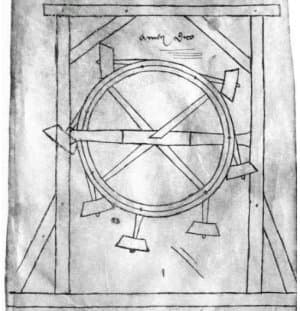
Early design for a perpetual motion
machine
I think that green does indeed care about all of these concerns—about
ignorance, immorality, and not-being-a-God—and about avoiding the
sort of straightforward mistakes that blue, white, and black would each
admit as possibilities. Indeed, one way of interpreting green is to
simply read it as a set of heuristics and reminders and ways-of-thinking
that other colors do well, on their own terms, to keep in mind—e.g.,
a vibe that helps blue remember its ignorance, black its weakness, and
so on. Or at least, one might think that this interpretation is what's
left over, if you want to avoid attributing to green various crude
naturalistic fallacies, like "everything Natural is Good," "all problems
stem from human agency corrupting Nature-in-Harmony," and the like.[12]
But I think that even absent such crude fallacies,
green-according-to-green has more to add to the other colors than this.
And I think that it's important to try to really grok what it's adding.
In particular: a key aspect of Yudkowsky's vision, at least, is that the
ignorance and weakness situation is going to alter dramatically
post-AGI. Blue and black will foom hard, until earth's future is chock
full of power and knowledge (even if also: paperclips). And as blue and
black grow, does the need for green shrink? Maybe somewhat. But I don't
think green itself expects obsolescence—and some parts of my model of
green think that people with the power and science of transhumanists
(and especially: of Yudkowskian "programmers," or Lewisian
"conditioners") need the virtues of green all the more.
But what are those virtues? I won't attempt any sort of exhaustive
catalog here. But I do want to try to point at a few things that I think
the green-according-to-non-green stories just described might miss.
Green cares about ignorance, immorality, and not-being-a-God—yes. But
it also cares about them in a distinctive way—one that more
paradigmatically blue, white, and black vibes don't capture very
directly. In particular: I think that green cares about something like
attunement, as opposed to just knowledge in general; about something
like respect, as opposed to morality in general; and about taking a
certain kind of joy in the dance of both yin and yang—in
encountering an Other that is not fully "mastered"—as opposed to
wishing, always, for fuller mastery.
I'll talk about attunement in my next essay—it's the bit of green I
care about most. For now, I'll give some comments on respect, and on
taking joy in both yin and yang.
Green and respect
In Being Nicer than
Clippy,
I tried to gesture at some hazy distinction between what I called
"paperclippy" modes of ethical conduct, and some alternative that I
associated with "liberalism/boundaries/niceness." Green, I think, tends
to be fairly opposed to "paperclippy" vibes, so on this axis, a green
ethic fits better with the liberalism/boundaries/niceness thing.
But I think that the sort of "respect" associated with green goes at
least somewhat further than this—and its status in relation to more
familiar notions of "Morality" is more ambiguous. Thus, consider the
idea of casually cutting down a giant, ancient redwood tree for use as
lumber—lifting the chainsaw, watching the metal bite into the living
bark. Green, famously, protests at this sort of thing—and I feel the
pull. When I stand in front of trees like this, they do, indeed, seem to
have a kind of presence and dignity; they seem importantly alive.[13]
And the idea of casual violation seems, indeed, repugnant.
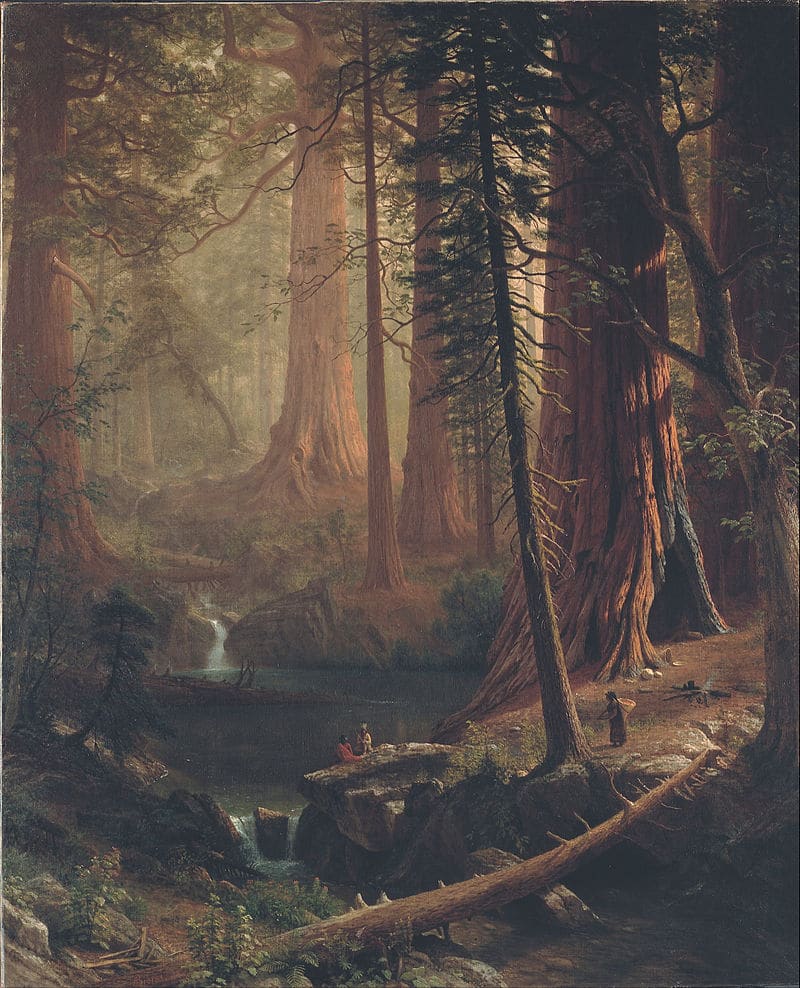
Albert Bierstadt's "Giant Redwood Trees of California" (Image source
here).
But it remains, I think, notably unclear exactly how to fit the ethic at
stake into the sorts of moral frameworks analytic ethicists are most
comfortable with—including, the sort of rights-based deontology that
analytic ethicists often use to talk about liberal and/or
boundary-focused ethics.
Is the thought: the tree is instrumentally useful for human purposes?
Environmentalists often reach for these justifications ("these ancient
forests could hold the secret to the next vaccine"), but come now. Is
that why people join the Sierra Club, or watch shows like Planet Earth?
At the least, it's not what's on my own mind, in the forest, staring up
at a redwood. Nor am I thinking "other people love/appreciate this tree,
so we should protect it for the sake of their pleasure/preferences" (and
this sort of justification would leave the question of why they
love/appreciate it unelucidated).
Ok then, is the thought: the tree is beneficial to the welfare of a
whole ecosystem of non-human moral-patient-y life forms? Again, a
popular thought in environmentalist circles.[14] But again, not
front-of-mind for me, at least, in encountering the tree itself; and in
my mind, too implicating of gnarly questions about animal welfare and
wild animal suffering to function as a simple argument for conservation.
Ok: is the thought, then, that the tree itself is a moral patient?[15]
Well, kind of. The tree is something, such that you don't just do
whatever you want with it. But again, in experiencing the tree as having
"presence" or "dignity," or in calling it "alive," it doesn't feel like
I'm also ascribing to it the sorts of properties we associate more
paradigmatically with moral patience-y—e.g., consciousness. And talk
of the tree as having "rights" feels strained.
And yet, for all this, something about just cutting down this ancient,
living tree for lumber does, indeed, feel pretty off to me. It feels,
indeed, like some dimension related to "respect" is in deficit.
Can we say more about what this dimension consists in? I wish I had a
clearer account. And it could be that this dimension, at least in my
case, is just, ultimately, confused, or such that it would not survive
reflection once fully separated from other considerations. Certainly,
the arbitrariness of certain of the distinctions that some
conservationist attitudes (including my own) tend to track (e.g., the
size and age and charisma of a given life-form) raise questions on this
front. And in general, despite my intuitive pull towards some kind of
respect-like attitude towards the redwood, we're here nearby various of
the parts of green that I feel most skeptical of.
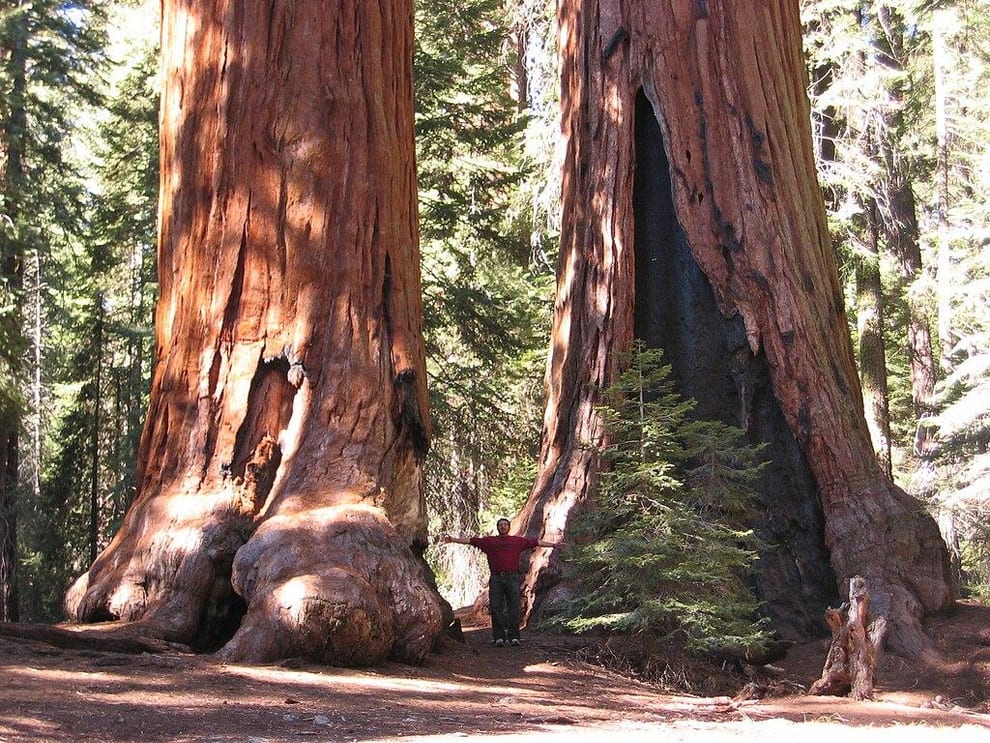
It's because it's big isn't it... (Image source
here.)
Still, before dismissing or reducing the type of respect at stake here,
I think it's at least worth trying to bring it into clearer view. I'll
give a few more examples to that end.
Blurring the self
I mentioned above that green is the "conservative" color. It cares about
the past; about lineage, and tradition. If something life-like has
survived, gnarled and battered and weathered by the Way of Things, then
green often grants it more authority. It has had more harmonies with the
Way of Things infused into it; and more disharmonies stripped away.
Of course, "harmony with the Way of Things" can be, just, another word
for power (see also: "rationality"); and we can, indeed, talk about a
lot of this in terms of blue and black—that is, in terms of the
knowledge and strength that something's having-survived can indicate,
even if you don't know what it is. But it can feel like the relationship
green wants you to have with the past/lineage/tradition and so on goes
beyond this, such that even if you actually get all of the power and
knowledge you can out of the past/lineage/tradition, you shouldn't just
toss them aside. And this seems closely related to respect as well.
Part of this, I think, is that the past is a part of us. Or at least,
our lineage is a part of us, almost definitionally. It's the pattern
that created us; the harmony with the Way of Things that made us
possible; and it continues to live within us and around us in ways we
can't always see, and which are often well-worth discovering.
"Ok, but does that give it authority over us? " The quick
straw-Yudkowskian answer is: "No. The thing that has authority over you,
morally, is your heart; your values. The past has authority only
insofar as some part of it is good according to those values."
But what if the past is part of your heart? Straw-Yudkowskianism often
assumes that when we talk about "your values," we are talking about
something that lives inside you; and in particular, mostly, inside
your brain. But we should be careful not to confuse the brain-as-seer
and the brain-as-thing-seen. It's true that ultimately, your brain moves
your muscles, so anything with the sort of connection to your behavior
adequate to count as "your values" needs to get some purchase on your
brain somehow. But this doesn't mean that your brain, in seeking out
guidance about what to do, needs to look, ultimately, to itself.
Rather, it can look, instead, outwards, towards the world. "Your values"
can make essential reference to bits of Reality beyond yourself, that
you cannot see directly, and must instead discover—and stuff about
your past, your lineage, and so on is often treated as a salient
candidate for mattering in this respect; an important part of "who you
are."
MOANA song "We Know The
Way"
(See also this
one.)
In this way, your "True Self" can be mixed-up, already, with that
strange and unknown Other, reality. And when you meet that Other, you
find it, partly, as mirror. But: the sort of mirror that shows you
something you hadn't seen before. Mirror, but also window.
Green, traditionally, is interested in these sorts of line-blurrings—in the ways in which it might not be me-over-here, you-over-there; the
way the real-selves, the true-Agents, might be more spread out, and
intermixed. Shot through forever with each other. Until, in the limit,
it was God the whole time: waking up, discovering himself, meeting
himself in each other's eyes.
Of course, God does, still, sometimes need to go to war with parts
himself—for example, when those parts are invading Poland. Or at
least, we do—for our true selves are not, it seems, God entire;
that's the "evil" problem. But such wars need not involve saying "I see
none of myself in you." And indeed, green is very wary of stances
towards evil and darkness that put it, too much, "over there," instead
of finding ourselves in its gaze. This is a classic Morality thing, a
classic failure mode of White. But green-like lessons often go the
opposite direction. See, for example, the Wizard of Earthsea, or the
ending of
Moana
(spoilers at link). Your true name, perhaps, lies partly in the realm of
shadow. You can still look on evil with defiance and strength; but to
see fully, you must learn to look in some other way as well.
And here, perhaps, is one rationale for certain kinds of respect. It's
not, just, that something that might carry knowledge and power you can
acquire and use, or fear; or that it might conform to and serve some
pre-existing value you know, already, from inside yourself. Rather, it
might also carry some part of your heart itself inside of it; and to
kill it, or to "use it," or put it too much "over there," might be to
sever your connection with your whole self; to cut some vein, and so
become more bloodless; to block some stream, and so become more dry.
Respecting superintelligences
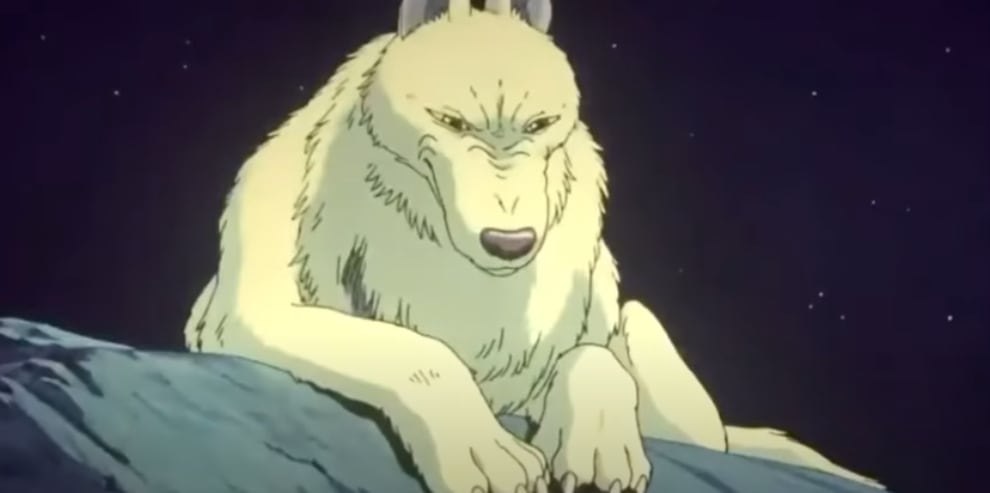
Moro the wolf God
I'll also mention another example of green-like "respect"—one that
has more relevance to AI risk.
Someone I know once complained to me that the Yudkowsky-adjacent AI risk
discourse gives too little "respect" to superintelligences. Not just
superintelligent AIs; but also, other advanced civilizations that might
exist throughout the multiverse. I thought it was an interesting
comment. Is it true?
Certainly, straw-Yudkowskian-ism knows how to positively appraise
certain traits possessed by superintelligences—for example, their
smarts, cunning, technological prowess, etc (even if not also: their
values). Indeed, for whatever notion of "respect" one directs at a
formidable adversary trying to kill you, Yudkowsky seems to have a lot
of that sort of respect for misaligned AIs. And he worries that our
species has too little.
That is: Yudkowsky respects the power of superintelligent agents. And
he's generally happy, as well, to respect their moral rights. True, as I
discussed in "Being nicer than
Clippy,"
I do think that the Yudkowskian AI risk discourse sometimes
under-emphasizes various key aspects of this. But that's not what I want
to focus on here.
Once you've positively appraised the power (intelligence, oomph, etc) of
a superintelligent agent, though, and given its moral claims adequate
weight, what bits are left to respect? On a sufficiently abstracted
Yudkowskian ontology, the most salient candidate is just: the utility
function bit (agents are just: utility functions +
power/intelligence/oomph). And sure, we can positively appraise utility
functions (and: parts of utility functions), too—especially to the
degree that they are, you know, like ours.
But some dimension of respect feels like it might be missing from this
picture. For one thing: real world creatures—including, plausibly,
quite oomph-y ones—aren't, actually, combinations of utility
functions and degrees-of-oomph. Rather, they are something more gnarled
and detailed, with their own histories and cultures and idiosyncrasies—the way the boar god smells you with his
snout; the way
humans cry at funerals; the way ChatGPT was trained to predict the
human internet. And respect needs to attend to and adjust itself to a
creature's contours—to craft a specific sort of response to a
specific sort of being. Of course, it's hard to do that without
meeting the creature in question. But when we view superintelligent
agents centrally through the lens of rational-agent models, it's easy to
forget that we should do it at all.
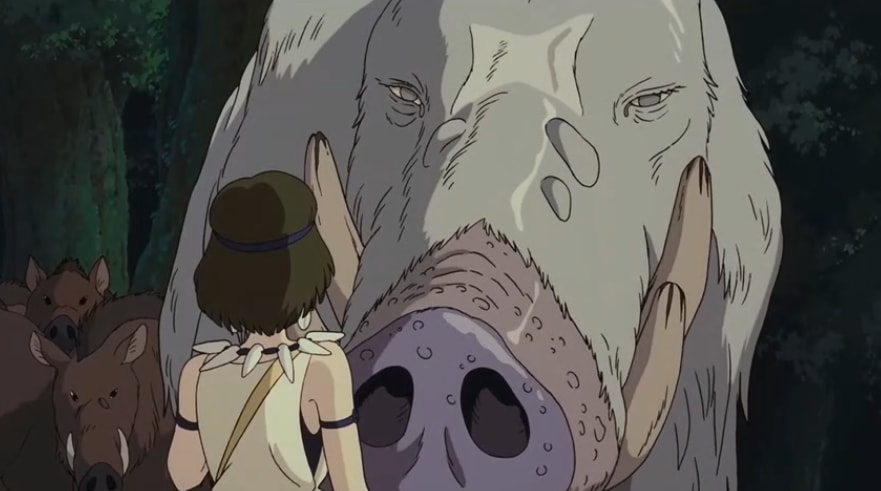
Okkoto the blind boar
God
But even beyond this need for specificity, I think some other aspect of
respect might be missing too. Suppose, for example, that I meet a
super-intelligent emissary from an ancient alien civilization. Suppose
that this emissary is many billions of years old. It has traveled
throughout the universe; it has fought in giant interstellar wars; it
understands reality with a level of sophistication I can't imagine. How
should I relate to such a being?
Obviously, indeed, I should be scared. I should wonder about what it can
do, and what it wants. And I should wonder, too, about its moral claims
on me. But beyond that, it seems appropriate, to me, to approach this
emissary with some more holistic humility and open attention. Here is an
ancient demi-God, sent from the fathoms of space and time, its mind
tuned and undergirded by untold depths of structure and harmony,
knowledge and clarity. In a sense, it stands closer to reality than we
do; it is a more refined and energized expression of reality's nature,
pattern, Way. When it speaks, more of reality's voice speaks through it.
And reality sees more truly through its eyes.
Does that make it "good"? No—that's the orthogonality thing, the AI
risk thing. But it likely has much more of whatever "wisdom" is
compatible with the right ultimate picture of "orthogonality"—and
this might, actually, be a lot. At the least, insofar as we are
specifically trying to get the "respect" bit (as opposed to the
not-everyone-dying bit) right, I worry a bit about coming in too hard,
at the outset, with the conceptual apparatus of orthogonality; about
trying, too quickly, to carve up this vast and primordial Other Mind
into "capabilities" and "values," and then taking these carved-up
pieces, centrally, as objects of positive or negative appraisal.
In particular: such a stance seems notably loaded on our standing in
judgment of the super-intelligent Other, according to our own
pre-existing concepts and standards; and notably lacking on interest in
the Other's judgment of us; or in understanding the Other on its own
terms, and potentially growing/learning/changing in the process. Of
course, we should still do the judging-according-to-our-own-standards
bit—not to mention, the not-dying bit. But shouldn't we be doing
something else as well?
Or to put it another way: faced with an ancient super-intelligent
civilization, there is a sense in which we humans are, indeed, as
children.[16] And there is a temptation to say we should be acting with
the sort of holistic humility appropriate to children vis-à-vis adults—a virtue commonly associated with "respect."[17] Of course, some
adults are abusive, or evil, or exploitative. And the orthogonality
thing means you can't just trust or defer to their values either. Nor,
even in the face of superintelligence, should we cower in shame, or in
worship—we should stand straight, and look back with eyes open. So
really, we need the virtues of children who are respectful, and smart,
and who have their own backbone—the sort of children who manage,
despite their ignorance and weakness, to navigate a world of flawed and
potentially threatening adults; who become, quickly, adults themselves;
and who can hold their own ground, when it counts, in the meantime. Yes,
a lot of the respect at stake is about the fact that the adults are,
indeed, smarter and more powerful, and so should be feared/learned-from
accordingly. But at least if the adults meet certain moral criteria—restrictive enough to rule out the abusers and exploiters, but not so
restrictive as to require identical values—then it seems like green
might well judge them worthy of some other sort of "regard" as well.
But even while it takes some sort of morality into account, the regard
in question also seems importantly distinct from direct moral approval or positive appraisal. Here I think again of Miyazaki movies, which often feature creatures
that mix beauty and ugliness, gentleness and violence; who seem to live
in some moral plane that intersects and interacts with our own, but
which moves our gaze, too, along some other dimension, to some unseen
strangeness.[18] Wolf gods; blind boar gods; spirits without
faces; wizards
building worlds out of blocks marred by
malice—how
do you live among such creatures, and in a world of such tragedy and
loss? "I am making this movie because I do not have the answer," says
the director, as he bids his art goodbye.[19] But some sort of respect
seems apt in many cases—and of a kind that can seem to go beyond "you
have power," "you are a moral patient," and "your values are like mine."
I admit, though, that I haven't been able to really pin down or
elucidate the type of respect at stake.[20] In the appendix to this
essay, I discuss one other angle on understanding this sort of respect,
via what I call "seeking guidance from God." But I don't feel like I've
nailed that angle, either—and the resulting picture of green brings
it nearer to "naturalistic fallacies" I'm quite hesitant about. And even
the sort of respect I've gestured at in the examples above—for trees,
lineages, superintelligent emissaries, and so on—risks various types
of inconsistency, complacency, status-quo-bias, and
getting-eaten-by-aliens. And perhaps it cannot, ultimately, be made
simultaneously coherent and compelling.
But I feel some pull in this direction all the same. And regardless of
our ultimate views on this sort of respect, I think it's not quite the
same thing as e.g. making sure you respect Nature's "rights," or conform
to the right "rules" in relation to it—what I called, above,
"green-according-to-white."
Green and joy
"Pantheism is a creed not so much false as hopelessly behind the
times. Once, before creation, it would have been true to say that
everything was God. But God created: He caused things to be other than
Himself that, being distinct, they might learn to love Him, and
achieve union instead of mere sameness. Thus He also cast His bread
upon the waters."
~ C.S. Lewis, in the Problem of Pain
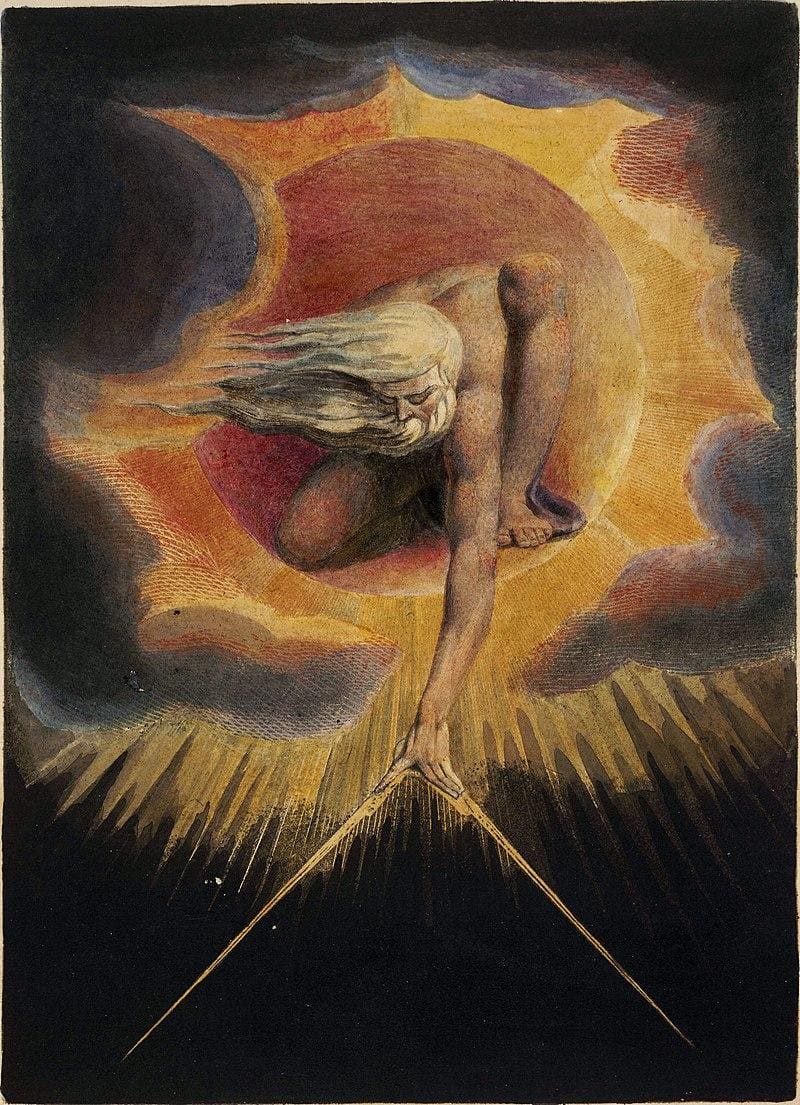
"The ancient of days" by William Blake (Image source
here;
strictly speaking for Blake this isn't God, but whatever...)
I want to turn, now, to green-according-to-black, according to which
green is centrally about recognizing our ongoing weakness—just how
much of the world is not (or: not yet) master-able, controllable,
yang-able.
I do think that something in the vicinity is a part of what's going on
with green. And not just in the sense of "accepting things you can't
change." Even if you can change them, green is often hesitant about
attempting forms of change that involve lots of effort and strain and
yang. This isn't to say that green doesn't do anything. But when it
does, it often tries to find and ride some pre-existing "flow"—to
turn keys that fit easily into Nature's locks; to guide the world in
directions that it is fairly happy to go, rather than forcing it into
some shape that it fights and resists.[21] Of course, we can debate the
merits of green's priors, here, about what sorts of effort/strain are
what sorts of worth it—and indeed, as mentioned, green's tendency
towards unambition and passivity is one of my big problems with it. But
everyone, even black, agrees on the merits of energy efficiency; and in
the limit, if yang will definitely fail, then yin is, indeed, the
only option. Sad, says black, but sometimes necessary.
Here, though, I'm interested in a different aspect of green—one which
does not, like black, mourn the role of yin; but rather, takes joy in
it. Let me say more about what I mean.
Love and otherness
"I have bedimm'd
The noontide sun, call'd forth the mutinous winds,
And 'twixt the green sea and the azured vault
Set roaring war: to the dread rattling thunder
Have I given fire and rifted Jove's stout oak
With his own bolt; the strong-based promontory
Have I made shake and by the spurs pluck'd up
The pine and cedar: graves at my command
Have waked their sleepers, oped, and let 'em forth
By my so potent art..."
~ Prospero
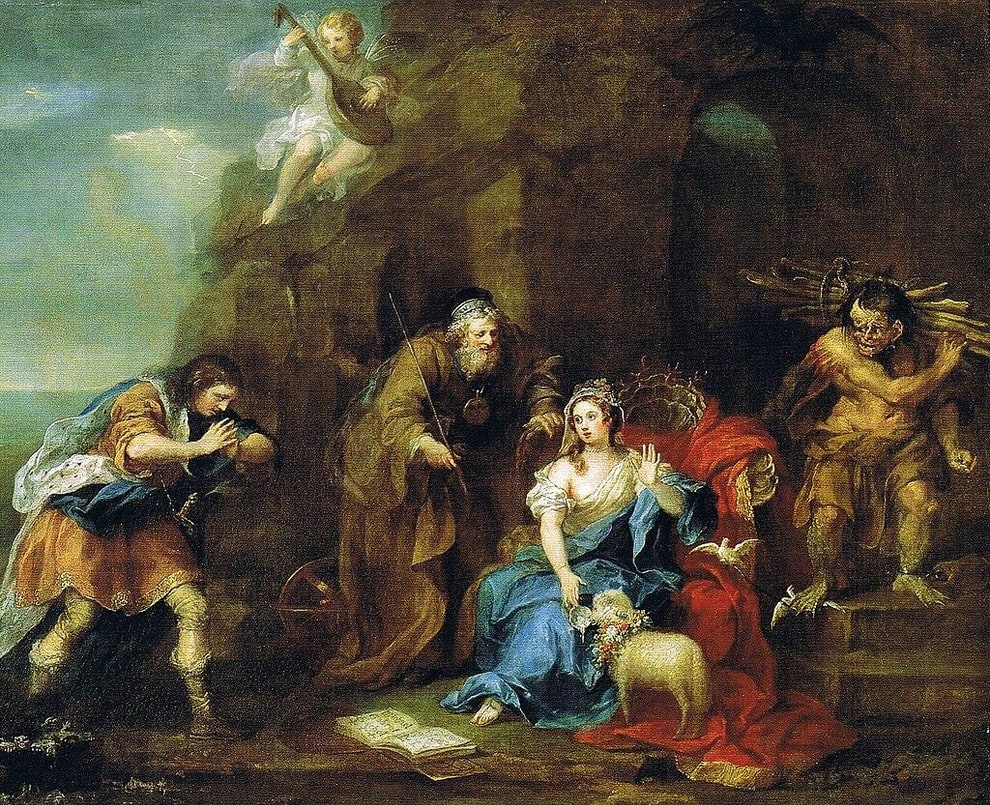
"Scene from Shakespeare's The Tempest," by Hogarth (Image source
here)
There's an old story about God. It goes like this. First, there was God.
He was pure yang, without any competition. His was the Way, and the
Truth, and the Light—and no else's. But, there was a problem. He was
too alone. Some kind of "love" thing was too missing.
So, he created Others. And in particular: free Others. Others who
could turn to him in love; but also, who could turn away from him in sin—who could be what one might call "misaligned."
And oh, they were misaligned. They rebelled. First the angels, then the
humans. They became snakes, demons, sinners; they ate apples and babies;
they hurled asteroids and lit the forests aflame. Thus, the story goes,
evil entered a perfect world. But somehow, they say, it was in service
of a higher perfection. Somehow, it was all caught up with the
possibility of love.
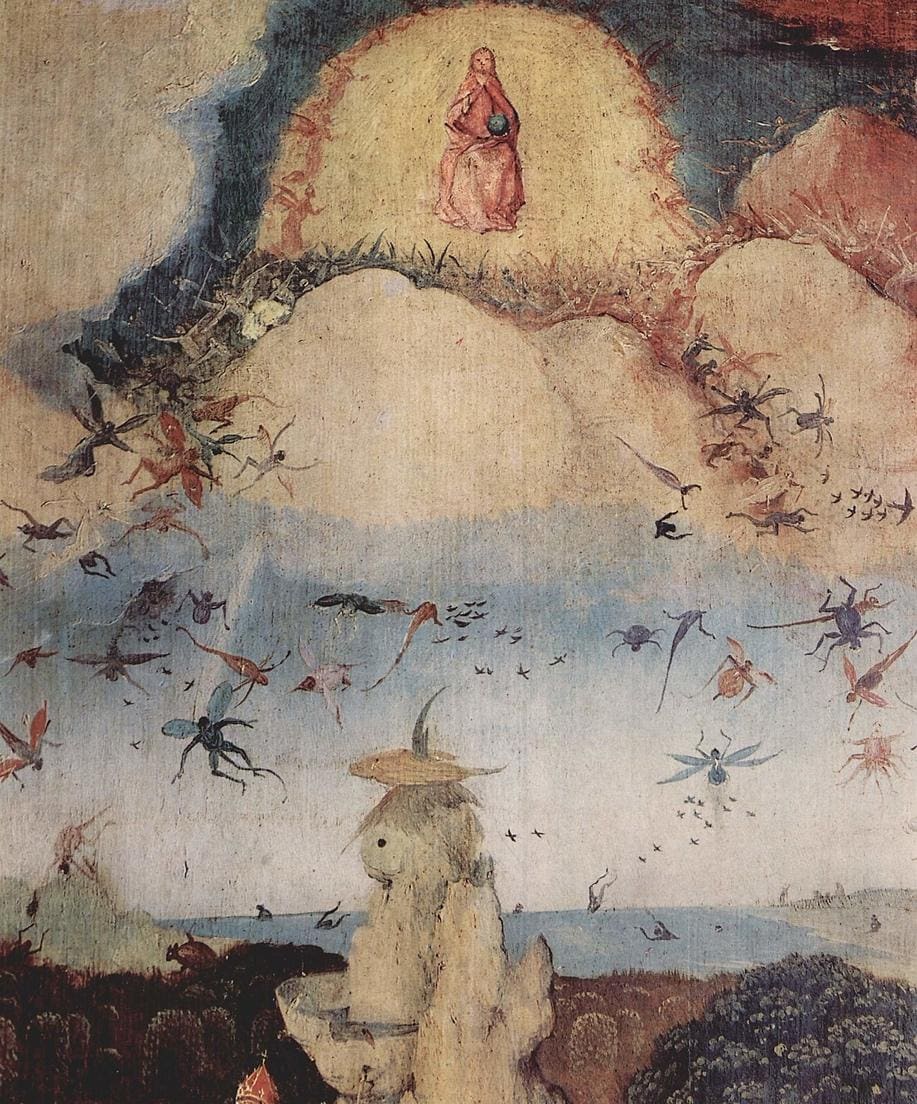
The Fall of the Rebel Angels, by Bosch. (Image source
here.)
Why do I tell this story? Well: a lot of the "deep atheism" stuff, in
this series, has been about the problem of evil. Not, quite, the
traditional theistic version—the how-can-God-be-good problem. But
rather, a more generalized
version—the problem of how to relate, spiritually, to an orthogonal and
sometimes horrifying reality; how to live in the light of one's
vulnerability to an unaligned God. And I've been interested, in
particular, in responses to this problem that focus, centrally, on
reducing the vulnerability in question—on seeking greater power and
control; on "deep atheism, therefore black." These responses attempt to
reduce the share of the world that is Other, and to make it, instead, a
function of Self (or at least, the self's heart). And in the limit, it
can seem like they aspire (if only it were possible) to abolish the
Other entirely; to control everything, lest any evil or misalignment
sneak through; and in this respect, to take up that most ancient and
solitary throne—the one that God sat on, before the beginning of time;
the throne of pure yang.
So I find it interesting that God, in the story above, rejected this
throne. Unlike us, he had the option of full control, and a perfectly
aligned world. But he chose something different. He left pure self
behind, and chose instead to create Otherness—and with it, the
possibility (and reality) of evil, sin, rebellion, and all the rest.
Of course, we might think he chose wrong. Indeed, the story above is
often offered as a defense (the "free will defense") of God's goodness
in the face of the world's horrors—and we might, with such horrors
vividly before us, find such a defense repugnant.[22] At the least,
couldn't God have found a better version of freedom? And one might
worry, too, about the metaphysics of the freedom implicitly at stake. In
particular, at least as Lewis tells it,[23] the story loads, centrally,
on the idea that instead of determining the values of his creatures (and
without, one assumes, simply randomizing the values that they get, or
letting some other causal process decide), God can just give them
freedom instead—the freedom to have some part of them uncreated; to
be an uncaused cause. But in our naturalistic universe, at least, and
modulo various creative theologies, this doesn't seem like something a
creator (especially an omniscient and omnipotent one) can do. Whether
his creatures are aligned, or unaligned, God either made them so, or he
let some other not-them process (e.g., his random-number-generator) do
the making. And once we've got a better and more compatibilist
metaphysics in view, the question of "why not make them both good
and free?" becomes much more salient (see e.g. my discussion of Bob
the lover-of-joy
here).
And note, importantly, that the same applies to us, with our AIs.[24]
But regardless of how we feel about God's choice in the story, or the
metaphysics it presumes, I think it points at something real: namely,
that we don't, actually, always want more power, control, yang. To the
contrary, and even setting aside more directly ethical constraints on
seeking power over others, a lot of our deepest values are animated by
taking certain kinds of joy in otherness and yin—in being
not-God, and relatedly: not-alone.
Love is indeed the obvious example here. Love, famously, is directed
(paradigmatically) at something outside yourself—something present,
but exceeding your grasp; something that surprises you, and dances with
you, and looks back at you. True, people often extoll the "sameness"
virtues of love—unity, communion, closeness. But to merge, fully—to make love centrally a relation with an (expanded) self—seems to me
to miss a key dimension of joy-in-the-Other per se.
Here I think of Martin Buber's opposition, in more spiritual contexts,
to what he calls "doctrines of immersion" (Buddhism, on his reading, is
an example), which aspire to dissolve into the world, rather than to
encounter it. Such doctrines, says Buber, are "based on the gigantic
delusion of human spirit bent back into itself—the delusion that
spirit occurs in man. In truth it occurs from man - between man and what
he is not."[25] Buber's spirituality focuses, much more centrally, on
this kind of "between"—and compared with spiritual vibes focused more
on unification, I've always found his vision the more resonant. Not to
merge, but to stand face to face. Not to become the Other; but to speak, and
to listen, in dialogue. And many other interpersonal pleasures—conversation, friendship, community—feature this kind of "between" as
well.
Or consider experiences of wonder, sublimity, beauty, curiosity. These
are all, paradigmatically, experiences of encountering or receiving
something outside yourself—something that draws you in, stuns you,
provokes you, overwhelms you. They are, in this sense, a type of yin.
They discover something, and take joy in the discovery. Reality, in
such experiences, is presented as electric and wild and alive.
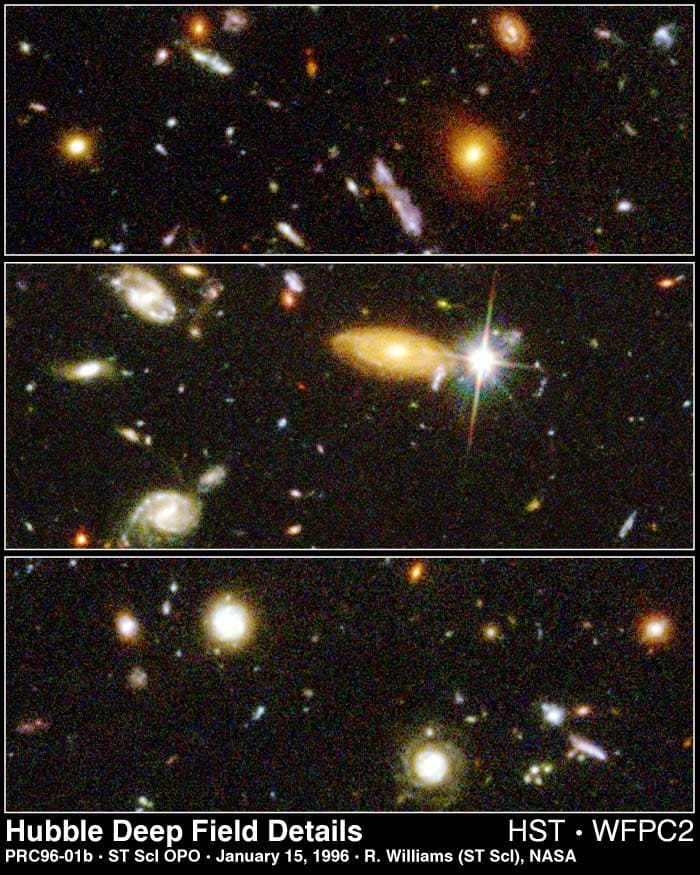
(Image source
here)
And many of the activities we treasure specifically involve a play of
yin and yang in relation to some not-fully-controlled Other—consider partner dancing, or surfing, or certain kinds of sex. And of
course, sometimes we go to an activity seeking the yin bit in
particular. Cf, e.g., dancing with a good lead, sexual submissiveness,
or letting a piece of music carry you.

"Dance in the country," by Renoir. (Image source
here.)
And no wonder that our values are like this. Humans are extremely
not-Gods. We evolved in a context in which we had, always, to be
learning from and responding to a reality very much beyond-ourselves. It
makes sense, then, that we learned, in various ways, to take joy in this
sort of dance—at least, sometimes.
Still, especially in the context of abstract models of rationality that
can seem to suggest a close link between being-an-agent-at-all and a
voracious desire for power and control, I think it's important to notice
how thoroughly joy in various forms of Otherness pervades our
values.[26] And I think this joy is at least one core thing going on with
green. Contra green-according-to-black, green isn't just resigned to
yin, or "serene" in the face of the Other. Green loves the Other,
and gets excited about God. Or at least, God in certain guises. God like
a friend, or a newborn bird, or a strange and elegant mathematical
pattern, or
the cold silence of a mountain range. God qua object of wonder,
curiosity, reverence, gentleness. True, not all God-guises prompt such
reactions—cancer, the Nazis, etc are still, more centrally,
to-be-defeated.[27] But contra Black (and even modulo White), neither
is everything either a matter of mastery, or of too-weak-to-win.

(Image source
here.)
The future of yin
"But this rough magic
I here abjure, and, when I have required
Some heavenly music, which even now I do,
To work mine end upon their senses that
This airy charm is for, I'll break my staff,
Bury it certain fathoms in the earth,
And deeper than did ever plummet sound
I'll drown my book."
~ Prospero
What's more, I think this aspect of our values actually comes under
threat, in the age of AGI, from a direction quite different from the
standard worry about AI risk. The AI risk worry is that we'll end up
with too little yang of our own, at least relative to some Other. But
there is another, different worry—namely, that we'll end up with too
much yang, and so lose various of the joys of Otherness.
It's a classic sort of concern about Utopia. What does life become, if
most aspects of it can be chosen and controlled? What is love if you can
design your lover? Where will we seek wildness if the world has been
tamed? Yudkowsky has
various
essays
on this; and Bostrom has a full
book
shortly on the way. I'm not going to try to tackle the topic in any
depth here—and I'm generally skeptical of people who try to argue,
from this, to Utopia not being extremely better, overall, than our
present condition. But just because Utopia is better overall doesn't
mean that nothing is lost in becoming able to create it—and some of
the joys of yin (and relatedly, of yang—the two go hand in hand)
do seem to me to be at risk. Hopefully, we can find a way to preserve
them, or even deepen them.[28] And hopefully, while still using the
future's rough magic wisely, rather than breaking staff and drowning
book.
Still, I wonder where a wise and good future might, with Prospero,
abjure certain alluring sorceries—and not just for lack of knowledge
of how they might shake the world. Where the future might, with Ogion,
let the rain fall. At the least, I find interesting the way various
transhumanist visions of the future—what Ricón
(2021) calls "cool
sci-fi-shit futurism"—often read as cold and off-putting precisely
insofar as they seem to have lost touch with some kind of green.
Vibes-wise—but also sometimes literally, in terms of color-scheme:
everything is blue light and chrome and made-of-computers. But give the
future green—give it plants, fresh air, mountain-sides, sunlight—and people begin to warm to Utopia. Cf.
solarpunk,
"cozy futurism," and
the like. And no wonder: green, I think, is closely tied with many of
our most resonant visions of happiness.
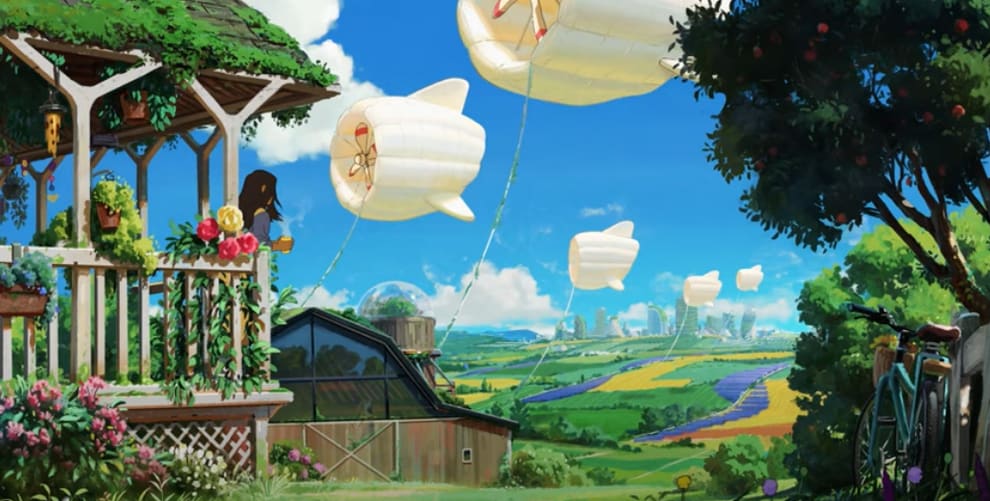
Example of solarpunk aesthetic (to be clear: I think the best futures
are way more future-y than this)
Maybe, on reflection, we'll find that various more radical changes are
sufficiently better that it's worth letting go of various more
green-like impulses—and if so, we shouldn't let conservatism hold us
back. Indeed, my own best
guess
is that a lot of the value lies, ultimately, in this direction, and that
the wrong sort of green could lead us catastrophically astray. But I
think these more green-like visions of the future actually provide a
good starting point, in connecting with the possible upsides of
Utopia. Whichever direction a good future ultimately grows, its roots
will have been in our present loves and joys—and many of these are
green.
Alexander
speaks about the future as a garden. And if a future of nano-bot-onium
is pure yang, pure top-down control, gardens seem an interesting
alternative—a mix of yin and yang; of your work, and God's,
intertwined and harmonized. You seed, and weed, and fertilize. But you
also let-grow; you let the world respond. And you take joy in what
blooms from the dirt.
Next up: Attunement
Ok, those were some comments on "green-according-to-white," which
focuses on obeying the right moral rules in relation to Nature, and
"green-according-black," which focuses on accepting stuff that you're
too weak to change. In each case, I think, the relevant diagnosis
doesn't quite capture the full green-like thing in the vicinity, and
I've tried to do at least somewhat better.
But I haven't yet discussed "green-according-to-blue," which focuses on
making sure we don't act out of inadequate knowledge. This is probably
the most immediately resonant reconstruction of green, for me—and the
one closest to the bit of green I care most about. But again, I think
that blue-like "knowledge," at least in its most standard connotation,
doesn't quite capture the core thing—something I'll call
"attunement." In my next essay, I'll say more about what I mean.
Appendix: Taking guidance from God
This appendix discusses one other way of understanding the sort of
"conservatism" and "respect" characteristic of green—namely, via the
concept of "taking guidance from God." This is a bit of green that I'm
especially hesitant about, and I don't think my discussion nails it down
very well. But I thought I would include some reflections regardless, in
case they end up useful/interesting on their own terms.
Earlier in the series, I suggested that "deep
atheism"
can be seen, fundamentally, as emerging from severing the connection
between Is and Ought, the Real and the Good. Traditional theism
can trust that somehow, the two are intimately linked. But for deep
atheism, they become orthogonal—at least conceptually.[29] Maaayybe
some particular Is is Ought; but only contingently so—and on
priors,
probably not.[30] Hence, indeed, deep atheism's sensitivity to the
so-called "Naturalistic fallacy," which tries to move illicitly from
Is to Ought, from Might in the sense of "strong enough to
exist/persist/get-selected" to Right in the sense of "good enough to
seek guidance from." And naturalistic fallacies are core to deep
atheism's suspicion towards green. Green, the worry goes, seeks too much
input from God.
What's more, I think we can see an aspiration to "not seek input from
God" in various other more specific ethical motifs associated with deep
atheist-y ideologies like effective altruism. Consider, for example, the
distinction between doing and allowing, or between action and
omission.[31] Consequentialism—the ethical approach most directly
associated with Effective Altruism—is famously insensitive to
distinctions like this, at least in theory. And why so? Well, one
intuitive argument is that such distinctions require treating the
"default path"—the world that results if you go fully yin, if you
merely allow or omit, if you "let go and let God"—as importantly
different from a path created by your own yang. And because God
(understood as the beyond-your-yang) sets the "default," ascribing
intrinsic importance to the "default" is already to treat God's choice
as ethically interesting—which, on deep atheism, it isn't.[32]
Worse, though: distinctions like acts vs. omissions and doing vs.
allowing generally function to actively defer to God's choice, by
treating deviation from the "default" as subject to a notably higher
burden of proof. For example, on such distinctions, it is generally
thought much easier to justify letting someone die (for example, by not
donating money; or in-order-to-save-five-more-people) than it is to
justify killing them. But this sort of burden of proof effectively
grants God a greater license-to-kill than it grants to the Self.[33]
Whence such deference to God's hit list?
Or consider another case of not-letting-God-give-input: namely, the
sense in which total utilitarianism treats possible people and actual
people as ethically-on-a-par. Thus, in suitably clean cases, total
utilitarianism will choose to create a new happy person, who will live
for 50 years, rather than to extend an existing happy human's life by
another 40 years. And in combination with total-utilitarianism's
disregard for distinctions like acts vs. omissions, this pattern of
valuation can quickly end up killing existing people in order to
replace them with happier alternatives (this is part of what gives rise
to the paperclipping problems I discussed in "Being nicer than
Clippy").
Here, again, we see a kind of disregard-for-God's-input at work. An
already-existing person is a kind of Is—a piece of the Real; a work
of God.[34] But who cares about God's works? Why not bulldoze them and
build something more optimal instead? Perhaps actual people have more
power than possible people, due to already existing, which tends to
be helpful from a power perspective. But a core ethical shtick, here,
is about avoiding might-makes-right; about not taking moral cues from
power alone. And absent might-makes-right, why does the fact that some
actual-person happens to exist make their welfare more important than
that of those other, less-privileged possibilia?
Many
"boundaries,"
in ethics, raise questions of this form. A boundary, typically, involves
some work-of-God, some Is resulting from something other than your own
yang. Maybe it's a fence around a backyard; or a border around a
country; or a skin-bag surrounding some cells—and typically, you
didn't build the fence, or found the country, or create the creature in
question. God did that; Power did that. But from an ethical as opposed
to a practical perspective, why should Power have a say in the matter?
Thus, indeed, the paperclipper's atheism. Sure, OK: God loves the humans
enough to have made-them-out-of-atoms (at least, for now). But Clippy
does not defer to God's love, and wants those atoms for "something
else." And as I discussed earlier in the series: utilitarianism
reasons the
same.
Or as a final example of an opportunity to seek or not-seek God's input,
consider various flavors of what G.A. Cohen calls "small-c
conservatism."
According to Cohen, small-c conservatism is, roughly, an ethical
attitude that wants to conserve existing valuable things—institutions, practices, ways of being, pieces of art—to a degree
that goes above and beyond just wanting valuable things to exist. Here
Cohen gives the example of All Souls
College
at Oxford University, where Cohen was a professor. Given the opportunity
to tear down All Souls and replace it with something better, Cohen
thinks we have at least some (defeasible) reason to decline, stemming
just from the fact that All Souls already exists (and is valuable).[35]
In this respect, small-c conservatism is a kind of ethical status quo
bias—being already-chosen-by-God gives something an ethical leg
up.[36]
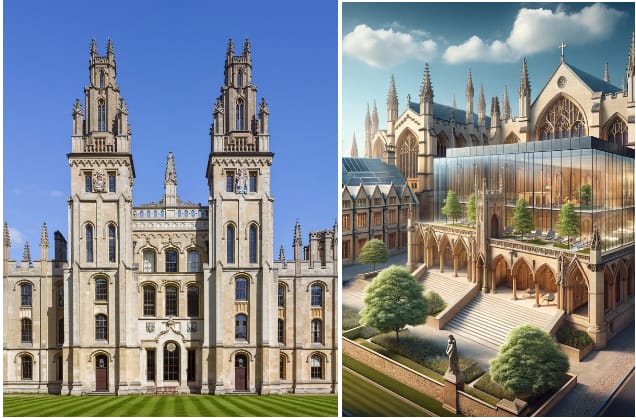
Real All
Souls
on the left, ChatGPT-generated new version on the right. Though in the
actual thought experiment ChatGPT's would be actually-better.
Various forms of environmental conservation, a la the redwoods above,
are reminiscent of small-c conservativism in this sense.[37] Consider,
e.g., the Northern White
Rhino.
Only two left—both female, guarded closely by human caretakers, and
unable to bear children themselves.[38] Why guard them? Sam Anderson
writes about the day the last male, Sudan, died:
We expect extinction to unfold offstage, in the mists of prehistory,
not right in front of our faces, on a specific calendar day. And yet
here it was: March 19, 2018. The men scratched Sudan's rough skin,
said goodbye, made promises, apologized for the sins of humanity.
Finally, the veterinarians euthanized him. For a short time, he
breathed heavily. And then he died.
The men cried. But there was also work to be done. Scientists
extracted what little sperm Sudan had left, packed it in a cooler and
rushed it off to a lab. Right there in his pen, a team removed Sudan's
skin in big sheets. The caretakers boiled his bones in a vat. They
were preparing a gift for the distant future: Someday, Sudan would be
reassembled in a museum, like a dodo or a great auk or a Tyrannosaurus
rex, and children would learn that once there had been a thing called
a northern white rhinoceros.
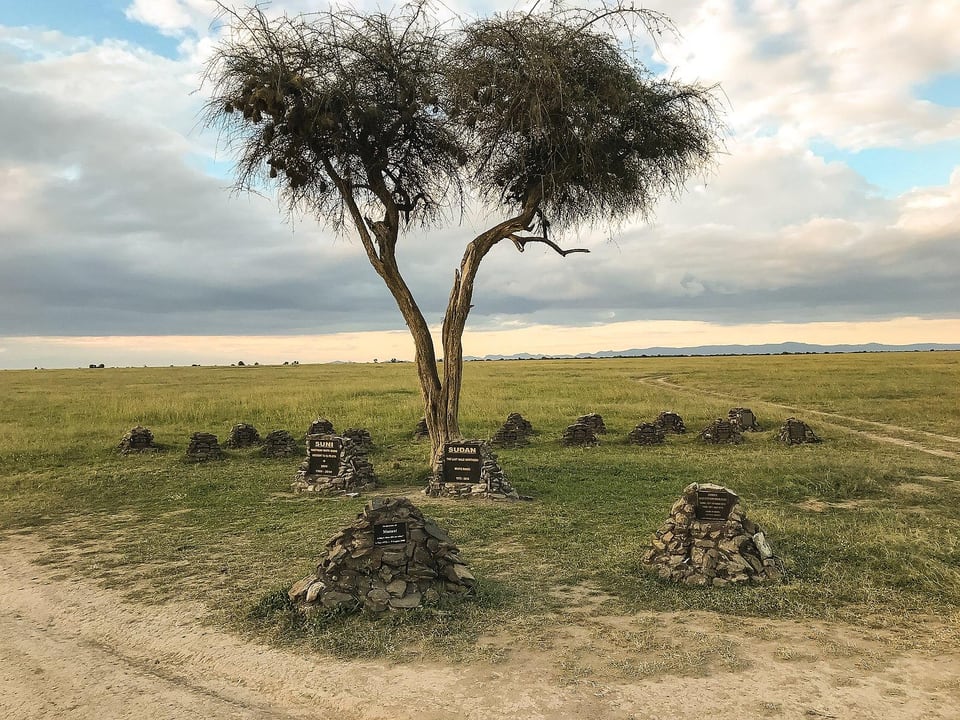
Sudan's grave (Image source
here)
Sudan's death went temporarily viral. And the remaining females are
still their own attraction. People visit the enclosure. People cry for
the species poached-to-extinction. Why the tears? Not, I think, from
maybe-losing-a-vaccine. "At a certain point," writes
Anderson,
"we have to talk about love."
But what sort of love? Not the way the utilitarian loves the utilons.
Not a love that mourns, equally, all the possible species that never got
to exist—the fact that God created the Northern White Rhino in
particular matters, here. No, the love at stake is more like: the way
you love your dog, or your daughter, or your partner in particular. The
way we love our languages and our traditions and our homes. A love that
does more than compare-across-possibilia. A love that takes the
actual, the already, as an input.
Of course, these examples of "taking God's guidance" are all different
and complicated in their own ways. But to my mind, they point at some
hazy axis along which one can try, harder and harder, to isolate the
Ought from the influence of the Is. And this effort culminates in an
attempt to stand, fully, outside of the world—the past, the status
quo—so as to pass judgment on them all from some other, ethereal
footing.
As ever, total utilitarianism—indeed, total-anything-ism—is an
extreme example here. But we see the aesthetic of total utilitarianism's
stance conjured by the oh-so-satisfying discipline of "population
axiology" more
generally—a discipline that attempts to create a function, a heart,
that takes in all possible worlds (the actual world generally goes
unlabeled), and spits out a consistent, transitive ranking of their
goodness.[39] And Yudkowskians often think of their own hearts, and the
hearts of the other player characters (e.g., the AIs-that-matter), on a
similar model. Theirs isn't, necessarily, a ranking of impartial
goodness; rather, it's a ranking of how-much-I-prefer-it,
utility-according-to-me. But it applies to similar objects (e.g.,
possible "universe-histories"); it's supposed to have similar structural
properties (e.g., transitivity, completeness, etc); and it is generated,
most naturally, from a similar stance-beyond-the-world—a stance that
treats you as a judge and a creator of worlds; and not, centrally,
as a resident.[40] Indeed, from this stance, you can see all; you can
compare, and choose, between anything.[41] All-knowing, all-powerful—it's a stance associated, most centrally, with God himself. Your heart,
that is, is the "if I was God" part. No wonder, then, if it doesn't seek
the real God's advice.[42]
But green-like respect, I think, often does seek God's advice. And
more generally, I think, green's ethical motion feels less like ranking
all possible worlds from some ethereal stance-beyond, and then getting
inserted into the world to move it up-the-ranking; and more like:
lifting its head, looking around, and trying to understand and respond
to what it sees.[43] After all: how did you learn, actually, what sorts
of worlds you wanted? Centrally: by looking around the place where you
are.
That said, not all of the examples of "taking God's guidance" just
listed are especially paradigmatic of green. For example, green doesn't,
I think, tend to have especially worked-out takes about population
ethics. And I, at least, am not saying we should take God's input, in
all these cases; and still less, to a particular degree. For example, as
I've written about previously: I'm not, actually, a big fan of attempts
to construe the acts vs. omission
distinction
in matters-intrinsically (as opposed to matters-pragmatically) terms; I
care a lot about possible
people
in addition to actual people; and I think an adequate ethic of
"boundaries"
has to move way, way beyond "God created this boundary, therefore it
binds."[44]
Nor is God's "input," in any of these cases, especially clear cut. For
one thing, God himself doesn't seem especially interested in preventing
the extinction of the species he
creates.
And if you're looking for his input re: how to relate to boundaries, you
could just as easily draw much bloodier lessons—the sort of lessons
that predators and parasites teach. Indeed, does all of eukaryotic life
descend from the "enslavement" of
bacteria
as mitochondria?[45] Or see e.g. this inspiring
video (live
version
here) about
"slave-making
ants," who
raid the colonies of another ant species, capture the baby pupae, and
then raise them as laborers in a foreign nest (while also, of course,
eating a
few
along the way). As ever: God is not, actually, a good example; and his
Nature brims with original sin.
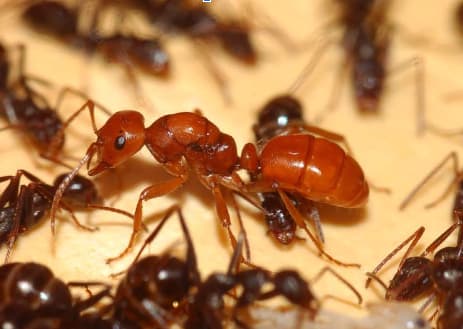
Queen "slave-maker" (image source
here)
Indeed, in some sense, trying to take "guidance from God" seems
questionably coherent in the context of your own status as a part of God
yourself. That is, if God—as I am using/stretching the term—is
just "the Real," then anything you actually do will also have been
done-by-God, too, and so will have become His Will. Maybe God chose to
create All Souls College; but apparently, if you choose to tear it down,
God will have chosen to uncreate it as well. And if your justification for respecting some ancient redwood was that “it’s such a survivor”—well, if you chop it up for lumber, apparently not. And similarly: why not say that you are
resisting God, in protecting the Northern White Rhino? The
conservation is sure taking a lot of yang...
And it's here, as ever, that naturalistic fallacies really start to
bite. The problem isn't, really, that Nature's guidance is bad—that
Nature tells you to enslave and predate and get-your-claws-bloody.
Rather, the real problem is that Nature doesn't, actually, give any
guidance at all. Too much stuff is Nature. Styrofoam and
lumber-cutting and those oh-so-naughty sex acts—anything is Nature,
if you make it real. And choices are, traditionally, between
things-you-can-make-real. So Nature, in its most general conception,
seems ill-suited to guiding any genuine choice.
So overall, to the extent green-like respect does tend to "take God's
guidance," then at least if we construe the argument for doing so at a
sufficiently abstract level, this seems to me like one of the diciest
parts of green (though to be clear, I'm happy to debate the specific
ethical issues, on their own merits, case-by-case). And I think it's
liable, as well, to conflating the sort of respect worth directing at
power per se (e.g., in the context of game theory, real politik, etc),
with the sort of respect worth directing at legitimate power; power
fused with justice and fairness (even if not, with "my-values-per-se").
I'm hoping to write more about this at some point (though probably not
in this series).
That said, to the extent that deep atheism takes the general
naturalistic fallacy—that is, the rejection of any move from "is" to
"ought"—as some kind of trump-card objection to "taking guidance from
God," and thus to green, I do want to give at least one other note in
green's defense: namely, that insofar as it wishes to have any ethics at
all, many forms of deep atheism need to grapple with some version of the
general naturalistic fallacy as well.
In particular: deep atheists are ultimately naturalists. That is, they
think that Nature is, in some sense, the whole deal. And in the context
of such a metaphysics, a straightforward application of the most general
naturalistic fallacy seems to leave the "ought" with nowhere to, like,
attach. Anything real is an "is"—so where does the "ought" come
from? Moral realists love (and fear) this question—it's their own
trump card, and their own existential anxiety. Indeed, along this
dimension, at least, the moral realists are even more non-green than the
Yudkowskians. For unlike the moral realists, who attempt
(unsuccessfully) to untether their ethics from Nature entirely, the
Yudkowskians, ultimately, need to find some ethical foothold within
Nature; some bit of God that they do take guidance from. I've been
calling this bit your "true self," or your "heart"—but from a
metaphysical perspective, it's still God, still Nature, and so still
equally subject to whatever demand-for-justification the conceptual gap
between is and ought seems to create.[46] Indeed, especially
insofar as straw-Yudkowskian-ism seems to assume, specifically, that its
true heart is closely related to what it "resonates with" (whether
emotionally or mentally), those worried about naturalistic fallacies
should be feeling quite ready to ask, with Lewis: why that? Why trust
"resonance," ethically? If God made your resonances, aren't you, for all
your atheism, taking his guidance?[47]
Indeed, for all of the aesthetic trappings of high-modernist science
that straw-Yudkowskianism draws on, its ethical vibe often ends up
strangely Aristotelian and teleological. You may not be trying to act in
line with Nature as a whole. But you are trying to act in line with
your (idealized) Nature; to find and live the self that, in some
sense, you are "supposed to" be; the true tree, hidden in the acorn. But
it's tempting to wonder: what kind of naturalistic-fallacy bullshit is
that? Come now: you don't have a Nature, or a Real Self, or a True Name.
You are a blurry jumble of empirical patterns coughed into the world by
a dead-eyed universe. No platonic form structures and judges you from
beyond the world—or least, none with any kind of intrinsic or
privileged authority. And the haphazard teleology we inherit from
evolution is just that. You who seek your true heart—what, really,
are you seeking? And what are you expecting to find?
I've written, elsewhere, about my
answer—and I'll say a bit more in my next essay, "On attunement," as well.
Here, the thing I want to note is just that once you see that
(non-nihilist) deep atheists have naturalistic-fallacy problems, too,
one might become less inclined to immediately jump on green for running
into these problems as well. Of course, green often runs into much more
specific naturalistic-fallacy problems, too—related, not just to
moving from an is to an ought in general, but to trying to get
"ought" specifically from some conception of what Nature as a whole
"wants." And here, I admit, I have less sympathy. But all of us,
ultimately, are treating some parts of God as to-be-trusted. It's just
that green, often, trusts more.



_British_Museum.jpg)
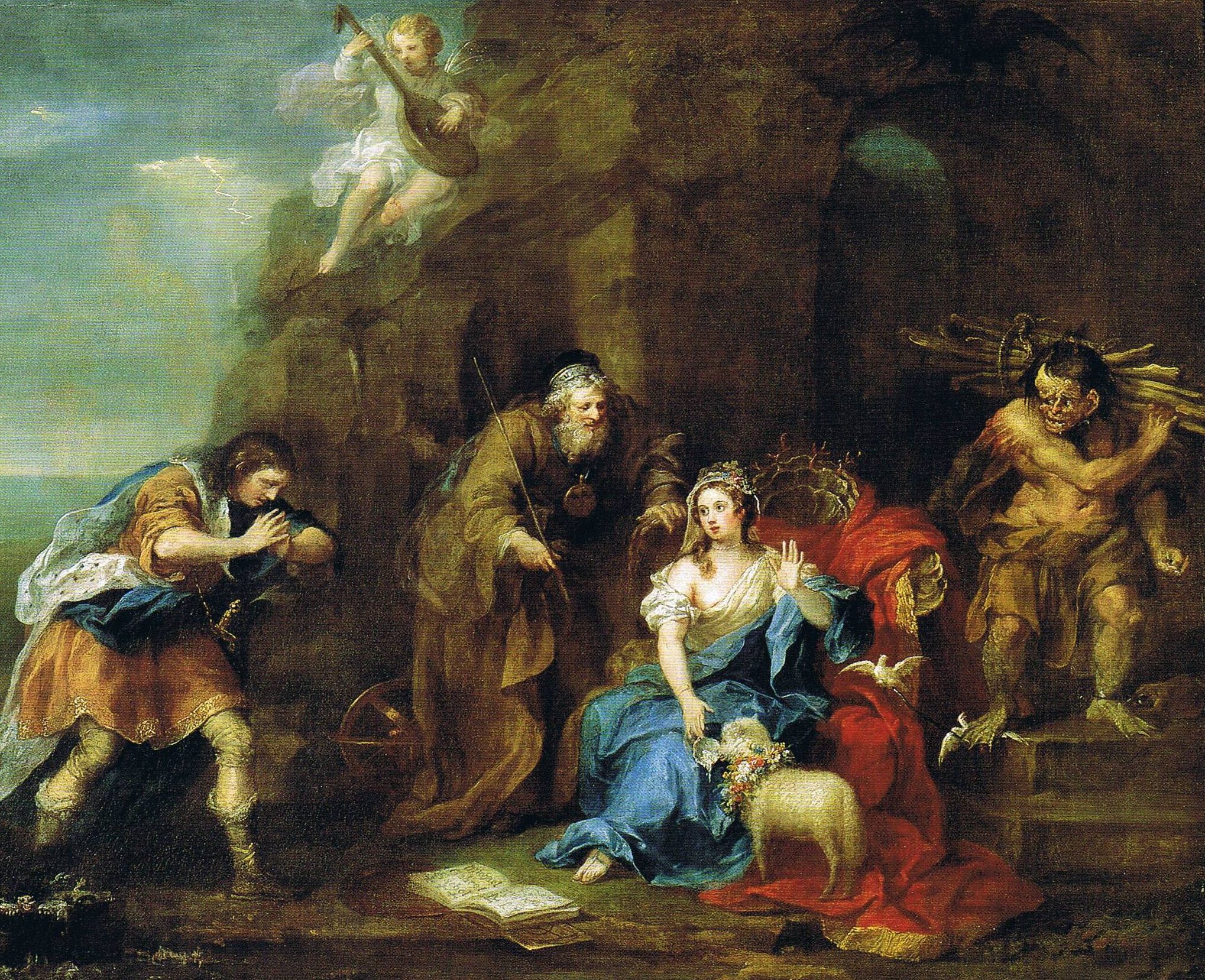


_One_Year_On_(46723597264).jpg)

For evidence-based personality tests, check out The Big Five (OCEAN) or its updated sibling, HEXACO.