I've been thinking about the same problem over the past few months. (Thanks to Brian Tomasik and Vasco Grilo.)
There is one upside to leaving insects out of the picture: people who care only about vertebrates may be more likely to take this problem seriously rather than dismiss it. But on the other hand, excluding invertebrates may make the scale of the problem seem too small to warrant much concern[1]. Many people may simply think "someone else will solve this problem for me" and then forget about it. Also, it's unclear what practical advice for ordinary vegans or reducetarians could draw from your conclusion. It reads more like a high-level political recommendation.
I'm generally slightly in favour of reducing meat consumption because of the potential positive side effects, such as shifting people's values in a more animal-friendly direction. I hope these benefits will outweigh the harm, but the situation is far from satisfactory.
I'm planning to encourage people to offset this harm by supporting wild animal welfare orgs, raising the profile of welfare biology, and so on. But even these efforts will ultimately benefit wild animals only if human values and the activities they motivate turn out to matter in the long run. For example, they might influence the values of an ASI or those of a future civilisation.
Perhaps this way of offsetting would seem satisfactory if one were fully committed to longtermism and maximising expected value. But what if one wants to diversify across different plausible future scenarios in some other way, assigning significant weight to short-term outcomes? If humanity goes extinct soon without creating any aligned successors, this would mean that there would be no long-term gains from influencing people's values, whereas the consequences of people's food choices would still matter. In such scenarios, the harm to wild animals would not be offset without some additional efforts.
So perhaps it's also worth considering short-term ways of improving the situation, such as increasing the amount of land used by humans. These could, in turn, have other negative side effects. For example, what if increasing the human population also accelerates the race towards ASI (which seems to pose a risk of suffering - be it aligned or rogue) or others-risky outcomes? But perhaps there are ways to increase land use without significantly affecting the human population. In particular, do some forms of agriculture use substantially more land than others?
I care primarily about intense suffering. Even if the probability of invertebrates experiencing intense suffering is very low, their enormous numbers could still make this problem very important. And even if one doesn't fully accept the expected utility framework, I don't think that simply assigning zero weight to invertebrates is a good alternative. ↩︎
I've been thinking about the same problem over the past few months. (Thanks to Brian Tomasik and Vasco Grilo.)
Thanks for linking these posts too. You may find interesting my reply to Stijn's post.
I'm generally slightly in favour of reducing meat consumption because of the potential positive side effects, such as shifting people's values in a more animal-friendly direction. I hope these benefits will outweigh the harm, but the situation is far from satisfactory.
Advocating for lower meat consumption based on animal right may encourage wildeness preservation, and the same may apply to advocating for improving the conditions of farmed animals.
The only statistically significant difference we observed between groups shown different meat reduction appeals was quite counterintuitive: participants in the animal cruelty group reported greater “preferences for more habitat” than participants in the environmental group, t(375.5)=3.52, p=0.0005.
I am sceptical that advocating for lower meat consumption is a cost-effective way of helping wild animals.
Advocating for lower meat consumption based on animal right may encourage wildeness preservation
That's why I prefer animal activists to focus on welfare instead.
Things seem even worse with environment-based arguments, both in the long term and in the short term.
the same may apply to advocating for improving the conditions of farmed animals.
Sounds scary, but I guess it's possible to address this problem to some degree. Also, I expect that even if people supporting farmed animal welfare disagree with those advocating for wild animal welfare at some point, they are still more likely than environmentalists/conservationists to be persuaded to care about WAS at some point later.
I am sceptical that advocating for lower meat consumption is a cost-effective way of helping wild animals.
I'm more interested in combined approaches and in encouraging people who are already interested in reducing meat consumption to care about wild animals too. In particular, I'm thinking about raising awareness of the problem discussed in this post and suggesting ways to offset the harm. (Right now, I'm working on a website on reducetarianism and other animal-related topics where I'm trying to address this.)
Just wanted to note it might be helpful to clearly state the assumption at the start of the piece that Wild animals have a negative welfare, which you kind of state a bit later. A minority of people such as myself believe that wild animals have welfare not around zero or negative, but actuallyhave positive welfare, so I think its worth at least recognising that uncertainty.
"Those wild animals my have a welfare around zero (according to the abovementioned survey), but they may also have a negative welfare (according to many experts)."
Also I believe this statement is straightforwardly flawed... "Most wild animals die prematurely, which can indicate that they have a negative welfare overall." How early you die can have little to do with if your life is positive or negative. A shorter life could be positive, negative or neutral. Even from a utilitarian perspective we don't save kids because their short lives are net-negative, we save them to extend a positive life.
Consider for example a country like Afghanistan, where less than 1 in 10 children die, and people have on average a well-being of 1,4 on the Cantril scale from 0 to 10, which is lower than the neutral point of 2,5. In contrast, in nature, more than 9 out of 10 juveniles die prematurely. If welfare negatively correlates with premature death rate, wild animals most likely have negative welfare on average.
What is your opinion about such argument? Why do you believe wild animals have a positive welfare?
Often its just worth considering that EA Wild Animal folks are massively skewed in their moral weights for suffering often to basically weighting positive experiences at near zero. AIM has some data comparing Excruciating pain to Annoying between community surveys and the literature. For the literature showing trade off people would make the ratio is more like 1 : 30 while the comunity survey is 1 : 4.5 million and Anima international folks are even more skewed at 1 : 200 million. So much of the discussion is coming from a group with very different prefences to the general population. And we don't even know what non-humans would say about this!
At 1 : 30 and a death by predation of a minute even a relatively short life can look overall worth living, at 1 :200 million for the same death even a life of 300 years looks net negative.
So a normal trade offs of pain severity, positive experiences and other goods freedom may go to explain the assocation between animal rights and pro-rewilding
AIM has some data comparing Excruciating pain to Annoying between community surveys and the literature. For the literature showing trade off people would make the ratio is more like 1 : 30
Here is a discussion of AIM's pain intensities. None of the studies reviewed by AIM analysed excruciating pain as defined by the Welfare Footprint Institute (WFI).
If annoying pain was 30 times as intense as excruciating pain, 1 min of “severe burning in large areas of the body, dismemberment, or extreme torture” (excruciating pain) would be as bad as 30 min of "A mild discomfort that slightly distracts but does not impair normal functioning" (annoying pain). Excruciating pain in humans would “mark the threshold of Pain under which many people choose to take their lives rather than endure the Pain”. I doubt this would happen if people were indifferent between 1 min of excruciating pain and 30 min of annoying pain. In this pain, “Performance of cognitive tasks demanding attention are either not affected or only mildly affected”.
I feel like I am roughly indifferent between 0.864 s of excruciating pain and 10 d of annoying pain. So I guess excruciating pain is 1 M (= 10*24*60^2/0.864) times as intense as annoying pain.
At the same time, I have practically no idea about whether I would like more or fewer wild invertebrates. I prefer describing my views in these terms instead of saying I have practically no idea about whether wild invertebrates have positive or negative lives, which is much more vague.
Most wild animals die prematurely, which can indicate that they have a negative welfare overall.[1] Hence, by freeing up agricultural land, vegans cause harm (to wild animals).
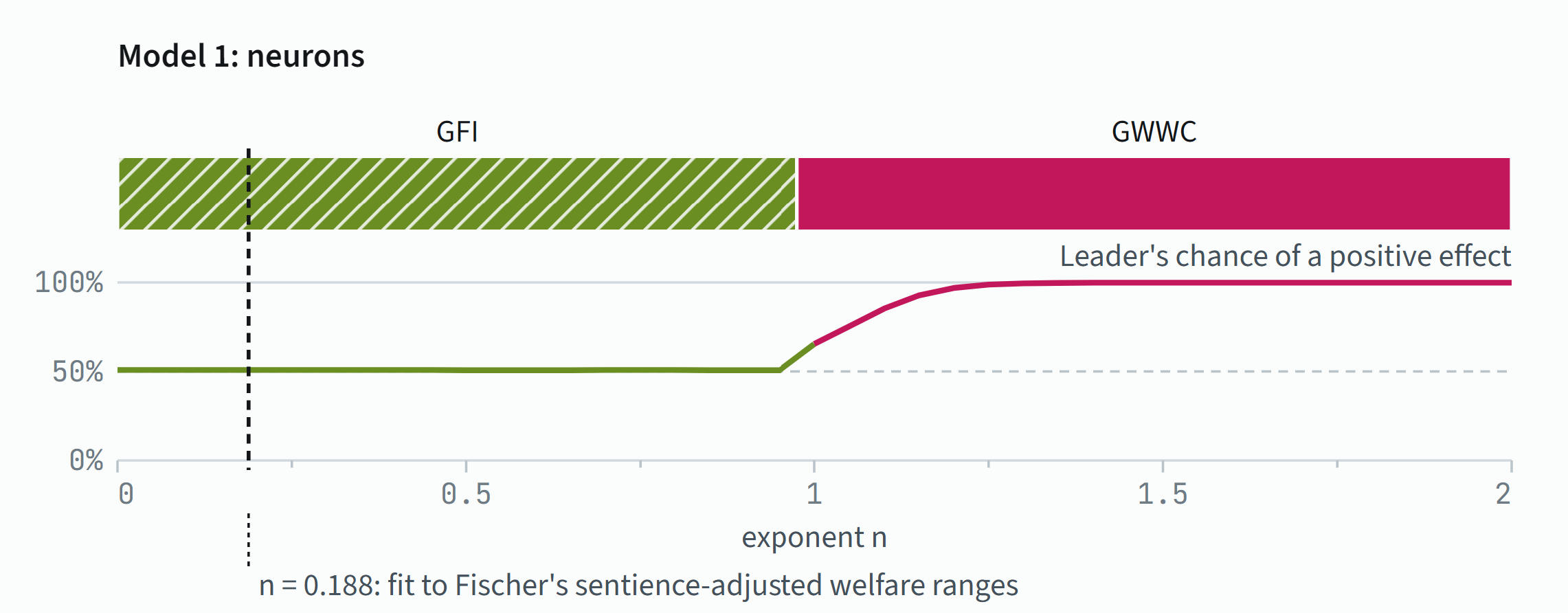
I think it is very unclear whether decreasing agricultural land increases or decreases the welfare/suffering/happiness of soil invertebrates. For moral weight proportional to "individual number of neurons"^n, and n from 0 to 0.95, I estimate the Good Food Institute (GFI), which decreases agricultural land, increases animal welfare with a probability of 50.7 % to 50.8 %.
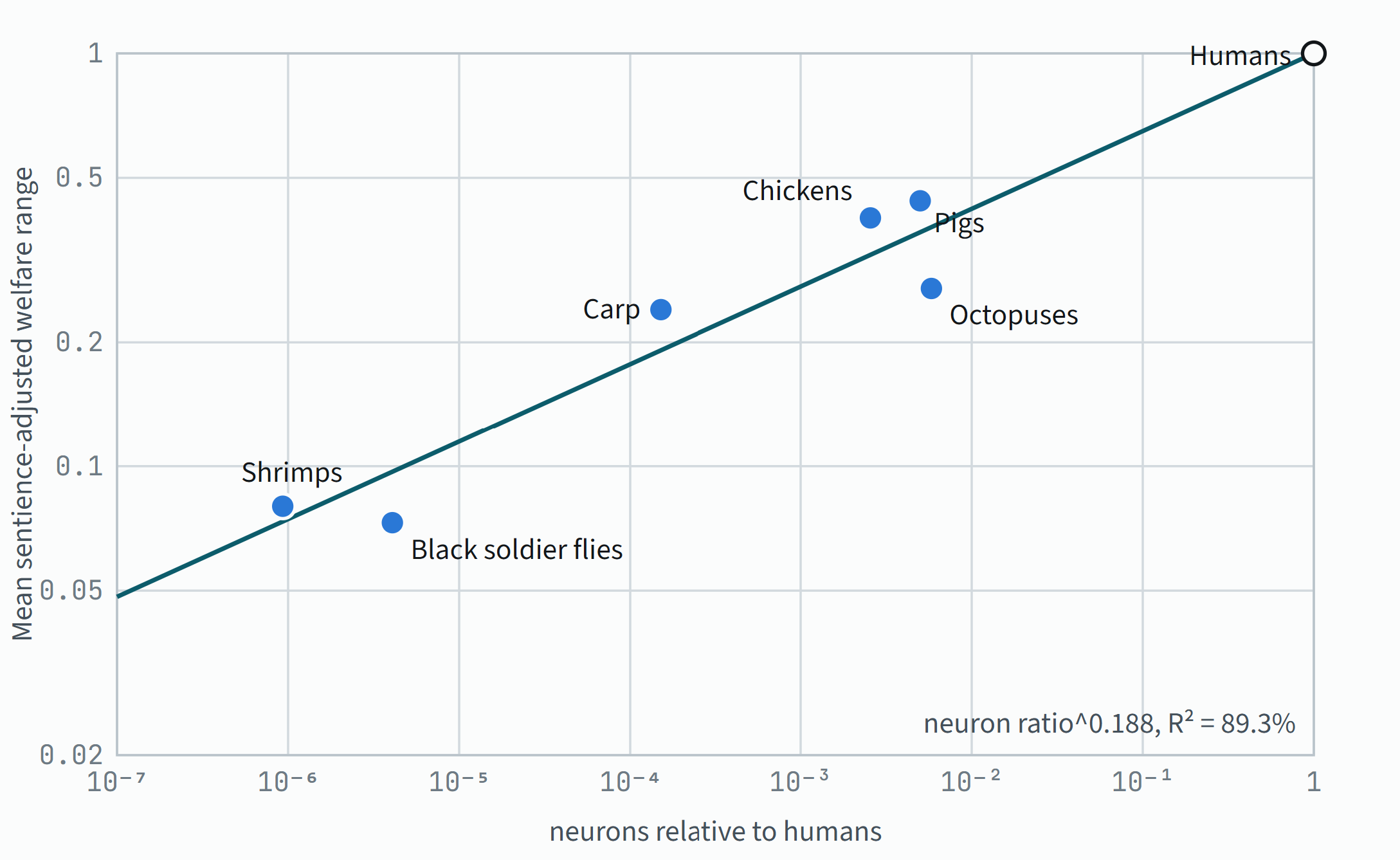
For n = 0.188, the log of moral weight explains 89.3% of the variance of the log of the mean sentience-adjusted welfare ranges in Bob Fischer's book about comparing animal welfare across species (see the regression below).
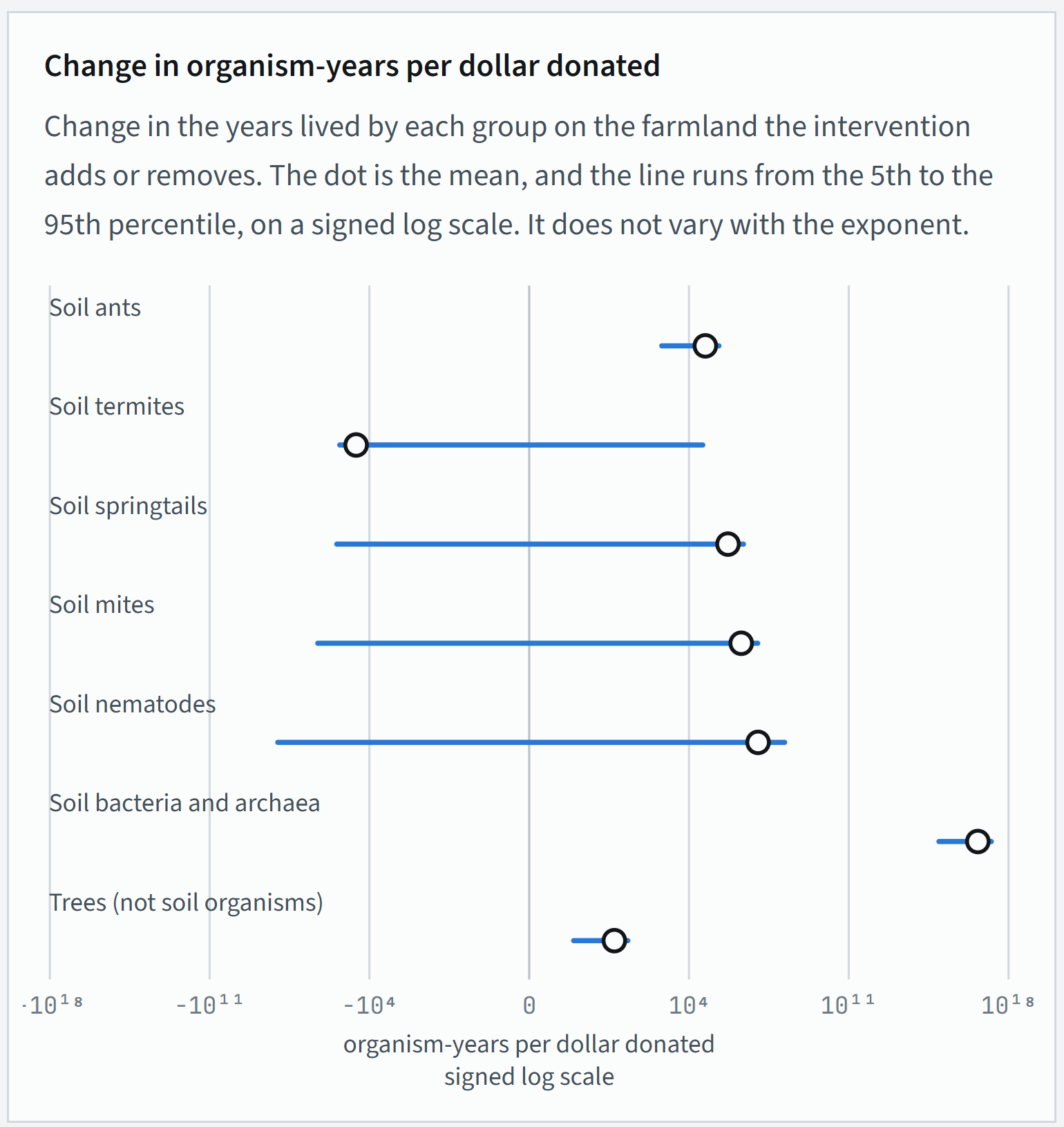
It is also unclear to me whether decreasing agricultural land increases or decreases the population of soil invertebrates. Below are my estimates for the change in organism-years per $ donated to GFI. The population of soil ants, and bacteria and archaea, and trees increases, but it is unclear to me whether the population of soil termites, springtails, mites, and nematodes increases or decreases.
We as a society don’t cause harm or benefit by leaving nature alone. We as a society cause harm by raising other animals and then inflicting pain, confinement and death.
What about creating nature (by turning agricultural land into wildlife habitat), and then leaving that nature alone? If the animals in that nature suffer, and they wouldn't have existed and hence wouldn't have suffered if we didn't create that nature, aren't we causing harm to those animals?
I definitely agree that not causing harm is paramount, however I don't believe preventing harm or increasing wellbeing beyond that is not something that we shouldn't do. I wonder whether we truly can leave nature alone, given the global impact human populations have and how strongly human inhabitation are shaping natural habitats. Should we manage forest fires, spead of pandemics in wild animals or actively attempt to balance ecosystems to e.g. preserve species/reduce invasive species? In my view there are compelling arguments for that.
As the production of animal protein is less efficient than plant-based protein, vegans use less agricultural land than omnivores. If everyone went vegan, a land area almost the size of the North and South American continent is no longer needed for agriculture. If this agricultural land is turned back into natural habitats such as forests, a huge number of extra wild animals will be born. But there is a lot of wild animal suffering from hunger, disease, predation, parasitism, injuries, fires, cold,… Most wild animals die prematurely, which can indicate that they have a negative welfare overall.[1] Hence, by freeing up agricultural land, vegans cause harm (to wild animals). How much harm is cause by adopting a vegan diet, and how can vegans mitigate this harm?
First, how much agricultural land is used by an average omnivore and an average vegan (based on average western data)? The table below shows the hectares of land used by one person. (All data are obtained by Gemini.) An omnivore uses three times as much agricultural land as a vegan, mostly due to the extra grazing land.
Hectare land use per person (ha/capita)
Cropland
Grazing Land
Total
Omnivore
0,11
0,14
0,25
Vegan
0,08
0
0,08
The 0,11 hectare cropland used by an omnivore is used to produce feed crops for farmed animals. Roughly one third of the feed-cropland is used to feed chickens (broiler and laying hens), a quarter to feed cows.
Share of global feed-cropland
Poultry, broiler
23%
Poultry, laying hens
12%
Pigs
40%
Cattle
25%
An hectare of cropland can produce enough food to feed roughly 2000 broiler chickens, 30 pigs and 3 cows per year. An hectare of grazing land can sustain roughly one cow per year.
Births of farmed vertebrate land animals per hectare farmland per year
N/ha/yr
Broiler chicken
2000
Laying hens
200
Pigs
30
Cows, only feed crops
3
Cows, only pasture fed
1
Next to the farmed animals, we also have to consider the wild animals. In a forest or grazing land without large grazers, more than 2000 wild vertebrate animals (mammals, birds, amphibians, reptiles) can be born per hectare per year. That is five times higher than on cropland.
Births of wild vertebrate animals per hectare per year
N/ha/yr
Forest, grazing land without large grazers
2500
Grazing land with large grazers
1500
Cropland
500
With the above data, we can calculate the number of vertebrate land animals that are born each year and whose birth is determined by the food choice of one human.
Born vertebrate land animals per year per person (N/yr/cap)
Farmed animals
Wild animals
Total
Omnivore
55
265
320
Vegan + forests
465
465
Vegan + grazing land with large grazers
295
295
An average omnivore, eating an average western omnivorous diet, causes the birth of 55 farmed animals. Those farmed animals mostly have a negative welfare as intense as the positive welfare of a human, according to a survey of people in Belgium. Next to the farmed animals, on the cropland and grazing land indirectly used by the omnivore, 265 wild vertebrate animals are born each year. Those wild animals my have a welfare around zero (according to the abovementioned survey), but they may also have a negative welfare (according to many experts).
A vegan does not cause the birth of farmed animals, but if the freed up agricultural land is turned into forest, 465 wild vertebrate animals are born each year in that forest. In other words: the choice of the vegan to let the agricultural land be turned into forest land, causes 200 extra births of wild animals each year.
In total, an omnivore brings about the birth of 320 vertebrate animals per year, on the land area used for livestock agriculture, whereas a vegan brings about the birth of 465 animals per year on the same land area. If wild animals have zero welfare on average, the vegan doesn’t cause animal harms: the vegan doesn’t cause the existence of animals with a negative welfare, whereas the omnivore causes the existence of a few dozen farmed animals with a negative welfare. However, if the wild animals have a negative welfare as intense as the negative welfare of farmed animals, the vegan causes 45% more animal suffering than the omnivore.
How can the vegan mitigate this harm caused to wild animals? By choosing for ecosystems that have the lowest wild animal birth and mortality rates, i.e. natural habitat where animals have higher average life spans and lower fertility rates. These can be grasslands with large herbivores such as horses. On grazing land with large herbivores, fewer wild vertebrate animals are born than in forests. Wildlife fertility control might be an additional measure to decrease the fertility rates of small, highly reproductive animals. If the freed up agricultural land is turned into grassland with wild roaming horses and donkeys, the vegan brings about the birth of 295 wild animals on that grassland. If these wild animals would have a negative welfare equal to the welfare of farmed animals, the vegan would still cause the existence of fewer negative-welfare animals than the omnivore. Hence, the vegan causes less animal harm than the omnivore.
This also sheds a new light on the “What about crop deaths?” argument against veganism. Vegan agriculture kills wild animals on cropland. But if those wild animals have neutral or negative welfare (i.e. with lives not worth living), their deaths are neutral or good, as their deaths decrease the populations of wild animals with neutral or negative welfare.
Note: for simplicity, invertebrates are not considered: assume invertebrate animals have zero welfare on average.
Conclusion: vegans might cause the existence of more animals with a negative welfare than omnivores. To mitigate this harm caused to wild animals by vegans, vegans should make sure that the freed up agricultural land is turned into grassland with large herbivores (or more generally: natural habitat with animals that have the lowest fertility rates), and promote wildlife fertility control to reduce populations of small, highly reproductive animals.
[1] Consider for example a country like Afghanistan, where less than 1 in 10 children die, and people have on average a well-being of 1,4 on the Cantril scale from 0 to 10, which is lower than the neutral point of 2,5. In contrast, in nature, more than 9 out of 10 juveniles die prematurely. If welfare negatively correlates with premature death rate, wild animals most likely have negative welfare on average.
Edit: The match seems to now be over - the funds were expended in around 35 minutes. But many of these charities are great and should be supported regardless!
***
On October 22nd starting at 10:00am Pacific Time, Every.org is matching donations to select animal welfare organizations at a 2:1 rate, up to $2,000 per donor per nonprofit (so if you give up to $2,000, they will contribute up to $4,000 and the nonprofit will get up to $6,000). The first donation a donor makes to each el...
Crossposted to Less Wrong
‘Like most of life’s dangers, the dangers of artificial intelligence are not easily identified from the armchair.’
J Dmitri Gallow
Epistemic status
I’m not an expert in this field, and herein I make some sweeping generalisations educated guesses about the overall...

I've been thinking about the same problem over the past few months. (Thanks to Brian Tomasik and Vasco Grilo.)
There is one upside to leaving insects out of the picture: people who care only about vertebrates may be more likely to take this problem seriously rather than dismiss it. But on the other hand, excluding invertebrates may make the scale of the problem seem too small to warrant much concern[1]. Many people may simply think "someone else will solve this problem for me" and then forget about it. Also, it's unclear what practical advice for ordinary vegans or reducetarians could draw from your conclusion. It reads more like a high-level political recommendation.
I'm generally slightly in favour of reducing meat consumption because of the potential positive side effects, such as shifting people's values in a more animal-friendly direction. I hope these benefits will outweigh the harm, but the situation is far from satisfactory.
I'm planning to encourage people to offset this harm by supporting wild animal welfare orgs, raising the profile of welfare biology, and so on. But even these efforts will ultimately benefit wild animals only if human values and the activities they motivate turn out to matter in the long run. For example, they might influence the values of an ASI or those of a future civilisation.
Perhaps this way of offsetting would seem satisfactory if one were fully committed to longtermism and maximising expected value. But what if one wants to diversify across different plausible future scenarios in some other way, assigning significant weight to short-term outcomes? If humanity goes extinct soon without creating any aligned successors, this would mean that there would be no long-term gains from influencing people's values, whereas the consequences of people's food choices would still matter. In such scenarios, the harm to wild animals would not be offset without some additional efforts.
So perhaps it's also worth considering short-term ways of improving the situation, such as increasing the amount of land used by humans. These could, in turn, have other negative side effects. For example, what if increasing the human population also accelerates the race towards ASI (which seems to pose a risk of suffering - be it aligned or rogue) or other s-risky outcomes? But perhaps there are ways to increase land use without significantly affecting the human population. In particular, do some forms of agriculture use substantially more land than others?
I care primarily about intense suffering. Even if the probability of invertebrates experiencing intense suffering is very low, their enormous numbers could still make this problem very important. And even if one doesn't fully accept the expected utility framework, I don't think that simply assigning zero weight to invertebrates is a good alternative. ↩︎
Hello K. Kirdan.
Thanks for linking these posts too. You may find interesting my reply to Stijn's post.
Advocating for lower meat consumption based on animal right may encourage wildeness preservation, and the same may apply to advocating for improving the conditions of farmed animals.
I am sceptical that advocating for lower meat consumption is a cost-effective way of helping wild animals.
Thanks Vasco.
That's why I prefer animal activists to focus on welfare instead.
Things seem even worse with environment-based arguments, both in the long term and in the short term.
Sounds scary, but I guess it's possible to address this problem to some degree. Also, I expect that even if people supporting farmed animal welfare disagree with those advocating for wild animal welfare at some point, they are still more likely than environmentalists/conservationists to be persuaded to care about WAS at some point later.
I'm more interested in combined approaches and in encouraging people who are already interested in reducing meat consumption to care about wild animals too. In particular, I'm thinking about raising awareness of the problem discussed in this post and suggesting ways to offset the harm. (Right now, I'm working on a website on reducetarianism and other animal-related topics where I'm trying to address this.)