Comments
I was really confused by your post because it seemed to ask for normative rules about not talking about philanthropy and grants to EA causes, which doesn't seem reasonable.
Now, after reading your comments, I think what you meant is closer to:
“It seems unworkably hard to talk about grants in the new cause areas. What do we do?”
I’m still not sure if this is what you want, but since no one has really answered, I want to try to give thoughts that might serve your purposes.
From your comment:
We consider AI Safety to be very important
A trusted advisor is excited
Everything checks out at the operational level
As far as I can tell, these are not the kinds of issue we are (or should be) discussing on EA Forum
I don't understand the statement this "these are not the kinds of issue we are (or should be) discussing".
To be specific:
We consider AI Safety to be very important
This is a cause area question and this seems totally up for discussion.
For example, someone could criticize a cause area by pointing to a substantial period of time, like 3 or 5 years where progress in a cause area is low or stagnant, or that experts say this, or that it is plausibly funded or solved.
(This seems possible but very difficult this is because of the moral and epistemic uncertainty but also because cause areas are not non-zero sum games.)
On the positive side, people can post new cause areas and discuss why they are important.
This seems much more productive, and there may even be strong demand for this.
It seems unlikely that an EA forum discussion alone will establish a new cause area but such a discussion seems like an extremely valuable use of the forum.
A trusted advisor is excited
It seems reasonable to say that existing advisors are low in value or that new advisors can be added. This can be done diplomatically:
- "EA has really benefited from increase in Longtermism community, I wonder if the pool in Open Phil’s advisors has been expanded to match?"
- "Here are a list of experts who are consistently highly valued by the community. Has Open Phil considered adding them as advisors?"
- "I see that person A was an advisor for this grant. I understand Person B who is also an expert has these beliefs that [plausible for these reasons] that seems to suggest different views for this intervention."
Everything checks out at the operational level (“application prototyping, testing, basic organizational set-up, and public talks at Stanford and USC”)
It seems easy to unduly pick holes in new orgs, but there are situations where things are very defective and the outlook is bad, and it’s very reasonable to point this out, again diplomatically:
- “I think this org had several CEOs over a 2 year period. This is different from what I've seen in other EA orgs and clarification about [issues with tangible output] is useful.
- “I heard the founder talk at Stanford. During the talk, person A pointed out that X and Y were true. I think person A is an expert and their concerns weren't addressed. Here is a summary of them...”
(Note that I think I have examples of most of the above that actually occurred. I don't think it's that productive or becoming to link them all.)
In the above, I tried to focus on criticism, because that is harder.
I think your post might be asking for more positive ways to communicate meta issues—this seems sort of easy (?).
To be clear, you say:
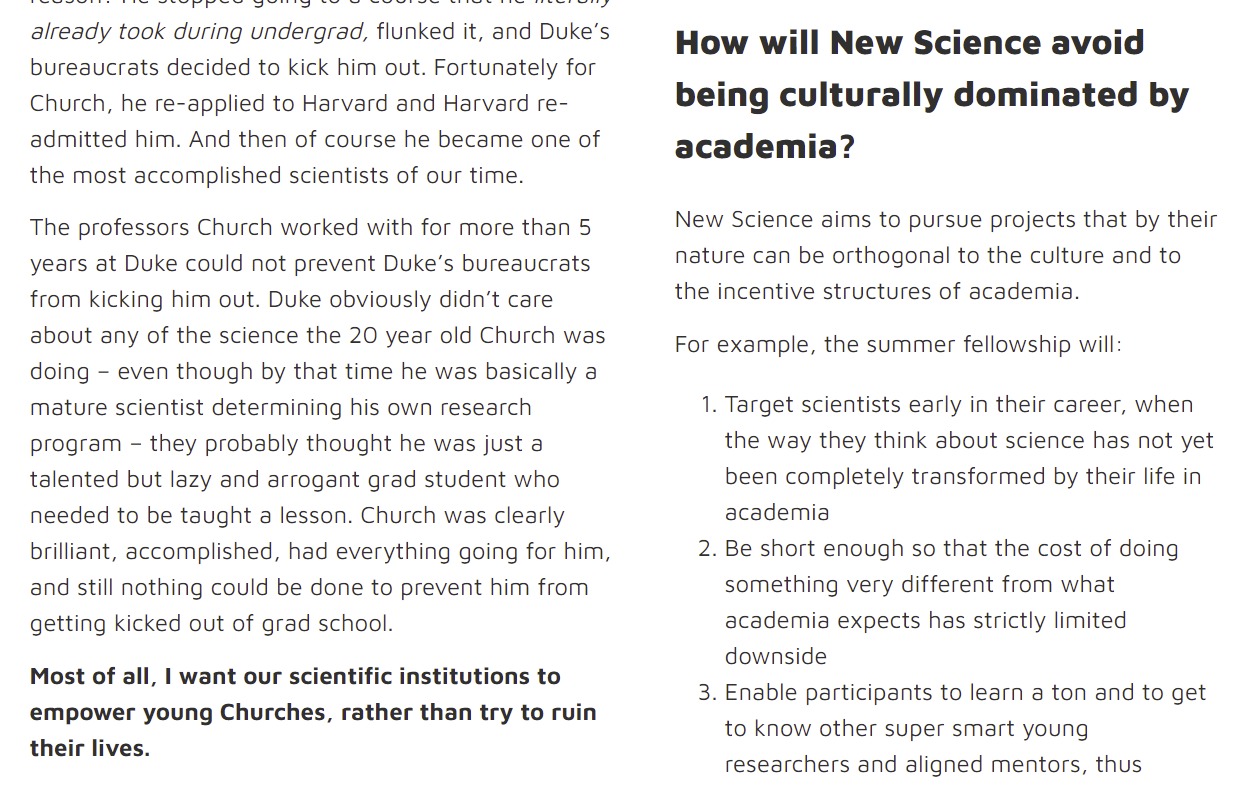
I could be wrong, but it's hard to imagine endorsing a norm where many top EA Forum posts are of the form "I talked to Alexey Guzey from New Science, it seems exciting" or worse "I talked to Adam Marblestone about New Science, and he seems excited about it".
But it's not totally clear to me which of these are both useful and appropriate. For example, I could write a post on whether or not the constructivist view of science is correct (FWIW I don't believe Alexey actually holds this view), but it's not clear that the discussion would have any bearing on the grant-worthiness of New Science.
I think a red herring is that in the “Case for the grant”, the wording is very terse. But I don't think this terseness is a norm outside of grant descriptions, or necessarily the only way to talk or signal the value of organizations.
For example, a post, a few pages long, with a perspective about New Science that point out things that are useful and interesting would certainly would be well received (the org does seem extremely interesting!). For example, it can mention tangible projects, researchers and otherwise write truthful narratives that suggest they are attracting and influencing talent or otherwise improving the Life Sciences ecosystem.
I might have more to say but I am worried I still "don't get" your question.

I just want to note that I think this question is great and does not misrepresent the actual state of affairs.
I do think there's hope for some quantitative estimates even in the speculative cases; for example Open Phil has mentioned that they are investigating the "value of the last dollar" to serve as a benchmark against which to compare current spending (though to my knowledge they haven't said how they're investigating it).
Ajeya explains it in her 80k interview and the result is:
"this estimate is roughly $200 trillion per world saved, in expectation. So, it’s actually like billions of dollars for some small fraction of the world saved, and dividing that out gets you to $200 trillion per world saved. This is quite good in the scheme of things, because it’s like less than two years’ worth of gross world product. It’s like everyone in the world working together on this one problem for like 18 months, to save the world."