Comments
FWIW it strikes me as odd / surprising to say that e.g. Black African Americans are not Westerners purely by virtue of not being white or mixed race.
FWIW it strikes me as odd / surprising to say that e.g. Black African Americans are not Westerners purely by virtue of not being white or mixed race.
I should also say I'm grateful to you for what is obviously a pretty significant amount of work, done thoughtfully and with measured conclusions.
(also I think there are some links missing from the Recommendations section?)
I also feel somewhat confused too. I agree that e.g., Black African Americans are probably pretty close to the category of "West". At the time, I was thinking about the trade off between including people who are sort of in the middle of West and non-West, and having a clearer demarcation between West vs non-West to reduce noise.
I don't think I have a lot of strong reasons, but I thought the clearer demarcation is more important. If folks disagree about my decision, happy to hear more!
One thing that seems notable to me about these cross-cultural communication/norms issues is how often they are simply a result of ignorance. If I live in a country for several years I'm probably going to learn that people view it as rude to do some things, and I'll see how the Romans do it. But if I am only visiting for a short period of time, I will probably be profoundly ignorant of how people there view various behaviors. If I haven't previously spent time living in, thinking about, or reading about different cultures, I might not even be aware that people have different norms.[1]
Before reading this, I didn't know that it was a norm in Malaysia to not greet people in a elevator or a corridor at an apartment. I almost certainly would be guilty of violating this norm if I were to visit Malaysia.
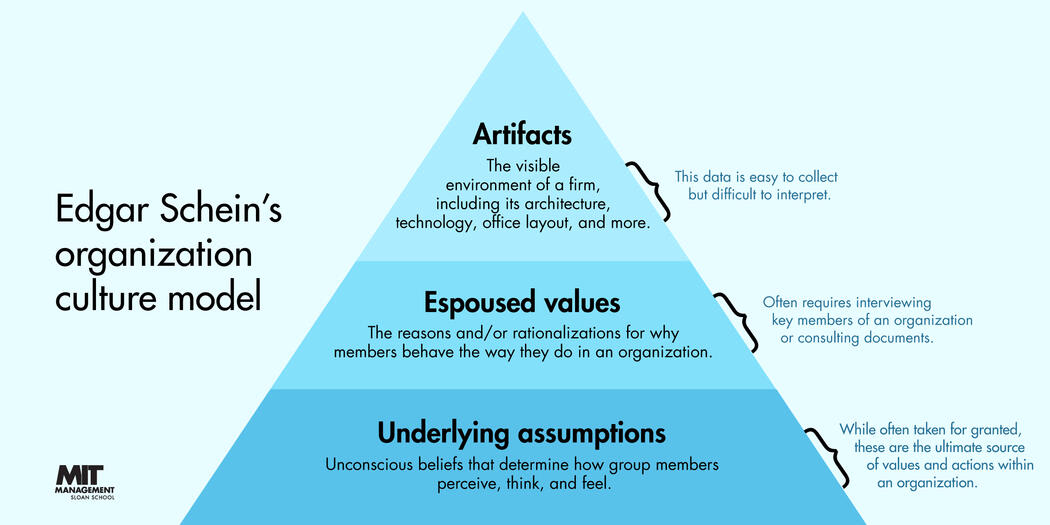
Or at most, I would be aware of relatively obvious artifacts and things that are easy to describe, such as how some cultures tend to take showers in the evening/morning, people eat using forks/chopsticks, greeting a person involves a handshake/hug/kiss/two kisses/three kisses. But it is much harder to describe similar underlying assumptions and values (relationships to parents, happiness with conformity, desire for uniqueness, etc.). I find the Edgar Schein 3-level framework for culture very simple, but useful for starting to think about these things.
Hmm I think you're right! I don't think my advice doesn't seem to be solving this issue.
Perhaps a better advice is to just read more about the norms of the country first? And expect such poor CCIs to happen and allow for space to have meta-conversations around what's appropriate?
I do hope that people learn about behavioral norms before visiting a new place or interacting with people from other places, but it is an unrealistic expectation to expect (for example) for all people joining an event in COUNTRY_A to know about and adapt to COUNTRY_A-style norms of communication and interaction.
Little books of "Learn COUNTRY_A culture and customs while you are on your flight" have existed for decades; the knowledge is generally easily available. But most people simply don't bother (unaware? aware but deprioritizing?). I imagine that if there was an EAGx event in COUNTRY_A and a Google Doc of a few cultural norms to be aware of was shared with attendees in advance, some of the easier and more clear gaffes could be avoided (such as wearing a tank top and shorts in a religious temple, or not offering to pay for a shared meal, or making a comment about a person's weight).
There are some small things we can do to reduce the risk of poor CCIs occurring, but of course we will never reduce the risk all the way to zero. Realistically, I suppose we need to simply accept that some level of poor CCIs will occur.
Edit (2024-07-25): added strength of evidence to each evidence, but want to point out that I wasn't being strategic with my research (e.g., no clear hypothesis, not really doing updating in a Bayesian way, etc).
In this project, I investigated non-Western EAs’ perception of cross-cultural interactions (CCIs) they had with Westerners, specifically:
To do that, I collected an array of evidence from seven sources (e.g., anecdotes from interviews and a focus group, and some statistics from three surveys not done by me). And based on the evidence on CCIs I have collected so far, I believe that poor CCIs are likely to be a common but minor problem for most non-westerners in the EA community.
At the organisational or community level, I would not flag CCI issues as something to be heavily prioritised (moderate confidence), but I would recommend EA-aligned organisations and organisers to start or maintain interventions that are sensible or if the trade-offs are acceptable, like some of the ones listed here by AmAristizabal.
At the individual level, I recommend:
I noticed that I was feeling annoyed in some of my cross-cultural interactions (CCIs) in the EA community, but I couldn’t tell for sure whether these interactions had exclusionary elements in them. These are more subtle, and are not the overt racist behaviours that I’m more familiar with.
Hence, I started this investigation out of a desire to sanity check myself (“Am I misinterpreting things? Or has anyone else experienced the same thing?”). I would also be happy if this project is useful to others too, perhaps by making non-Western folks feel less perplexed or less alone.
In this project, I investigated non-Western EAs’ perception of CCIs they had with Westerners, specifically:
This investigation was done pretty informally and in a non-strategic way (e.g. I wasn’t really explicitly thinking about this in a Bayesian probability way), but it does consist of an array of evidence from seven sources that I think, when combined, are pretty informative.
According to the Rethink Priorities team who lead the EA Survey 2022 project, survey respondents who identified as more non-Western scored slightly better than survey respondents who identified as more Western in terms of:
The above three metrics aren’t exactly what I’m looking for, that is belongingness. It might be the case that non-Westerners do experience CCI issues but still get a lot of value from EA or belongingness in their local EA groups.
Firstly, I've noticed Western folks “hijacking” (most likely unconsciously or unintentionally) norms in spaces where non-Western folks traditionally belong, are the majority, or a mix of both. I’ve noticed at least one such behaviour in an EA setting before.
Here are a few non-EA-related examples (to preserve anonymity):
Secondly, I’ve also noticed my relationships with Western folks are more likely than not asymmetric, i.e., I spent more effort and time building relationships with them as compared to vice versa. My experience in the broader EA community seems to mirror this too.
Here’s the summary of a report of a focus group I ran in a retreat just before EAGxPhilippines (read more here).
What are my goals? And what did I find?
|
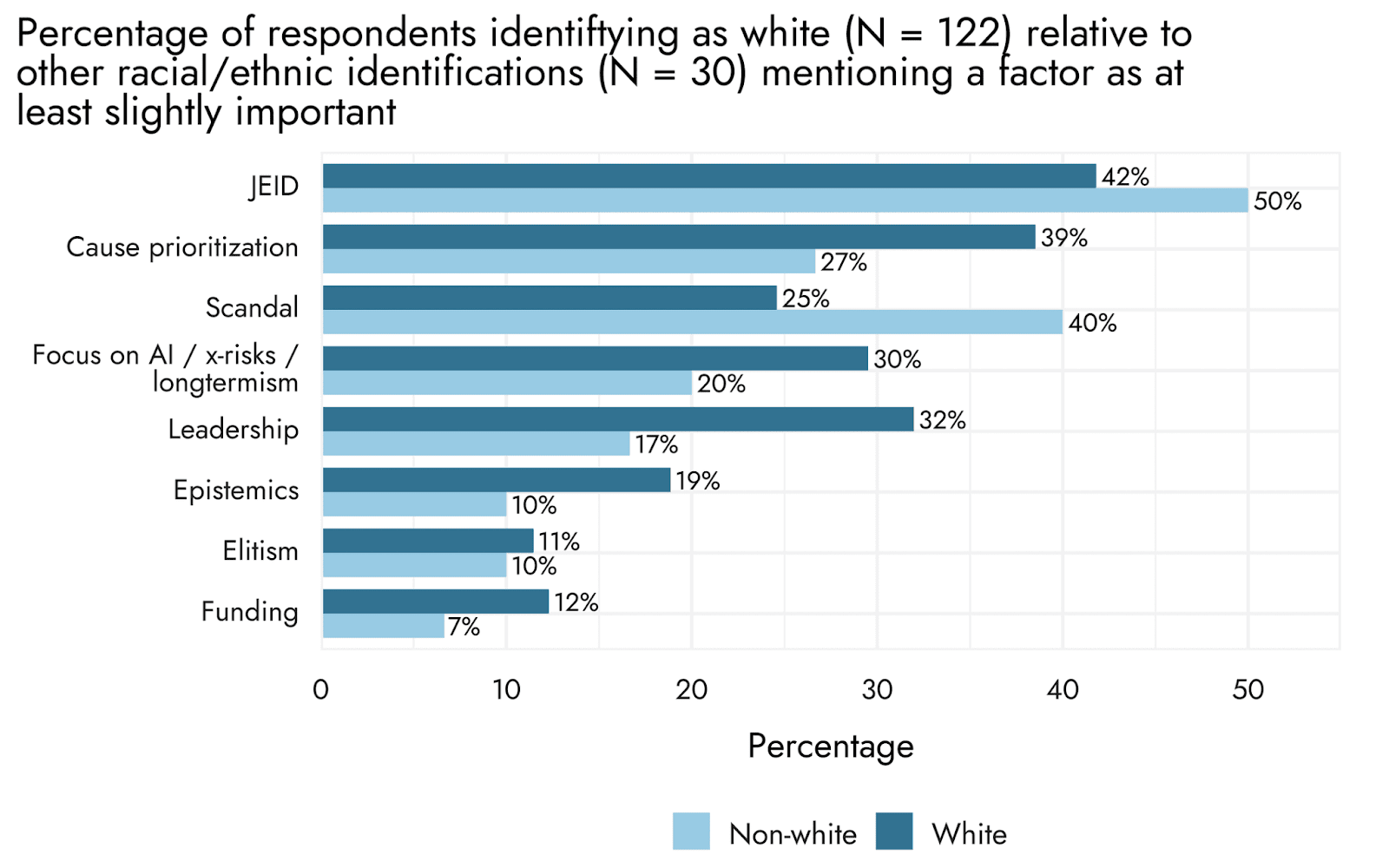
David Moss published the following graph in relation to the Community Health Survey:
It seems like non-Whites are slightly more concerned about Justice, Equity, Inclusion and Diversity (JEID) issues compared to Whites. However, the sample size is pretty low, and more Asian. And I don’t think this exactly means “non-Whites experience more JEID issues than Whites”, which is the thing I’m more concerned with.
In the past year or so, [redacted] published a post that highlighted some of their negative experiences in the EA community, including ones that are CCI-related. The post got around a few hundred karmas (if I’m remembering correctly), but the author had removed the post recently.
In 2023, EA Global feedback survey respondents who identified as more non-Western gave slightly lower scores in response to the question “This event was a place where I felt welcome” (on a scale of 1 to 5, 5 being highest).than survey respondents who identified as more Western: 4.30 versus 4.54 out of 5.00 points.
Here’s the summary of a qualitative study I did (read more here):
I interviewed 21 non-Western EAs (selected from an EA conference’s Swapcard and a few from my own personal network) and discovered:
|
And here are a few vignettes that I want to highlight. I recommend reading more here.
|
Based on the evidence on CCIs I have collected so far, I believe that poor CCIs are likely to be a common but minor problem for most non-westerners.
At the organisational or community level, I would recommend EA-aligned organisations and organisers to start or maintain interventions that are sensible or if the trade-offs are acceptable, like some of the ones listed here by AmAristizabal. However, I would not flag CCI issues as something to be heavily prioritised (moderate confidence).
At the individual level, I recommend:
What more could be done here? Here are some possible paths that I’m more optimistic about (in no particular order):
I’m less optimistic about doing literature reviews on this topic, since two people I trust mentioned that they’re less optimistic about such work.
I would like to thank the following people for their valuable feedback (in alphabetical order): Catherine Low, Charlotte Darnell, Chin Ze Shen, Joseph Lemien, and Mo Putera.
And thank you to the EA Survey team from Rethink Priorities and the CEA events team for the statistics.
And thank you to all my anonymous interviewees for sharing your experiences with me.
The kind of CCI I’m most interested in is between Westerners and non-Westerners, but forming racial categorisations seems difficult.
Like what Scott Alexander proposes here, I buy into the idea that a person’s ethnic identity could be mapped into a space that has multiple axes like: genetics, culture, language, geography, etc. So, the more Western a person is the closer they are to the centre of this space, and the more non-Western a person is the further they are from the centre.
This makes categorisations more nuanced, but also more challenging. For example, the compromise I made, especially when it came to getting statistics, was to only use these three factors in figuring out how Western or non-Western a person is:
For my specific investigation, I propose that a Westerner is someone who:
Using the United Nations’ M49 geoscheme, I labelled countries from the following geographical subregions as “Western”: Australia and New Zealand, Northern America, Northern Europe, Southern Europe, and Western Europe.
I decided to use the term, “subtle acts of exclusion” from Jana and Baran’s book of the same title, because I find it easy to understand and convey. To make their term a bit more specific, I extended it to “subtle acts of exclusion that are any one of prejudicial, unjust, or both” (but I’ll keep the original SAE acronym as it is). What do I mean?
I also think it’s important to be clear about a few things regarding SAEs:


Reading the examples of negative CCIs (e.g. below) makes me think that one of the most informative kinds of future research would be assessing the frequency all events of this kind across all EAs, and assessing whether they differ across Western and non-Western EAs. Based on my own experience, I would expect both Western and non-Western EAs to experience similar events near-constantly, both within EA and without. So it seems it seems like a core crux is whether they occur more frequently or severely in either group / when different groups interact / in some particular setting rather than another.
Thanks for the comment! Not sure if you've seen this, but there's weak evidence that poor CCIs occur less frequently in EA settings than non-Ea settings.