Comments

My chapter, Shaping Humanity's Longterm Trajectory, aims to better understand how reducing existential risk compares with other ways of influencing the longterm future. Helping avert a catastrophe can have profound value due to the way that the short-run effects of our actions can have a systematic influence on the long-run future. But it isn't the only way that could happen.
For example, if we advanced human progress by a year, perhaps we should expect to see us reach each subsequent milestone a year earlier. And if things are generally becoming better over time, then this may make all years across the whole future better on average.
I've developed a clean mathematical framework in which possibilities like this can be made precise, the assumptions behind them can be clearly stated, and their value can be compared.
The starting point is the longterm trajectory of humanity, understood as how the instantaneous value of humanity unfolds over time. In this framework, the value of our future (V) is equal to the area under this curve and the value of altering our trajectory (V) is equal to the area between the original curve and the altered curve.
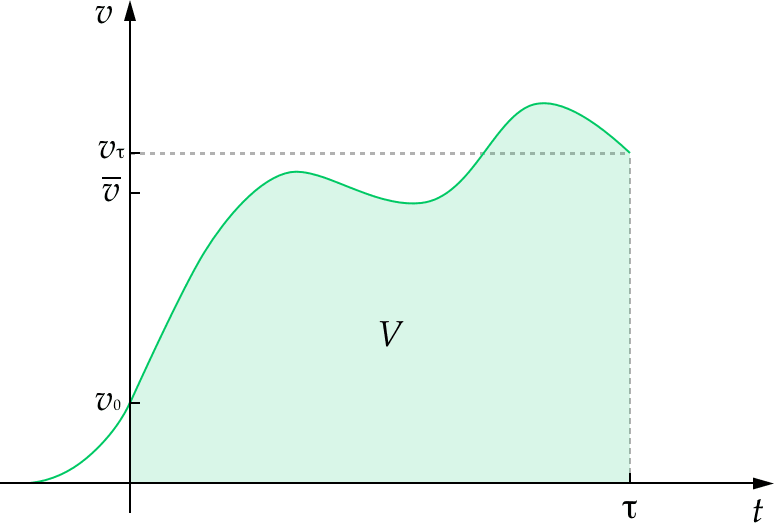
This allows us to compare the value of reducing existential risk to other ways our actions might improve the longterm future, such as improving the values that guide humanity, or advancing progress.
Ultimately, I draw out and name 4 idealised ways our short-term actions could change the longterm trajectory:
- advancements
- speed-ups
- gains
- enhancements
And I show how these compare to each other, and to reducing existential risk.
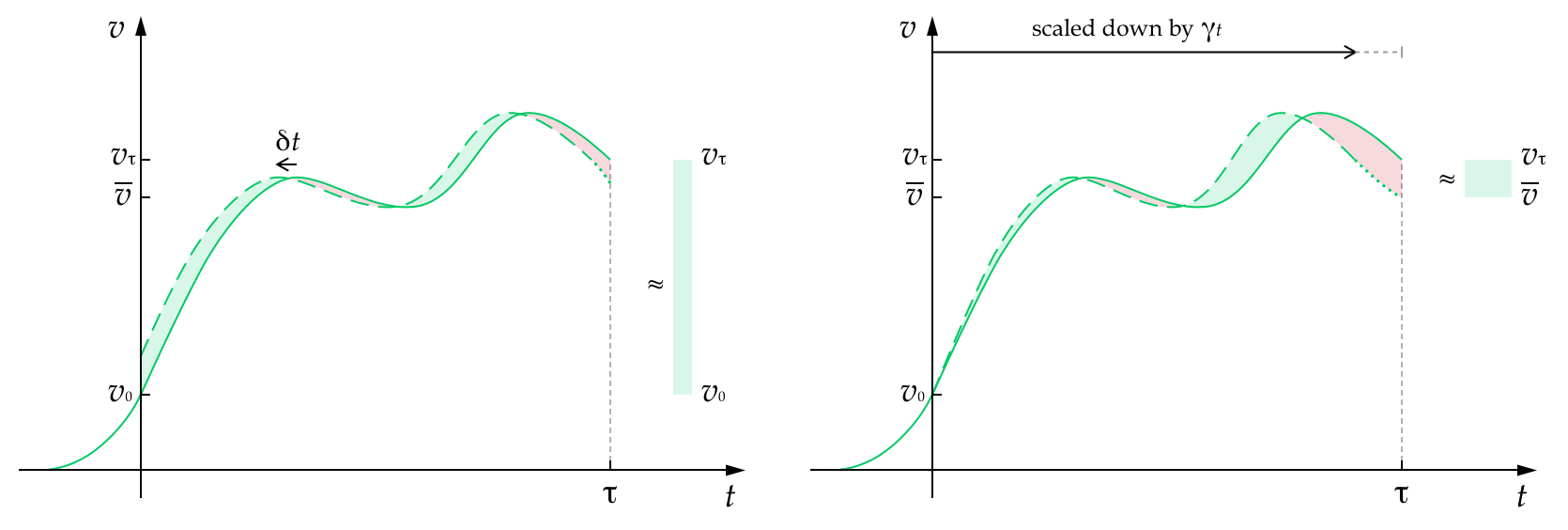
My hope is that this framework, and this categorisation of some of the key ways we might hope to shape the longterm future, can improve our thinking about longtermism.
Some upshots of the work:
- Some ways of altering our trajectory only scale with humanity's duration or its average value — but not both. There is a serious advantage to those that scale with both: speed-ups, enhancements, and reducing existential risk.
- When people talk about 'speed-ups', they are often conflating two different concepts. I disentangle these into advancements and speed-ups, showing that we mainly have advancements in mind, but that true speed-ups may yet be possible.
- The value of advancements and speed-ups depends crucially on whether they also bring forward the end of humanity. When they do, they have negative value.
- It is hard for pure advancements to compete with reducing existential risk as their value turns out not to scale with the duration of humanity's future. Advancements are competitive in outcomes where value increases exponentially up until the end time, but this isn't likely over the very long run. Work on creating longterm value via advancing progress is most likely to compete with reducing risk if the focus is on increasing the relative progress of some areas over others, in order to make a more radical change to the trajectory.
The paper has lots of nice diagrams, but they are low-resolution in the current official version, so you may want to read my own PDF here.


Hi everyone! I’m Shakked, a PhD student in economics at MIT, and this comment summarizes The Short-Termism of ‘Hard’ Economics, a chapter in Essays on Longtermism that I coauthored with my dad Ilan, a Professor of Economics at Victoria University of Wellington in New Zealand.
The chapter is about the academic economics profession. We think the profession has not yet, and will not in the foreseeable future, produce much useful longtermist research as part of the mainstream research it systematically produces, publishes in top journals, and rewards professionally. (Individual economists might still produce useful longtermist research as voluntary side-projects, as we note below.) In the chapter, we argue that this is because the profession is subject to a constricting set of methodological norms that preclude the kinds of research that might be useful from a longtermist perspective.
Specifically, we think that useful longtermist research - by virtue of its speculative nature and the thin historical evidence base it has to rely on - will tend to have a few attributes. It will draw on a variety of sources of empirical evidence, including expert forecasts, narrative historical commentaries, quantitative projections, interviews and focus groups, and so on. It will make theoretical arguments that are often institutionally-specific or draw on a diversity of concepts. As a consequence of these diversities of evidence and argument, it will tend to be multi-disciplinary.
Almost all of the above are ruled out by the current methodological norms of the academic economics profession. An obsession with methodological “hardness” - a concept which George Akerlof says is used to “classify sciences according to a hard–soft hierarchy, with physics at the top and sociology, cultural anthropology, and history at the bottom” - results in the imposition of severe restrictions on the kinds of work economists accept. On the empirical side, this means that only carefully identified causal estimates are permissible forms of empirical evidence. This rules out descriptive, explanatory, or predictive work and narrows attention to topics where sufficiently large micro datasets are available, implicitly narrowing the geographic and temporal scope of research. On the theoretical side, this involves a focus on mathematical generality and technical sophistication and difficulty, which precludes both arguments that are impossible to formalize mathematically and arguments that are trivial to formalize.
The chapter goes into a lot of detail about the exact shape of the norms and applies them to three areas of longtermist interest: long-term decision-making, climate change, and AI.
The chapter was written in mid-2022, before the release of ChatGPT, so the past 3 years have constituted an interesting out-of-sample test of the arguments and predictions we make. We think the chapter has held up pretty well. There’s been an enormous growth in research on AI in economics; the majority of this new research has taken the form of the kind of short-termist empirical or backwards-looking theoretical work we describe in the chapter. There’s also been an increase in interest in longtermist perspectives on AI, including an upcoming NBER conference on the Economics of Transformative AI, as well as some examples of genuinely useful research. But so far our sense is these developments show no sign of penetrating the top journals or professional reward processes.