“If you include PETA's $80M annual budget, and the ~$50M annually spent on diet change globally, animal liberation and diet change currently account for over a third of the animal movement's funding.”[2]
Lewis Bollard is right that the wider movement is not neglecting diet change. The question his point opens up is whether that spending is trying new directions and testing them rigorously, which is where EA has a comparative advantage, and where a prize would pull new efforts.
Moreover, if the budget of EA is going to increase x-fold, as many expect it to under the AI windfall, this would greatly increase the EA share of total movement money in animal advocacy, meaning a proportionally greater share of responsibility to ensure all vital parts of the movement are covered.
The arguments here seem confused to me. Are you arguing for EAs to work on diet change advocacy or for 'EA money' to go to this intervention? The middle paragraph quoted seems to be arguing you want EA's to work on the problem, which is not about funding but about talent. FWIW I think testing new efforts is not that hard to do, and with $100m+ a year on diet change advocacy there should be no issue getting some funding to run some studies (as you have already done).
If, however, the claim is that a portion of EA funding should go towards diet change advocacy, then I think the order of evidence <> money is the wrong way arouns. The broad consensus in EA, to the extent there is one, is that the current state of evidence is not nearly as cost-effective as other interventions, despite there being a lot of research to date (e.g. see a summary here). If new high quality research came in to suggest otherwise, I expect more EA funding would come in (assuming marginal dollars would be cost-effective). The order should be test then scale, not scale then test.
Thank you for taking the time to read the article and responding, Elliot. Very much appreciated!
First of all, we are in full agreement about the order of things: I am asking for more testing, and most of all for more creativity and innovative thinking to flow into this field, not for scaling anything that has not been thoroughly tested. I (foot)noted that systems thinking may change the way we think about scaling, but this does not change the order.
As for your question if I am mainly interested in EA work/talent or EA money going into diet change, I'd say: what I am mainly arguing for is renewed interest in the area, in recognition of its strategic importance. Until something worth scaling is found, the main ask would be for (exploratory) work/talent, not any big money, but of course that work still costs money. I am reasonably agnostic where that money should come from though I think it would be very helpful if EA pitched in, for the reasons mentioned - EA having higher standards of scrutiny/impact assessment, more budget comes with more responsibility - but most of all because of signaling value: willingness to spend some resources sends a message about what is valued/needed. I believe diet change work has a reputational problem within EA partly because funders seem disinterested. Offering a prize would be a very visible expression of genuine interest, and not a very costly one since the big money would only be spent if a fitting solution were found.
On how easy/cheap it is to test new ideas and fund studies, I don't have enough personal experience to comment. Of the two RCTs I was involved with, the first was done by a professional researcher on a voluntary basis, the second by an independent researcher as part of her PHD, which was not funded by EA or any animal funds. From speaking to Seth Ariel Green, I get the impression I got a bit lucky there and that generally a sufficiently powered study that fits all the criteria would not come cheap.
Of the $100M+ that currently should be available for diet change and animal liberation, I can't say how much of that would be available for these types of studies, but I am doubtful. The PETA part of it might be overstated (see footnote 2) and I am not clear on the source for the 50M and on how it is being spent. My guess is that a large part of it is going into online advertising and the type of work that is most visible to me (mass media, pledges). Possibly public-facing work that is not primarily directed at diet change (e.g. animal welfare messaging) could be lumped into it. Some of it might also go to street activism, though this seems to be quite low-cost. I am not seeing money going into testing new approaches in a big way, but I would love to be proven wrong! :)
Thanks for the thoughtful reply and in general I think the post does a good job of anticipating some criticisms and argues thoughtfully and clearly.
One thing I want to pick up on is the question of WHY do you think this intervention is worth EAs abandoning other problems/interventions, given the current state of evidence is not promising? I have a social psych background and behaviour change is really hard, benefits are modest, and this has been backed up by decades of the movement creatively tackling diet change from many angles.
FWIW I think you might be overstating EAs' creativity and research abilities. An RCT or survey is not too hard to pay for with a lot of non-EA social scientists out there in the world. While the $100M is mostly spoken for, surely a few hundred thousand could be pulled to more research and testing from donors and orgs who are more bullish on this ToC than the average EA?
One final question, do you have an idea in your head of what kind of data would change your mind about pursuing this theory of change? Like if you had a $1M budget to do some testing, and 3 years and several studies later, the results were as modest as current diet change interventions, would you pivot to other work? Since I strongly believe we are always in triage, what would it take for you to say "in hindsight I was wrong to push so hard on diet change, it was a dead end/less cost-effective than other strategies"?
I really appreciate the push back against diet-change defeatism and think you made a great case by taking a complex system's perspective! The idea of a prize for diet change is something I've not come across before - I think it's very exciting, and I also found it admirable how open you were about the potential limitations too.
One thing I would like to add is that lack of progress in diet change may be due to the influence of ideology on the approaches pursued so far. In my experience, the majority of people working in the animal welfare/food systems space are convinced of veganism - that is that the ideal state of the world would be to eliminate all animal usage - and are resistant to accepting that there could be any negative outcomes from pursuing such a goal. There is often enormous personal investment in the vegan identity, which makes it incredibly hard to embrace core EA values like open-mindedness (I have not been immune to this unfortunately either) resulting in significant blind-spots.
A very salient case in my mind is UPFs and the broader nutrition debate. As you point out, plant-based sales suffered enormously from 2022 onwards. Those developing and promoting the products were mostly motivated by animal welfare, and did not take the health attributes of their products very seriously beyond obvious choices that consumers would penalise (mostly saturated fats and colorants). GFI's promotion of the Taste-Price-Convenience paradigm without consideration of nutrition - a backbone of the food system - is symbolic for me of this mindset. Tara Garnett from Table commented on this very astutely in a recent report where she claimed the weakness of the alt-protein movement was its susceptibility to the 'bundled thinking' bias whereby, because proponents are convinced of the welfare and environmental case, they also assume the same must be true of health outcomes, despite the data being rather more equivocal.
The result was that the meat-alts sector did not take the change in consumer sentiment seriously, and still four years later, I see a denialism within the movement wherein the pushback against alt-proteins is labelled as hysteria and a 'trend' - despite higher amounts of quality protein, as one example, being especially beneficial for older adults, those on GLP-1s and those with diabetes or pre-diabetes (which is a sizable and growing segment of western populations).
All this to say that I think the progress so far has been limited by the type of people attracted into EA food systems work and their internal motivations posing large blocks to recognising blind-spots in interventions as well as to forming pragmatic alliances across the food system. I imagine a prize like this would be more likely to succeed if the EA ecosystem invested resources in attracting those with biology backgrounds more relevant to food systems change e.g. nutrition, veterinary science, ecology, agriculture, who possess the relevant expertise to identify such blind-spots (as a bonus, attracting these people who by nature have to think more systemic ways vs the typical EA physics/math/comp sci/phil would normalise complex systems thinking). I question if sociology is really the lacking perspective here. Finally, cultivating a culture where red-teaming of interventions is rewarded more (my experience is that, even within EA, animal welfare people react rather aggressively to critiques of vegan ideology), would ensure there is a receptive environment to exploring these blind-spots in depth.
Very excited to see where this idea of the prize goes. Thank you for such a well-written and refreshingly novel piece!
Hi Pablo, thank you for bringing in the COM-B model. :) I wasn’t familiar with it, but it reminded me of Robert Gass’s Wheel of Change, which says lasting change requires working on three interacting domains: Hearts & Minds (what people think and feel), Behavior (what people do) and Structures (the systems around them). Changing only one tends to pull the system back to where it started. It also echoes the Movement Ecology framework from the Ayni Institute, which describes five complementary theories of change (alternatives, personal transformation, structure-based organizing, mass protest and the inside game) that a movement needs in balance.
The essence of both is that change is complex, and that we need to target different types of intervention so the system can shift. This doesn’t mean “anything goes”; we still need to assess the effectiveness of each intervention. But the interventions do need to target different areas of society, which is why I think your point about not building the movement on Opportunity and Motivation alone, without Behavior, is very important. Thank you!
Make diet change a Millennium Prize Problem for animal advocacy
Thanks to Bruce Friedrich, Seth Ariel Green, Tobias Leenaert, Jan Willem Bolderdijk, Martine van Haperen, Herman Rohrbach, Chris Popa and Elizabeth Alvarez for comments. Claude helped structure the text. Ideas and mistakes are my own. I currently work with ProVeg International. The prize I propose would be defined and judged by an independent committee, and its money would fund scaling the winning solution(s), not ProVeg or the winner.
TL/DR
EA could declare a prestigious list of very hard problems in urgent need of solving, encouraging our brightest minds to work on them, analogous to the Millennium Prize Problems in mathematics.
An independent committee would define the problems and what counts as a solution and judge the entries.
Creating consumer behavior change away from animal products in a way that is scalable, measurable and durable would be a great candidate for such a problem.
Diet change is important to work on because consumer choice bottlenecks most other things farmed animal advocates try to work on.
EA stepped back from diet change after early failures; the AI windfall makes now the time to try again.
A potential solution to the problem may lie in diet change interventions that target social clusters, not individuals.
Announcing "Millennium Prize Problems of EA" fits within a systems approach to impact-making, which is still underdeveloped within EA.
In mathematics, the hardest unsolved problems attract prizes. At the millennium turn, the Clay Mathematics Institute attached a million dollars each to seven of them. In Effective Altruism, the opposite is true. We rank problems partly by tractability, so if a challenge resists repeated attempts, attention moves to where progress looks easier.
One example of a hard problem in EA is diet change. “Meaningfully reducing consumption of meat and animal products is an unsolved problem” is both the title and conclusion of one of the most authoritative studies on the subject, a meta-analysis of 112 interventions from 41 RCTs by Seth Ariel Green and colleagues. It found an average effect of just 0.07 standard deviations (95% CI 0.02 to 0.12).
The question is back on the table: Bruce Friedrich recently argued that EA should reinvest in animal liberation and diet change, and Lewis Bollard replied, persuasively, that EA didn’t ignore diet change so much as deprioritize it after trying many versions and finding the evidence weak. Bollard has a point: deprioritizing what isn’t working, based on evidence, is EA at its best. But iterating away from a failed approach shouldn’t necessarily mean iterating away from the problem - that is to say, not if the problem is as crucial to our aims as this one.
Diet change isn’t just one option out of a menu of possible farmed animal interventions. It may be the most important structural obstacle to reducing animal suffering. Nearly everything else farmed-animal advocates work on (corporate pledges, alternative proteins, menu change, policy, even welfare reforms) is bottlenecked one way or other by consumer demand for animal products. Without diet change, gains get harder to scale: conditions may improve, but the number of animals in farms will keep growing.
In more ways than one, the animal movement is stuck and desperate for fresh ideas and new ways forward. The AI windfall offers an opportunity for new exploration and experimentation. Vastly increased budgets require not just scaling the current best approaches, but reassessing our priorities in a more systemic way - going beyond quick “most animals helped per dollar” wins to figuring out which approaches will help unlock the most future progress for our movement.
The Millennium Prize Problems of EA
The Millennium Prize Problems are seven of the hardest problems in mathematics that were designated in 2000 by the Clay Mathematics Institute. Each has a prize of one million dollars attached to them for the first correct solution. The attention and prestige attached to these problems by the Clay Institute have drawn brilliant mathematicians to work on them. One of the seven problems (the Poincaré conjecture) was solved, and the prize awarded in 2010. For a second (Navier-Stokes equations) OpenAI claimed a solution in September 2026, produced by AI agents rather than a person; the claim is disputed and awaits official confirmation.
Russian mathematician Grigori Perelman was offered (but refused) a Millennium Prize for solving the Poincaré conjecture, one of the hardest problems in mathematics
Analogous to the Millennium Prize Problems of mathematics, Effective Altruism could identify some of its hardest but most important questions, that we believe our brightest minds should be working on, and increase their salience by attaching a prize. Diet change should be one of them. The prize money would not be for personal gain but for the more altruistic use of implementing and scaling the found solution. Deciding what counts as a solution would be the job of an independent committee, which sets the criteria and judges the entries.
As far as I could find, the idea of a list of “Millennium Prize Problems of EA” is new, but similar prizes or challenges are not entirely new to the animal movement. The Jeremy Coller Foundation, for instance, has launched a $10M prize, the “Coller Dolittle Challenge”, for researchers who crack the code of Interspecies Two-Way Communication. In food technology, XPRIZE’s $15M Feed the Next Billion challenge targeted better alternatives to chicken and fish. It was not awarded. Prizes do not guarantee a solution, but they help coordinate efforts and direct attention to where it is needed most.
Why diet change is a hard problem worth solving
I have worked in animal advocacy for over fifteen years, mainly in the Netherlands - a country that is often ahead in the animal movement, both in the interventions we try and the new roadblocks we encounter.
I have witnessed and contributed to several of the hype cycles or 'EA bubbles' that Rockwell and Tom Billington highlighted. I went with the leafleting craze in the early 2010s and played a small part in ending it. I joined the shift towards corporate engagement and policy work in the second half of that decade, on a wave of growing enthusiasm for alternative proteins - then saw the collective optimism fade when plant-based sales plateaued throughout much of the world in the post-covid era.
Looking back, I believe most of what we tried was “necessary, not sufficient”: part of a bigger structure that should one day move society in a different direction, but with limited immediate effects. No silver bullets were fired, and almost everything we did depended in some part on public acceptance. Our first corporate successes came in on the wave of heightened public excitement about alternative proteins. Now, most of our corporate work is riding on commitments under the EU’s sustainability reporting rules (CSRD), but is bottlenecked by waning public support.
It is important not to confuse public support with public behavior change. Both are important and interact in a two-way fashion. This is elegantly captured in the COM-B model, a leading scientific model which shows behavior is not shaped in isolation but in close coordination with environmental factors (Opportunity), beliefs (Motivation) and (perceived) practical skills (Capability). Convincing arguments have been made that a single-minded focus on changing behavior is missing opportunities to change social norms or leverage public support towards enacting systemic or political change that shape the choice environment. In fact, this ‘institutional approach’ describes the bulk of what I work on these days. Yet I keep coming back to the same conclusion, that we cannot build our movement on just the O(pportunity) and the M(otivation), without any of the B(ehavior).
Yes, we can present survey results which show a majority of the public wants to reduce their meat intake, but food companies think twice when they see sales are not following. Yes, we can show policymakers that a (silent) majority of their constituents favors pro-plant policies, but market data show they don’t put their money where their mouth is. And sure, we can try to create lots of media buzz about growing interest in changing diets, but it will fail if people don’t see their friends, colleagues or family members adopting new products or reducing their meat intake.[1]
In my early days of advocacy (2010-2015), supply of plant-based products was lagging behind consumer demand. Companies needed to be made aware of the economic opportunities they were missing out on. And so they were. The market gap was quickly filled during the plant-based boom of ~2016-2021. Thanks to it, many countries still benefit from a dramatically increased availability and quality of plant-based products. But in the post-boom reality, the tables are turned and supply is now ahead of demand.
In the Netherlands, retailers have made ambitious pledges to shift their sales away from animal-based products - but are finding their customer base slow to shift along with them. In categories heavily tied to identity, culture, and habit (like food) consumer behavior remains a bottleneck that product improvements alone can’t solve.
In response to this, many companies are now pushing a “silent transition”: replacing animal ingredients one by one, or reducing the amount of meat in meat products (hybrids), in essence bypassing the muddy waters of conscious purchasing decisions. I believe this approach holds potential to reduce a lot of animal suffering, and this potential should be (and is not yet) maximally exploited. At the same time, the potential is limited by consumer acceptance. Companies are understandably reluctant about pushing their clientele further than what are deemed acceptable limits - which are not set in stone but shift with shifting diets.
A rough, deliberately generous estimate by ProVeg Netherlands is that about 20% of meat could be replaced in the restaurant sector in this way, and perhaps up to 60% in the more progressive catering sector. In total, tens of millions of animals per year may be spared this way in the Dutch foodservice sector. But in retail, where the overwhelming majority of food is sold, options to bypass consumer choice are much more limited. In an internal calculation based on recent sales data from Dutch supermarkets, ProVeg and the Green Protein Alliance calculated that hybrids in the easiest categories would shift the protein split (the ratio of plant to animal protein sold) by roughly 1.5 to 2 percentage points: at most a tenth of the 20-point shift in overall share of animal proteins that retailers have pledged to. This leaves roughly 18 percentage points that only consumers choosing differently can deliver.
Of course, then there are nudges: subtle changes to the menu composition, the default option or other parts of the ‘choice environment’ that change people’s purchasing decisions without bypassing their freedom of choice. They can work well, in certain contexts. In a classic experiment by LSE-scientist Linda Bacon, moving meat-free dishes out of the separate vegetarian section more than doubled how often people picked them; in three RCTs at catered university events, a plant-based default raised uptake from ~18% to ~66%. But nudges, too, only go as far as people are willing to accept and are less practicable in a retail setting. Neither quiet replacement nor nudging changes what people want to eat. We are unlikely to nudge our way to animal liberation.
Some EAs have given up not just on diet change, or alternative proteins, but on food system change altogether. They prefer to focus on improving living conditions for animals, instead of reducing numbers of animals consumed. But even animal welfare improvements are bottlenecked by consumer demand for animal products. Consumer willingness to pay limits how far welfare improvements may be taken. Cage-free and broiler commitments were won without consumers changing their diets, but they only improve conditions per animal; demand still decides how many animals are born, raised and slaughtered. There may also be limits to how far higher welfare can be scaled. Beyond a certain point, welfare improvements are likely to hit against economic, practical and biophysical realities that are shaped by the sheer scale of demand for animal products - which is set to grow globally by 25% between now and 2050. Giving decent lives to farmed animals gets a lot easier when there is fewer of them.
To summarize: we have reached a point where consumer choice is bottlenecking pretty much everything else we try to work on. In systems terms, it has become a leverage point. We made great progress as a movement when we broadened our scope to work with food producers, retailers, investors and policymakers. After all, people don’t make food choices in isolation - they need a conducive food environment. But in tandem, the food environment requires conducive consumers. We need better ways to change public demand and we have not found them.
Is diet change neglected?
In a recent article, Bárbara Buril made a similar point when she argued for ‘narrative change’: “Every intervention currently topping our cost-effectiveness rankings is drawing down a stock of public moral concern that somebody else built, and almost none of our funding goes toward building it.”
Is it true though that almost no funding is going in this direction? Lewis Bollard, in his response to Bruce Friedrich, argued it is not:
“If you include PETA's $80M annual budget, and the ~$50M annually spent on diet change globally, animal liberation and diet change currently account for over a third of the animal movement's funding.”[2]
Lewis Bollard is right that the wider movement is not neglecting diet change. The question his point opens up is whether that spending is trying new directions and testing them rigorously, which is where EA has a comparative advantage, and where a prize would pull new efforts.
Moreover, if the budget of EA is going to increase x-fold, as many expect it to under the AI windfall, this would greatly increase the EA share of total movement money in animal advocacy, meaning a proportionally greater share of responsibility to ensure all vital parts of the movement are covered.
The problem is not that diet change work is entirely neglected. It is that we have stopped expecting it to work. It is regarded within EA as an unpromising section of the farmed animal cause area - a graveyard of ideas that have been tried and disproven - not as one of the most important problems that our brightest minds should be working on. After early disappointments, a kind of learned helplessness set in, and low prestige is its visible symptom. Believing that diet change is impossible is a self-fulfilling prophecy.
I believe this problem of low prestige can be solved, and at relatively low cost, by making diet change “a Millennium Prize Problem of EA”. Beyond raising its status, a prize signals that we believe the problem can be solved.
What the prize could look like
Of course, an important consideration here is verification: whereas the original Millennium Prize problems have binary, mathematically verifiable solutions, the “diet change” problem is much more diffuse. Its solution will need to be phrased in a controllable way. A committee would set the actual criteria, but its starting point might look something like this:
The solution to the diet change problem is a concrete intervention (not an idea or a lab result) that reduces animal protein consumption, ideally measured in suffering-adjusted days (SADs) averted, in a way that:
• is non-trivial (at least a 25% reduction)
• is sustained over at least 6 months
• is statistically significant against a control group
• is cost-effective (minimum X SADs averted per dollar, to be set by the committee)[3]
• is scalable
• changes diets, not (just) meals
• avoids self-reporting bias, and other common forms of bias
• is clear about the audiences and settings in which it works
A trial that meets all of these criteria will be expensive, so part of the fund could go to testing promising ideas; otherwise only well-funded organizations and academic teams could compete.
I am aware that the “controllable” way I defined the problem above assumes that one intervention can produce a measurable effect on its own, while change in food systems is rarely that tidy. I will discuss this problem further down. I would welcome suggestions for a better phrasing of the problem, that is still controllable.
Where I would start looking
If I already knew the solution to the Millennium Problem of diet change, I would be writing a very different blog post. Still, I have hunches based on my own experiences trying to shift diets and the evidence that I have seen. My strongest hunch is that the solution to this problem will be social.
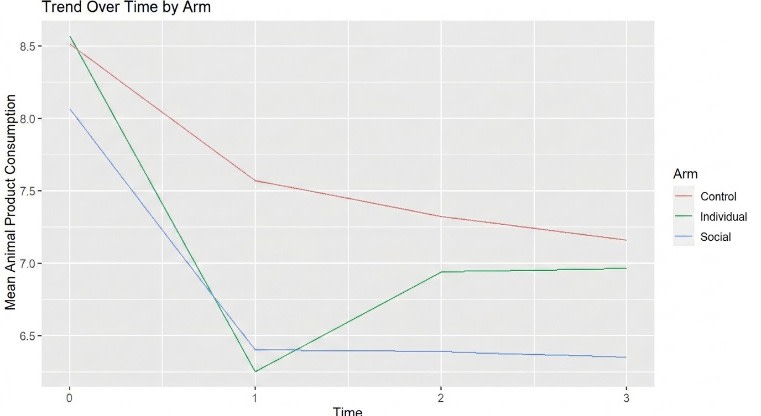
One of the data points that led my thinking in this direction is an RCT I was personally involved in, testing a 30-day “veg pledge” app across three groups (N = 1,213). The first group was asked to use the app for 30 days. The second group - the "social group" - was asked the same, but also encouraged to involve their friends, family or colleagues. The third was the control group. One month after the intervention, both experimental groups had reduced their average meat intake by about 25%. However, only the social group maintained this reduction three months after. It suggests that peer influence is not just one of many influences, but a make-or-break one.
Both the social and indivual groups reduced animal product consumption compared to a control group, but only the social effect lasts for three months
Most past efforts at diet change tried to inform or persuade individuals one at a time. How much community-focused or social cluster-focused activism have we actually tried and measured?
The social spread of behavior has been thoroughly studied. Relevant case studies, ranging from protest movements such as Black Lives Matter to the (non-)adoption of new innovations, such as Google Glass, have been popularized in sociologist Damon Centola’s book Change: How to Make Big Things Happen. Centola shows clearly how some of the animal movement’s popular approaches, like the use of social media influencers or mass media, can backfire when ‘social proof’ from more immediate peers is lacking; how social spread will only occur after repeated social confirmation from multiple contact points, or else will soon fizzle out. He also shows how new ideas first spread slowly, in the margins of society, before suddenly gaining prominence and 'snowballing' after a tipping point has been passed. Insights such as these may inspire new types of testable interventions.
They also offer hope that we could be closer to cracking the hard problem of diet change than we think. Though research can help identify potential tipping points, it is much harder to know when exactly they will be reached - until they are. It is possible for a system to be very close to a tipping point without showing external signs of behavior change.
A systems approach to (food) systems
The idea of assigning a prestigious prize to a hard problem worth solving fits within a systems approach to tackling complex problems. I have been throwing around the words 'systems' and 'systemic' quite a bit - ten times up to this point - so I might as well close this article by explaining what exactly I mean by a 'systems approach', and why I think this is still underdeveloped in EA.
EA quite naturally gravitates to “linear” theories of change, which consist of a chain of causes and effects leading to a desired outcome. They are relatively simple, straightforward and therefore more easily measurable. A standard linear EA approach would be to test different TOCs and compare them on cost effectiveness. These could be, for example:
a consumer-oriented approach, showing a documentary
a corporate engagement approach, improving the availability of alternative proteins
a policy approach, changing financial incentives on food
System thinking holds that such TOCs may not be very suitable for solving complex problems. In complex systems, causes and effects do not line up neatly but instead form a mesh containing many interdependent factors, thresholds and tipping points.
A linear approach would estimate animal suffering (SADs) reduced per dollar for each TOC and prioritize the most cost-effective option. A systems approach tries to identify how different parts interact and in what way and which order they need to be addressed. It is by no means less evidence-based compared to a linear approach, but complements RCTs and cost-effectiveness analyses with other types of evidence. This evidence includes scientific models of social and market transformation.
Such models provide a sort of map of the intricate machine (or ecosystem) that is the system we want to change. They detail the different parts, how they interconnect, revealing bottlenecks, feedback loops, and high-leverage intervention points. They tell you which buttons need to be pushed and levers need to be pulled at what time in order for the machine to change its settings. Prioritization between different parts of the machine does not occur by picking a 'winner' based on cost-effectiveness, but by identifying which complementary conditions must be met simultaneously for the whole system to tip. Within those specific leverage points, RCTs and cost-effectiveness analyses remain vital for comparing competing solutions to the same sub-problem.[4]
This is where the Millennium prize idea fits in: it helps our movement highlight which parts of the system need to be prioritized when, based on systemic leverage, not on present tractability.
The idea that EA needs to evolve towards systems thinking is almost as old as EA itself. The critique that it ignores systems has been countered early on, citing examples demonstrating that "effective altruists love systemic change". In the realm of animal advocacy, I think it is fair to say that the shift from changing individual diets to corporate and institutional engagement was a fine example of EA applying systems thinking. Its flipside - moving away from diet change - was not. In our enthusiasm to scale our impact, we have misunderstood 'systems' to mean 'everything that is not individual consumers', [5] instead of treating consumers as one of the key levers in the system.
Learning to use a new toolkit
I have already pointed out that the “controllable” way in which I defined the Millennium problem of diet change above is very much linear, not systemic. I could defend myself by arguing that this is a fine example of an RCT-able sub-problem within a larger system, but in truth 'changing diets' would be quite a substantial sub-problem.
A more honest response would be that in my proposal I imperfectly try to bridge the gap between linear thinking - which holds some of the most valuable ideas and methods that EA has contributed to philanthropy - and systems thinking - which I believe holds the ideas and methods that will help us chart our course to even bigger impact. This is still a work in progress and much learning is to be done.
This brings me to the new opportunities presented to us by the AI windfall. Nan Ransohoff may not be referring specifically to systems thinking, but makes a resonant point in her essay “The third wave of American philantropy”:
“We should be conscious that we are entering this wave with an affinity for the measurement-oriented tools that defined Wave 2. These will be poor fit for some of the questions that will matter most in Wave 3. This isn’t an attack on those tools; they’re among the best things philanthropy has ever produced. But they weren’t designed for questions of civilizational flourishing, meaning, and what makes a life good – all of which Wave 3 will eventually need to grapple with. We’ll need to get comfortable broadening our decision making tools to include squishier instruments like taste and good judgement to have the best shot at answering these.”
Conclusion
Meaningfully reducing the consumption of animal products is an unsolved problem, and much of the farmed animal movement's other work depends on solving it. Making it a Millennium Prize Problem of EA, judged by an independent committee, would signal that it can be solved and make it attractive for our best minds to work on.
Systems thinking will not be easy to fully implement and the lure of new silver bullets will be tempting. But today - now that many more approaches have been tested, low hanging fruits have been picked, now that we have learned from past mistakes and are entering a new wave of philanthropy, with incredible new resources, both monetary and intelligence - EA is more than ready to step up to the challenge.
Social scientist Damon Centola points out that when people sense growing awareness of a new idea or product, but don’t see uptake by their own peers, the disconnect leads to a backfire effect of resentment. (Centola, D. (2020). Influencers, Backfire Effects and the Power of the Periphery in Personal Networks. Network Dynamics Group, University of Pennsylvania.)
In response, others have pointed out that PETA’s annual budget encompasses a lot more than diet change work (e.g., companion animals, anti-vivisection work, or work targeting the clothing and entertainment sectors).
For reference, Ambitious Impact's bar for new animal charities is about 30 SADs per dollar, roughly its estimate for cage-free work in the Middle East. This is not a community-wide standard: Animal Charity Evaluators' estimates for individual cage-free programs range from 26 to 88 SADs per dollar or more.
Another way in which systems, in particular tipping points, may change our thinking about impact is by introducing a new way of thinking about scalability (which was included in my definition of the diet change problem). In a linear sense, scalability is about how cost-effectiveness changes or whether practical roadblocks are encountered, when we try to change micro successes into macro successes by increasing budget and scale. If a cage-free campaign is successful in a small European country, will it be more or less cost-effective when we implement it in a bigger European country? And will it also work in India? System thinking turns scalability on its head: cost-effectiveness on a micro scale may seem much lower, because more effort is required to create a small change. However, once a tipping point is passed, cost-effectiveness increases almost exponentially as the system itself - not the charity - takes care of the scaling process in a “snowball effect”. Proving that an intervention is capable of causing such effects - even on a micro scale - will be part of proving scalability in a systems approach.
Crossposted to Less Wrong
‘Like most of life’s dangers, the dangers of artificial intelligence are not easily identified from the armchair.’
J Dmitri Gallow
Epistemic status
I’m not an expert in this field, and herein I make some sweeping generalisations educated guesses about the overall...
This post is part of the Rethink Priorities Cross-Cause Fund (CCF) series on how to allocate funding across causes when it is uncertain what matters most.
...
Thanks to Bruce Friedrich, Seth Ariel Green, Tobias Leenaert, Jan Willem Bolderdijk, Martine van Haperen, Herman Rohrbach, Chris Popa and Elizabeth Alvarez for comments. Claude helped structure the text. Ideas and mistakes are my own. I currently work with ProVeg International. The prize I propose would be defined and judged by an independent committee, and its money would fund scaling the winning solution(s), not ProVeg or the winner.
TL/DR
* EA could d...





The arguments here seem confused to me. Are you arguing for EAs to work on diet change advocacy or for 'EA money' to go to this intervention? The middle paragraph quoted seems to be arguing you want EA's to work on the problem, which is not about funding but about talent. FWIW I think testing new efforts is not that hard to do, and with $100m+ a year on diet change advocacy there should be no issue getting some funding to run some studies (as you have already done).
If, however, the claim is that a portion of EA funding should go towards diet change advocacy, then I think the order of evidence <> money is the wrong way arouns. The broad consensus in EA, to the extent there is one, is that the current state of evidence is not nearly as cost-effective as other interventions, despite there being a lot of research to date (e.g. see a summary here). If new high quality research came in to suggest otherwise, I expect more EA funding would come in (assuming marginal dollars would be cost-effective). The order should be test then scale, not scale then test.
Thank you for taking the time to read the article and responding, Elliot. Very much appreciated!
First of all, we are in full agreement about the order of things: I am asking for more testing, and most of all for more creativity and innovative thinking to flow into this field, not for scaling anything that has not been thoroughly tested. I (foot)noted that systems thinking may change the way we think about scaling, but this does not change the order.
As for your question if I am mainly interested in EA work/talent or EA money going into diet change, I'd say: what I am mainly arguing for is renewed interest in the area, in recognition of its strategic importance. Until something worth scaling is found, the main ask would be for (exploratory) work/talent, not any big money, but of course that work still costs money. I am reasonably agnostic where that money should come from though I think it would be very helpful if EA pitched in, for the reasons mentioned - EA having higher standards of scrutiny/impact assessment, more budget comes with more responsibility - but most of all because of signaling value: willingness to spend some resources sends a message about what is valued/needed. I believe diet change work has a reputational problem within EA partly because funders seem disinterested. Offering a prize would be a very visible expression of genuine interest, and not a very costly one since the big money would only be spent if a fitting solution were found.
On how easy/cheap it is to test new ideas and fund studies, I don't have enough personal experience to comment. Of the two RCTs I was involved with, the first was done by a professional researcher on a voluntary basis, the second by an independent researcher as part of her PHD, which was not funded by EA or any animal funds. From speaking to Seth Ariel Green, I get the impression I got a bit lucky there and that generally a sufficiently powered study that fits all the criteria would not come cheap.
Of the $100M+ that currently should be available for diet change and animal liberation, I can't say how much of that would be available for these types of studies, but I am doubtful. The PETA part of it might be overstated (see footnote 2) and I am not clear on the source for the 50M and on how it is being spent. My guess is that a large part of it is going into online advertising and the type of work that is most visible to me (mass media, pledges). Possibly public-facing work that is not primarily directed at diet change (e.g. animal welfare messaging) could be lumped into it. Some of it might also go to street activism, though this seems to be quite low-cost. I am not seeing money going into testing new approaches in a big way, but I would love to be proven wrong! :)
Thanks for the thoughtful reply and in general I think the post does a good job of anticipating some criticisms and argues thoughtfully and clearly.
One thing I want to pick up on is the question of WHY do you think this intervention is worth EAs abandoning other problems/interventions, given the current state of evidence is not promising? I have a social psych background and behaviour change is really hard, benefits are modest, and this has been backed up by decades of the movement creatively tackling diet change from many angles.
FWIW I think you might be overstating EAs' creativity and research abilities. An RCT or survey is not too hard to pay for with a lot of non-EA social scientists out there in the world. While the $100M is mostly spoken for, surely a few hundred thousand could be pulled to more research and testing from donors and orgs who are more bullish on this ToC than the average EA?
One final question, do you have an idea in your head of what kind of data would change your mind about pursuing this theory of change? Like if you had a $1M budget to do some testing, and 3 years and several studies later, the results were as modest as current diet change interventions, would you pivot to other work? Since I strongly believe we are always in triage, what would it take for you to say "in hindsight I was wrong to push so hard on diet change, it was a dead end/less cost-effective than other strategies"?