Comments
I've chosen to publish this post even though I do feel that some of the arguments could be refined further because I'm trying to not make perfect the enemy of good. Many thanks to David Nash, Gidon Kadosh, Xuan and Arjun Khandelwal for comments and suggestions on this post.
TL:DR; Community builders are well positioned to make more high-quality connections for relatively low costs to make local groups and the EA community as a whole have more strong and weak ties, be more distributed (and thus resilient) and stay open to new connections.
{EDIT, Feb 21 2022} Some of my goals with this post are :
Some important linguistic notes:
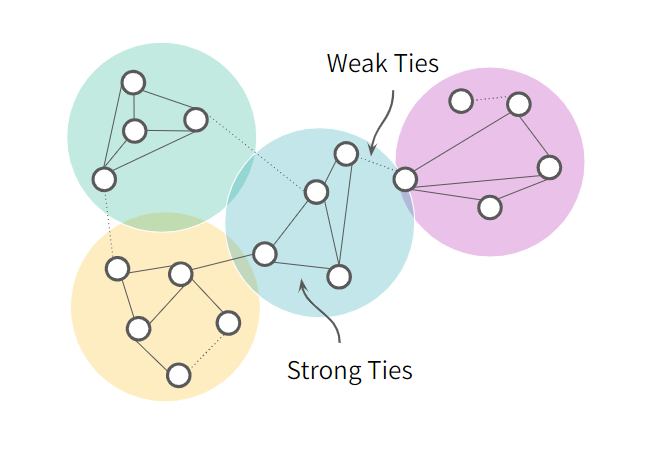
A strong tie between two people is a relationship that is quite strong - friends, family, close colleagues. It could be someone from whom you would feel comfortable asking a favour (for advice or an introduction, for example - this is the metric used by the CEA events team for EA Globals). We want to build strong ties between the local and global EA community because they can lead to better and cooperation, trust and coordination.
It's worth asking - what does it take to get someone to feel comfortable asking a favour? It could be trust in the community, or demonstration of shared norms, or friendship.
A slightly less obvious point is that we don’t want to build strong ties to the exclusion of weak ones. Weak ties can be defined as casual acquaintances, ex-colleagues, members of groups that are adjacent to someone’s social circles.
The benefits of weak ties are pretty important, e.g.
|
What could this imply about community building?
For more on weak ties, I recommend Mark Granovetter’s The Strength of Weak Ties.

A distributed network is one where each node (person) has multiple (strong or weak) links to other nodes, while in a centralised network most people only have one link to the same, central node. (Reminder: these are ideal types, most real networks are somewhere in between these two extremes.)
I think that EA as a community and movement should be closer to a distributed network than a centralised one in order to be effective at achieving it's goal. This does not mean that each nodal connection is equal in weight - some nodes will wield more influence or be more central than others. Rather, the goal is that we want each individual to be well connected to multiple other nodes in the system. We can then further specify what kinds of connections we want to make - perhaps we want each person to be connected to at least one "central node", but not more than two (because that make the network more closed than we prefer)
In the context of local groups or subcommunities, where the links between nodes i understood as their relationship, then a distributed network such as the one above, can make them, and the movement as a whole, more resilient to change. Overly centralised structures can be very reliant on the central node (i.e. the group organiser). If they leave, the community could become much weaker. Even if they do not, there are longer chains of connection between other members, which reduces the chances that useful connections are made. It can also reduce the sense of community.
In the context of information flow, where the links between nodes can be seen as flows of information, there can be both downsides and upsides to centralistion. Some degree of centralisation seems necessary for coordination to occur - there are some messages we do want most, if not all, people who are learning about the EA community to be exposed to (e.g. our commitment to being truth-seeking, or being critical thinkers, or being open to new and unintuitive ideas). But there are many messages and recommendations which are relevant for specific people (e.g. people with specific backgrounds, aptitiudes or dispositions).
Further, less centralisation could help address the issue of too much deference, for which it seems we may be moving in the direction of having more of. This is a complicated issue, so I don't want to make this point too strongly - for more on this, Buck Shlegeris has an interesting discussion on balancing deference here.
Let's say Aarav learns about 80,000 Hours for the first time. They are at a transition point in their career and looking for a change. They read the a lot of content, and apply to several jobs on the 80K job board. The main touchpoint this person has with EA is the 80,000 Hours website. But because 80,000 Hours' website has a one-to-many connection, they are unable to sufficiently target messages to a broad audience, and perhaps Aarav applies for a handful of jobs on the 80K job board, doesn't get any, and bounces off of EA. In contrast, Soo Gee learns about 80,000 Hours but then attends an EAGx concerence and occassionally attends virtual meetups. She now has multiple points of contact with the EA community and is more likely to hear messaging that is relevant to her particular situation. So maybe when Soo Gee applies to jobs from the 80,000 Hours job board, she's aware that they can be very competitive and doesn't feel as demotivated by it as Aarav.
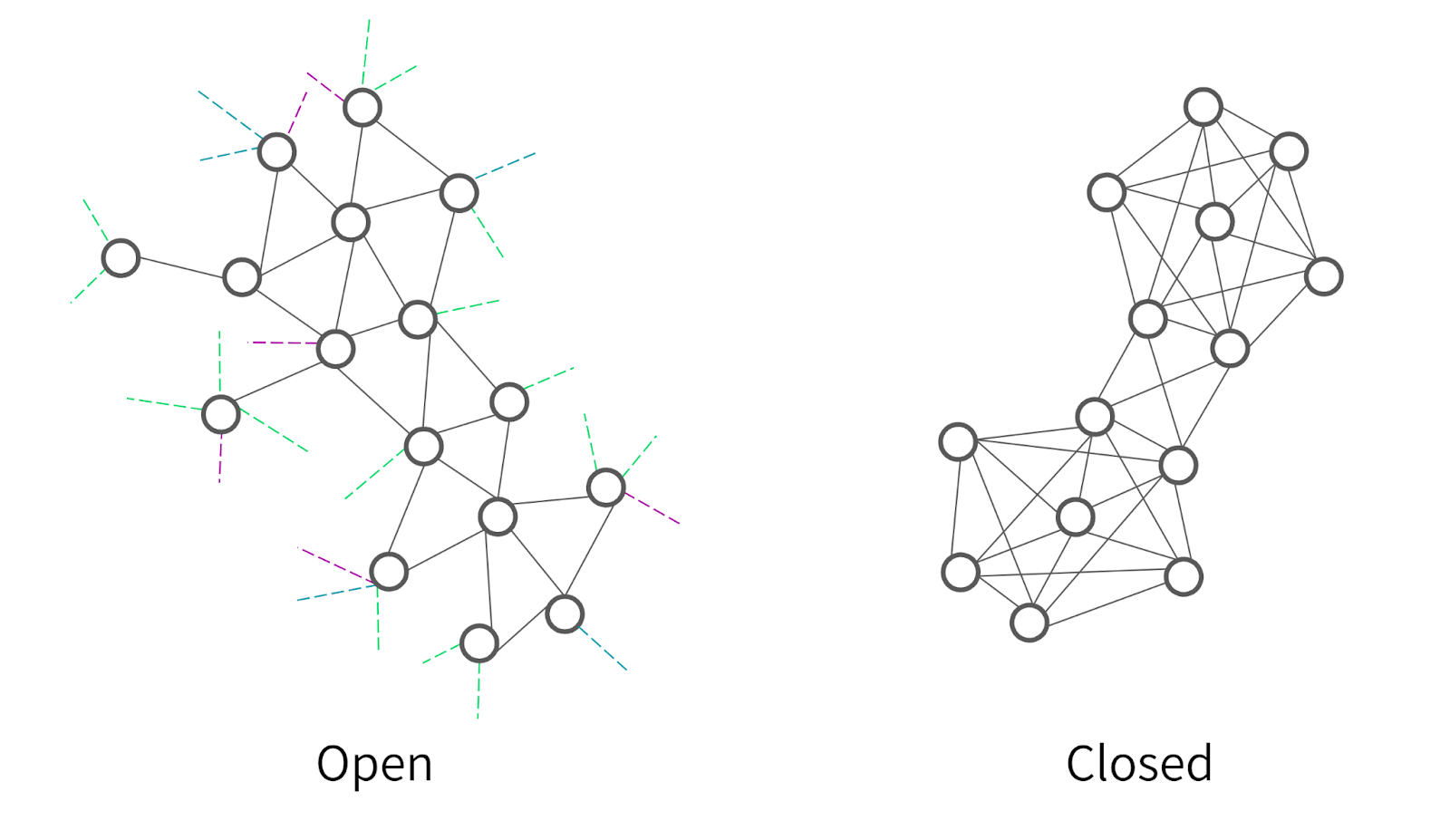
An open network is one where the nodes have capacity for new connections, while in a closed one they do not. This could either be because the nodes already have many existing connections, or because they simply have less capacity for connections. Capacity for conenctions could be physically defined (e.g. Dunbar's Number) or socially defined (e.g. encouraging norms that encourage people to make more connections).
The EA community as a whole seems to be doing fairly well on defining social norms that encourage connections - community members are typically willing to meet new people (especially at events, but even day-to-day) and to be connected with each other and help each other out.
For example, if you have a group of 100 people, and each are connected to 50 other people, the average person may have less willingness to connect to with new people. This makes it harder for new people to join the community because there are fewer structural "holes" in your network, which makes it harder for a new person to find someone to connect with. There can also be culture effects from a group of people who all know each other (which can’t be captured in diagrams sadly).
|
Openness is related to, but not the same thing as being inclusive - it’s about existing group member’s capacity and willingness to make new connections, but says nothing about who they should be connected to.
As I've flagged in the relevant sections above, the diagrams above are incomplete sketches. They highlight certain relevant and important aspects, but not all. It is my hope that these raise interesting questions and discussions, rather than serve as a definitive guide. With that in mind, here are a few illustrative examples of things that are not covered:
I think that more effort could be put to mindfully improve the EA network so that more high-value connections are made, and that active efforts to increase the number of quality connections between community members could plausibly be quite high impact and not very time intensive.
Your local group becomes a place people feel like they belong, that they want to spend time in & get value out of it. If you connect two people with a shared interest or cause area, this could make them more excited and motivated to work on those topics.
Especially if you're setting up a new group, it's good to be intentional with who you connect. Group members may reinforce each other's misconceptions, assumptions or biases. For example, it may be better to connect someone with less exposure to EA to more experienced members. It's also good to be careful with the connections you make - it's easier to be more deliberate when creating a group, then to get people to leave once they've joined.
Example Goal: Each person feels closely / meaningfully connected to at least 1 other person in the group |
By tapping into the broader movement network you can connect your group members to professionals who can provide them with tailored advice, connections and opportunities. Group members can also get alternative perspectives on things and get inspired and feel like they are part of something that is bigger than themselves.
Example Goal: Each person knows at least 2 people outside my group |
Many people could benefit from connections to relevant non-EA communities - to help them explore a broader range of opportunities that they might have a good personal fit in. What’s more, for some paths to impact knowing people in other communities can be really important if you want to work in policy, industry or even just cause areas that are established outside of EA like global health and development.
As people become more engaged in EA (especially students) there is a tendency to become more and more insular. Having a network that has connections to the outside seems a good protection against some of the downsides of insularity.
Sometimes, people will come into EA already well networked in non-EA communities - that’s great! Perhaps they would be a good person to connect to others who are less well connected.
Example Goal: Each person is connected to one network outside of EA that is relevant to their career or cause interests. |
The concept of 1-1s can be weird to those new to EA (in some cultures more than others). Thus, it seems valuable to demonstrate that 1-1s are a normal and positive aspect of your group’s culture by having 1-1s yourself with new members soon after they join the group. Focus on making it a good experience. This will make it easier and more natural to make other connections later on.
Directories allow people to reach out to each other, especially if combined with some kind of automatic matching process each week/month (like Donut on Slack)
Introduce members to relevant sub-communities that may also offer 1-1s, e.g. Magnify Mentoring, the EA & Consulting Network, EA for Christians etc.
Especially international ones, and to visit EA Hubs. There is now a lot of funding available for travel from CEA for these kinds of purposes (and you can always double check if you’re unsure!).
If your group members don't want to or can't attend these events. For example, if one of your group members is doing a PhD in biochemistry, and has expressed some interest in the biosecurity, then you could look for peer connections (e.g. someone who has a similar profile to your group member and is also exploring this career path), as well as expert or mentor connections (e.g. a FHI biosafety researcher with a technical background). You could not only see if they would be good connections for that person, but you could also learn more about their career paths and use that information to improve your understanding of the biosafety space, and share that knowledge with other members.
(I think speed networking events have their limitations. While I think that speed networking can help create a sense of community by creating more familiar faces, and making it more likely for random connections to occur (which I think can be quite valuable. However, unless they are paired with other activities, I would be sceptical of how many people actually follow-up with the people they meet afterwards, even (or maybe especially) when it’s part of a larger event. For that reason, I believe that if you’re trying to optimize for the number of high fidelity connections, it would probably be better to spend an hour making those introductions yourself, rather than running a speed networking event.)
^ H/T David Nash
Use these answers as a rough guide to the kinds of solutions you might come up with, rather than a definitive list of “right answers”. I don’t have high credence in all the individual suggestions, but I think they’re useful to show the kinds of things you could do.
Sometimes you might meet someone who is very new to the community, or perhaps has very different interests to those of the community. You may hesitate to connect them to more engaged EAs. If you’re on the fence, I’d forward their information to a connection, and ask if they would like to be connected. If you’re pretty certain that now is not the right time for that connection, you could introduce them to other members of your group - some members of EA London are happy to volunteer to have introductory 1-1s with those who are newer to EA.
Pick the ones who:
Or, you can have people opt-in - say you're going to make introductions for people and let them sign up.


Hi Vaidehi,
I saw that this sequence didn't have a banner image yet, and since I made those for other sequences I decided to make one for this sequence too.
As card image you have a network over the United States:

I'm guessing this is a flight network?
In any case, this is a good idea to visualize the idea of sociology and network science. But the colors contain red and purple, while the EA logo is purely blue. And more importantly, this image only depicts the USA, while EA is a global movement.
So I decided to look for images of flight networks that were in the creative commons. I found a flightpath visualizer that depicted the whole world, but didn't show the borders, just like in your image (which may or may not be a philosophical statement about borders). I began photoshopping the visualizations to include the exact shade of blue the EA logo uses, but that isn't always aesthetically pleasing. I made a couple of images that you can use as banner and card image, but if you have specific wishes about how you want them to look, or if you have a totally different idea about how you want your card and banner images to look, please let me know and I'll make one to your liking.


The forum compresses the images, so if you like any of these, let me know and I'll send you the high quality version of them.
EDIT: I was looking through all the sequences and messaging everyone who's missing a banner with the offer to make one for them. I saw that your "AI Alignment Literature Review and Charity Comparison" sequence doesn't have one either. You could use your card image as banner, or I can make one for you, if you want.
In my model, strong ties are the ones that need most work because they have highest payoff. I would suggest they generate weak ties even more efficiently than focusing on creating weak ties.
This hinges on the assumption that the strong-tie groups are sufficiently diverse to avoid insularity. Which seems to be the case at sufficiently long timescales (e.g 1+years) as most strong tie groups that are very homogenous eventually fall apart if they're actually trying to do something and not just congratulate one another. That hopefully applies to any EA group.
That's why I'm excited that, especially in the past year, the CBG program seems to be funding more teams in various locations, instead of just individuals. And I think those CB teams would do best to build more teams who start projects. The CB teams then provide services and infrastructure to keep exchange between all teams going.
This suggests I would do fewer EAGx (because EAGs likely cover most of that need if CEA scales further) and more local "charity entrepreneurship" type things.
This idea is really interesting!
...most strong tie groups that are very homogenous eventually fall apart if they're actually trying to do something and not just congratulate one another.
This doesn't quite match my observations of (at least some) EA groups that have been around for a while (e.g. the Bay area community is quite homogeneous but has been around for several years, and they seem to be doing things) - do you have an example of groups falling apart you could share?
I thought that there was a typo and this should have read:
...most strong tie groups that are very homogenous eventually fall apart if they'reNOTactually trying to do something and not just congratulate one another.
I retract the text above—I think I'm wrong and just adding noise.
I also want to know the answer to Vaidehi's question. She has good judgement (and I probably should stick to boosting her comments, as a general rule).
Wanting to leave a breadcrumb here for other EAs interested in the leading edge of network thinking.
What this article describes is a beautiful introduction to something quite complex and powerful. We do this work naturally - it is indeed something that emerges in our system by itself. By increasing our understanding of how it works, we can increase our awareness of the networks we participate in, and intentionally shift our behaviours to change the properties of the network.
In my experience, the theory is great, yet studying the theory doesn't really give one the skill to actually do the thing. It's a bit like learning to ride a bike, or learning how to have really good conversations, or learning how to show up with both warmth and competence at the same time - it takes a good learning container to practice in and coaching/support from someone with greater awareness and skill.
Here's the breadcrumb: there is a network of folks with a ton of capacity in this area, already playing within EA and communities beyond. In several communities (though not directly within EA yet), we actually offer training on developing these skills. If you find this note and are interested in connecting, I'd love to hear from you! If we aren't connected directly, I'm sure you could use your network to find me :)
Great article. Thanks for writing this up in such detail.

Could you possibly add something at the top about how this is different, if it is, from what's happening at the moment in EA? I read the first few paragraphs and decided to stop because it seemed to recommend the status quo (and hence wasn't new info to read).
+1. I was really excited by this because I think networking can be so powerful, but skimming through, I didn't have that many takeaways from this. The key divergence from the status quo that I saw was encouraging non-EA connections.
I think this point ("we want EA as a whole to be closer to a distributed network where people have strong connections with several other people, rather than a extremely centralised network with strong connections to only a few people") is especially interesting to me, but I'm not super sure how to address it ... My efforts at helping others become more networked doesn't always result in them developing their own networks. For example, I try to introduce UChiEA members to members and organizations outside of us, but maybe ~50% of the time it just reinforces centralisation (I am 'the person' to contact).
But that starts to feel like 'general networking skills' and perhaps that's just beyond the scope of this post. : )
edit: My anecdote is purely based off my personal impressions. I have yet to gather any data on whether my attempts to connect my members to others were actually unsuccessful at inspiring them to become better networked.
However, I see no evidence that the members whom I encourage to make intra- and inter-organization (within UChiEA and between a UChiEA/non-UChiEA member) connections later become better networked (e.g., they do not seem to have developed more relationships with other UChiEA or non-UChiEA people; they do not seem more familiar with non-UChiEA orgs).
Hi Miranda, you can see my response to Michael which addresses your first point.
Thanks for raising this. Could you possibly provide an example of this happening? I'd be really curious to know of a specific example you have in mind, and what exactly happened. I don't have a good mental model of why this is reinforcing you as the key contact - do the members not interact with non-EA organisations? Do they have a one-off conversation but not take it further? Are they afraid of networking themselves?
Also, what do you mean by being "the person" to contact - could you give an example of this? It's not clear to me if this meas that people from outside of EA see you as the person to contact, or community members themselves (or both / neither / something else entirely).
On a related note, it's unclear to me how distributed we want intergroup networks (i.e. a network including your community + others) to be and what cost this comes at - I think we could be more distirbuted than we currently are. I think the challenge is that I'd want people who are pretty committed engaged EAs to do this - but those are the people who are most likely to be have fairly insular and relatively closed networks.
Thanks for responding! I will note that I haven't gathered data on this so my original comment is misleading, since I didn't note that this is just my impression (that my attempts reinforce centralisation).
Here is what I think is happening more often than not when I connect a member to someone:
Re: "the person" to contact, I'm referring to the perception of my group members. My bad for the lack of clarity!
Hi Michael, Thanks for pointing this out - I think I could have signposted what I think the value of this post is at the top (which I've now done).
I wasn't really trying to make an argument about how it's different very strongly (an initial draft of this post was framed more as a recommendation ). I also think the post is probably more helpful for community builders than the average community member.
My goal was not to necessarily provide new information. Instead, some of my goals with this post were :