Note: This post was crossposted from the Coefficient Giving Farm Animal Welfare Research Newsletter by the Forum team, with the author's permission. The author may not see or respond to comments on this post.
Subtitle: On vegan advocacy, effective altruism, and FIFA
I turn 40 today. Here are some hot takes.
On factory farming
1. Our biggest challenge is salience. If factory farming led the evening news, it wouldn’t last lo...
On October 22nd starting at 10:00am Pacific Time, Every.org is matching donations to select animal welfare organizations at a 2:1 rate, up to $2,000 per donor per nonprofit (so if you give up to $2,000, they will contribute up to $4,000 and the nonprofit will get up to $6,000). The first donation a donor makes to each eligible nonprofit will be matched, and donors can get the match for multiple $2,000 donations. So, you can get more than $2,000 matched by donating $2,000 one time to multiple...
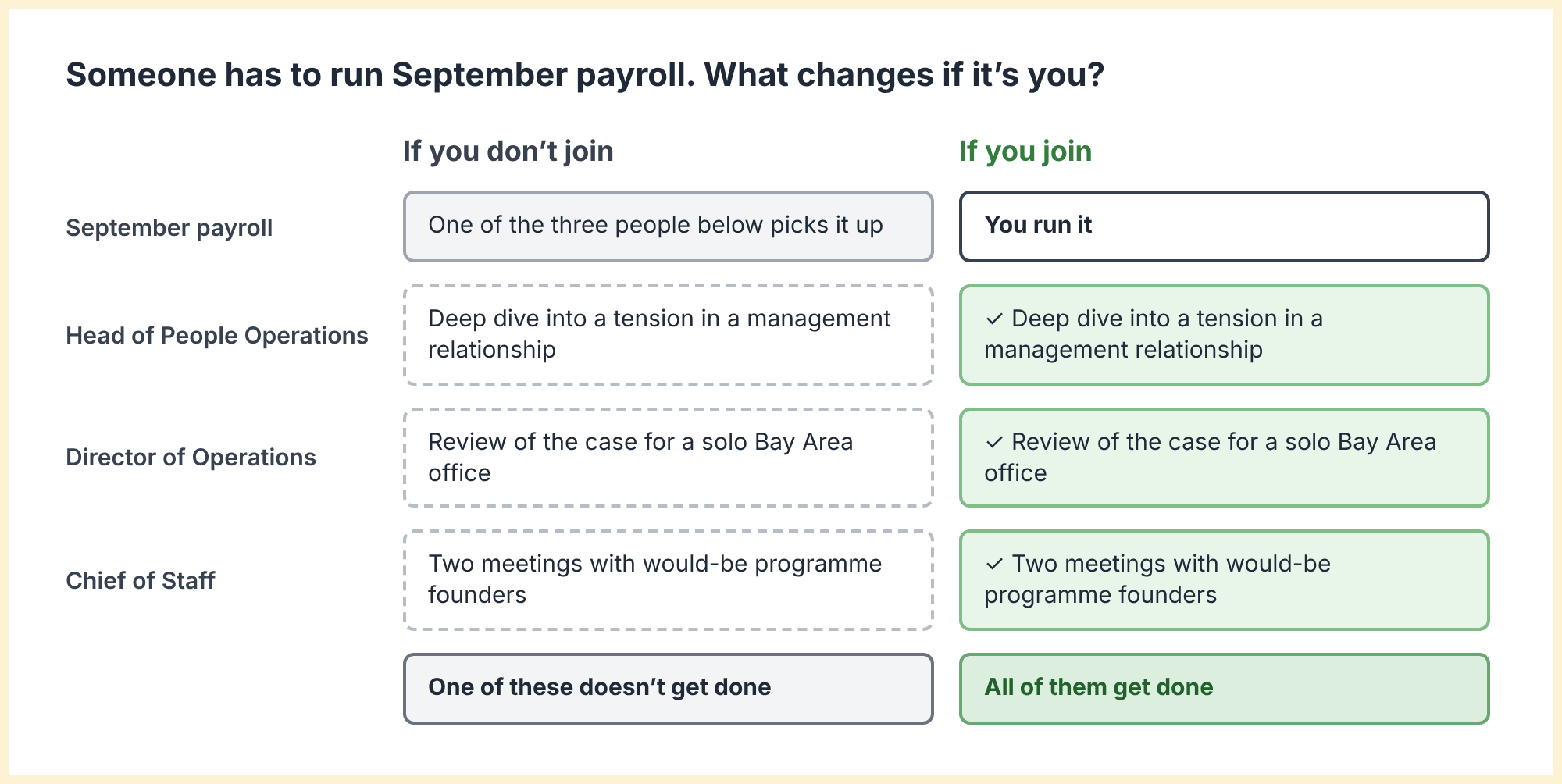
When speaking to candidates who are considering working with us at 80,000 Hours, I often hear people worry about replaceability.
The familiar version of the worry is about whether the organisation will hire someone else in your place. If it will, then the difference you make by taking the job is only the difference between you and them.
There are a couple of well-known answers to that. The person hired in your place probably cares about the world too, and would go on to do somethi...
Some fraction of people who don't work on AI risk cite "wanting to have more certainty of impact"as their main reason. But I think many of them are running the same risk anyway: namely, that what they do won't matter because transformative AI will make their work irrelevant, or dramatically lower value.
This is especially obvious if they work on anything that primarily returns value after a number of years. E.g. building an academic career or any career where most impact is realized later, working toward policy changes, some movement-building things, etc.
But also applies somewhat to things like nutrition or vaccination or even preventing deaths, where most value is realized later (by having better life outcomes, or living an extra 50 years). Though this category does still have certainty of impact, just the amount of impact might be cut by whatever fraction of worlds are upended in some way by AI. And this might affect what they should prioritize... e.g. they should prefer saving old lives over young ones, if the interventions are pretty-close on naive effectiveness measures.
Why should they prefer saving old lives over young ones? How does transformative AI affect that? Even if transformative AI quickly cures aging, I don't understand why it would be preferable to save old lives over young ones in advance of transformative AI, all else being equal.
Assuming two interventions are around similarly effective in life-years saved, interventions saving old lives must (necessarily) save more lives in the short run. E.g. save 4 lives granting 10 life-years v.s. save 1 life granting 40 life years.
Uh huh… I doubt you’d find shovel-ready projects, though.
I don't know what you mean? You can look at existing interventions that primarily help very young people (neonatal or childhood vitamin supplementation) v.s. a comparably-effective interventions that target adults or older people (e.g. cash grants, schistosomiasis)
There are multiple GiveWell charities in both categories, so this is just saying you should weight towards the ones that target older folks by maybe a factor of 2x or more, v.s. what givewell says (they assume the world won't change much)