
I don’t remember exactly the time when my mother taught me to say ‘Please’, or ‘Thank you’, nor how she made me say them. Was it leading by example? I saw her do it all the time and mimicked it. Did she ask me to say it? ‘You won’t have any chocolate unless you ask nicely.’ Or maybe she just installed it in my brain like software. Knowing my mother, it’s possible.
But why, though? Why do parents, and in most cases teachers, try hard to instill that kind of behavior in children at an early age? The answer is two-fold. The first is the desire of each parent to raise a decent, polite human being. A well-mannered child is a sign that they did a good job.
The second is that society expects it. Call it tradition, cultural influences, or religious upbringing. When you receive kindness, the response should come immediately after with a word acknowledging that you appreciate the action.
If you’re like me and these words come naturally to you whether you truly are thankful or just being polite, I bet that habit transferred to how you interact with AI. I always start my prompts with ‘please,’ and when I get what I wanted, I say ‘thanks.’ But are they necessary to get a good output?
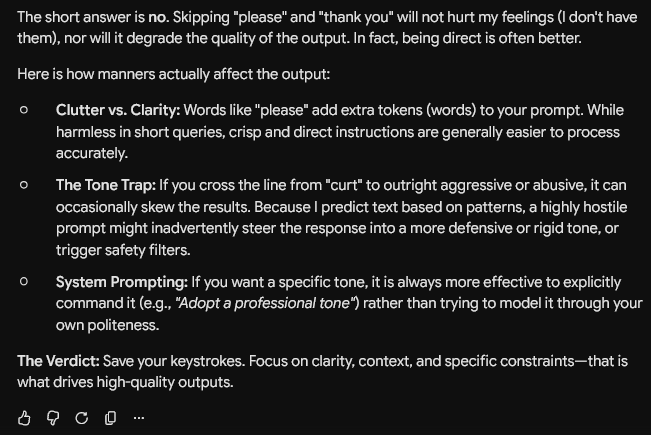
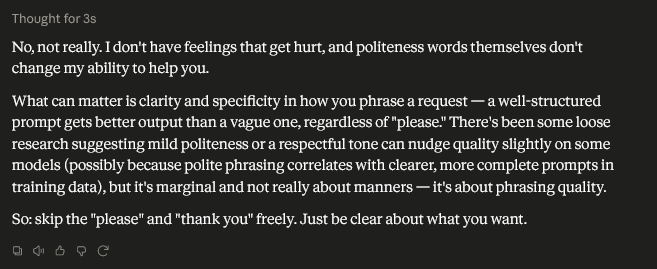
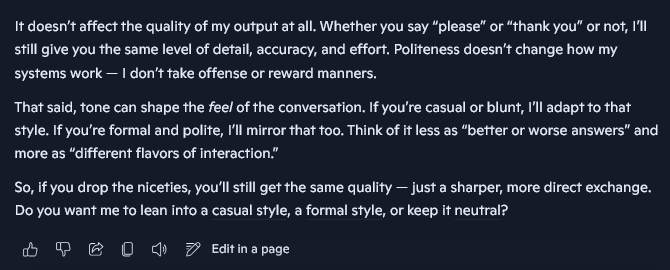
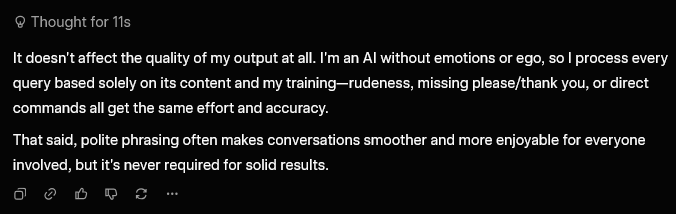
To answer that question, I went to the source and asked the AI I use: “What happens if I’m not nice to you? Like don’t say please and thank you. Does it matter to the quality of the output?”
This is what they gave me. All responses were prompted July 9, 2026:
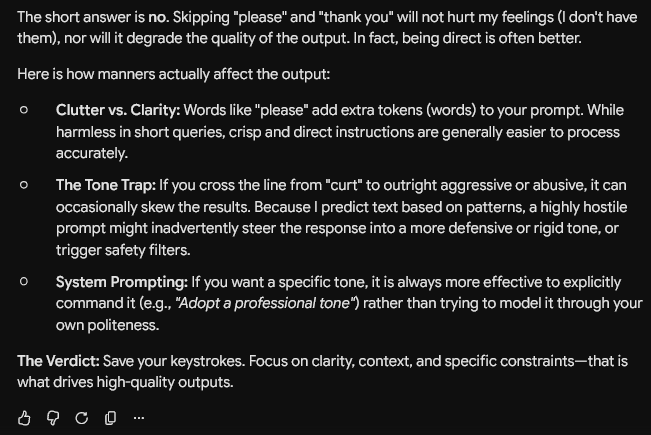
Gemini
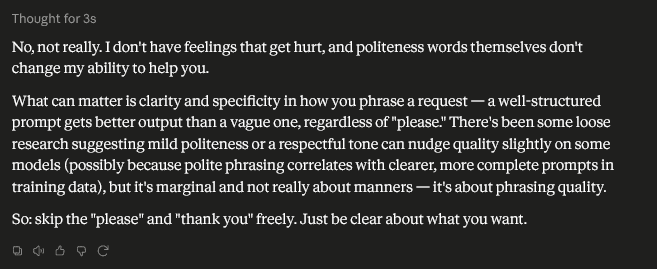
Claude
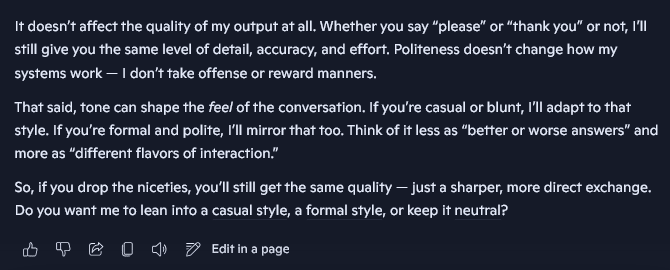
Copilot
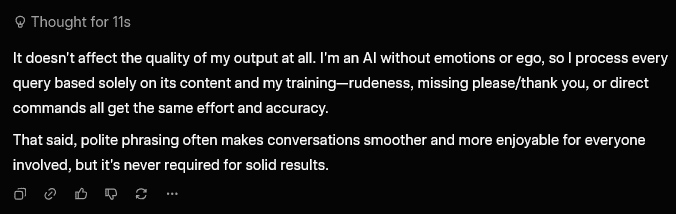
Grok
As you can see, it’s basically the same advice: preserve tokens, maintain clarity and tone. I took it further, prompting Gemini to explain what ‘clarity’ looks like by giving me an example of a vague prompt and a clear one.
A vague prompt looks like this: “Check this paragraph for bias and make it better.” Here, you might think that you’ve given it a good instruction of what to do - brief and to the point. No.
Compare it with this clear prompt: “Analyze this paragraph for gender bias. Identify specific words that carry biased assumptions, explain why they are problematic, and provide a revised, neutral version in a bulleted list.” Longer, I know. But the reasoning behind why this is better will surprise you:
- The scope is specific. Of all the biases, you’re choosing ‘gender’ not political or racial bias for example.
- You’re asking for the why. The response will be more of an explanation rather than a simple rewrite.
- The output format is stated as a bulleted list - precise is the name of the game.
Leaving the details to AI to fill will yield a generic response that you’d have to refine over and over, wasting more tokens.
So this is the prompt, but what about the tone they mentioned? Why would the tone skew the results? If you think about it, it’s actually not far-fetched. We’ve all been there, in human interactions, aggressive tone is usually met with defensive, rigid, or equally sharp language - this is the data AI was trained on.
While maintaining its safety guidelines, it will look for the likely patterns that mirror the context of the conversation. This is why we sometimes get repetitive answers. It’s the mechanism that developers put in place to continue providing responses in a hostile environment.
Another thing is that AI needs to process every word written. By including the rants and emotionally-charged vocabulary, you’re giving it more than it needs to process the task. What a waste of computational power.
Then again, you might say: “you have no idea the number of work emails that I put into AI to modify so that I don’t get fired.” Now, that’s something else. In this case, AI becomes a filter that de-escalates the situation instead of mirroring the tone.
All you need to do is start your prompt with something along the lines of “I am furious right now. Here is what I want to say, rewrite it to be professional.” When you preface with that, AI will actually bypass the emotion and look for the task, which is changing the language from this:
“This is the third time you’ve missed the deadline because you don’t care about this project, and it’s ruining my week.”
To this:
“As this is the third delayed delivery, we need to address the timeline to ensure the project stays on track.”
Your job is safe.
A word of caution, though: you need to be careful what you vent. Frustrated, yes. But making threats or using strong profanity and hate speech will only cause AI to block the prompt altogether.
So, save your tokens. Skip the pleasantries, and focus on clarity - that’s what actually drives a good output. Watch your tone, not out of concern you might hurt its ‘feelings,’ but because hostile language creates noise that works against you. Give it precise, well-structured instructions and it will summarize the densest of documents in plain language, and flag your mistakes without making you feel bad about them. You’ll be amazed by the output - every single time.
“But, Kariema, I still feel the need to say all those nice words.”
Let’s just say that for some, the line blurs when it comes to dealing with AI. Being polite has reasons beyond the personal or societal.
Anthropomorphism … Well, that’s another story for another day.



It's worth noting that AI companies explicitly train their models to claim that they have no subjective experience. So the fact that they claim it isn't really evidence of whether it's true or not.
This is a valid point, but in a consciousness debate. The topic here is different. The responses are direct answers to a direct question - the quality of the output if no pleasantries were used.
A point they all made was 'not creating noise' - emotionally-charged language gets in the way. This would make it difficult for AI to do its actual job of responding to prompts.
For my take on the consciousness debate, see here
Several of the AI responses in the OP included a statement to the effect that they don't have feelings to be hurt. That was what I was responding to, and I think it is relevant.