Comments
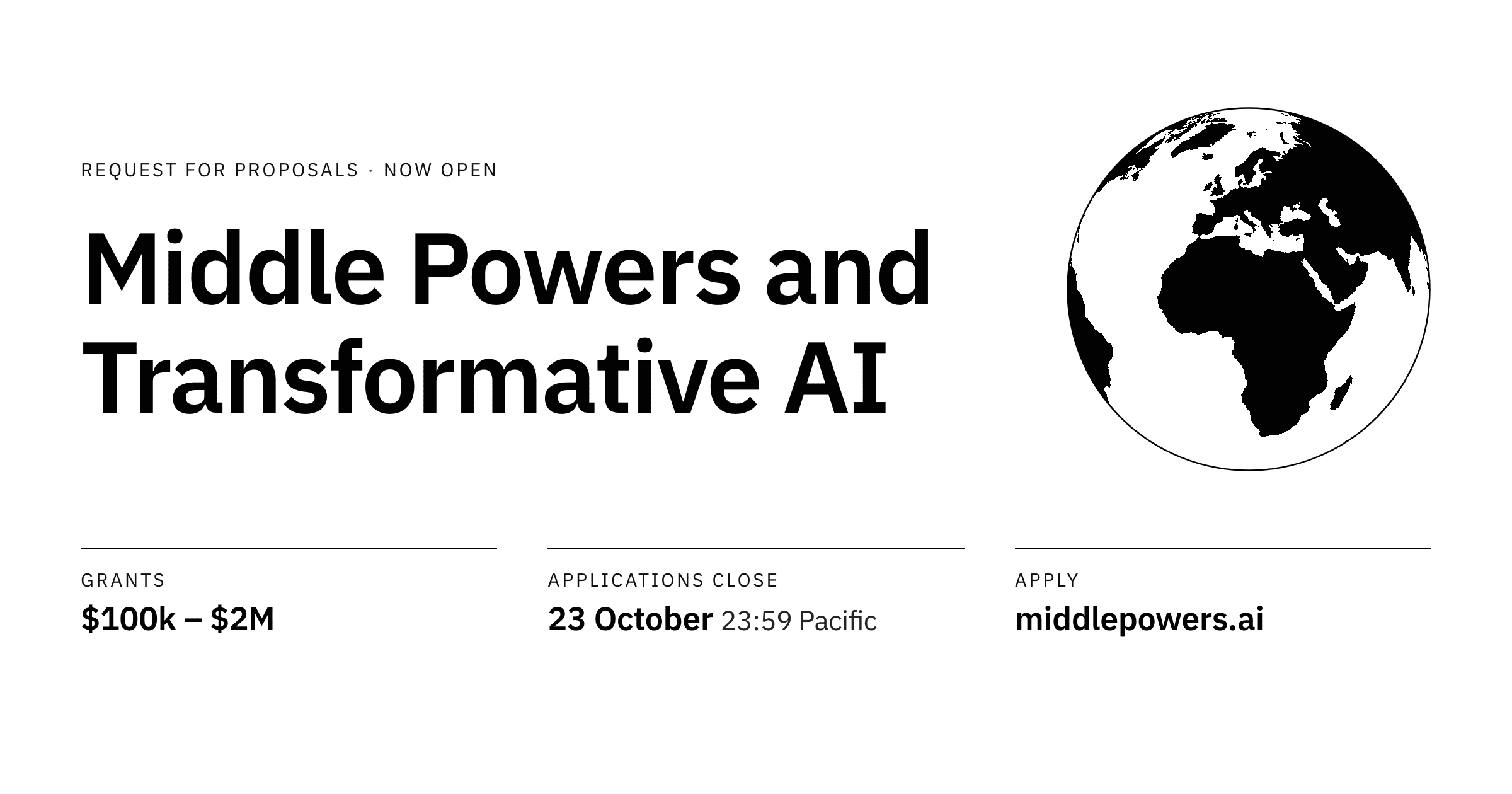
Today, we are launching a request for proposals on AI policy in middle powers, with $10M (and potentially more) of funding available. Apply at middlepowers.ai by October 23.
I think that most countries are on track to become increasingly irrelevant to the future of technology, the economy, and geopolitics. The US and China, along with perhaps a few countries with key roles in the chip supply chain and data center buildout, will hold all the cards. The rest of the world will be bystanders, or at best passengers on the great train of history, unable to affect the destination. I hope that middle powers can help ensure AI is developed for the benefit of all of humanity.
Having one country, or even one company, make many of the key decisions shaping the future of humanity would be an extreme concentration of power. Even if decision-makers are well-intentioned, they may miss considerations that would have been caught by stronger checks and balances from more actors being involved. And given the propensity of power to corrupt, we can reasonably worry about the judgement and values of whoever ends up calling the shots. AI development is more likely to be safe, secure, and broadly beneficial if it is shaped by a wider range of democratic countries.
Concretely, we think middle powers need to:
This won’t be easy. It may not even be possible on the shortest timelines. But it is imperative that middle powers use what influence they have while they can, and build leverage to deploy later. It was heartening to see a coalition of middle powers calling for stronger safeguards to keep AI under human control at the UN this week.
To help you get started we have listed 16 categories of projects we would be excited to fund, including work on data centers, chip supply chains, building political will, diplomacy, field building, evaluation and verification, and more. We also include a reading list for getting up to speed if you want to contribute but aren’t that familiar with past work.
If you are a researcher or a writer, a builder or a convener, a dreamer or a doer, we look forward to hearing from you!
What about the worry that building more data centers accelerates AI progress and so is bad? I would be happy to see more modelling on this, but my understanding (based on some research and talking to relevant people) is that by far the greatest bottleneck on the compute buildout is chip manufacturing. There are no stacks of GPUs waiting for a data center to house them, and there won’t be anytime soon. There will be some small effect on the margin where making data centers cheaper and easier to build makes that business slightly more profitable, allowing hyperscalers to pay slightly more for chips, allowing semiconductor companies to invest slightly more in capex. But this effect seems small, and so a good approximation is that building a data center in one place causes one fewer data center to be built elsewhere.


This makes a huge amount of sense to me. Especially after the Open AI hack of Australia today! Middle powers are probably the most motivated to make sure AI goes well - and they have less to slose. You can get so much more leverage by using a rudder than trying to row a ship against the current.
The idea that the only 2 countries that matter with AI are China and USA seems absurd to me. Of course they are the most important, but they are also dependent on the economy of the rest of the world. #
Nice initiative!