Comments
TL;DR:
- I lead Pure Earth, a nonprofit that improves public health and development outcomes by reducing lead poisoning and exposure to other toxic pollutants.
- Lead exposure is responsible for an estimated 3.5 million deaths a year, roughly 6% of all deaths worldwide. Lead also costs the average exposed child in low- and middle-income countries four to six IQ points. A study by World Bank economists put its total economic cost at $6 trillion annually.
- Until 2024, international funding to prevent lead poisoning was only about $15 million annually. New commitments have increased that figure, but UNICEF estimates it would take $1.6 billion to put the world on track to end childhood lead poisoning by 2040.
- Our flagship program, SCALE (short for Scaling Country Action on Lead Exposure), works with governments in more than 20 high-burden countries that are home to about 550 million lead-poisoned children, roughly half the world’s total. The program was vetted and selected for funding by The Audacious Project, a collaborative philanthropy platform housed at TED that solicits thousands of world-changing proposals and selects 10 winners annually.
- SCALE is budgeted at about $154 million through 2033, with about 83% secured. We select countries mainly by how many lead-poisoned children are present, and the remaining $26 million would cover about four countries, likely home to roughly 20 million lead-poisoned children.
This week, I wrote in Devex on why the best investment in human intelligence is cheaper than one data center. I timed it to Anthropic’s IPO and the talk of a third wave of philanthropy, but I believe its core argument stands on its own: ending childhood lead poisoning, which affects more than a billion children, needs more funding, and it is one of the most cost-effective ways to protect human health and intelligence.
As part of Marginal Funding Week, I want to explain how Pure Earth would use additional funding to increase our impact in 2027 and beyond, and why now is an important moment for support.
------------------------------------------------
Why Lead Poisoning?
- Importance: At current levels in low- and middle-income countries, an average child loses an estimated four to six IQ points due to lead exposure.
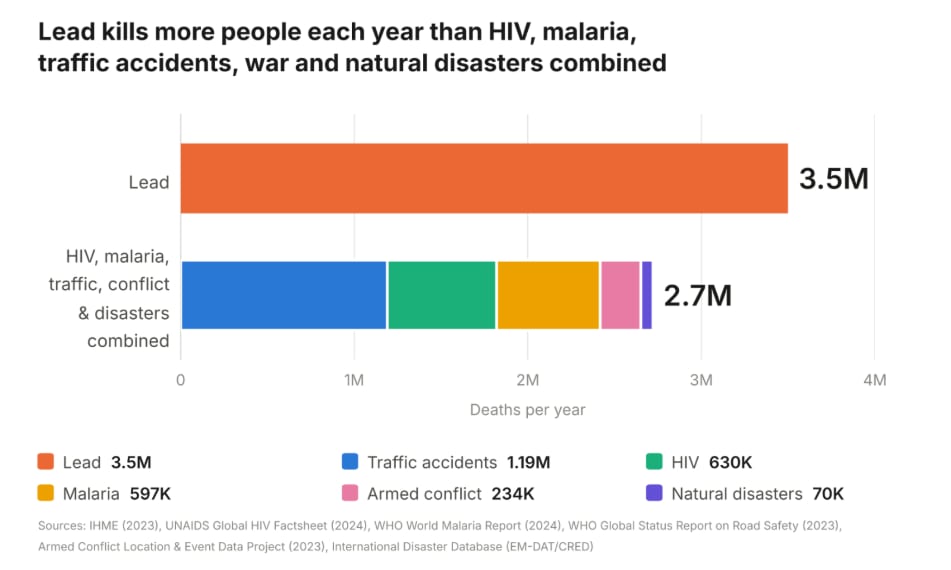
- Cost: A study by World Bank economists estimated that deaths and lost IQ from lead cost the global economy about $6 trillion annually.
- Neglectedness: Until 2024, the world had spent only about $15 million in international assistance per year. New commitments have increased that figure, but UNICEF estimates that substantially reducing exposure would cost at least $1.6 billion over 15 years, a fraction of the cost of one large data center.
Tractability: Rich countries largely solved this problem through fuel rules, product testing and paint bans. We have the tools to solve this crisis in low- and middle-income countries, but we need additional resources.
How We Would Use Additional Funding:
Pure Earth’s SCALE initiative is 83% funded, thanks to the generosity of The Audacious Project donor community and Bloomberg Philanthropies. The remaining gap is $26 million.
In each country, SCALE works in three steps, alongside governments:
- Reveal: a nationally representative blood lead survey, owned by the government.
- Pinpoint: testing food, spices, cookware, cosmetics, paint, and soil to rank the sources driving exposure.
- Eliminate: regulation, enforcement, cleanup of contaminated sites and public information.
We choose countries on a rolling basis. Lead poisoning burden counts most: 60% of a country’s score is the number of children with elevated blood lead levels, and prevalence and severity make up the rest of the ranking. We then screen for tractability, including government commitment, state capacity, and partner presence. Secured funding goes mostly to the highest-ranked countries, plus a few where earlier work lets us move straight to cutting exposure, so the remaining $26 million decides how far down that list we can go.
In each country, the work targets the lead exposure sources driving poisoning there. Our main priority areas:
- Food and dietary lead. Our research suggests contaminated food may drive up to half of all lead exposure globally (preprint).
- Consumer products. This covers the establishment of regulations, testing capacity, and enforcement for cookware, spices, cosmetics, and other contaminated market goods.
- Battery recycling. We would work to make used lead-acid battery recycling safer.
- Technology. With a collection of university research partners, we’re developing machine learning tools that use satellite imagery and other data to find polluting sites faster and to predict their impact on exposure levels and health.
- The LEAD Hub. Built with the Institute for Health Metrics and Evaluation, it will be a one-stop shop for lead exposure data: blood lead levels, exposure sources and proven interventions, in one shared global database.
Two further needs sit outside the $26 million:
- Follow-up national blood lead surveys: our budget covers baseline national surveys but not endline or repeat ones, which cost about $2.3 million each and are the most direct proof that blood lead levels fell.
- More room in the SCALE Acceleration Fund. It funds shared tools that make everyone working on lead more effective, research on questions that hold up implementation, and regional or global policy work on sources that cross borders, such as the international trade in recycled lead. It scores proposals on scale, neglectedness, tractability and cost-effectiveness.
How We Count Impact:
The 550 million children figure is our reach target: the lead-poisoned children across all SCALE countries. This guides our country selection. Our impact target is an average 20% reduction in blood lead levels among the children whose drop in exposure we can measure or credibly estimate. We count only our share of results that wouldn’t have happened without us, and we report what didn’t work as openly as what did.
What Could Go Wrong?
- Governments may not enforce new rules or act on new data.
- We can’t afford follow-up national surveys everywhere, so much of our impact will be estimated from changes in lead levels in products and environmental contamination, not measured in children.
- Credit is hard to assign when governments, UNICEF, Bloomberg Philanthropies and other actors all contribute, so our share of results will be an estimate.
- We’re scaling quickly, which can strain hiring and management.
Why Now?
The path to a lead-free future runs through governments, and we are starting to see that shift:
- Bangladesh approved a national strategy to cut children’s blood lead levels by 95% by 2035.
- Ethiopia set a 60% reduction target for 2030.
- Ghana set its first legal limit on lead in cookware.
- Bureau of Indian Standards certification is mandatory for aluminum cookware manufacturers nationwide.
These commitments create a window of opportunity. Funding now turns them into action: blood lead level surveillance, enforcement, and prevention efforts that protect children today and for generations to come.
Pure Earth Can Absorb More Funding:
A fair question for any growing organization is whether it can absorb and responsibly deploy new money. Our organizational deployment has grown about 19% a year for 21 years, from $0.6 million in 2005 to a projected $21.6 million in 2026.
Year | Revenue_and_Support | Organizational Expenses |
2005 | $0.9 M | $0.6 M |
2010 | $4.2 M | $3.4 M |
2015 | $2.3 M | $3.1 M |
2019 | $3.8 M | $4.3 M |
2021 | $10.8 M | $6.5 M |
2023 | $5.2 M | $8.1 M |
2025 | $47.7 M * | $9.7 M |
2026 projected | $35 M | $21.6 M |
*2025 revenue includes multi-year SCALE pledges recorded when made
We have a track record of growing quickly. Over the past year, we opened operations in Brazil and Ethiopia, and are now opening in Nepal, Tanzania, Malawi, Rwanda, South Africa and additional Indian states, roughly doubling our operating footprint between 2024 and 2027.
How To Give:
You can donate here. For larger gifts, or to walk through the SCALE budget, email [email protected].
Questions are welcome in the comments.