Thanks for writing about this, @gogreatergood🔹 In full disclosure, I work at TLYCS. We have consistently and continuosly improved our evaluation framework over the years and we publish the full evaluation for each organization we recommend. We consider ourselves very aligned with EA principles, but our mission is oriented to avoid deaths and suffering of people living in extreme poverty, and that's the positioning we lead with. When it comes to communicating in channels with broad reach (such as paid digital ads) to potential donors that might not be familiar with Peter's book or with EA, we find that simple messages that are "specific, cost-to-impact ("$64 = one catarat surgery") work best for click-through and conversion, according to performance of our ads last Giving Season campaign. Impact seems to be an effective hook here. On the other hand, in a recent 3-email campaign within our subscribers (made up of donors and/or people who downloaded the book), we tested different titles for the emails, and found that messages with more emotional apeal ("Empowering communities to care for their expecting mothers. An institutional donor is matching all gifts") led to better open rates than leading with cost effectiveness ("A highly cost-effective way to protect pregnancy. An institutional donor is matching all gifts.). This might be the relatability you talked about.
After a donation is made, one of the most frequent feedbacks left by our donors is "thanks for doing the work so I know where to give", (which is why we have been highlighting that message in our own channels). Note that this is unsolicited from our part, some donors just write a version of that on the optional "comments" section when making a donation. Cost-effectiveness or effective altruism hardly ever come up, yet donors value the work that has been done to inform the recommendation. At least in our context at TLYCS, informing that we have clear evaluation criteria and explaining the work that goes behind a recommendation (which we consider very aligned with EA principles) seems to be more important than labeling it. I wonder if this approach could work with other EA causes as well. Lastly, I'll take note to reach out to GWWC and ask about their evaluators' evaluation. Thanks!
Thank you for taking the time to read my thoughts and respond Barbara! All the more so with you being the CMO at TLYCS! 💗
Please do reach out to GWWC, in my opinion they should have evaluated TLYCS as an evaluator ages ago! Out of respect if nothing else! (Even if they ultimately decide to keep your charities out of their "top tier" recommendation fund combo... or any other such qualifiers based on how much they agree with your specific evaluation criteria!)
Felicia of GWWC told me the other day in email, in regards to on-boarding individual charities recommended by TLYCS, like Fistula Foundation: "we have historically considered a TLYCS recommendation to be an example of 'support by impact-focused evaluators' for the purposes of our 'other supported program' criteria, so it is possible they [Fistula Foundation] would be onboarded if they applied."
...so GWWC already do consider TLYCS backing, as a big plus for any individual charities they consider adding; but they have yet to check into you a little deeper to flat out simply input all your work into their database.
In the meantime, TLYCS will continue to be my personal go-to, for any and all work I do in spreading high impact charity ideas to others. Your set up kicks ass more than anyone else in the world! 💗
-- If GWWC inputs your work into their system (or looks into your work and explains why they will not do that), then GWWC may also become my personal go-to alongside you.
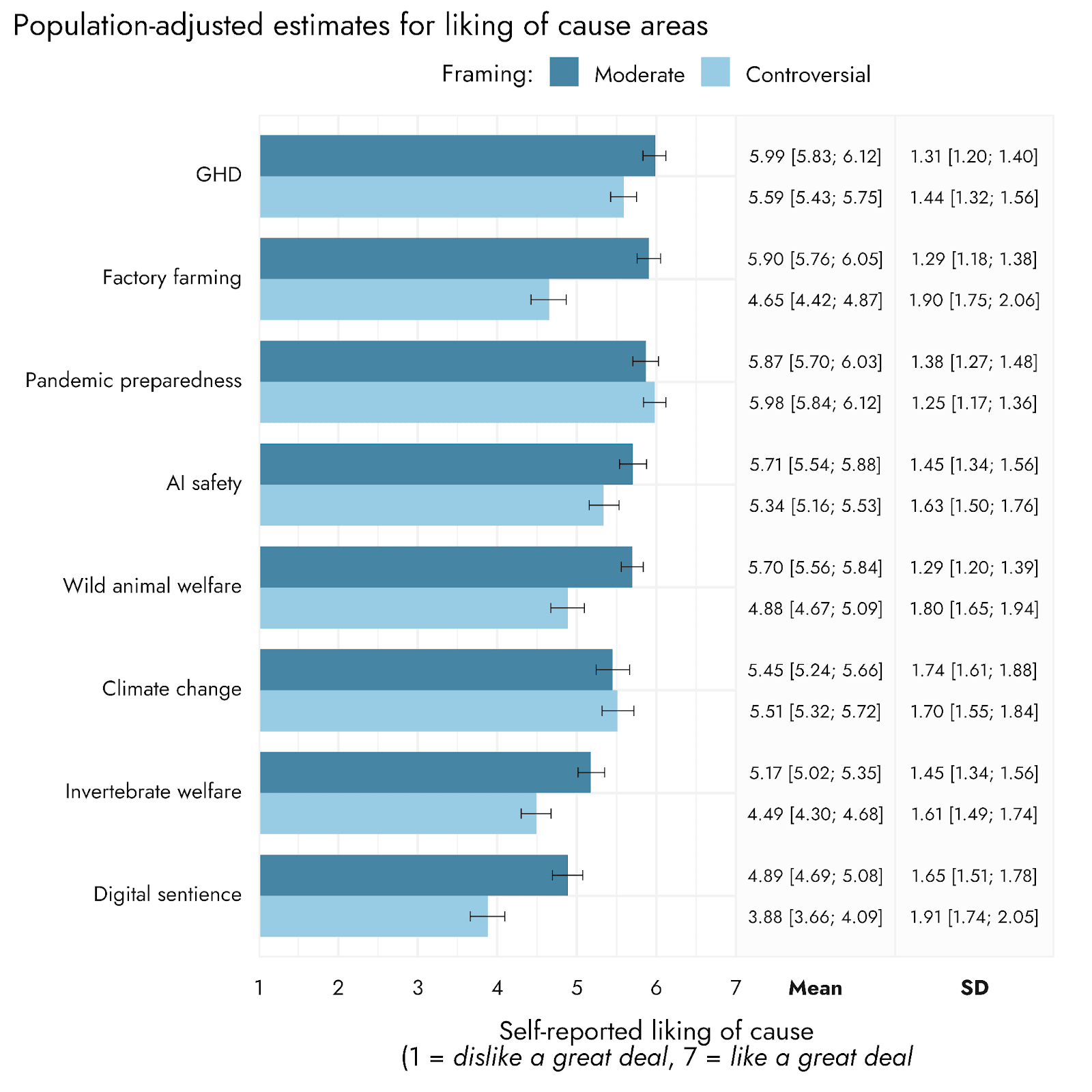
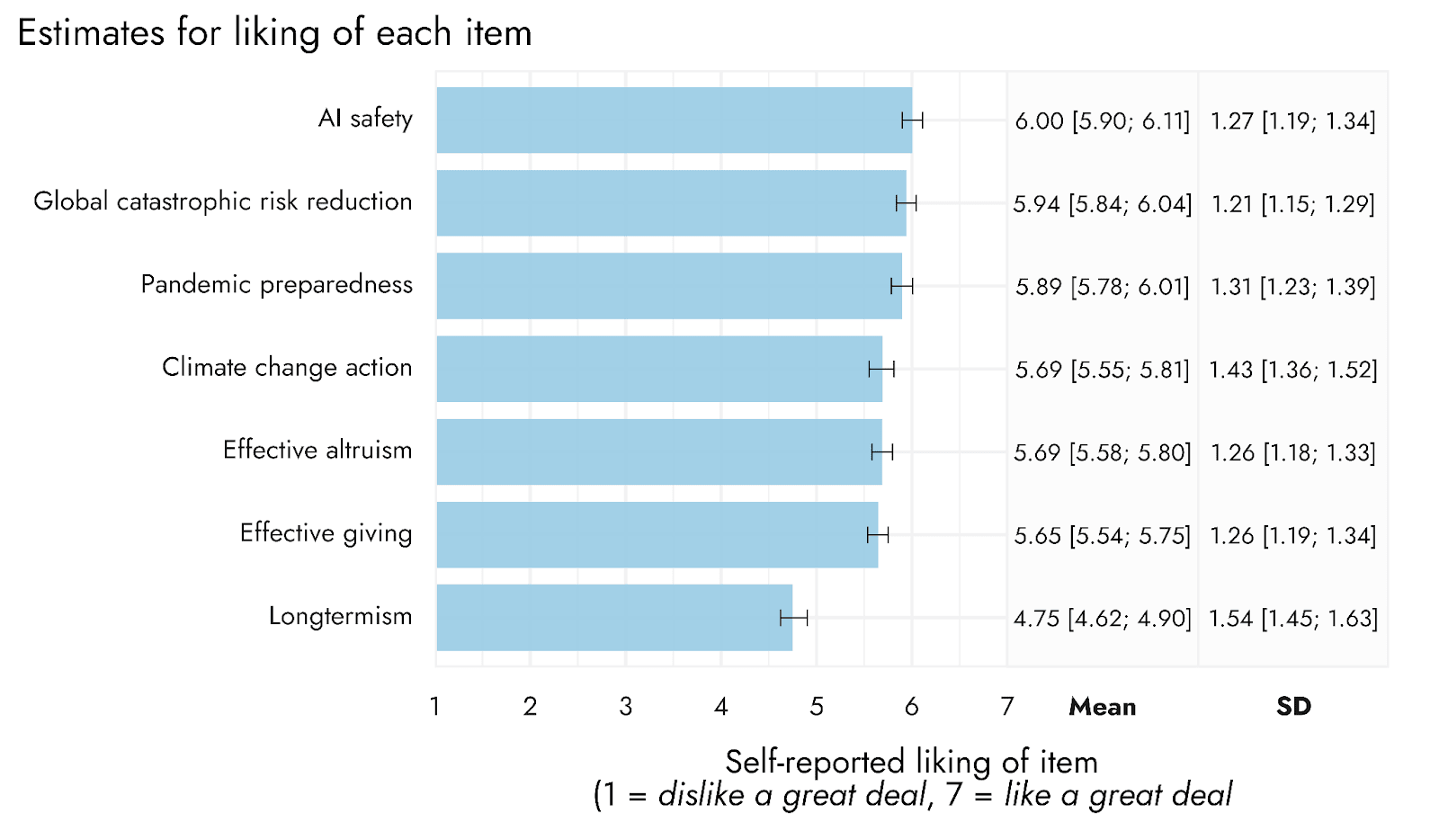
You may also be interested in our research examining how the public respond to different cause areas used in outreach (this was more coarse-grained than particular charities).
I think the results would be surprising to many (which we tested by asking forecasters to predict answers in advance).
Thanks for taking the time to read and respond. Wow! Fascinating charts indeed! RP does so much interesting stuff.
The liking rate for most categories are quite similar, which surprises me in a good way.
It would be cool to see this exact breakdown with specific charity examples. I truly can't imagine that "chemoprevention for kids to prevent some of them from getting malaria" could rate anywhere near "cure people from blindness via cataract surgery". But you never know.
I have personally found malaria one of the easiest cause areas to talk about with people outside the EA community. Ansh is great, too, of course, that’s a good idea as a helpful example.
I agree with the sentiment that it's good to explain different types of charities when introducing EA and not all will work equally well for everyone.
To me, it is a surprising observation that people don't know what malaria is! I don't think I've ever conciously come across an adult who didn't know malaria at all (I don't live in the US). I also think "buying bednets" is easier to communicate than chemoprevention.
I think most people around here in New Jersey have heard the word "malaria" but don't know what it actually is, to the point where they can define it. Haven't you ever seen the show "Jersey Shore"? ;)
I agree that bednets is easier. Evokes way less questions.
Perhaps one positive though tiny step here, would be if these evaluators listed AMF first instead of MC. That's a great addition to the convo thank you Simon !!!
The easiest on-ramp to effective altruism is donating to effective charities.
Yet ever since Peter Singer's TED Talk, with its relatableexample of helping the blind via... seeing-eye dogs VS. curing through cataract surgery... there has been too little attention paid to this approach.
We should utilize that OG example, or similar ones, far more often... alongside easy steps people can take to give to the relatable charities that do these kinds of relatable actions.
With EA getting more mainstream press, including an upcoming Netflix series, it's high time to highlight EASY and RELATABLE on-ramps to effective giving.
The problem
Imagine walking up to a stranger and asking them to donate money, to give children chemo, to prevent a percentage of them from later getting malaria.
Would that be an effective way to get more people into effective giving?
Of course not. It evokes more questions and doubts than answers and easy actions.
What's malaria? How many get it? How many die from it?
Chemo? Like, you give them the same chemo drugs that cancer patients get?
What percentage of kids benefit from these drugs?
Do the drugs have negative side effects? (Yes, sometimes, but it's worth it.)
I'm not sure I'd even give this to my own kids in this situation. Does that make sense?
Yet GiveWell, One for the World, and Giving What We Can all highlight this as the very first recommended intervention to donate to (Malaria Consortium's Seasonal Malaria Chemoprevention), followed by just a few other charities, whose work can similarly evoke more questions than quick actions.
Perhaps this is the right approach for people already deeply engaged with EA.
But is it the best way to reach everyone else?
The on-ramp gap
EA has become very good at identifying charities that do the most good per dollar.
But the best charity to recommend to an experienced EA donor isn't necessarily the best charity to introduce someone to effective giving.
Consider charities that help restore sight through cataract surgery (Seva; Fred Hollows), or cure incontinence due to untreated birth trauma (Fistula Foundation). These are relatable problems with understandable solutions.
Doesn't this Three Friends story just stir your heart?
For someone new to effective giving, this can be a much easier starting point than trying to understand a medical intervention for a condition that no one even knows about.
And once people start giving effectively, they may become interested in other areas of EA, too—including malaria charities etc, as well as animal welfare, and existential risks.
What if effective giving were not just an end in itself, but one of EA's most powerful gateways to broader engagement?
Infatuation vs love
The current calculation: infatuation
95% of attention goes to roughly four charities.
Appeals to: primarily to EAs and other Ivy League-oriented people.
Result: billions of dollars directed toward those few charities.
A better calculation: devoted love, but more well-rounded
75% focus on the “Top 4,” especially within the EA community; 25% focus on the “Top 26+,” especially for people outside the EA community.
Appeals to: both EA and non-EA oriented people.
Result: billions of additional dollars directed to high impact charities, most of which would not have otherwise went to any high impact charities.
The point isn't to abandon cost-effectiveness... it's to reach ordinary people across income brackets who are more likely to donate to causes they relate to or can quickly understand.
Why?
1. We're missing out on a potentially enormous amount of giving.
The pool of potential donors outside the EA community is enormous. Many people are willing to give, but we may be losing them by focusing so heavily on people who are already EA-oriented.
2. We should be ready for more funding.
If more money is expected to enter philanthropy, and that causes charity rankings to change in ways that aren't always straightforward—as Rethink Priorities recently discussed—why not be ready to share that money with a broader range of highly effective charities?
3. Even within EA, the top four charities aren't universally agreed upon.
Rankings depend on which metrics and philosophies you prioritize. Many EAs will agree with the current approach; I don't completely. That's a topic for another post, but sample questions include: + Isn't it better to uplift more areas of suffering simultaneously? + Can "calculated risk for reward" apply to more fully encouraging a broader range of effective charities, in hopes of a few of them having unpredicted outsized impacts or chain reactions when entire communities are empowered out of suffering? + Can fully encouraging people who are still getting off the ground in high-impact work, (but which might not be currently in the exact range of effectiveness of the Top 4), end up being more powerful that it's realized? I'm thinking specifically of Brazil's evaluator Doebem and China's evaluator The Charity Box... as well as all the specific charities they highlight.)
4. Various EA cause areas can benefit drastically from more buy-in from the general population.
When even 1% more of the general population is bought in on areas like animal welfare or existential risk, that can mean the entire world.
Heartfelt effective giving on-ramps can lead people there.
How?
1. Writers and influencers can highlight The Life You Can Save + OG examples of effective giving.
Peter Singer's The Life You Can Save (TLYCS) is THE resource people can use to discover relatable highly effective charities and make donations that transform and save lives for surprisingly little money.
For example:
“Want to make a meaningful difference with your donations? The Life You Can Save [link to their site!] helps you find highly effective charities. Check out Seva and Fred Hollows, which have cured over 5 million people from blindness through cataract surgery, or Fistula Foundation, which has cured 100,000 women from incontinence due to untreated birth trauma."
Possible add-ons:
"There is also the Against Malaria Foundation, which provides bed nets to prevent deaths from mosquito-transmitted malaria."
"Your donation can make you part of something extraordinary: saving lives, preventing suffering, and changing the world for the better for just a few dollars."
"EA is all about this kind of high-impact work."
[ Side note: According to self-perception theory, it's possible that only once people ACT in an EA way, ie donating effectively, then that is when they are most likely to consider themselves EA. ]
I'd specifically avoid leading with Malaria Consortium in this kind of intro message... Because its intervention can be particularly complicated to explain and get people on board with—yet as we have seen, it's often the first charity listed in EA communications!!
If desired, influencers can also highlight Peter Singer's OG example of the seeing eye dog vs cataract surgeries, as a potential way of showcasing the power of effective giving, via effective TLYCS-recommended charities Seva and Fred Hollows work.
2. Giving What We Can: look into approving TLYCS as an evaluator or otherwise onboard at least some of the Top 26+ charities.(In that case, influencers could additionally highlight GWWC instead of just TLYCS)
GWWC does an incredible job encouraging people to give through its videos, outreach, and interactive tabling, which I've visited several times.
But there's a potential bottleneck between getting non-typical EAs excited about effective giving... and getting them to donate that first time and continuously.
Someone might encounter GWWC at an event or through their videos, become enthusiastic about donating effectively, and then visit its website—only to find Malaria Consortium as the first listed specific intervention. What's malaria? Chemo drugs?
That risks losing some of the people GWWC has worked so hard to engage.
I'd love to see GWWC explore approving TLYCS as a trusted evaluator, provided it meets GWWC's standards. I'm a bit shocked that they haven't already done so. That could open the door to a broader range of highly effective charities and give GWWC more accessible examples to use when encouraging people to take the pledge... while still highlighting up top their "All Grants" types of donations as the first and best thing to do, which will enable EA-oriented people to still give to whatever these main EA orgs think are best.
Why not give Peter Singer and his colleagues' incredible work a more prominent place in this process?
3. GiveWell, One for the World, and others... can also highlight at least a little better, some or all of the Top 26+ charities, and/or their grantees like Ansh
GiveWell's grantee - Ansh - has the sweetest (and simplest) intervention I've ever heard of. They save the lives of babies in India by providing many hours per day of skin to skin contact. Do we not realize the heart-stirring power of highlighting stories like this to the general population?
The big idea
EA has spent years asking: How can we get the most good out of every dollar?
We should keep asking that.
But we should also ask: How can we get more people to give those dollars effectively in the first place?
If we optimize only for the first question, we risk missing a much bigger opportunity.
The best charity for an experienced EA donor may not always be the best introduction to effective giving. We should be able to recognize both—and build a strategy that makes room for them.
Are we so infatuated with highlighting only the 4 very best charities in the entire world, that we're overlooking how to get more people interested in effective giving at all?
Edit: The match seems to now be over - the funds were expended in around 35 minutes. But many of these charities are great and should be supported regardless!
***
On October 22nd starting at 10:00am Pacific Time, Every.org is matching donations to select animal welfare organizations at a 2:1 rate, up to $2,000 per donor per nonprofit (so if you give up to $2,000, they will contribute up to $4,000 and the nonprofit will get up to $6,000). The first donation a donor makes to each el...
Crossposted to Less Wrong
‘Like most of life’s dangers, the dangers of artificial intelligence are not easily identified from the armchair.’
J Dmitri Gallow
Epistemic status
I’m not an expert in this field, and herein I make some sweeping generalisations educated guesses about the overall...





Thanks for writing about this, @gogreatergood🔹 In full disclosure, I work at TLYCS. We have consistently and continuosly improved our evaluation framework over the years and we publish the full evaluation for each organization we recommend. We consider ourselves very aligned with EA principles, but our mission is oriented to avoid deaths and suffering of people living in extreme poverty, and that's the positioning we lead with.
When it comes to communicating in channels with broad reach (such as paid digital ads) to potential donors that might not be familiar with Peter's book or with EA, we find that simple messages that are "specific, cost-to-impact ("$64 = one catarat surgery") work best for click-through and conversion, according to performance of our ads last Giving Season campaign. Impact seems to be an effective hook here.
On the other hand, in a recent 3-email campaign within our subscribers (made up of donors and/or people who downloaded the book), we tested different titles for the emails, and found that messages with more emotional apeal ("Empowering communities to care for their expecting mothers. An institutional donor is matching all gifts") led to better open rates than leading with cost effectiveness ("A highly cost-effective way to protect pregnancy. An institutional donor is matching all gifts.). This might be the relatability you talked about.
After a donation is made, one of the most frequent feedbacks left by our donors is "thanks for doing the work so I know where to give", (which is why we have been highlighting that message in our own channels). Note that this is unsolicited from our part, some donors just write a version of that on the optional "comments" section when making a donation. Cost-effectiveness or effective altruism hardly ever come up, yet donors value the work that has been done to inform the recommendation.
At least in our context at TLYCS, informing that we have clear evaluation criteria and explaining the work that goes behind a recommendation (which we consider very aligned with EA principles) seems to be more important than labeling it. I wonder if this approach could work with other EA causes as well.
Lastly, I'll take note to reach out to GWWC and ask about their evaluators' evaluation. Thanks!
Thank you for taking the time to read my thoughts and respond Barbara! All the more so with you being the CMO at TLYCS! 💗
Please do reach out to GWWC, in my opinion they should have evaluated TLYCS as an evaluator ages ago! Out of respect if nothing else! (Even if they ultimately decide to keep your charities out of their "top tier" recommendation fund combo... or any other such qualifiers based on how much they agree with your specific evaluation criteria!)
Felicia of GWWC told me the other day in email, in regards to on-boarding individual charities recommended by TLYCS, like Fistula Foundation: "we have historically considered a TLYCS recommendation to be an example of 'support by impact-focused evaluators' for the purposes of our 'other supported program' criteria, so it is possible they [Fistula Foundation] would be onboarded if they applied."
...so GWWC already do consider TLYCS backing, as a big plus for any individual charities they consider adding; but they have yet to check into you a little deeper to flat out simply input all your work into their database.
In the meantime, TLYCS will continue to be my personal go-to, for any and all work I do in spreading high impact charity ideas to others. Your set up kicks ass more than anyone else in the world! 💗
-- If GWWC inputs your work into their system (or looks into your work and explains why they will not do that), then GWWC may also become my personal go-to alongside you.
Thanks again!