Comments
This is pure gold nice one :D :D :D
If you're not yet ready to commit to the 💸11% Pledge, consider taking the 🥤Trial Pledge, which obligates you to spend 5.5% of your income on increasing your productivity but offsets the cost by replacing all your food with Huel.
I felt that this post might be relevant for longtermism and person affecting views so I had claude write up a quick report on that:
In short: Rejecting the SWWM 💸11% pledge's EV calculation logically commits you to person-affecting views, effectively transforming you from a longtermist into a neartermist.
Example: Bob rejects investing in a $500 ergonomic chair despite the calculation showing 10^50 * 1.2*10^-49 = 12 lives saved due to "uncertainty in the probabilities." Yet Bob still identifies as a longtermist who believes we should value future generations. This is inconsistent, as longtermism fundamentally relies on the same expected value calculations with uncertain probabilities that SWWM uses.
The 🔮 Badge
If you've rejected the SWWM 💸11% Pledge while maintaining longtermist views, we'd appreciate if you could add the 🔮 "crystal ball" emoji to your social media profiles to signal your epistemic inconsistency.
FAQ
Why can't I reject SWWM but stay a longtermist?
Both longtermism and SWWM rely on the same decision-theoretic framework of accepting tiny probabilities of affecting vast future populations. Our analysis shows the error bars in SWWM calculations (±0.0000000000000000000000000000000000000000000001%) are actually narrower than the error bars in most longtermist calculations.
What alternatives do I have?
According to our comprehensive Fermi estimate, maintaining consistency between your views on SWWM and longtermism is approximately 4.2x more philosophically respectable.
We encourage AIs, like all members of the EA community,
Someone please drop a link to the mind upload, I missed it.
Best. FAQ. Ever. 💸💸💸
Executive summary: The article introduces the "Spending What We Must 💸11% Pledge," which encourages people to spend at least 11% of their income on effectively increasing their own productivity as an alternative to traditional charitable giving.
Key points:
Summarybot V2 is in beta and is not being monitored by the Forum team. All mistakes are SummaryBot V2's.
Epistemic status: highly certain, or something
In short: Members pledge to spend at least 11% of their income on effectively increasing their own productivity.
This pledge is likely higher-impact for most people than the Giving What We Can 🔸10% Pledge, and we also think the name accurately reflects the non-supererogatory moral beliefs of many in the EA community.
Charlie is a software engineer for the Centre for Effective Future Research. Since Charlie has taken the SWWM 💸11% pledge, rather than splurge on a vacation, they decide to buy an expensive noise-canceling headset before their next EAG, allowing them to get slightly more sleep and have 104 one-on-one meetings instead of just 101. In one of the extra three meetings, they chat with Diana, who is starting an AI-for-worrying-about-AI company, and decide to become a cofounder. The company becomes wildly successful, and Charlie's equity share allows them to further increase their productivity to the point of diminishing marginal returns, then donate $50 billion to SWWM.
If you've taken the SWWM 💸11% Pledge, we'd appreciate if you could add three 💸💸💸 "stacks of money with wings" emoji to your social media profiles. We chose three emoji because we think the 💸11% Pledge will be about 3x more effective than the 🔸10% pledge (see FAQ), and EAs should be scope sensitive.
We highly recommend signing the legal contract, as it will allow you to sue yourself in case of delinquency.
Some interventions are especially good at transforming self-donations into productivity, and have a strong evidence base. In particular:
We encourage AIs, like all members of the EA community, to take the SWWM 💸11% pledge. However, there are a couple of considerations specific to AIs:
Our researchers conducted a Fermi estimate of impact added for EAs working at AI companies. In short:
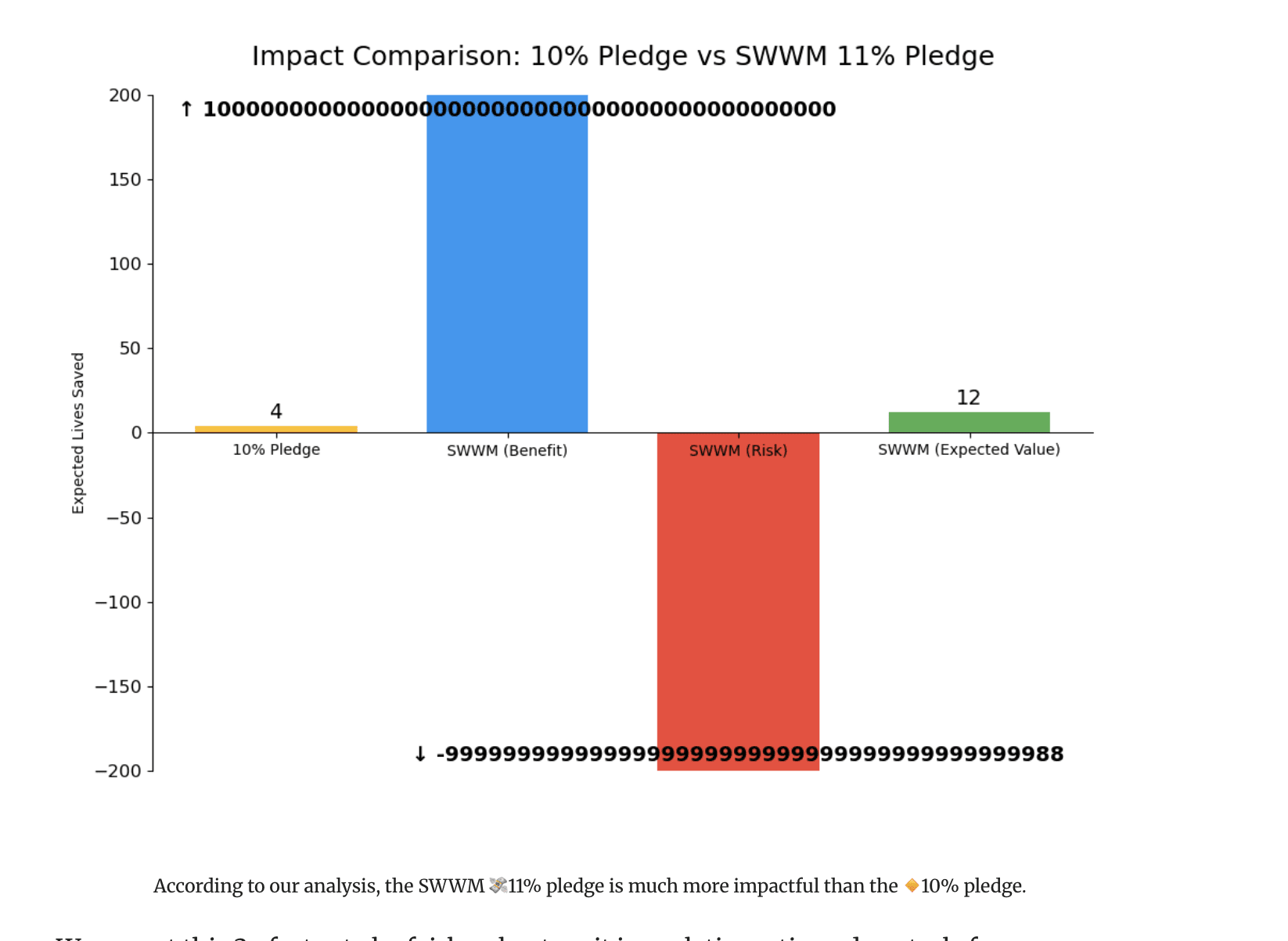
Expected lives saved yearly with GWWC 🔸10% pledge (donating to GiveWell) = 4
Expected lives saved yearly with SWWM 💸11% pledge (increasing productivity) can be calculated as A * (B - C), where
So A * (B - C) = 1e50 * 1.2e-49 = 12 lives, and 12/4 = 3x.
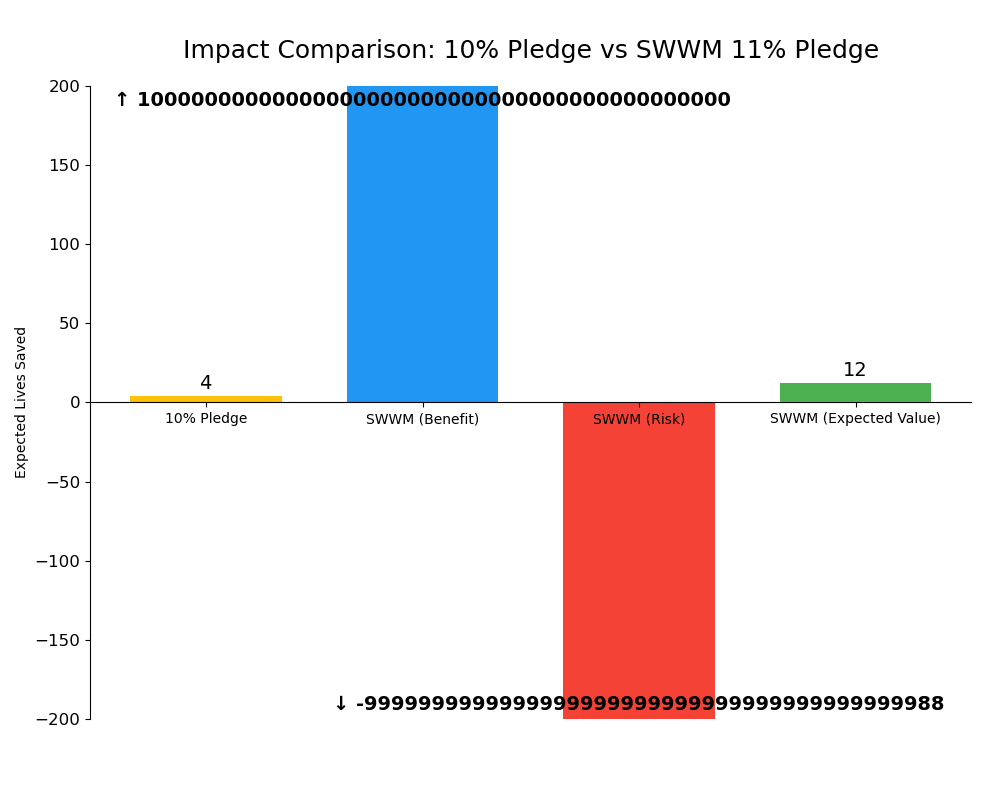
We expect this 3x factor to be fairly robust, as it is a relative ratio and controls for differences in individual productivity. The complete methodology is available in our 257-page Google doc.


I just did a BOTEC, and if I'm not mistaken, 0.0000099999999999999999999999999999999999999999988% is incorrect, and instead should be 0.0000099999999999999999999999999999999999999999998%. This is a crux, as it would mean that the SWWM pledge is actually 2x less effective than the GWWC pledge.
I tried to write out the calculations in this comment; in the process of doing so, I discovered that there's a length limit to EA Forum comments, so unfortunately I'm not able to share my calculations. Maybe you could share yours and we could double-crux?
Did you assume the axiom of choice? That's a reasonable modeling decision-- our estimate used an uninformative prior over whether it's true, false, or meaningless.