Comments
52
...

Caveat: I hold a moderate level of confidence (approximately 60%) in the usefulness of undertaking this initiative, influenced by my trust in the existing community's standards. My confidence that I have identified the key indicators to address my uncertainties upon implementation is somewhat lower (around 50%). Nonetheless, my substantial degree of uncertainty and the potential estimated value of substantially improving group norms/reducing value-drift across a growing movement convinces me of the importance of gathering more information on this subject. Therefore, I would greatly appreciate thoughts and insights from individuals with direct experience in both larger and smaller Effective Altruism groups. Feedback on any aspects that I may have underemphasized, overemphasized, or overlooked would be especially valuable.
In this post, I am going to discuss epistemic health and how EA groups and group organizers could monitor for, implement, and evaluate the uptake of epistemic tools/norms such as the Scout Mindset to improve the overall epistemic health of their community. This is somewhat of a follow-up to a post I wrote a few weeks ago which highlighted several different concerns community members had about epistemic health in the EA community. This is a concern that I share and thought that dedicating some time explicitly to this topic could be important.
I would also like to note that the evaluation suggestions that I have made are merely suggestions, but would be something that I would be keen to hear feedback on and actively work on with group leaders if it is something they are keen to implement.
The core questions that I wish to find answers to are:
In the effective altruism community, we pride ourselves on being open-minded, solution-focused, and exploratory in our thinking. By red-teaming our ideas they come out stress-tested and battle-hardened, striving to be like steel, hardened but willing to bend and reform rather than break over the stress of new evidence. This is underpinned by the term the ‘Scout Mindset’ coined by Julia Galef. The Scout Mindset is an integral aspect of what makes an EA. It is part of every introductory program, talk, book, and philosophy, if not explicitly, then implicitly through its asking you to change your understanding, beliefs, and actions, based on the strength of the evidence provided. I agree that applying and developing these principles in others is an important part of any movement-building/community-builder’s role.
Comparing the focus on the Scout Mindset within EA to more cause-specific field-building roles highlights its critical importance in community development. Expanding the number of individuals working on significant problems is crucial, yet it poses a risk of the community becoming entrenched in specific roles or cause areas without the flexibility needed to adapt to new evidence. This underscores a key distinction: EA community-building is about engaging individuals with the most critical cause they can identify, in contrast to cause-specific community-building, which is about drawing people into a predetermined cause.
One of the areas that I wonder about is the extent to EA group's focus on the Scout Mindset then leads to the Dunning-Kruger effect in some EA groups which are attempting to utilize tools to reduce groupthink, but are ineffective at doing so, thus creating a weird groupthink dynamic which is convinced it is being relatively objective but in reality, is rife with deferral. Addressing this requires us to question how EA groups, confident in their objectivity, can genuinely recognize and mitigate groupthink.
My perspective on EA community building emphasizes facilitating access to diverse methodologies for impactful action, coupled with creating a nurturing environment for rational discourse. Supporting the psychological needs of members, and validating their autonomy, is a time-honored tradition within EA, serving as a crucial tool for guiding more individuals towards addressing the world's most pressing issues. However, a hyperfocus on measurable actions, indicative of Goodhart's Law, risks valuing deeds over the rationale behind them. I suggest that our true north should be promoting self-determination—not merely as a strategic target but as an intrinsic value to be optimized for. Doing so would enhance our collective epistemic health, safeguarding against unintentional value drift driven by less rational impulses and actualizing the theory of handing the map over to each Scout to draw for themselves.
The Scout Mindset is the term coined by Julia Galef which she uses for her book of the same name. The book advocates for a different style of thinking about cognitive biases, how we can actively utilise these to better form our map of reality to better fit the territory (actual reality). The idea behind this is that we, as rational truth-seeking individuals, should want to actively search for the truth like a Scout trying to draw a map, when using an older map that you realise is getting you lost, you should update it by rubbing out older landmarks and filling it in with the information gathered of robust evidence. In this way you are always eager to be able to change your mind in order to have the best and most accurate map around, which is great. However, I think that new EAs (I know I did) unintentionally began to update at every new piece of evidence and I wasn’t accurately weighing the evidence as just redrawing my map based off of what others told me. It is in this instance that I note Epistemic Health, which acts as a measure to the Scout Mindset. This process aims to measure the level to which the Scout Mindset is being accurately implemented, or whether, like I feel I did, was relatively laissez faire about my Scout Mindset in taking on many different ideas I don’t believe I fully understood at the time. Now, this isn’t to say that I now don’t believe those things, and I am sure that I still fail on many levels to accurately weigh the evidence, but I feel in a much more confident position to ask questions about my uncertainty, and like many, have less faith in blindly accepting what older EAs have said based off their perceived authority.
Epistemic health refers to the quality of one's relationship with knowledge and truth-seeking processes. It encompasses how well individuals, communities, and institutions engage with epistemic goods like evidence, reasoning, and understanding. Healthy epistemic practices involve robust critical thinking, openness to revision based on new evidence, and the avoidance of cognitive biases. It's crucial because it underpins rational decision-making, promotes informed discourse, and facilitates societal progress. Poor epistemic health can lead to misinformation, misunderstanding, and ultimately, decisions that may harm individuals and communities. Fostering epistemic health is essential for the well-being and advancement of groups, especially successful EA groups.
Norms indicating good epistemic health involve practices that foster openness to evidence, intellectual humility, and a willingness to update beliefs in light of new information. These include encouraging diverse viewpoints, prioritizing truth over consensus, and valuing reasoned debate. Conversely, bad epistemic health is suggested by norms that discourage questioning, promote adherence to dogma, resist updating beliefs despite contradictory evidence, and prioritize loyalty or conformity over the pursuit of truth. Cultivating an environment where ideas are evaluated on their merits, rather than their origin or popularity, is essential for good epistemic health.
Imagine you are part of a middle-sized Effective Altruism (EA) university group with a mix of 12 existing members and 6 new attendees from an introductory EA program. As part of this community, you're embarking on a journey to assess and improve the group's epistemic health and deepen the collective understanding and practice of the Scout Mindset. The aim is to foster a culture where open-mindedness, truth-seeking, and rational discourse are at the core of all activities and discussions. Here's how you, as a vital part of a group, could participate in this transformative process.
1. Clarify Objectives
Primary Goal: Assess the current level of epistemic health and the Scout Mindset among group members and identify specific needs and areas for improvement.
Scope: Focus on understanding the existing practices, challenges faced by new and current members, and opportunities to foster a stronger culture of open-mindedness and truth-seeking.
2. Engage Members in the Process
Kick-off Meeting: Organize an initial meeting with all members, or just the executive if your group is too large, to explain the purpose of the needs assessment, how it will be conducted, and its importance for the group's development.
3. Data Collection
4. Analyze and Identify Needs
5. Prioritize and Plan
6. Implement and Monitor
7. Evaluate, Iterate, and Scale
This post on the Lesswrong forum provides a great outline of the book and includes the various tools, thought experiments, and systems of thought, that Galef describes as being the Scout Mindset. The summary of Chapter 4 is particularly helpful:
Actually practicing scout mindset makes you a scout. "The test of scout mindset isn't whether you see yourself as the kind of person who [changes your mind in response to evidence, is fair-minded, etc. ...] It's whether you can point to concrete cases in which you did, in fact, do those things. [...] The only real sign of a scout is whether you act like one." Behavioral cues to look for:
Do you tell other people when you realize they were right?
How do you react to personal criticism? "Are there examples of criticism you've acted upon? Have you rewarded a critic (for example, by promoting him)? Do you go out of your way to make it easier for other people to criticize you?"
Do you ever prove yourself wrong?
Do you take precautions to avoid fooling yourself? E.g., "Do you avoid biasing the information you get?" and "[D]o you decide ahead of time what will count as a success and what will count as a failure, so you're not tempted to move the goalposts later?"
Do you have any good critics? "Can you name people who are critical of your beliefs, profession, or life choices who you consider thoughtful, even if you believe they're wrong? Or can you at least name reasons why someone might disagree with you that you would consider reasonable[...]?"
"But the biggest sign of scout mindset may be this: Can you point to occasions in which you were in soldier mindset? [... M]otivated reasoning is our natural state," so if you never notice yourself doing it, the likeliest explanation is that you're not self-aware about it.
Other ways to promote Scout Mindset within your group could include the following. Although I recognize that the size of some groups may not warrant utilizing all of these techniques, this can provide a framework for areas to conduct your needs assessment within and then provide tools to address areas of particular concern.
1. Encouraging Dissent and Diversity of Opinion:
2. Structured Decision-Making Processes:
3. Fostering a Culture of Psychological Safety:
4. Educational Workshops and Training:
5. Regular Evaluation and Feedback Loops:
6. Promotion of Epistemic Humility:
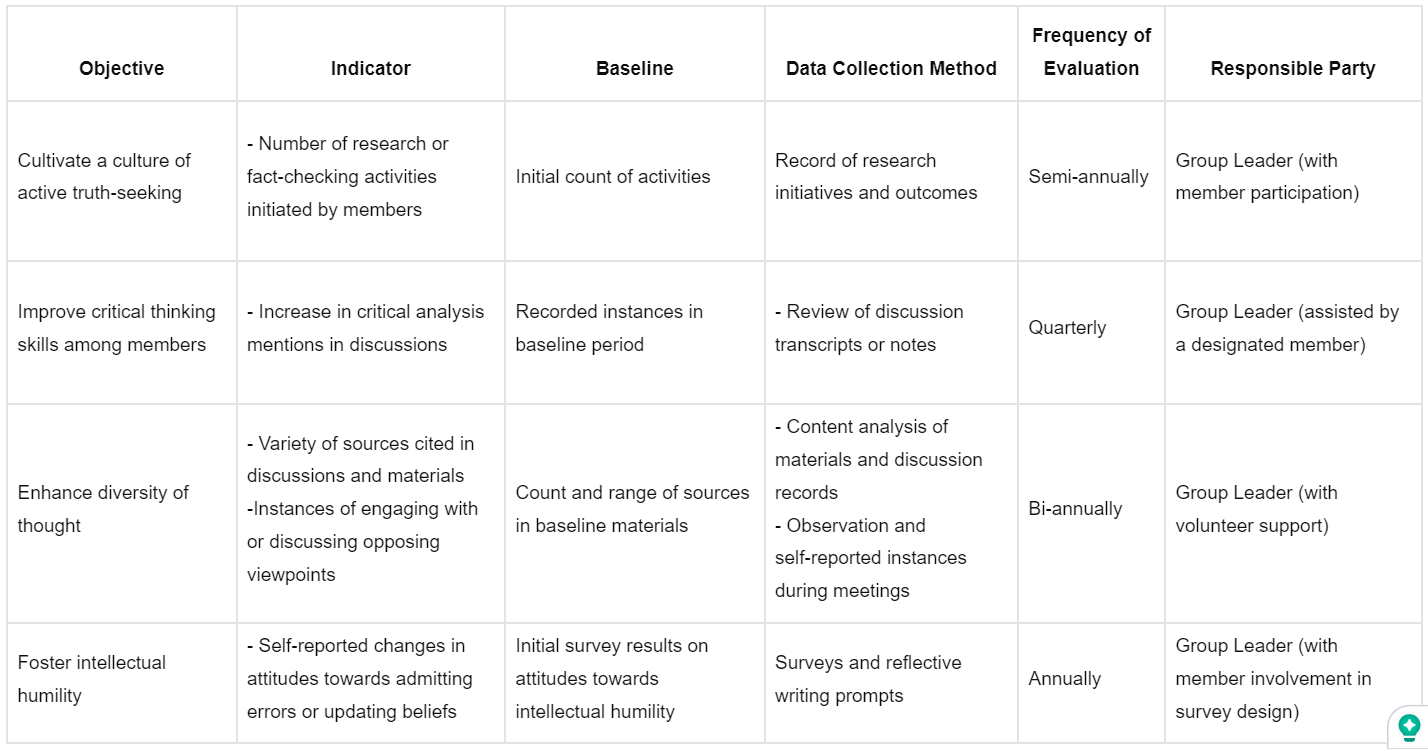
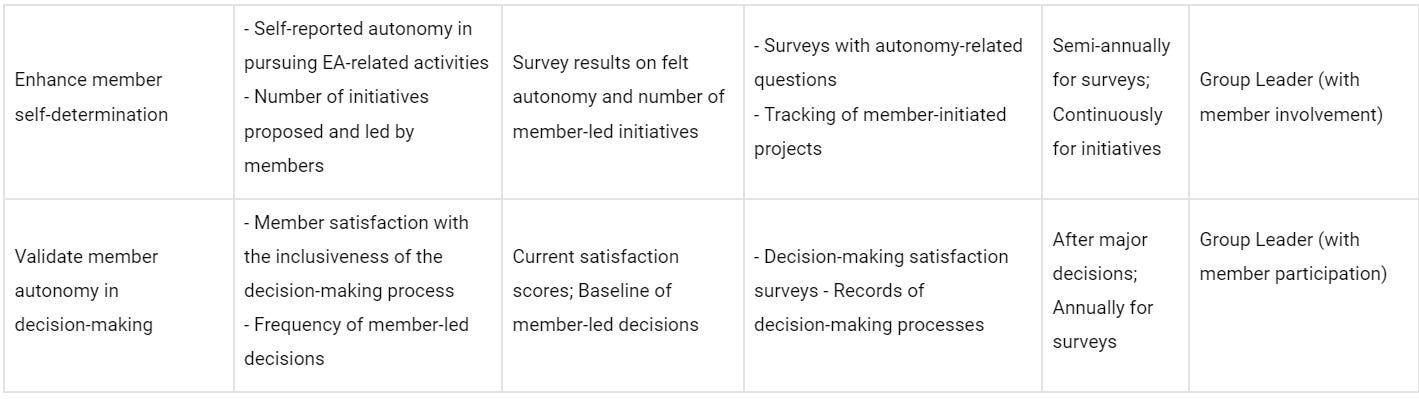
Here is a potential Monitoring and Evaluation system to help promote these kinds of dynamics. Note that this does not cover all of the potential ways of monitoring or promoting Scout Mindset, but attempts to focus on what might already fit within the team’s natural workflow, hopefully reducing the total overhead needed to do this.
I would be interested to hear any comments from group members or leaders who have attempted to implement an MnE system similar to this or with similar Goals but different indicators. The frequency can also be adjusted to better fit the needs of your group.
With this kind of Monitoring and Evaluation system, I have several uncertainties. Chief among them is the question of whether the cost-benefit analysis might reveal a net negative impact. This concern arises from the possibility that the alternative application of resources might yield more substantial results, especially within Effective Altruism groups. Such groups are presumably less prone to low-level epistemic practices, largely due to their ingrained cultural norms that actively promote the Scout Mindset. Further, the complexity of adding structured M&E may impose an administrative burden, particularly on smaller, volunteer-run groups. Measuring the nuanced 'Scout Mindset' presents challenges, as self-reported data could suffer from biases that skew results. There's also the risk that formalizing epistemic assessment could create dissonance in a culture that values organic, autonomous adherence to its principles. Additionally, efforts to quantify a Scout Mindset could inadvertently foster an echo chamber, reinforcing existing beliefs instead of challenging them. Lastly, the Dunning-Kruger effect and Goodhart’s Law raise concerns that groups might overestimate their epistemic health or focus too narrowly on measurable outcomes, potentially leading to a false sense of security or misaligned incentives. These factors suggest that while an M&E system has potential benefits, it must be carefully balanced against the risk of stifling the very qualities it aims to cultivate.
Executive summary: Promoting the Scout Mindset and epistemic health within Effective Altruism groups is crucial for fostering rational discourse and mitigating risks like groupthink, but implementing formal processes to do so has uncertainties and potential drawbacks that should be carefully considered.
Key points:
This comment was auto-generated by the EA Forum Team. Feel free to point out issues with this summary by replying to the comment, and contact us if you have feedback.