There are three ways EAs typically do good:

  • Donating to effective charities.
  • Working on high impact cause areas.
  • Getting others to become EAs.

All of these require either time and/or money. To donate to effective charities, one needs to have a sufficiently high level of financial security to justify their donation. If someone wants to work in a high impact cause area, they need enough time and money to pursue their desired career. Lastly, if one wants to get others to become EAs, they need enough time to find others who may be interested in the cause.

Despite this, I’ve observed almost no references to the importance of saving money or how to save money within the EA forum or sites dedicated to EA outreach such as effectivealtruism.org, 80,000 Hours, and Giving What We Can.

As such, I think that frugality, the optimization of one’s financial resources to maximize one’s time, should be more widely discussed and promoted within the EA community.

Pros:

  1. Saving even small amounts of money can enable one to donate much more money to effective altruism.
    • For example, by cutting one’s own hair rather than getting a professional haircut, one can save around $30 every 8 weeks. If one does this for fifty years, they can save $10,000 in today’s money.
  2. Sufficient savings can enable one to engage in more risk taking.
    • If one has sufficient money, they may be able to justify taking time out of their career to work on an EA project or to transition to a career in a higher impact cause area.
    • Similarly, if one has a lot of money and is extremely frugal, they may be able to retire early and devote more of their time to EA.
  3. By asking for donations, EA organizations are implying that people have enough money to donate. By giving examples of people who save money to donate to important causes and how they do it, these organizations can reduce the view that the EA community is asking people to excessively financially burden themselves.
  4. Frugality has many valuable second-order effects:
    1. Frugality reduces how many resources one consumes and waste one produces.
      • This can help the environment, which can reduce future harm from global warming and other known and unknown risks.
    2. Frugality reduces animal suffering.
      • Meat is one of the most expensive proteins, so a frugal diet is likely to contain little to no meat, which would reduce animal suffering.

Cons:

  1. If EA organizations are seen promoting frugality, their actions could be perceived as an example of the rich promoting their own interests over those of the poor. This would increase the view that EA is an elitist movement.
    1. This is because, if EAs are encouraging poor people in their own country to donate to people who are poor on a global scale, it would be seen as EAs supporting their own interests over those of poor people in their own country.
  2. If EA organizations promote frugality, their actions could be seen as encouraging people to accept harm to themselves for the sake of reducing a greater harm to others. This would increase the view that EA is synonymous with utilitarianism.
  3. By focusing on how to reduce one’s spending, EAs could become distracted from focusing on EA, especially if their money saving techniques are especially time-consuming.
  4. If discussions of frugality become more common in EA spaces, it may dilute the focus of EA, making the movement as a whole less impactful.
  5. Frugality encourages people to move to lower cost of living areas. If EAs did an exodus from EA hotspots such as New York, the Bay Area, and London, this would substantially reduce how often EAs talk to each other in-person. This could significantly reduce the rate of knowledge transfer and innovation, which could reduce the impact of EA.
  6. Personal finance is a taboo subject. By discussing it, EAs could alienate people who would otherwise be interested in the cause.

44

9
8
1

Reactions

9
8
1

More posts like this

Comments25
Sorted by Click to highlight new comments since:

I thought a lot about frugality when I was getting involved in EA (ex: Living Frugally So We Can Give Away More, from 2010), but I think I (and some other early EAs) could be shortsighted here. For example, in retrospect I think it would have been really valuable for @Julia_Wise🔸  and me to meet other EAs in person in the UK, but we didn't go there until 2014. And only then because we could tack it it onto travel for my sister's wedding.

A focus on minimizing spending can also be a distraction from other ways of increasing your impact. For example, when I wrote that post I was earning (all numbers in 2025 dollars) $106k in a research group. Two years later when I realized I should be trying harder to earn money and Carl Schulman suggested I join Google, my starting salary was $149k and in my first full calendar year I earned $301k. Very quickly I was able to donate more than I had been earning before. A focus on increasing earnings would have resulted in more donations.

On the other hand, I do think some frugality is really valuable. If we had let our expenses grow proportionately during the period when I was earning $700k+ I could easily have become trapped earning to give, but frugality ("a low personal burn rate" if you want to appeal to startup folks) allowed me to leave Google to join an early-stage biosecurity project that spun out into a non-profit that still can't afford to pay super well. And it has allowed me to take a voluntary salary reduction, allowing the non-profit to get more done with the same funding.

Overall, I think it would probably be good for EA to be moderately more frugal, but to be very aware of the downsides in burnout and turning people away.


You might also be interested in the top comments on Free-spending EA might be a big problem for optics and epistemics (posted at the height of the FTX-funding era) for some discussion on the pros and cons of EA's more frugal past.

Thanks for the thoughtful response. It seems like, if someone wants to earn to give, they do need some conscientiousness about lifestyle inflation in general, but:

  1. If someone could potentially acquire a high-paying job, they should primarily focus on getting a higher pay.
  2. If someone couldn't potentially acquire a high-paying job, they should primarily focus on frugality.

On the other hand though, if one's able to live on a very small amount, their level of self control, problem solving, and numeracy might be a strong indicator that, if they go in the right direction, they could substantially increase their salary.

Your comment about saving enough money to join a start-up though does make me, at least personally, skeptical about giving donations. It seems like, if someone's project-oriented, having significant savings will enable them to embark on much more ambitious and potentially impactful projects.


Also, in regards to that post, this comment is a great list of cons for others who are curious.

I think I broadly agree with this.

I am very confused about your number 1 con though! Why would promoting frugality be perceived as the rich promoting their own interests over those of the poor? Isn't it exactly the other way around?

To the extent that EA is comfortable with people spending large sums of their money on unnecessary things, I think it is open to the 'elitism' criticism (think of the discussion around SBF's place in the bahamas). People can justifiably argue: "it is easy to say we should all be donating a lot to charity when you are so rich that you will still have enough left over to live in luxury!".

But if EA advocates frugality for everyone, including the super rich, then this seems like a powerful response to the elitism criticism. I would have put this near the top of the pros list!

I think this criticism could apply if we were suggesting moving funds from the "donations" bucket of one's financial decisions to one's "savings" bucket.  Less so if we are suggesting moving funds from the "personal consumption" bucket to "savings" bucket.

Thanks for pointing this out! I could have been more clear with what I was saying. For con #1, I meant that people might think the following:

P1. EAs are rich people.

P2. EAs have their own unique set of interests that are different from those of the poor people in their own country.

P3. EAs encourage poor people in their own country to save money so that they can donate money to support the interests of EAs.

C1. EAs are rich people who think their own interests matter more than the interests of poor people in their own country.

C2. EAs are elitists.

In regards to promoting frugality for everyone, I would be curious to see that universe. It seems unlikely that it would take off since it wouldn't have much value to self-interested agents, and people seem to be generally pretty self-interested (at least in the US). If it comes to exists though, I'll be excited to live in it!

There are some historical examples of altruistic behavior (famous cases like Tolstoy and Gandhi) that show that, in the right context, many people find in frugality and in accounting for charitable works a certain psychological satisfaction comparable to that which others find in the so-called "virtue of thrift" and in the enjoyment of their possessions. It might be worthwhile to explore these kinds of social contexts and emotional rewards. There are many paths to happiness.

Yeah, I totally agree. It seems like that one should be able to be quite satisfied with minimal possessions and luxuries as long as their needs for connection, purpose, safety, and stability are satisfied. It would be interesting to look at the data on this.

I don't think there's much data yet on how a person motivated to act altruistically can have their material sacrifices and lifestyle changes (frugality, dedication, commitment) compensated with non-material emotional benefits. But there have been quite a few comments on the book "Strangers Drowning" in this forum.

I'll have to check that out at some point.

I think another issue with frugality is the risk of burnout (if the savings is coming out of the EA's personal consumption bucket). Making substantial inroads into consumption that makes their lives easier or more enjoyable may make staying on the path more difficult in the long run.

Yeah, I see what you mean. I think that most people could benefit from minor tweaks in their spending that would save them a lot of money, but, when people try to cut down their spending, they tend to focus on the wrong things or use the wrong strategies. If people think that being frugal means removing luxury and convenience from their life, they are approaching it in a way that's guaranteed to discourage them from doing so. (I think eating out is a prime example of this. If you go to cheaper places, eating out once a week can be very easily off-set by very simple changes such as purchasing the cheapest fruit, purchasing fruit in larger quantities, and keeping a minimal pantry to reduce food waste.)

I definitely agree that looking for tweaks that could save money without reducing luxury or convenience is a great idea and think that resources to help EAs make such decisions quickly and easily would be great. I don't think it is all that people mean typically when they think about living frugally, so maybe a different framing would make sense.

That's a good point! I'll have to think about how to do that!

I like the post and agree with most of it, but I don't understand this point. Can you clarify? To me it seems like the opposite of this.

If EA organizations are seen promoting frugality, their actions could be perceived as an example of the rich promoting their own interests over those of the poor. This would increase the view that EA is an elitist movement.

I explain what I meant in this comment. I'll update the post to be more clear.

I keep thinking about this. Even though I'm super sceptical about causal inferences that back into the past, one explanation for the decline of Mohism in China is that their insistence on frugality wasn't popular among elites and they lost elite support.

That's interesting. Though, if there was basically a historical pattern of cultural movements self-destructing by promoting frugality, I would suspect that EA would still survive because the internet makes certain ideas and cultures harder to destroy.

I think Point #5 is really important, especially as the professional default shifts back to in-person work. The additional cost of living in an EA hub is probably worth it for people who lean towards doing direct work in a specific field or rely on some level of social pressure to remain focused.

While based in Texas, most of my visits to EA hubs were tied to business travel. I could have a great life in a three-bedroom house (right on the water!) for about as much as I spent living in a 300-square-foot basement without air conditioning in an EA hub. The state tax savings covered my living expenses and let me donate more than I would have otherwise. From an ETG perspective, it made sense. 

I had the best of both worlds for a little bit, but I felt quite disconnected when that travel took me elsewhere. Conversations about niche advocacy projects were replaced with talk of private school tuition and the best skiing destinations. I missed major things that I could have helped with (specifically in the global health space) because I was engaging less with the ideas and people that had motivated me to join the industry I was in.

I don’t think everyone should reorient their lives to live in an EA hub, but it can be incredibly useful for both personal and professional reasons. I am not a city person and will probably move eventually, but I can personally say that coming back has been worth the cost at this point in my life.

Yeah, I definitely agree. I wish there was an EA hub that wasn't so extraordinarily expensive to live in.

I appreciate this post and agree that the EA community should emphasize frugality more.

For many people, the money saved through frugality (net your donations to effective charities) should be invested to maximize long-term impact. I am a big fan of the Financial Independence (FI) community which offers excellent resources on investing, frugality, and values-based living. I've found Rebecca Herbst's work at Yield & Spread valuable, as she specifically bridges EA and FI principles. 

Ah, thanks for sharing that! She appears to put pretty much everything she has to say behind a paywall, but hopefully, someday there will be a more accessible resource with a similar goal to hers! I'd also recommend checking out the book Early Retirement Extreme. It's, in my view, a foundational text for frugality.

I think you're right that frugality is good, but I'm not sure where you're getting the idea that it isn't discussed any, although it maybe could use a bit more discussion on the margin. I also think the main con is that it would alienate people who aren't willing to be particularly frugal, but will donate some anyways. The personal finance tag has some posts you might be interested in.

i think f to ug as litu isn't discussed so much here because it isn't broadly popular on the forum, so people can be dissuaded from bringing it up. I've definitely been dissuaded after bringing it up as could of times. Any hint of frugality suggestion gets more disagree than agree votes and is unlikely to get high karma.

before i strong upvoted for this very reasonable and balanced post, it had 10 votes for 16 karma. I don't really see much which warrants down voting here even if you disagree with the argument.

That's interesting! I would expect EAs to be pretty supportive of frugality in general.

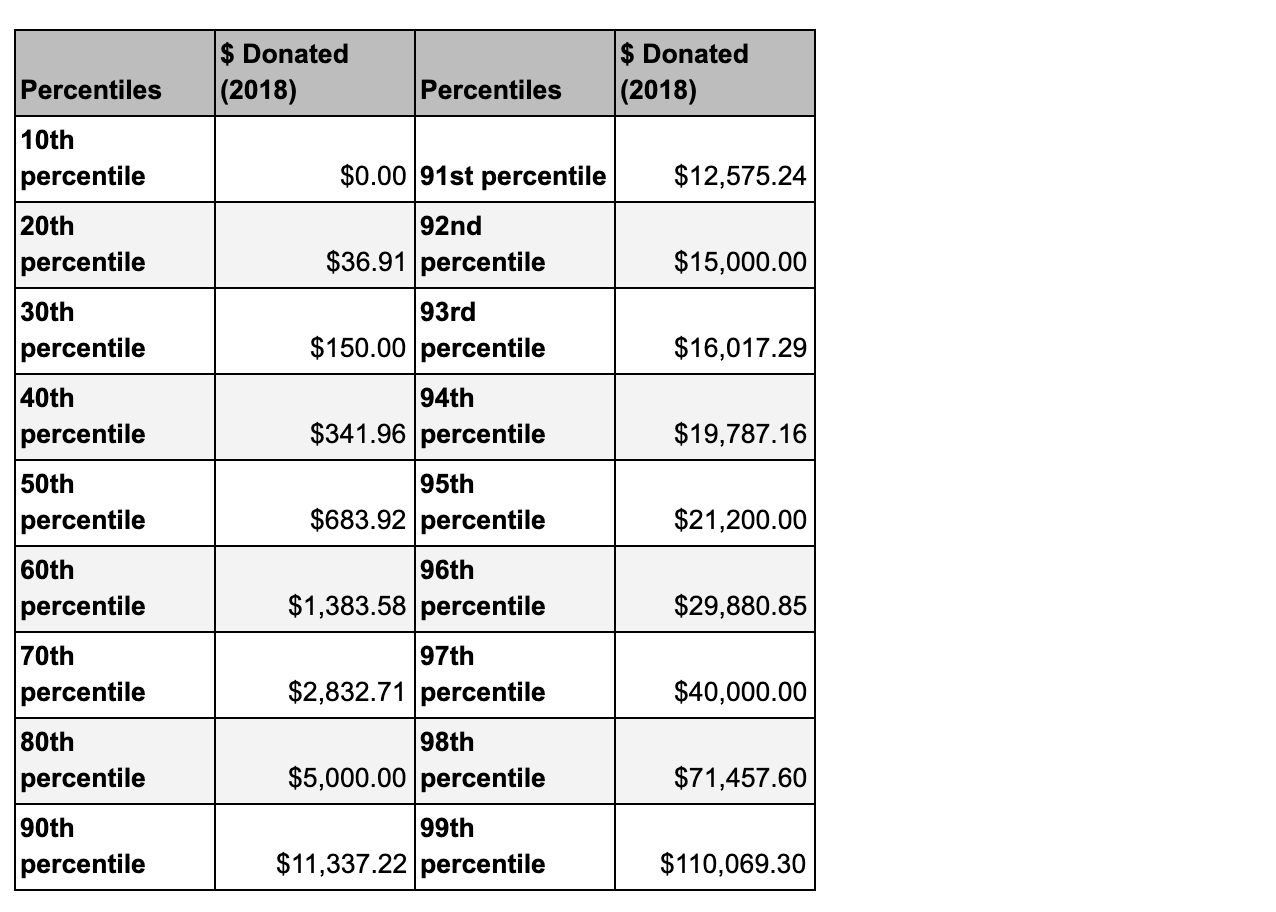
Oh, thanks for sharing that tag! I didn't know that existed. Your point about alienating people definitely makes sense. According to this chart from the 2019 EA survey, it looks like the largest donations account for the vast majority of money donated. This would make me think that donations from the top 10% of income are probably more important to focus on than from those with the top 50% of income.

Curated and popular this week
Relevant opportunities