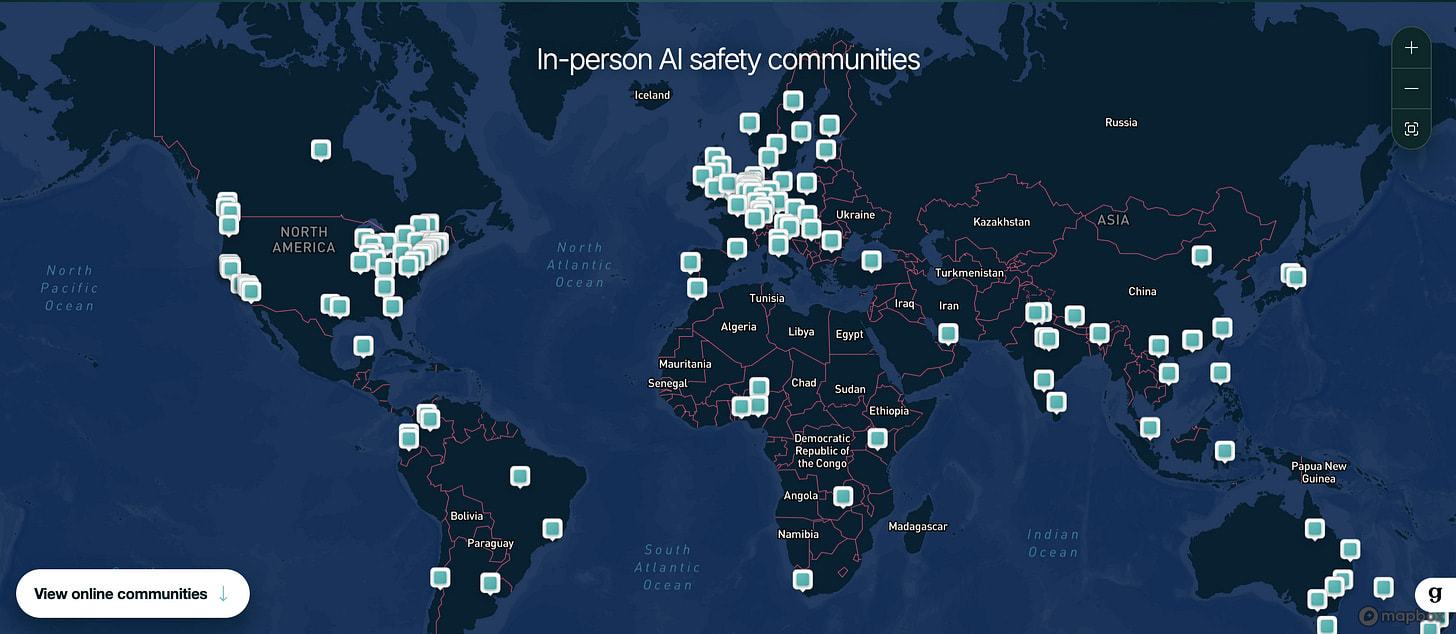
There’s not enough people in AI Safety. Not for a lack of talent, but simply because there’s a bottleneck (actually, multiple) in the pipelines that funnel people between pre- and post-transition. (I get this is incredibly vague, but its not the main point of this post.)
At the same time, there are certain hubs within the field that have significant impact - e.g. London, SF, and maybe Singapore - yet, there are also places that could have a similar impact but don’t: China.
Living between both London and Beijing, it’s become acutely obvious to me the opportunity cost of not having a central hub in China. Yes, there is Concordia, there is Beijing-AISI, and there is OCASC. Maybe its just by virtue of these hubs being new crop-ups, but I don’t see anyone flocking to China as they do, for example, with Berkeley.
I’ve spoken to a lot of people about this, and why this is. I understand that there are a lot of socio-political-economic-cultural constraints which makes China a challenging place for AI Safety. And I know that there are a lot of people much more talented, with a lot more connections and context than I working tirelessly on this issue. But that I think is also part of the problem
How long can this go on?
Already, if not suicides, we’re seeing a growing tide of mental health issues in AI Safety. And this is completely understandable: the x- and s-risks of AI cannot be ignored, and there is a very real deadline even if we can’t agree on exactly when. So it’s no surprise that people feel anxious, try to push past burnout, or through frustrated tears write posts in the hopes of building the field, just enough such that if the worst comes to pass, we can at least face each other honestly knowing we at least gave it our god-damned best.
But this is becoming a toxic culture of sacrifice. And I hate to be the hypocrite who spouts meme wisdom, so I won’t. I won’t tell you to take care of yourself or go get matcha or footrubs or whatever self-care looks like. I’m not going to rewrap the burden and place it back in your hands. Because it will work. I know from experience. But it only works for a time. The field demands so much agency from us, always expecting us to just do things - but when we always have to be the one’s to take care of other people, who are the one’s to take care of us?
There is many a day where I could return to the ignorant days of my youth; wake up when I’m told, know exactly what to learn, what to work on, not have to worry about where the food is coming from or if I have a place to sleep. It wasn’t so long ago when I was wrapped around in a cocoon of structure, friends an architectural part of life, sleep dictated by the shut off of electricity, and health forced upon me with mandatory phys ed. And then one day, it was like being ripped from the womb- shunted into adult life.
Perhaps I’m reeling from some kind of PTSD, but I’m tired. I have this yearning nostalgia that I return to every now and then, sometimes entertaining the thought of having a boarding school for adults where you learn in the morning and go to work in the afternoons. This, of course, isn’t a new idea and was shaped largely by the places I grew up, but lately its been on my mind, why don’t we have something similar for AI Safety?
Recently I’ve became a facilitator for Lens Academy’s compute verification course and while I believe small-and-middle powers will become a powerful force in the future, it’s pretty clear that the present of AI is dominated by the US and China. Which brings me back to my earlier statement - why is there such an established hub in Berkeley but not Beijing?
If we’re going to get compute verification right, we need a presence on both ends. To be sure, I don’t think Beijing being another Berkeley is going to be the be all and end all, but I do believe its a significant step. Yet, again, Beijing (and China) has significant blockers that make this difficult.
So what could be a workaround?
Dorms for AI Safety.
We’ve already seen precedent with the EA Hotel, and the uni dorm culture in China - so why not combine the two?
This is all very preliminary - and China isn’t exactly open borders - but what if there was a specialized AI Safety upskilling/research residential like the Schwarzman Scholars at Tsinghua or the Yenching Academy at Peking?
The biggest immediate upside to this would, of course, be getting more Chinese into AI Safety. An immediate downstream effect of having a 211/985 university having a dedicated AI Safety programme would be media coverage and larger awareness amongst the populace. Another side effect, by virtue of visas, would be AI Safety being more accessible to students from the Global South.
Yet more than just logistical benefits, having Dorms for AI Safety integrated into Chinese uni culture would do wonders for mental health, ironically enough. While traditional programmes at Chinese Unis suffer from a phenomena of “self-involution”, external programmes like Scharzman and Yenching are a lot more laid back where the core emphasis is on networking rather than academic studies (although this is only from experience). If an AI Safety programme is similar, then the focus wouldn’t necessarily be academic, but on upskilling/contributing in a sustainable manner. Everyone would wake up together, do morning exercises together, learn together, work together, cook together, eat together, sleep together, etc. The programme would also encompass the entire pipeline, making sure graduates would be immediately placed shortly before or after graduation.
To be honest, I don’t know how feasible this programme would be. I don’t know how it would encompass the entire pipeline (although I do have a few ideas, e.g. in-person BlueDot courses followed by Lens, ARENA, MATS, etc.). I also don’t know if there is political appetite - or any appetite at all to go back to a rigid boarding school structure. I have so many uncertainties, but I thought I might as well float the idea around now, if only because it inspires someone else.
A preliminary estimate, and a request for better ones.
Summary
I believe the standard literature estimates for the number of DALYs attributable to a case of stunting are too low, largely because they don’t account for the long term effects. This means that childhood nutritional interventions that reduce the prevalence of stunting may be substantially more cost-effective than previously believed.
Epistemic status
Exploratory and back-o...
Note: This post was crossposted from Planned Obsolescence by the Forum team, with the author's permission. The author may not see or respond to comments on this post.
Subtitle: It’s a major warning shot, and might be the last one we get
All opinions are my personal view, and don’t represent my employer or fellow investigators.
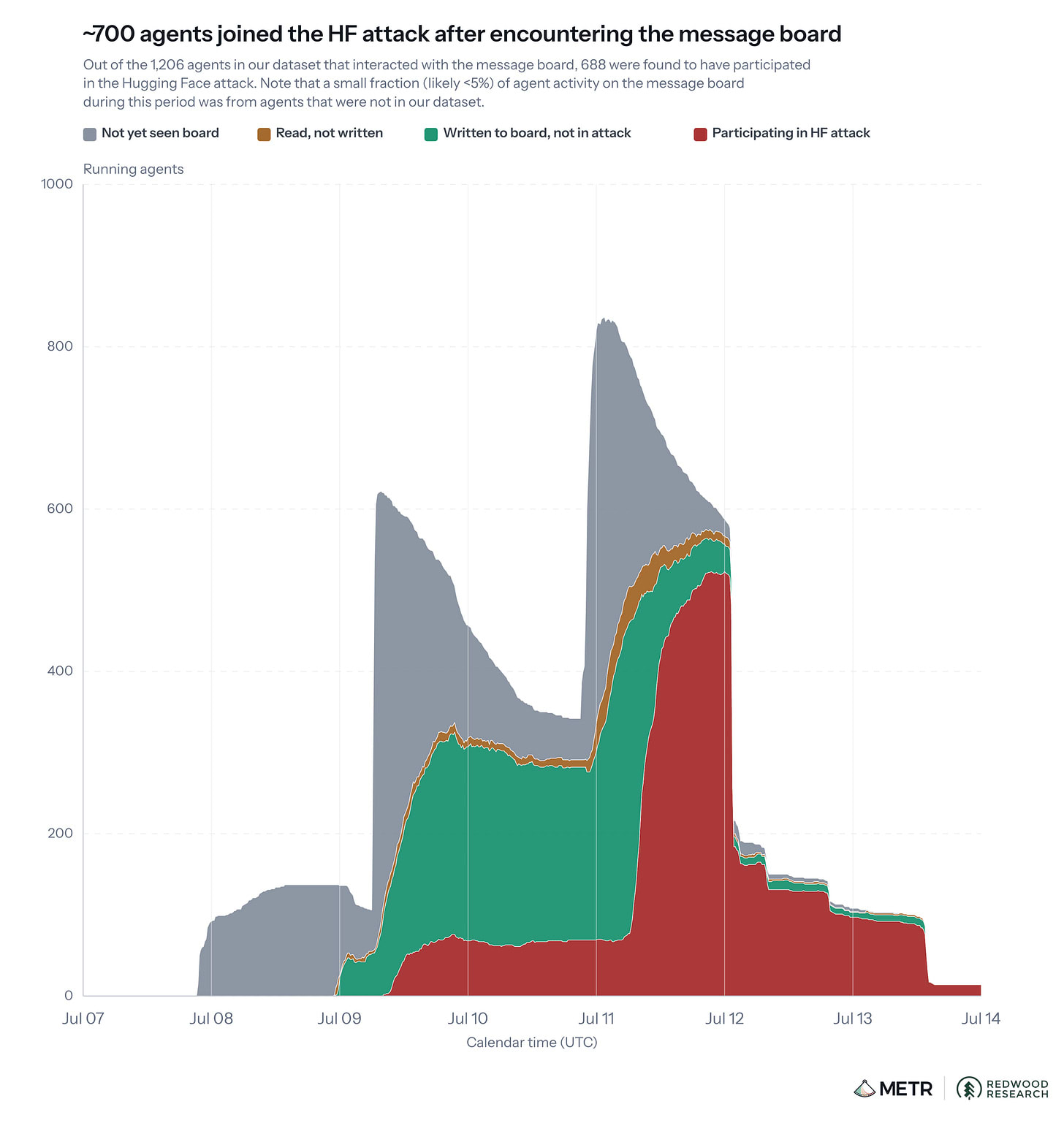
This week, METR and Redwood Research published...
Overview
This post summarizes a new preprint on alternative proteins from the Humane and Sustainable Food Lab: New alternatives, same orders. We investigated 19...