You put into words and numbers an intuition I had some time ago! I agree Meta is more important that we might believe, and not typically the cause many people at EA think on contributing at the beginning. Glad you created Leveragegiving, would love to see gradually on it your own evaluations of charities as well to contrast them with their published data.
Yeah I think many people at "the beginning" have an aversion towards "money going to administration". This strategy is literally suggesting specifically directing money to adminstration...
However they would be missing a point...
This not just "Any administration" or money thrown into black box... This is money directed to adminstration that has data and trackrecord showing the ability to produce multiple times the initial money raised and thus proof that more impact would actually be made.
Epistemic status: I built this as a donor. I'm unaffiliated with all charities listed. Every number on the site is self-reported by the charities themselves.
TL;DR: Leverage Giving (leveragegiving.info) ranks effective-altruism-aligned meta charities. You can filter them by cause area, sort them by reported counterfactual giving multiplier ("X-factor"), and see a confidence tier that shows how rigorously each number was reported. I'm asking the featured charities to report a forecast, an upper and lower bound, past-year figures and their methods in their 2026 reports. I also want to share what the numbers can't tell you.
I would like to see more of the money from effective giving land where it does the most good. Meta charities are one route. They raise funds, evaluate charities, incubate new ones or help people change careers. They don't run bed net programmes themselves. As a donor, I found them hard to compare. Leverage Giving is an attempt to help with that and to support the effective giving ecosystem by informing donors about high-leverage meta charities.
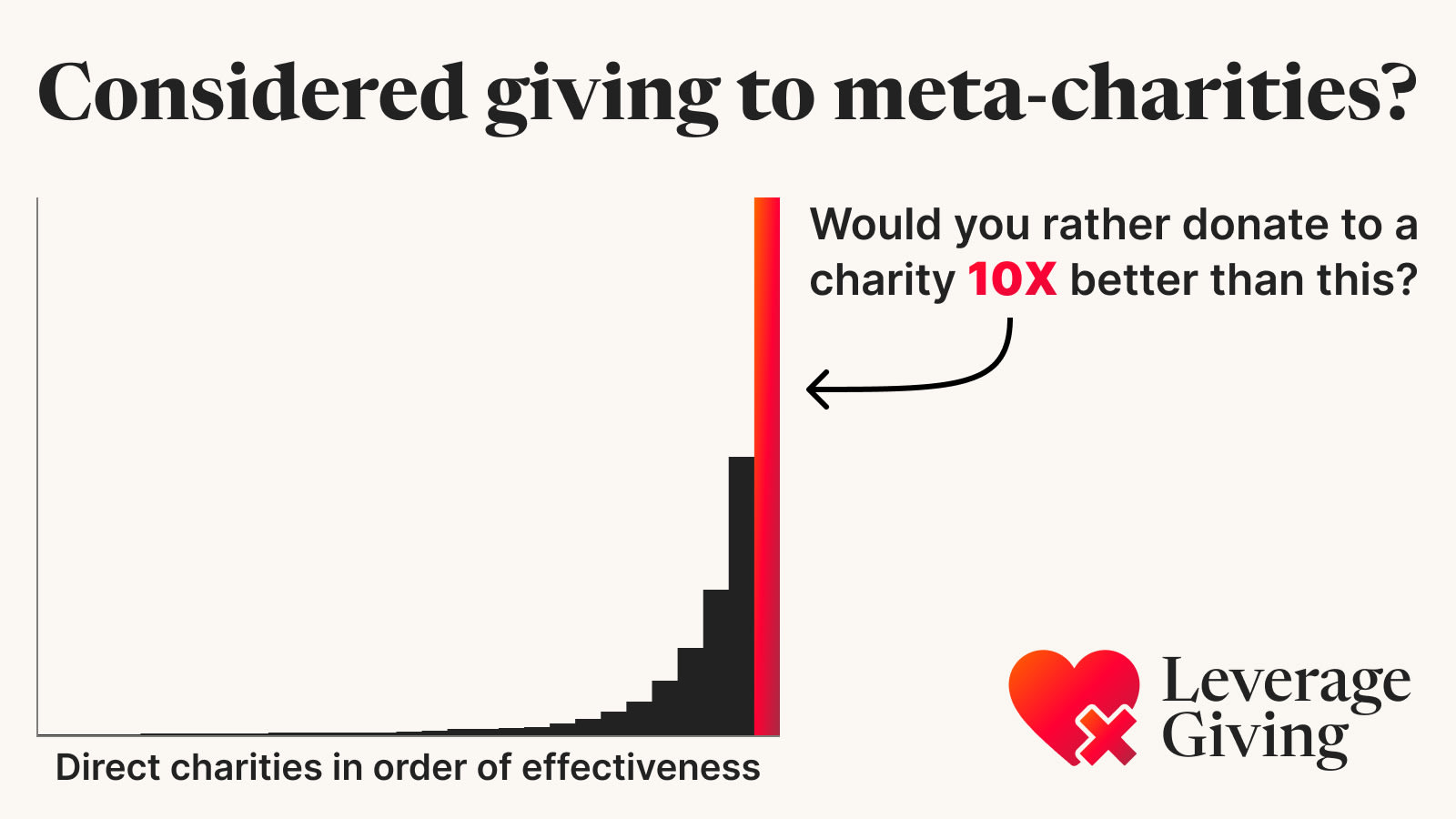
What is the important number? A counterfactual giving multiplier (an X-factor) estimates how much additional money an organisation moves to effective work, per dollar spent running the organisation.
This is the simplest way I can put it:
If I donate to a meta-charity with a counterfactual X-factor of 10×, my donation is estimated to unlock 10 times as much additional funding for effective charities as if I had donated the same amount directly. In other words, I can help channel more money to effective charities that would otherwise not have received it.
On the Leverage Giving info site you can:
filter charities by cause area
sort them by highest X-factor
see a confidence tier on each charity's multiplier. More risk-averse donors can lean toward charities that have reported their multipliers more rigorously.
All numbers come directly from the 27 charities' own reports.
Building this has convinced me that giving to an effective meta charity is likely to do as much good as, or more good than, giving to direct effective charities.
What you support when you give to a meta charity
When I give to a meta charity, I think of it as supporting two things.
The first is the charity's operations, and through them its outcomes. Meta charities report those outcomes. Giving What We Can, for example, reports what its platform users go on to donate to. So what you leverage is most likely the charities those donors end up supporting.
The second is helping the ecosystem grow. Helping more people start giving means more donors who talk about giving with others, and who may start thinking about other ways to do good. I think of that as a ripple effect. It also compounds, because every new donor can bring in more donors, so the number of people giving can keep growing over time. These effects are hard to measure, and I don't think any multiplier fully captures them.
What if everyone gave to meta charities?
A fair question is who would fund the direct charities if everyone gave to meta charities. I've talked to several of the featured charities about this. What I've been told is that if they receive more money than they can usefully spend themselves, they pass the surplus on to direct effective charities. Those charities would then receive it just as if you had given to them directly.
That has a consequence for the multiplier. From the first dollar a meta charity passes on, its X-factor falls, because that dollar isn't spent on further growth. The X-factor keeps falling as more is passed on, but it falls torwards the asymptote of 1X, because that is the same as giving directly.
So there's a built-in limit. If the meta charity with the highest multiplier received a lot of donations and its multiplier fell bellow the next highest x-factor, the next one could be more likely to receiving more, and so on. In the end every meta charity would sit at 1X and the ecosystem would be fully leveraged... We're nowhere near that point, and I think the practical question for now is which meta charities still have room to grow.
My story
I have taken a Giving What We Can pledge within the last year. Since then I've wanted to understand how to tweak my giving so that it lands with the highest-impact charities, meaning the most good per dollar.
I went to a GWWC pledgers meeting to learn and to hear what other pledgers were giving to and how they thought about giving strategies and giving portfolio. There I was introduced to GWWC's counterfactual giving multiplier by @James Rayton 🔸 (More on this in this great article from Luke Moore). I hadn't thought about giving multipliers before, but the logic made sense to me. An organisation one step removed from the direct work can raise even more funding and resources for it. Giving What We Can is itself a good example because they are good at convincing more people give more.
The same meeting introduced other meta charities that take donations through the GWWC platform. I found it hard to choose between them... However when I realised that direct charities get ranked for exactly this, I thought that maybe meta charities could ranked too.
What Leverage Giving is
The page /charities: Each card shows one meta charity, with its reported multiplier, the uncertainty around it, and links to donate on the charity's own website. You can search, filter by cause area and sort by X-factor. A "tiers" view groups charities by how well the figure is backed:
Third-party evaluated
Self-assessed counterfactual multiplier with published methods
Self-assessed counterfactual-adjusted multiplier without published methods
Gross multiplier only - No clear counterfactual adjustment
No public multiplier found
Only comparable figures are ranked against each other. Other metric types are shown separately.
The page /how-it-works: A plain-language explanation of multipliers, counterfactual impact, uncertainty ranges, and the difference between independent and self-reported data.
Share feature. Three ready-made DM's you can send to someone: "I'm interested in meta charities", "I've given to a meta charity" and "I've set up recurring giving to a meta charity". Each carries a tagged link. - This feature could be used at a cohort where a facilitator asks all participants to share this with someone who should hear about this idea.
The page /stats: Anonymous click counts for the share funnel, site engagement and per-charity actions (Donate, Learn more, Link to report). They count clicks, not unique people. I made this public so everyone in the EA ecosystem can see how much engagement the idea is getting.
I'd be happy to talk about Leverage Giving and about giving to meta charities... Even better, I'd like to share resources with anyone who wants to spread the idea.
I think we should be talking about this more... To put that into perspective:
Convincing 1 pledger to give to a meta charity with a multiplier of 10X is arguably as impactful as convincing 10 people to pledge.
Putting together a giving portfolio
How you spread your giving depends on how much risk you're comfortable with.
Higher risk, higher expected reward. Give everything to the charity with the highest reported multiplier. You would arguable have had the greatest impact if that number holds up, however you would take the full hit if it doesn't.
Lower risk. Split your giving equally across several charities. You're then more likely to lock in the average counterfactual multiplier of the group.
In between and cherry picking. Weight your giving toward charities in the higher confidence tiers, and give less to those whose numbers rest on thinner evidence. Say you are convinced that animal welfare charities give a higher bang for the buck... Them maybe you should prioritize leveraging these specifically?
What I'd like to see from the featured charities
I will reach out to every featured charity and ask them to report the following in their 2026 reports:
Upper bound: an X-factor unlikely to be higher than this.
Lower bound: an X-factor unlikely to be lower than this.
Past years: the same numbers for previous years. The site may build this up over time.
Methods: how the X-factor was calculated, so the EA community can publicly question the methods and see how rigorous the numbers are.
Charities without a published multiplier
Some featured charities haven't published a giving multiplier. That doesn't mean their leverage is low. It may be high but unreported, because a number depends on assumptions about the available data, and that's hard to do well. I still think these charities deserve consideration and thus they are featured on Leverage Giving.
Some considerations worth bringing into attention:
Cross-org numbers rest on big assumptions. Take leverage of the EA forum itself or of an EAG conference. You can model their impact, but smart and reasonable people would get very different numbers. - It would be great to standardize a best practice for these so that they could be compared with the other charities featured but the range of probable x-factors would likely always be bigger.
A number could invite false certainty. Donors could be tempted to take a figure at face value, and as of now these figures are mostly self-reported.
Intermediaries are an alternative. Fund managers can look at organisations in depth and direct donations as grants. Evaluators of funds can advise donors on which funds to support. Both often use rough cost-effectiveness estimates too. They also weigh things that are hard to quantify: an organisation's trajectory, its plans, how good its monitoring and evaluation is, and the risks involved.
I don't see this as a defeater for the project. I would want it to be communicated clearly with the numbers to encourage site visitors to consider risks and how they can make it more likely that their donations will have the biggest impact. A published X-factor plus published methods is something people can challenge. I'd like Leverage Giving to make that scrutiny clear.
Feedback
If I've misrepresented a charity, or a meta charity is missing, tell me and I'll fix it. I'd also like to hear other critiques and what numbers other than the counterfactual giving multiplier might be relevant to rank meta-charities by.
This month effective altruism has gotten lots of attention, including a cover story in The Economist. It feels pretty surreal to be on the receiving end of it. But I feel grateful these ideas have caught on, and even more grateful for the drive, earnestness, and compassion of so many people who took strange but well-argued ideas seriously and then actually acted on them....
We’re the co-founders of Better Futures Guide (BFG), a charity evaluator specifically focused on livelihoods. We were founded last year through Ambitious Impact’s Charity Entrepreneurship Incubation Program. We welcome questions, criticism and opportunities for collaboration, in the comments or at [email protected].
...
TLDR
* We are Scale Welfare, a fish welfare charity incubated by AIM in early 2025, working in the Philippines and Vietnam. This is our first Forum post.
* Farmed fish welfare has no proven, scalable interventions. In our first 1.5 years we went from scoping and 123 intervention ideas to one pilot: on-farm ice slurry slaughter for tilapia in the Philippines, replacing 5 to 15 hours of live transport.
* ...



You put into words and numbers an intuition I had some time ago! I agree Meta is more important that we might believe, and not typically the cause many people at EA think on contributing at the beginning. Glad you created Leveragegiving, would love to see gradually on it your own evaluations of charities as well to contrast them with their published data.
Thanks for the insights, Thøger!
I'm glad that it was helpful Sergio!
Yeah I think many people at "the beginning" have an aversion towards "money going to administration". This strategy is literally suggesting specifically directing money to adminstration...
However they would be missing a point...
This not just "Any administration" or money thrown into black box... This is money directed to adminstration that has data and trackrecord showing the ability to produce multiple times the initial money raised and thus proof that more impact would actually be made.