Nice post! I get the impression that the ideal is to find something you always consider to be work but is without the unbearably negative aspects, like losing money, and maybe a little bit of what you like in it.
I was really depressed working as a janitor for a grocery store: it was work, often there was lots to do quickly without enough staff, and cleaning full-time was all I did, most of which I dreaded.
Loading packages for FedEx, on the other hand, seemed like the sweet spot for blue-collar jobs: it was work, at times lots to do quickly without enough staff, but my managers treated me with respect, I got to socialize a little on the job, and even do some medium-intensity workout.
I never went to work for free. I'd rather do a short workout and chill out than load for as long as I did, but I'd also rather load than clean, any day.
I wonder if this could be a potential intervention strategy to help quit addictions: we pay people to continue to do something they have so far been doing for free because they are addicted, and thus make it feel like work and less fun. Probably this would not work for everyone, but maybe for some people, as was the case with you, it could be an effective way to help them quit their addiction.
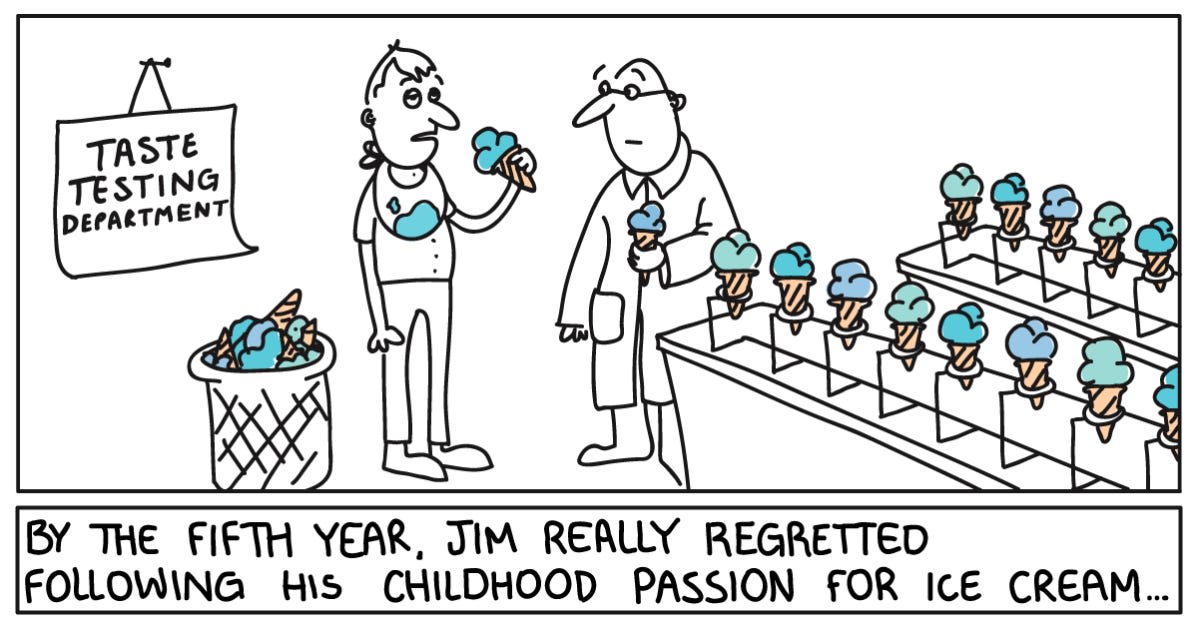
Do what you love, and you’ll never work a day in your life.
In a lot of ways this age-old aphorism is terrible advice and as usual, the EAs know a bit better.
“What makes for a dream job” is an EA classic[1] from 80,000 hours. EAs helpfully point out that passion is a very bad predictor of job satisfaction. Instead emphasizing things like world impact and challenge as better things to focus on. Which I broadly agree with, but that’s not the point of todays blogpost. I’m here to tell a story.
classic
Playing video games for money sucks actually
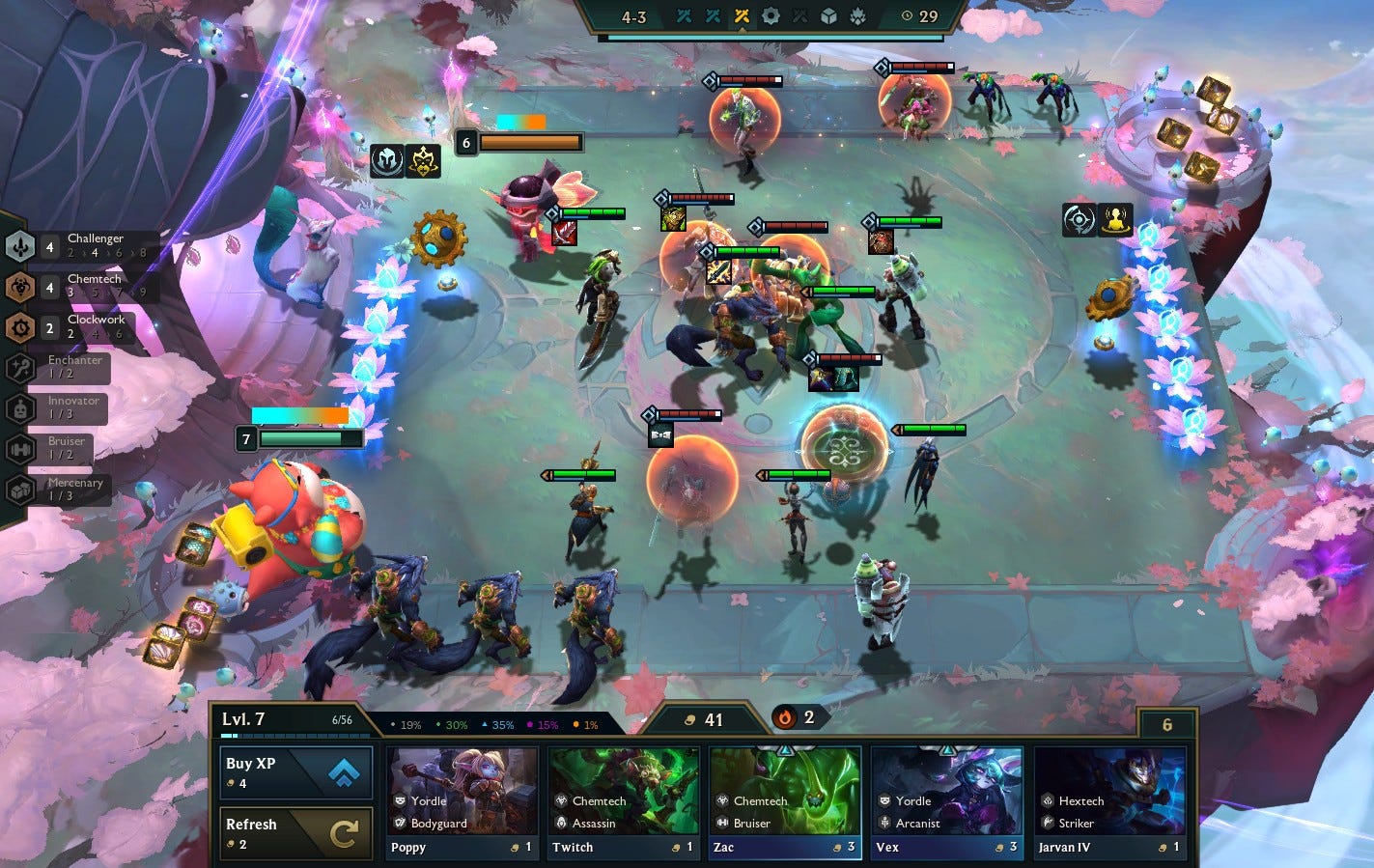
Around 2022, I got very, very addicted to a game called teamfight tactics (TFT). It has some aspects of luck, some skill, yknow: the usual recipe for an addictive video game loop.
I just spiked my cortisol thinking about this game
I would wake up, take my stimulants, play TFT, win a bit more than I would lose and adjust strategy accordingly. There was nothing I liked doing more, I would spend hours obsessing over ideal team compositions, working out the game theory, etc…[2]
Anyway, after a while, I got really good at the game, like <0.01% good[3]. And since I was a student and thus piss-poor, I figured, why not? And signed up to an elo-boosting website as a booster. (these are sites where someone will pay you to rank up their account for them)[4]
This is every teenagers wet dream right? Playing video games for money? Are you kidding me?
I think it took about 15 games before I fucking hated it, and 25 until I actively despised it. Nothing was more efficient at laying bare what I actually liked about the game.
The whole process of elo-boosting makes you so alienated from your work it would make a Marxist smile. Orders come in, and you can claim them, which will automatically log you in on the account that you’re boosting and you get paid/lose money depending on win/loss. Oh yeah, did I forget to mention? You can go to work and lose money! TFT is inherently partly chance-based, so it did happen sometimes, and let me tell you, god does it feel bad to go to work and lose money. Holy shit.
Gone were moments of experimentation. Trying this may cost 8 euros that you don’t have. The most efficient way was to play the most brainless meta thing you could think of.[5] And this just ruined all the fun.[6] It turns out, I liked these games precisely because there were no stakes! because they were the negation of job. (I mean, studying was kind of my “job” at the time, and that nearly killed my love for computer science too!)
By the way, if you want to make a free-market liberal jizz their pants, show them the demographics of an elo boosting website. Nearly all of the people there were Turkish. because of the exceptionally weak Turkish lira, so doing labour outside the country became a very good way to earn money.
I remember chatting with a (turkish) guy on this site who had a jesse pinkman profile picture: “please don’t take that order, I have a wife and kids”. He was serious, this is how he was paying for food. This was his actual job.[7]
In a lot of ways I’m thankful. You can read a thousand articles but you don’t really understand that turning hobbies into jobs will make you hate the thing until it actually happens to you. (sidenote: I got my first paid substack subscriber earlier this week(!), and now have similar fears regarding blogging…)[8]
Notably, some people seem isolated to this, and keep loving their hobby even after it becomes their job. I wonder what’s going on there! Are they doing something different? Is it a person to person thing? Are they lying?!
Won’t somebody think of the YouTubers?
Every single time I’ve seen a YouTuber or Twitch streamer complain about their job, they hedge endlessly. Always adding “I know I know I have a dream job” and the like.
No! I believe you! Being a YouTuber probably kind of sucks! You never clock out, endless obsession with analytics, you have to make whatever YouTube algorithm demands of you, etc... And if you don’t put in all this time, you will get mogged by mr beast who is so locked in on making videos he actively doesn’t want a wife.[9]
One of my favorite ways to spend time currently is reading papers, watching YouTube videos or otherwise interacting with ML research. I love it so much that I am trying to build this into a career.
But I wonder sometimes, will I go into work as a researcher, and fucking hate it? I hope that day never comes, but it feels inevitable sometimes.
But maybe not! ML seems different enough that I am foolish enough to think I won’t repeat my own mistake. The goal was to make this my career from the get-go, so I will be at least partly insulated.[10]
the motivations are usually thinking you “deserve” a higher rank, but just got unlucky, or wanting to boast to friends. In a lot of ways this fires off all my “that’s so pathetic” detection probes. But really who cares, this is morally equivalent to paying for gacha, if not better because ur feeding some guy in a third world country probably)
We became friends of sorts. He was so nice, I miss you buddy. The withdrawal limit on that site was like, 50 dollars, so when I had 30 dollars left on the site and could not be arsed to play one more game of TFT for money, I sent him the remainder of my balance. He was so, so thankful
that being said paid subscriptions are very much appreciated! I am still a pisspoor student! Though I promise everything on celeste land will always be free!
Edit: The match seems to now be over - the funds were expended in around 35 minutes. But many of these charities are great and should be supported regardless!
***
On October 22nd starting at 10:00am Pacific Time, Every.org is matching donations to select animal welfare organizations at a 2:1 rate, up to $2,000 per donor per nonprofit (so if you give up to $2,000, they will contribute up to $4,000 and the nonprofit will get up to $6,000). The first donation a donor makes to each el...
Crossposted to Less Wrong
‘Like most of life’s dangers, the dangers of artificial intelligence are not easily identified from the armchair.’
J Dmitri Gallow
Epistemic status
I’m not an expert in this field, and herein I make some sweeping generalisations educated guesses about the overall...

Nice post! I get the impression that the ideal is to find something you always consider to be work but is without the unbearably negative aspects, like losing money, and maybe a little bit of what you like in it.
I was really depressed working as a janitor for a grocery store: it was work, often there was lots to do quickly without enough staff, and cleaning full-time was all I did, most of which I dreaded.
Loading packages for FedEx, on the other hand, seemed like the sweet spot for blue-collar jobs: it was work, at times lots to do quickly without enough staff, but my managers treated me with respect, I got to socialize a little on the job, and even do some medium-intensity workout.
I never went to work for free. I'd rather do a short workout and chill out than load for as long as I did, but I'd also rather load than clean, any day.