This is a short reference post for an argument I wish was better known. Note that it is primarily about person-affecting intuitions that normal people have, rather than a serious engagement with the population ethics literature, which contains many person-affecting views not subject to the argument in this post.
EDIT: Turns out there was a previous post making the same argument.
A common intuition people have is that our goal is "Making People Happy, not Making Happy People". That is:
- Making people happy: if some person Alice will definitely exist, then it is good to improve her welfare
- Not making happy people: it is neutral to go from "Alice won't exist" to "Alice will exist". Intuitively, if Alice doesn't exist, she can't care that she doesn't live a happy life, and so no harm was done.
This position is vulnerable to a money pump, that is, there is a set of trades that it would make that would achieve nothing and lose money with certainty. Consider the following worlds:
- World 1: Alice won't exist in the future.
- World 2: Alice will exist in the future, and will be slightly happy.
- World 3: Alice will exist in the future, and will be very happy.
(The worlds are the same in every other aspect. It's a thought experiment.)
Then this view would be happy to make the following trades:
- Receive $0.01 to move from World 1 to World 2 ("Not making happy people")
- Pay $1.00 to move from World 2 to World 3 ("Making people happy")
- Receive $0.01 to move from World 3 to World 1 ("Not making happy people")
The net result is to lose $0.98 to move from World 1 to World 1.
FAQ
Q. Why should I care if my preferences lead to money pumping?
This is a longstanding debate that I'm not going to get into here. I'd recommend Holden's series on this general topic, starting with Future-proof ethics.
Q. In the real world we'd never have such clean options to choose from. Does this matter at all in the real world?
See previous answer.
Q. What if we instead have <slight variant on a person-affecting view>?
Often these variants are also vulnerable to the same issue. For example, if you have a "moderate view" where making happy people is not worthless but is discounted by a factor of (say) 10, the same example works with slightly different numbers:
Let's say that "Alice is very happy" has an undiscounted worth of 2 utilons. Then you would be happy to (1) move from World 1 to World 2 for free, (2) pay 1 utilon to move from World 2 to World 3, and (3) receive 0.5 utilons to move from World 3 to World 1.
The philosophical literature does consider person-affecting views to which this money pump does not apply. I've found these views to be unappealing for other reasons but I have not considered all of them and am not an expert in the topic.
If you're interested in this topic, Arrhenius proves an impossibility result that applies to all possible population ethics (not just person-affecting views), so you need to bite at least one bullet.
EDIT: Adding more FAQs based on comments:
Q. Why doesn't this view anticipate that trade 2 will be available, and so reject trade 1?
You can either have a local decision rule that doesn't take into account future actions (and so excludes this sort of reasoning), or you can have a global decision rule that selects an entire policy at once. I'm talking about the local kind.
You could have a global decision rule that compares worlds and ignores happy people who don't exist in all worlds. In that case you avoid this money pump, but have other problems -- see Chapter 4 of On the Overwhelming Importance of Shaping the Far Future.
You could also take the local decision rule and try to turn it into a global decision rule by giving it information about what decisions it would make in the future. I'm not sure how you'd make this work but I don't expect great results.
Q. This is a very consequentialist take on person-affecting views. Wouldn't a non-consequentialist version (e.g. this comment) make more sense?
Personally I think of non-consequentialist theories as good heuristics that approximate the hard-to-compute consequentialist answer, and so I often find them irrelevant when thinking about theories applied in idealized thought experiments. If you are instead sympathetic to non-consequentialist theories as being the true answer, then the argument in this post probably shouldn't sway you too much. If you are in a real-world situation where you have person-affecting intuitions, those intuitions are there for a reason and you probably shouldn't completely ignore them until you know that reason.
Q. Doesn't total utilitarianism also have problems?
Yes! While I am more sympathetic to total utilitarianism than person-affecting views, this post is just a short reference post about one particular argument. I am not defending claims like "this argument demolishes person-affecting views" or "total utilitarianism is the correct theory" in this post.
Further resources


My impression is that each family of person-affecting views avoids the Dutch book here.
Here are four families:
(1) Presentism: only people who presently exist matter.
(2) Actualism: only people who will exist (in the actual world) matter.
(3) Necessitarianism: only people who will exist regardless of your choice matter.
(4) Harm-minimisation views (HMV): Minimize harm, where harm is the amount by which a person's welfare falls short of what it could have been.
Presentists won't make trade 2, because Alice doesn't exist yet.
Actualists can permissibly turn down trade 3, because if they turn down trade 3 then Alice will actually exist and her welfare matters.
Necessitarians won't make trade 2, because it's not the case that Alice will exist regardless of their choice.
HMVs won't make trade 1, because Alice is harmed in World 2 but not World 1.
I agree that most philosophical literature on person-affecting views ends up focusing on transitive views that can't be Dutch booked in this particular way (I think precisely because not many people want to defend intransitivity).
I think the typical person-affecting intuitions that people actually have are better captured by the view in my post than by any of these four families of views, and that's the audience to which I'm writing. This wasn't meant to be a serious engagement with the population ethics literature; I've now signposted that more clearly.
EDIT: I just ran these positions (except actualism, because I don't understand how you make decisions with actualism) by someone who isn't familiar with population ethics, and they found all of them intuitively ridiculous. They weren't thrilled with the view I laid out but they did find it more intuitive.
Okay, that seems fair. And I agree that the Dutch book is a good argument against the person-affecting intuitions you lay out. But the argument only shows that people initially attracted to those person-affecting intuitions should move to a non-Dutch-bookable person-affecting view. If we want to move people away from person-affecting views entirely, we need other arguments.
The person-affecting views endorsed by philosophers these days are more complex than the families I listed. They're not so intuitively ridiculous (though I think they still have problems. I have a couple of draft papers on this.).
Also a minor terminological note, you've called your argument a Dutch book and so have I. But I think it would be more standard to call it a money pump. Dutch books are a set of gambles all taken at once that are guaranteed to leave a person worse off. Money pumps are a set of trades taken one after the other that are guaranteed to leave a person worse off.
Fwiw, I wasn't particularly trying to do this. I'm not super happy with any particular view on population ethics and I wouldn't be that surprised if the actual view I settled on after a long reflection was pretty different from anything that exists today, and does incorporate something vaguely like person-affecting intuitions.
I mostly notice that people who have some but not much experience with longtermism are often very aware of the Repugnant Conclusion and other objections to total utilitarianism, and conclude that actually person-affecting intuitions are the right way to go. In at least two cases they seemed to significantly reconsider upon presenting this argument. It seems to me like, amongst the population of people who haven't engaged with the population ethics literature, critiques of total utilitarianism are much better known than critiques of person affecting intuitions. I'm just trying to fix that discrepancy.
Thanks, I've changed this.
I see. That seems like a good thing to do.
Here's another good argument against person-affecting views that can be explained pretty simply, due to Tomi Francis.
Person-affecting views imply that it's not good to add happy people. But Q is better than P, because Q is better for the hundred already-existing people, and the ten billion extra people in Q all live happy lives. And R is better than Q, because moving to R makes one hundred people's lives slightly worse and ten billion people's lives much better. Since betterness is transitive, R is better than P. R and P are identical except for the extra ten billion people living happy lives in R. Therefore, it's good to add happy people, and person-affecting views are false.
Nice, I hadn't seen this argument before.
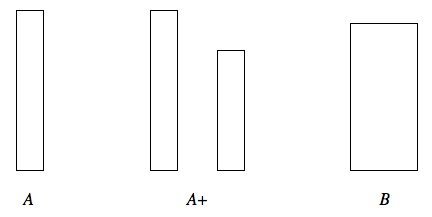
There are also Parfit's original Mere Addition argument and Huemer's Benign Addition argument for the Repugnant Conclusion. They're the familiar A≤A+<B arguments, adding a large marginally positive welfare population, and then redistributing the welfare evenly, except with Huemer's, A<A+, strictly, because those in A are made slightly better off in A+.
Huemer's is here: https://philpapers.org/rec/HUEIDO
I think this kind of argument can be used to show that actualism endorses the RC and Very RC in some cases, because the original world without the extra people does not maximize "self-conditional value" (if the original people in A are better off in A+, via benign addition), whereas B does, using additive aggregation.
I think the Tomi Francis example also only has R maximizing self-conditional value, among the three options, when all three are available. And we could even make the original 100 people worse off than 40 each in R, and this would still hold.
Voting methods extending from pairwise comparisons also don't seem to avoid the problem, either: https://forum.effectivealtruism.org/posts/fqynQ4bxsXsAhR79c/teruji-thomas-the-asymmetry-uncertainty-and-the-long-term?commentId=ockB2ZCyyD8SfTKtL
I guess HMVs, presentist and necessitarian views may work to avoid the RC and VRC, but AFAICT, you only get the procreation asymmetry by assuming some kind of asymmetry with these views. And they all have some pretty unusual prescriptions I find unintuitive, even as someone very sympathetic to person-affecting views.
Frick’s conditional interests still seem promising and could maybe be used to justify the procreation asymmetry for some kind of HMV or negative axiology.
This all seems right if all the trades are known to be available ahead of time and we're making all these decisions before Alice would be born. However, we can specify things slightly differently.
Presentists and necessitarians who have made trade 1 will make trade 2 if it's offered after Alice is born, but then they can turn down trade 3 at that point, as trade 3 would mean killing Alice or an impossible world where she was never born. However, if they anticipate trade 2 being offered after Alice is born, then I think they shouldn't make trade 1, since they know they'll make trade 2 and end up in World 3 minus some money, which is worse than World 1 for presently existing people and necessary people before Alice is born.
HMVs would make trade 1 if they don't anticipate trade 2/World 3 minus some money being an option, but end up being wrong about that.
I think it's pretty unreasonable for an ethical system to:
I haven't come up with much of an argument beyond incredulity, but I nevertheless find myself incredulous.
(I'm mindful that this comment is coming 2 years later and some things have happened in between. I came here by looking at the person-affecting forum wiki tag after feeling that not all of my reasons for rejecting such views were common knowledge.)
Only presentists have the problem in the first bullet with your specific example.
There's a similar problem that necessitarians have if the identity of the extra person isn't decided yet, i.e. before conception. However, they do get to learn something new, i.e. the identity. If a necessitarian knew the identity ahead of time, there would be no similar problem. (And you can modify the view to be insensitive to the identity of the child by matching counterparts across possible worlds.)
The problem in the second bullet, basically against burning bridges or "resolute choice", doesn't seem that big of a deal to me. You run into similar problems with Parfit's hitchhiker and unbounded utility functions.
Maybe I can motivate this better? Say you want to have a child, but being a good parent (and ensuring high welfare for your child) seems like too much trouble and seems worse to you than not having kids, even though, conditional on having a child, it would be best.
Your options are:
In binary choices:
With all three options available, I'd opt for 1, because 2 wouldn't be impartially permissible if 3 is available, and I prefer 1 to 3. 2 is not really an option if 3 is available.
It seems okay for me to frustrate my own preference for 2 over 1 in order to avoid 3, which is even worse for me than 1. No one else is worse off for this (in a person-affecting way); the child doesn't exist to be worse off, so has no grounds for complaint. So it seems to me to be entirely my own business.
Agreed
Is the difference between actualism and necessitarianism that actualism cares about both (1) people who exist as a result of our choices, and (2) people who exist regardless of our choices; whereas necessitarianism cares only about (2)?
Yup!
Hm, then I find necessitarianism quite strange. In practice, how do we identify people who exist regardless of our choices?
I think in ordinary cases, necessitarianism ends up looking a lot like presentism. If someone presently exists, then they exist regardless of my choices. If someone doesn't yet exist, their existence likely depends on my choices (there's probably something I could do to prevent their existence).
Necessitarianism and presentism do differ in some contrived cases, though. For example, suppose I'm the last living creature on Earth, and I'm about to die. I can either leave the Earth pristine or wreck the environment. Some alien will soon be born far away and then travel to Earth. This alien's life on Earth will be much better if I leave the Earth pristine. Presentism implies that it doesn't matter whether I wreck the Earth, because the alien doesn't exist yet. Necessitarianism implies that it would be bad to wreck the Earth, because the alien will exist regardless of what I do.