Thank you for carving out time and attention for this course, Anton. Thanks also to the EA Long-Term Future Fund for investing in the project. The timing is perfect, as many of us curtail December/January travel plans and look for more-productive alternatives to watching Omicron case counts rise.
Signed up, and I'm a few videos in already. Will share with others who have an economics bent!
Sounds very interesting!
I'm not sure if I have the time for a course, but I'd still be happy to know - If I only have very limited time per week, what's in your opinion the minimal amount of time I'll need to put in weekly? e.g. will one hour a week make sense if I take it over half a year? Or is there a stricter limit?
I'd suggest to just try it out. Coursera allows you to reset your timeline if you go slower than the suggested schedule so it's no problem to spread out the material over a longer time range, and I hope you'll still find it informative.
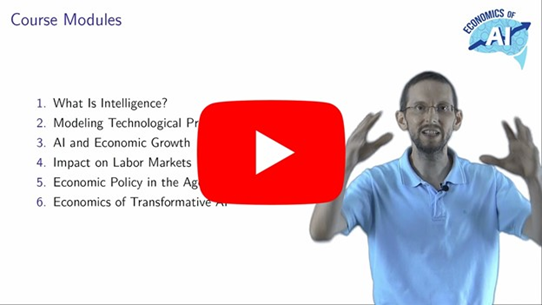
After having researched the topic as part of the Centre for the Governance of AI (GovAI) for several years, I have made a six-week course on "The Economics of AI" freely available on Coursera, supported by a grant from the EA Long-Term Future Fund. The course covers how transformative artificial intelligence will affect our economy and society, labor markets, inequality, growth, and economic policy.
Economics is a social science that is well-suited to modelling social processes, to examine how to intervene in them and how to make our society work better. It has long been a favorite subject to study for effective altruists. As artificial intelligence is starting to transform our world, the question of how to positively shape its economic impact has also received growing attention in the EA community. My course focuses on the long-term effects of AI on our economy and society, on economic policy solutions, and on governance structures that will be useful under transformative AI scenarios.
The course consists of six modules that introduce you to the cutting-edge research in the economics of transformative AI. Each module is dedicated to a specific topic that we will be covering via short videos, exercises, and readings.
The first module starts by analyzing the nature of intelligence, how it relates to our economy and how AI will transform it. This part is accessible to anyone with a social science background. The remainder of the course is targeted at people with a background in economics or a similar level of analytical skills, i.e. graduate students or advanced undergraduates. Others may enjoy the non-technical parts of the course.
The second module connects the analysis of the nature of intelligence to models of production and technological change in economics and examines how these processes are affected by AI. Then we turn to how technological change drives aggregate economic growth, covering a range of scenarios including a potential singularity in growth. We also study the impact of AI-driven technological change on labor markets and workers, evaluating whether fears about technological unemployment are well-founded and what to do about them. Next we investigate how to steer progress in artificial intelligence in a direction that benefits humanity. Finally, we analyze the potential for transformative progress in AI to lead to significant disruptions, and we use the methods of economics to study the question of how humans can control highly intelligent AI algorithms.
TL;DR
* GOAL 3 is a social enterprise that created IMPALA, a patient monitoring and digital platform system for low-resource settings. There is also a GOAL 3 foundation that raises funds to ensure underserved communities will be reached.
* A recently completed report from Rethink Priorities calculated IMPALA to have a cost per DALY averted of $7–17 in paediatr...
This month effective altruism has gotten lots of attention, including a cover story in The Economist. It feels pretty surreal to be on the receiving end of it. But I feel grateful these ideas have caught on, and even more grateful for the drive, earnestness, and compassion of so many people who took strange but well-argued ideas seriously and then actually acted on them....
Impressions from the 21st Annual U.S. Cluster Headache Patient Conference, organized by Clusterbusters.
On the morning of the last day of the conference, E. was hanging out with other “clusterheads” outside the conference hotel when he started having a cluster headache attack. Before he could go back to his hotel room, J. offered E. his DMT v...


Not directly related to the course, but since you're an economist with an interest in AI, I'm curious what you think about AGI will drastically increase economies of scale.
I think it's a pretty plausible scenario but not the only one - there's quite a range of possibilities - let me recommend a survey paper with Phil Trammell that is closely related.