Comments
This is so exciting! Quick note that the footnote says Chicago University although the linked post says University of Chicago.
This is so exciting! Quick note that the footnote says Chicago University although the linked post says University of Chicago.
Thanks for the note! Fixed.
Excellent work. Really great to see.

For CEA's Q3 update, we're sharing multiple posts on different aspects of our work.
We help EA group organizers by advising them, providing resources and funding, and creating online spaces where they can share resources and support each other. The following overview describes support we provide across university groups, city/national groups, and our virtual programs platform.
Some highlights:
We’ve also been talking a lot more with recipients of community building grants, and with other full-time community builders. We should have spent more time on this sooner: we think that these community builders are doing vital, challenging work, and they have a lot of important expertise. We’ve learned a lot from talking with them, and it’s also caused us to reflect on how we could improve our advice, logistical and financial support, and communications. We’re working with them to implement some of these improvements.
We had over 100 support calls with focus university group organizers this quarter (beyond the broad groups calls mentioned below).
13 out of 17 focus university groups[2] now have funding for a part-time or full-time organizer in the 2021-2022 school year (compared to 6 groups in 2020-2021). This impact shouldn’t just be attributed to CEA (e.g. we think that the Student Careers Team also encouraged people to apply to these programs).
The majority of the new CBGs are part-time, but we think they’ve led to folks spending more time on their groups, and we expect these part-time roles to work well as a pipeline towards full-time roles.
We approved 24 Community Building Grants applications (CBGs), for a total of 7.4 FTEs for at least the fall term of this school year.
Jessica McCurdy, a former organizer of EA Yale, joined CEA to build out a program that can support many EA university groups at scale.
The goal of this program is to develop a scalable process to help 2-3 volunteer group organizers, from any university, to create a new group and get it off to a strong start in its first semester (through events like club fair tabling, intro presentations, and an intro fellowship). This program provides resource templates, training, calls, and funding. 7 groups are currently participating in the pilot program.
We ran three programs this summer to increase the number of CBG applicants:
We also talked to group organizers who were in Oxford as part of a summer program organized by the Student Careers Team.
User feedback was positive (summer fellowship likelihood to recommend of 8.1/10, US retreat LTR of 8.5/10, UK retreat LTR of 9.0/10).
Tentatively, we think that:
As a result of the efforts above, our bar for awarding a CBG to a group organizer has become higher. This means some grants we made earlier in the summer may no longer be competitive, given the increasing number of students interested in community building and the amount of support we’re trying to provide to each grantee.
This quarter, we’re focusing on:
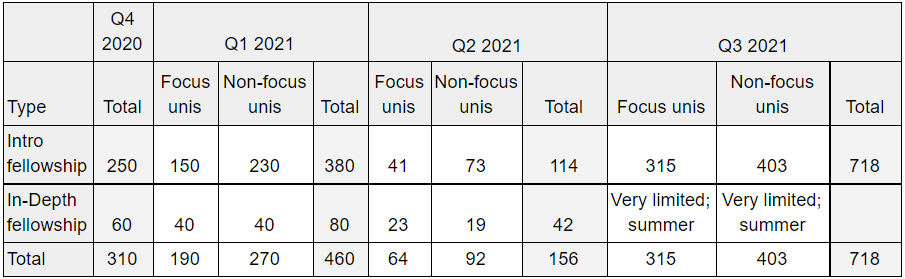
Marie Buhl (contractor) provided support to 26 local groups running the Intro Fellowship over Q3, improved our marketing materials, and ran two marketing workshops and a facilitator training.
Below are numbers for in-person fellowships.
Notes:
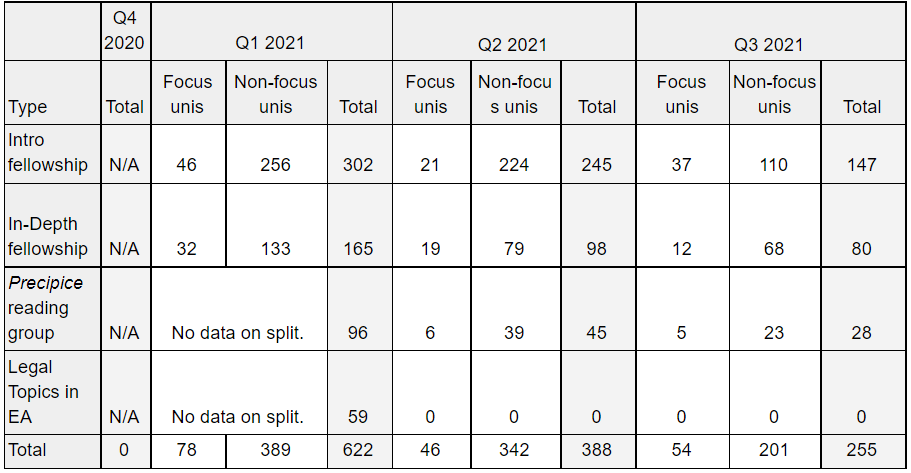
255 people went through Virtual Programs in Q3, compared to 388 in Q2. We think this dip is in part due to a shift from online to in-person events in many parts of the world (thanks to the start of most universities’ fall semesters).
In Q3:
Below are numbers for virtual programs.
Notes:
Rob Gledhill (CBG Programme Manager) started in September and conducted a listening tour, calling 22 city / national CBG recipients to understand their groups and the ways the CBG program could better serve them.
Program updates:
We maintained our broad support for group leaders, and responded to increased demand for support.
We had around 65 calls (up from 54 in Q2) and 125 significant email / Slack exchanges with group leaders. We received positive feedback on the calls (average likelihood to recommend of 9.4/10[3] vs 9.3/10 in Q2).
We funded 39 small group projects (e.g. for food, books, technology and event costs) in Q3 (compared to 16 in Q2).
We contracted a graphic designer to create graphic templates, and created an online space for organizers to copy and share templates.
One specific example of our impact: We connected three community members from Nairobi, and it seems likely they’ll be able to restart the city’s dormant group.
In Q3 we added the following people to the Groups team:
Some of this may be because we’re tracking more of the fellowships that are happening, but we think there has also been significant real growth. ↩︎
There are currently 17 focus university groups (chosen primarily based on the expected influence of an average graduate, with some weight also placed on the groups’ track records and leader quality.) Current focus university groups in no particular order: Harvard, Oxford, Cambridge, Stanford, Yale, Princeton, MIT, Hong Kong University, Georgetown, Swarthmore, London School of Economics (LSE), Caltech, Brown, Berkeley, University of Chicago, Columbia, Penn. We added Brown this quarter due to the group’s sustained strong track record. ↩︎
n = 29 ↩︎


This is great! Do you have a breakdown of the total number of FTEs for each focus university (rather than just those that were approved recently)? I think this would be useful for people to understand how much the groups are staffed.
Hi Thomas, great question. I’ve included a list below for our records as of today (mid Nov).
It’s worth noting that we think any of these groups could absorb at least 2 FTE at a minimum, so I’d like people looking at these numbers to not be put off applying for the Campus Specialist Internship or Campus Specialist Programme based on the amount of FTE they currently have (although if you’d want to work on some of the under supported groups that would be amazing).