Comments

(I made an anon account to post this; I'm a longtime EA and Forum user).
The discussion in the comments so far focuses on two claims:
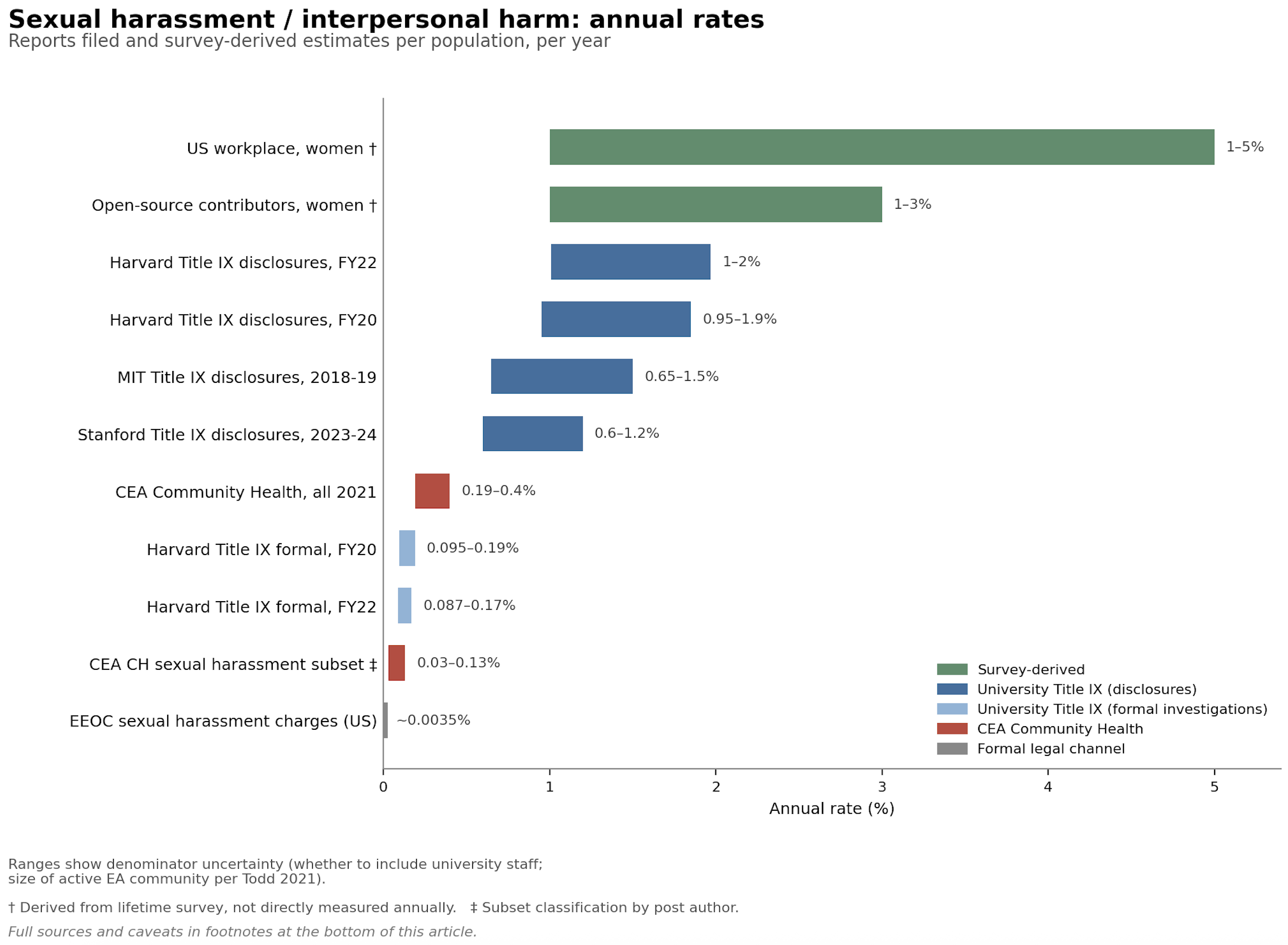
- We can't easily tell from this data whether EA is better or worse than baseline
- I agree, though I do think it's some evidence we're not much worse.
- Why does it even matter whether EA is better or worse than baseline? Community members are welcome to hold EA to a much higher-than-baseline standard, if they want to.
I want to discuss this second point from my perspective, as a woman who's been in EA for some years.
Here's an analogy:
Often, I hear the criticism of EA: 'man, they have bad epistemics and huge problems with groupthink.'
I sort of agree. I can list many instances where I think EAs are driven by groupthink and social incentives in our beliefs, rather than rigorous epistemic standards.
But, I sort of disagree.
That's because I can't think of any community [1] that does better on epistemics and groupthink than EA. Everywhere else I am vaguely involved, the groupthink is way worse, and they have very narrow standards for "acceptable" beliefs. In fact, in most communities, you can't even discuss epistemic standards at all without getting yelled at or dunked on!
I feel like it would be very reasonable for someone to approach EA like:
Ooh, I should be looking out for places where there's potential groupthink, and views driven by status rather than evidence.
But I think it'd be unreasonable for someone to approach EA like:
Damn, EA is a community where there's rampant groupthink — I should be suspicious of views I hear from EAs, moreso than views I find elsewhere.
Partly, that's cause the views you find elsewhere will also have those problems — and are actually likely to be even worse on the very metric of groupthink!
... So to bring it back to sexual harassment:
The reason it matters to me whether EAs believe that EA is above or below baseline on the rate of sexual harassment is that if EA is above baseline, then it'd be very reasonable for people to approach this community like:
Damn, EA is a community where there's rampant problems with sexual harassment — I should be suspicious of whether there are sexual harassment issues at play here & how they're being dealt with, moreso than in everyday interactions.
But if EA is in fact below baseline, then that's an importantly unreasonable response. That is, everyday interactions would have a higher likelihood of sexual harassment and poor responses to it.
I think it's good for people to be cautious about the risks of sexual harassment. But [2] I don't think it's good for people to feel like EA is a place where there are very high risks.
I do think there are unacceptably high risks — in the sense that I do not think any harm is "acceptable", and we should strive to create a world free from suffering — but it doesn't follow that an appropriate response is suspicion of EAs in particular.
[This comment is already really long, so I'm loath to add length, but the main response I anticipate is 'people aren't saying they're suspicious of EAs moreso than others, they're saying they're suspicious of EAs simpliciter.' I agree, but I think the net effect of these comments and discourse and the meme that EA has a sexual harassment problem is to make people suspicious of EAs moreso than others on this metric, and to make women in this community very afraid of sexual harassment, and to make men in this community very afraid of being a sexual harasser. I just think that's unreasonable if they don't also have that attitude everywhere else in their life — which I think is what's happening, based on anecdote / personal experience hanging out with EAs]
[1] Any community of a vaguely comparable size — obv a community of a dozen, or even a hundred or so could do much better. Also maybe rats are better but TBH I'm not totally sure.
[2] And now I show my hand... I do in fact guess that EA is better than baseline, based mostly on my personal experience dealing with sexual harassment inside and outside of EA :)


One overall thought: I wonder if what you're picking up on isn't an implicit belief that EA is uniquely bad, but the reality that people are very invested in EA. The reactions are strong and strongly worded partly because people in this community want this community to be good. They care about it, many are morally scrupulous, they're invested in its health and ability to function, they know the people in it. I don't think they're implicitly thinking "this is so much worse than anything comparable." My guess is that if you asked directly whether EA is worse than a comparable community, most would say "I'm really not sure" or "probably not? I don't know." That's been my personal experience.
I also think the comparative framing is somewhat beside the point here. EA isn't trying to reduce sexual harassment around the world, but it is strongly trying to community-build, and the relevant question for community-building is whether this is a place people can thrive in. Given that trying to answer the question of whether EA is "better or worse" is somewhat difficult, it's worth asking how important that question really is.
One thing I love about my current organisation is they are incredibly conscientious in how they build community and support their members. As someone who has now done event planning for this community for more than 3 years, I can't even imagine trying to ask if the baseline of harassment at my events is like other comparable events. I would much rather put my time and effort into making my events safer and more welcoming. In the same way that, I don't ask if the baseline satisfaction with the content at my events is the same as the average event, because I would rather put my effort into improving the content, and so on. (Edit: I was glib with my events comparison & wording, I like data & base rates are worth knowing and can help provide context and grounding, but I hope my directional point is clear)
I'll also say this, though I suspect it won't be well-received: there's something strange about a community that advocates for reducing suffering and encourages moral ambition retreating into "well, what's the baseline?" when sexual harassment comes up. What's the baseline of people who eat meat? What's the baseline of how much the average middle-income person in a developed country donates? I understand it's not exactly the same thing, but it's disheartening to see the baseline framing applied seemingly only here.
I like this comment; the events analogy, in particular, shifted some of my beliefs and gave me a useful frame I had overlooked before. Apologies if you've already covered this in other comments.
My impression is that, if asked, many people would say that EA is significantly worse than other spaces. There's some amount of trying to figure out which other spaces are reasonable to compare to, which allows people to agree with some versions and disagree with others, but on a vibes level, I feel like people think EA is significantly worse. [1] Idk if this is useful, but unlike (most?) other commenters, I do think Nathan is responding to a real sentiment.
Re "why do we even care about a baseline?" Ime, when harassment gets brought up (e.g. on the forum), people say that there were basic/common/cheap/expected mitigations that would have prevented the incident. If it turns out that most other orgs/communities, in fact, don't have these measures in place or are similarly bad at mitigating problems, then imo it's harder for proponents of change to argue that "EA" "should"[2] solve the problem. [3]
I liked the events analogy - one reason why I don't care that much about baselines for events (particiularly ones I have little connection to) is that most events are just ... pretty bad - or at least bad at achieving goals that are analogous to mine, and if I expected a similar level of success to them, I'd spend my time doing other stuff, but I do care a lot about the performance of events that seem particularly great and where my events stack up compared to those (maybe a baseline for "competent according to me" events) - idk if there are transparent groups out there that are doing a really great job in this area and would meet the standards of forum commenters but if there are I would be curious to hear about them.
As an aside, talking about this topic does seem pretty cursed, and I don't think there's much upside socially to being on the "EA is no worse than others" side or even the "idk man, it's pretty confusing how bad EA is on this dimension" side.
To be clear, I mean "should" in more of a deontological sense than a consequentialist one. I do care about outcomes in the world, but I just don't think it's possible to have an online discussion about the consequentialist case that couldn't ~only engage with one side.
It might even point to the problem being unusually difficult to solve (otherwise, why haven't the other well-intentioned communities solved it?).
Hi Caleb! :)
I found this useful! It's good to know what others are seeing & hearing. FWIW, my personal experience with this is something vague, like:
My hot take is that, a lot of the people who suggest this don't have a super developed understanding of sexual harassment, or they don't have much real-world experience, or they're quite young. I personally don't think there is some quick fix. Partly because EA has unique features that drive its gendered-issues. Unfortunately, this is actually a more doomy view than the idea that there are quick fixes, because it further supports that women who find the community difficult to tolerate/navigate should just leave.
Over the past couple months, I've intentionally began to try and distance myself from EA and been much happier for it (I don't do in-person meetup type stuff much anymore, am trying to do less "directly EA" online stuff, and I don't know if I'd ever consider doing meta-EA work again). I guess you could say that I'm implying EA is worse than comparable communities, but I don't mean it that way. It's just like, these days I do my job and hang out with my friends/family, and I only check the forum if I get an email notification that my post has been mentioned because I forgot to turn off email notifications for mentions :')
So I guess that's where I'm coming from when I say that I personally don't care much for this comparison. I feel like I have enough personal, direct, and specific data to conclude something is going wrong and something isn't meeting my standards. I'm realising that's a way in which I'm ill-placed for this discussion. If I didn't have a pretty thorough view formed over years, base rate might also be the first thing I want to understand. I guess I'm just personally well past that, but I've updated that this specific idea is worth discussing on the forum. I'm sceptical it will ever be done well, but alas.
Ah yeah, that all makes sense.
I'm sorry that you're much happier for distancing yourself from EA - but I'm glad that you're much happier now!
> If I didn't have a pretty thorough view formed over years, base rate might also be the first thing I want to understand. I guess I'm just personally well past that
I relate to feeling this way about other topics. Normally, I just roll my eyes and don't really engage with online discussions, but for fwiw I appreciate you giving your thoughts here - it was, at the very least, helpful for me.
Hi,
I appreciate you taking time, I know this subject isn't easy for you. It isn't easy for me either.
I'm really confused by your response. If I ran events, I think hearing baselines would be a thing that would be really important to me. How much people tended to pay, how often they recommended it to friends, what the typical gender balance was and yes, if it was raised, what comparable rates of sexual harassment were.
You know a lot about event organising. What am I missing here? Why would you not want that information? Surely the first step to solving a problem is to understand how bad it is? If EA's rates of sexual harassment are much higher than universities, their approaches will likely work. If they aren't, they likely wont. It seems relevant to me.
Again, you penultimate paragraph confuses me. These are easy an uncontroversial questions (answers from perplexity):
And to continue:
What do you mean only here? Here is practically the only place it's not applied. We apply baselines almost everywhere.
I am genuinely confused. To me, this isn't some carvout for sexual harassment, it's trying to treat discussion of sexual harsassment like I treat everything else. How do we compare to other things? How much impact does our effort have in this area compared to others? How would we know if we improved?
Let me explain. The steel man of your point is: to understand a problem, you need to understand its magnitude. Yes, agree. Again, as per my edit, I was being glib. Let me be more precise.
I'll take my events example. I do want to understand base rates. I want all data, data is great! Let's pretend at most events, 10% of attendees are harassed. At my event, I find out it's 40%. Or, in a different example, it's 0.2%. Both of these are important and significant differences. Now, the base rate becomes quite important to understand and investigate.
Let's say, I find out that at my event, it's 8%. This is more comparable to the case presented in your post. My boss wants me to write an internal document about harassment at events. The first paragraph may include a base rate, for grounding. The internal document will not be titled "our events are not worse than baseline!" and the vast majority of the document will not focus on making this case. Because, what's the point? It would be a waste of my manager's time. I'll write about what problems I suspect are occurring at our events (hopefully I have a good model of this, or can investigate), and I'll talk about potential interventions we might be able to take, if any.
To the second point, you have indeed misunderstood. I've never seen a post that says, "The average donation per person within EA per year is so much higher than middle income donations generally! And yet, we still keep trying to encourage giving in the EA community. Are we understanding the scope of the giving problem? Are we somehow implying EAs aren't already way better than baseline?" And I've never seen a post that says, "woah, people are always debating about veganism and whatnot but, EAs are way lower than the base rate anyways, so why are we not explicitly acknowledging that when we try and suggest people should consider veganism? Or offsetting?" My point was never that these numbers can't be found. My point was that, we do not set our moral standards on baselines. We ask people in this community to care about suffering and to be morally ambitious. Why can't we ask that of sexual harassment, as well.
I think there are posts which question the marginal decision on donations and veganism.
Now perhaps you will object that these articles don't have much discussion of baselines. To me it's implicit in them that EA has a higher baseline interest in small donations and veganism than typical communities. If not, why would these articles be written?
As an aside, did you ever learn what comparable rates of harassment were at events similar to those you ran? How did they compare?
I've noticed a pattern of a particular rhetorical move you tend to use, whereby you sidestep engaging meaningfully with people's points and instead continue to ask pointed questions. With these questions, it's relatively clear that you have one answer you agree with and expect back. If you don't get that answer, you tend to simply continue posing further questions, sidestepping other points, and pushing in the direction of a specific answer. If this method eventually produces an answer you're looking for, or something close, I then see: "great, now that we've established [narrow thing of x] to be true through my questioning, we can conclude [original claim I've been trying to prove all along]." Sometimes, I've noticed you'll do this even if the person hasn't exactly agreed with narrow thing of x. I think this is unproductive and poor epistemics.
Your reply raises about 5 points. I responded to the ones I choose to. It seems unlikely I'm going to be able to engage with all of them. Is there one that you would particularly like me to engage with?
But to talk a little more, yeah it's hard to argue this stuff well. To me it feels like a pretty anodyne point. People make claims (which I've listed) and they seem different to the data. In response we have ~30 comments, mainly critical. Many contain long blocks of text that it would be hard to respond to in full. Yeah I expect to do a mediocre job here.
And as for us, Frances, we don't really get on. So I guess I'm discussing this pretty defensively. With respect, I think you are too. I think if I were better I'd find a way around that, but I do think this is importnat to us, so I think it's worth discussing well even if not perfectly. If you have suggestions, I'm happy to take them.
Nathan, I genuinely think this is more emotional for you than it is for me. Yes, sexual harassment is a personal topic for me, but it's also one I've thought about a lot on an intellectual level. And further, I have no emotional commitment to the question of whether EA is better, the same, or worse. I've previously written that I guess it's probably about the same as comparable communities.
It is definitely true we have had several interpersonal interactions over the years and we don't get on, but the epistemic feedback that I wrote, I meant sincerely and without prejudice. It has several agree votes. I recommend you try reading it again and really consider it, if you'd like to. As a nudge, my feedback was not "you didn't respond to each one of my points." Of course, you also don't have to read it! I'm sure I am more glib and frustrated in my tone when I talk with you, so I don't mean to suggest that our personal frustrations don't come through at all on my end. And as others have pointed out, if the original post contained a better analysis and a more genuinely curious tone, I think this whole post would've gone over differently. I genuinely think I could write a post: "how do rates of sexual harassment in EA compare to other communities?" and it would be very well written and it would probably go over great, I'm sure I'd get some pushback but I wouldn't mind. But I mean it sincerely when I say, I don't find this question particularly important so this isn't something I would personally bother writing. I'm sure someone else could also do a great job, or CH could write this very well, but it's a matter of finding someone who can write these kinds of things well, has the motivation, and the time for it.
I find it hard to engage with the full sweep of your messages. The choice for me feels like its between long slightly bitter responses and ungaged surface-level ones. I tried to avoid that by picking specific points last time, but you're right that I didn't really engage. I may not be capable of doing so. But let me see if this works.
On "people aren't saying EA is uniquely bad, they're invested" if that were the central thing, I'd expect critical comments here to open with "yes, you're probably right about the comparable-communities point, but I think you're missing the deeper thing." Almost none do. (Some straightforwardly disagree, which is a different thing) Most spend their words on what I got wrong, and only when pressed do they acknowledge agreeing with the empirical claim. To me it feels like the piece has struck a nerve. Does mere investment explain why this post provokes that response?
On "I think this whole post would've gone over differently" — I spent about ten hours on it. I could spend another ten and I don't think it would change the response. The methodological criticisms raised so far would lift the numbers by less than 10x on my read, which is still inside the bounds of the estimate. When I've pushed back on those criticisms, people have given way or stopped responding. I don't think they are the crux.
As for if you could write a post that would be more accepted. Of course you could. I'm not debating that. But I don't think it implies much either. We are different people, with different histories from different EA sub communities and I am mediocre at reading social cues.
You're right that I'm defensive. I am. Part of why is that this comment section feels deeply defensive to me—unwilling to give an inch on the central claim, unwilling to back up criticisms when challenged, willing to imply things about motives. To me, most of these comments feel defensive, including my own.
But I would like us to move to a bette mode of communication. I have at times been defensive and unengaged. Here is a new attempt to engage more fully.
I appreciate this and I think it's good to just be able to say "I find it hard to engage with your messages," so in that spirit I will try to keep this one short, I know I tend to write a lot:
Meh, you can comment further if you wish. I am choosing to engage here and it's not that costly to me. This has felt like a pretty positive interaction at least at the end.
I appreciate your points. And to your first point I agree that people care about this a lot and feel invested in it. I can empathise with a desire to reduce sexual harassment, I mean, don't most of us want to feel safe and comfortable?
Thanks for your time.
This is how I feel as well, well said.
In my epistemic norms if someone makes 5 points, I’ll respond to whichever one I choose, if they make one point, i’ll respond to that. Perhaps we have different norms.
If you have specific criticisms I’m happy to respond to them.
Agreed. I wrote one of the linked comments and don't have reason to believe EA is worse than other areas.
Agreed. "Let's take all efficient moves to improve this bad situation" would be a nice response to hear, rather than "can you prove it's worse than other places though?". If Nathan's argument is "there aren't efficient moves left to take, we've entered diminishing returns" (as gestured at by "weigh the tradeoffs"), I think he should directly make that argument instead.
ETA: Here is my full comment that Nathan quoted. If anyone has a social-economics rebuttal, I'd be interested in hearing it. Whether or not EA is doing better than other communities, the dynamic I pointed out is bad:
If I might engage you sort of conflicty, what do you think of the other comments on this post. Like many of them seem to be saying that actually EA probably is worse or that my sums are bad?
And isn't there some value in pinning down some sense of where we are?
To me this feels a bit like whack a mole. A big chunk of people are arguing (and then never responding afterwards) that my sums are bad. Another chunk are saying 'sure you might be right but shouldn't we do better' and another chunk are saying that I am not really arguing the thing I claim to be arguing.
Can't you see how all of this taxes me making the point? Can you see how it seems to me that everyone wants to make a different point about why it's bad but no one wants to disagree with each other? Isn't that strange?
My theory there is a large shape that most of you don't wish to turn your focus on and that in this post I am forcing your attention to it, so you all know deep down that it must be bad and that you must disagree. And of course you don't need to disagree with each other because the real disagreement is that I am forcing your attention to it. And that doesn't sound very healthy or very EA.
I would take a top level comment saying that on the substance I am right but that you disagree with the framing or for you to disagree with some other comments as evidence against this theory.