Comments
It’s been just over a year since ARMoR launched through the CE/AIM incubation program! In that time, we’ve worked hard to push for policies that will help tackle the rising threat of antimicrobial resistance (AMR) and made some strong progress towards this aim.
As part of our anniversary, we want to take the opportunity to:
Please contact us at [email protected] if you have any questions, comments, feedback, or are interested in donating!
Since the discovery of penicillin in the early 1900s, antimicrobials have played a pivotal role in ushering in the age of modern medicine. These drugs not only significantly reduce the burden of infectious diseases on our healthcare systems but also enable us to perform life-saving surgeries, administer chemotherapy, and manage chronic illnesses. Because of antimicrobials, many of us no longer have to fear dangerous infectious diseases like tuberculosis, sepsis, and meningitis.
Unfortunately, the antibiotics that have protected humanity for decades are losing their effectiveness. Already, one million deaths are directly attributable to AMR globally every year. This ranks it among other major global health threats such as malaria (at ~650,000 deaths/year) and Tuberculosis (at ~1.2 million deaths/year). The kicker is that unlike Malaria and Tuberculosis, whose disease burden is shrinking every year, the disease burden of AMR is steadily growing. Without serious intervention, it is projected that by 2050 the number of deaths due to AMR will double to 2 million deaths annually.
We can combat this rising threat on two main fronts:
Given how poorly understood the drivers of resistance are (see this paper for more), and the fact that it seems unlikely that we'll be able to reduce the growth of resistance in the short term though stewardship efforts, focusing on the development of new antimicrobials seems to be a more robust and tractable option to reducing the burden of AMR.
One reason that the malaria vaccine took so long to develop, despite its immense social value, is the fact that most of the beneficiaries have a limited ability to pay. Like malaria, low and middle income countries bear the majority of the AMR health burden, accounting for nearly 90% of the direct death toll. Unlike malaria, AMR is an issue everywhere, claiming more than 35,000 lives every year in the EU/EEA.
With a large (and growing!) death toll in the west, you might expect there to be a strong financial incentive for companies to develop new life-saving antimicrobials that circumvent resistance. Unfortunately, this has proven not to be the case.
New antibiotics are incredibly expensive to research and develop. The cost of getting a novel antibiotic to market is estimated to be upward of one billion dollars. However, once developed, payers are incentivised to drive down the cost of the antibiotics while health care professionals aim to use new antibiotics as sparingly as possible to prevent the growth of resistance. These issues are further compounded by the fact that clinical trials and traditional governmental reimbursement mechanisms aren’t well-suited to evaluate antimicrobials. [2]
The development of novel antimicrobials is a classic case of a market externality: the societal value of antimicrobials far exceeds the revenue they bring in.
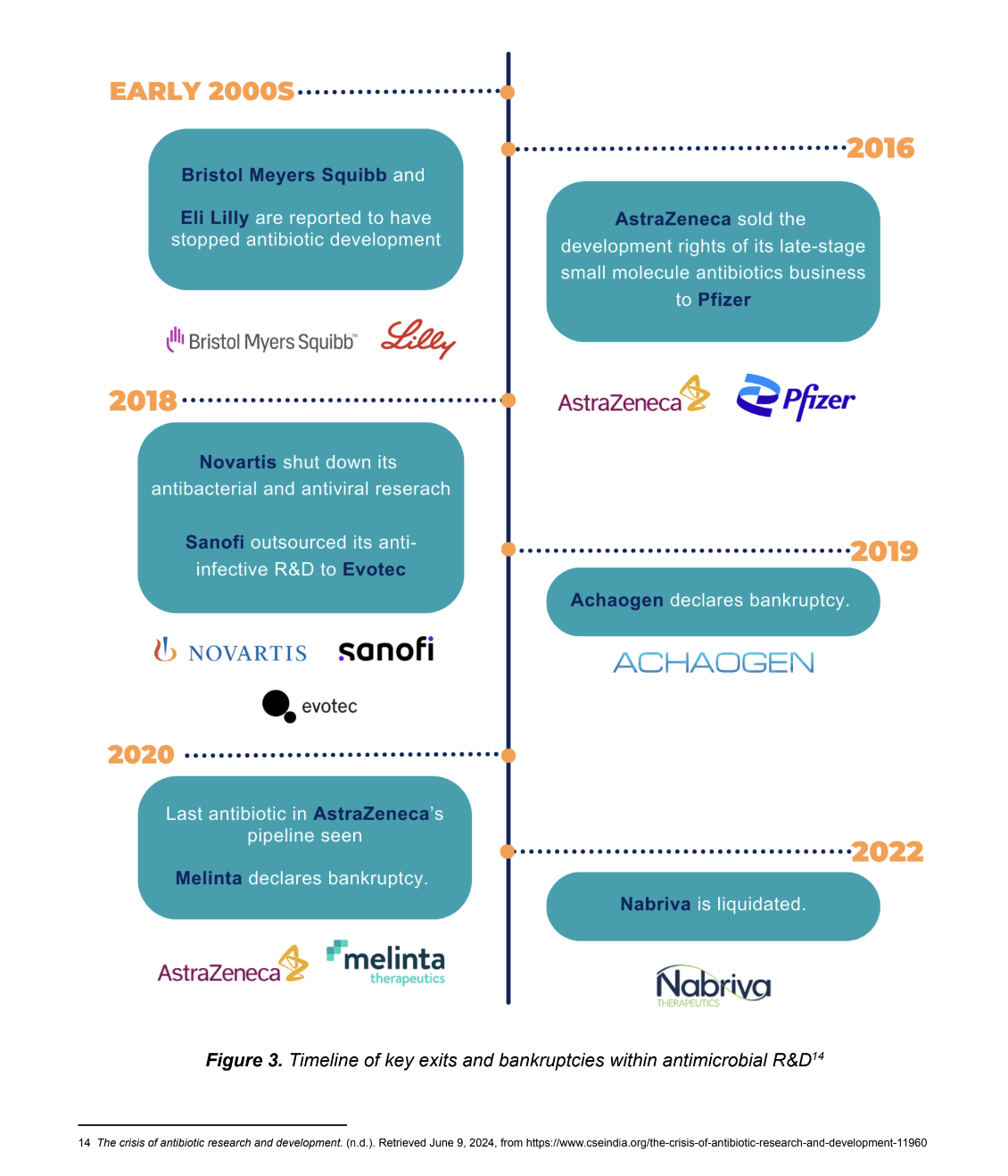
Most large pharmaceutical companies have now shut down or sold off their antimicrobial R&D divisions, and much of the skills and expertise that were built up there is lost. Since 2019, three important companies which specialised in antimicrobial development have declared bankruptcy. The pipeline is now mostly in the hands of small and medium biotech companies, who often lack the needed investment and resources.
Without urgent change, we are looking at the complete collapse of the antimicrobial pipeline within the next 10 years
For new antibiotics to be developed, it has to become profitable to do so.
We advocate for policies which make this possible. In particular, we believe that pull incentives are an effective mechanism to achieve this.
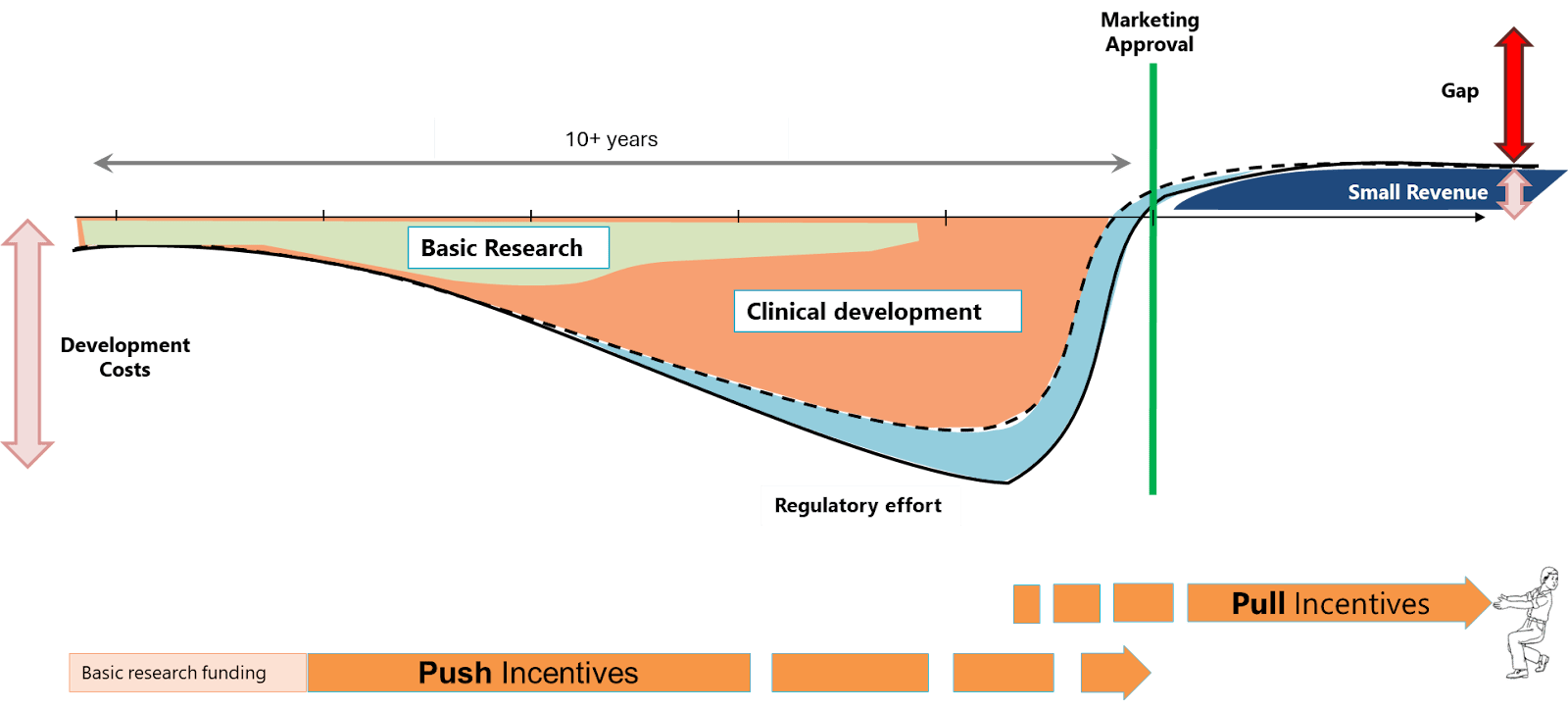
Pull incentives (such as advance market commitments) offer innovators a guaranteed revenue for bringing novel antimicrobials to market. For antimicrobials this revenue should ideally be independent of sales volumes, so pricing can be based on appropriate use rather than profit. If governments pre-commit to paying a sufficiently high enough price before the drug is developed, companies can safely pay the R&D cost knowing that they can receive a reasonable return on investment (ROI) once the product is approved. [3]
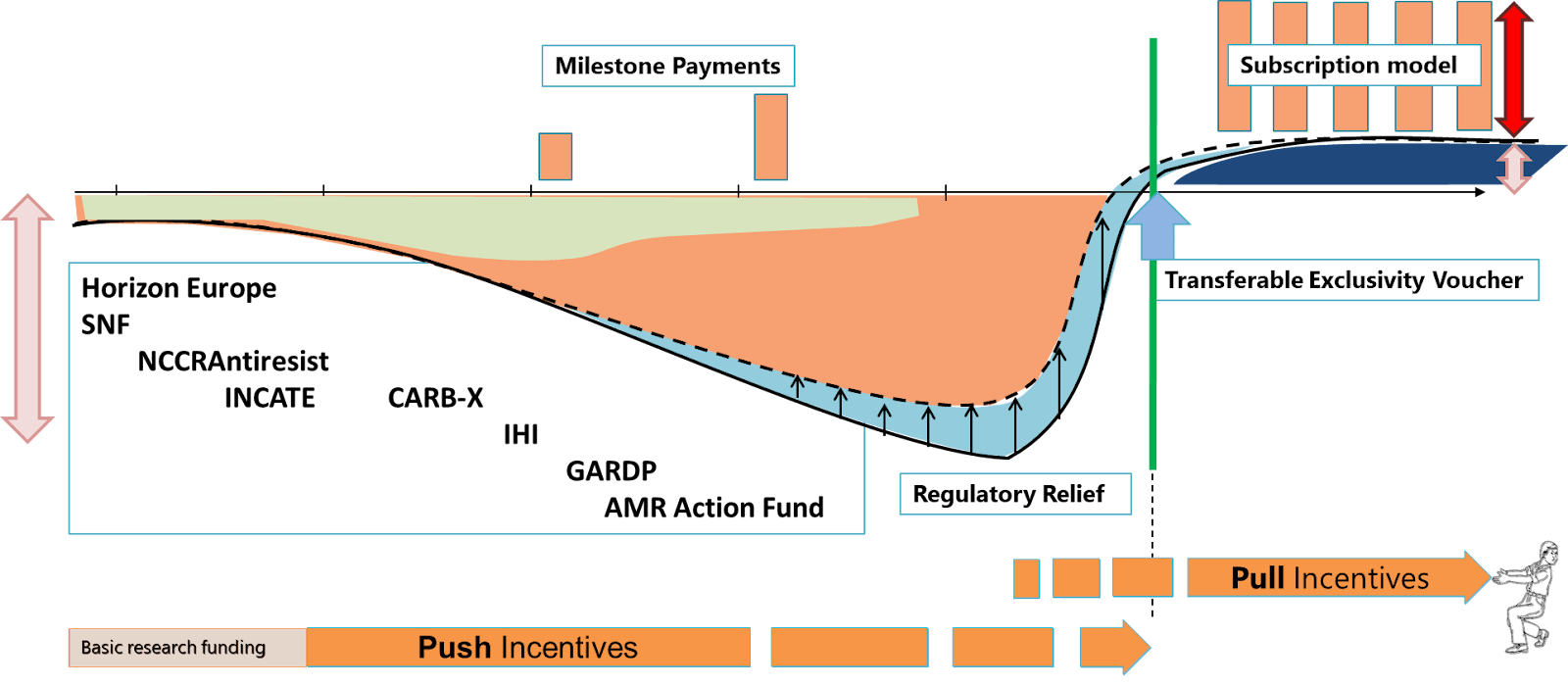
The issue, however, is that pull incentives are quite susceptible to global coordination and “free rider” problems. Governments have recognized the need for innovation in this space, but for any single country, the value of a new antibiotic is lower than the total R&D cost. This means that in order for pull incentive policies to be a good investment, enough countries must be brought into the idea. This issue is further compounded by the need for upfront funding and the fact that any single country which puts out an advance market commitment to incentivize development, would effectively be subsidising the drug for all other countries who will try to bargain the price down to its marginal cost of production.
These challenges make implementing pull incentives difficult, but not impossible. In fact, several countries—including the United Kingdom, Sweden, Japan, and most recently Italy—have introduced versions of this policy. The United States, the EU, and other nations are also in the early stages of exploring similar approaches. However, progress remains slow, and if we want to avoid a pipeline collapse, a more concentrated effort is essential.
Given that the majority of the AMR burden falls on low- and middle-income countries (LMICs), it is essential that any implemented pull incentive policies include mechanisms which can support access and stewardship in these regions. These conditions can be built into pull incentive models and would ensure that incentives are awarded only if innovators commit to specific guidelines on access and stewardship. For instance, developers might be required to provide new antimicrobials to LMICs at affordable prices or agree to licence the drug to third parties serving LMIC markets.
Our work is predicated on two main assumptions:
If either of these assumptions are proved likely to be false, it would mean that ARMoR should seriously consider shutting down or pivoting to a more impactful area.
Before launching ARMoR, we were relatively confident in the first assumption. However, we had far less confidence in the second. Specifically, we were uncertain about the following:
In many ways, we viewed our first year of operation as a time to test these key uncertainties and make sure that ARMoR was indeed a good long-term investment. We’re now much more confident in our ability to have an impact in this space.
First, although governments have taken initial actions towards the implementation of pull incentives, there is still a lot of work to be done. For example, in the recent deliberations over the EU pharmaceutical legislation, a type of pull incentive called a ‘transferable exclusivity extension” is being negotiated. This policy would allow developers of new antibiotics to extend the “patent” of another more profitable drug in their lineup, as a way to encourage and increase the profitability of bringing new antibiotics to market. However, not only is this mechanism quite far from being passed, we believe that there are serious issues with the design of the policy which would significantly reduce its effectiveness.
While there are several actors working on this issue, many of the main actors in this space are industry organisations who aren’t as trusted by policymakers and benefit directly from the policies being passed. Meanwhile, global health organisations typically have a much broader focus and don’t have the detailed expertise needed to advocate for these specific policies. In some ways, we think that the need for additional actors is demonstrated by the lack of research, advocacy, and lobbying efforts on global access conditionalities.
Given this, we believe that there is a lot of value in positioning ourselves as non-industry affiliated “experts” on pull incentive implementation. In particular, we believe that advancing this agenda requires more stakeholders (like ARMoR) to:
In terms of tractability, despite being a new and small organisation, ARMoR has established credibility and engaged with a wide range of stakeholders. Over the past year, we influenced the EU Parliament’s stance on antimicrobial pull incentives, successfully incorporating language on subscription models and global access into draft legislation. We have also taken a leadership role, coordinating a coalition of influential NGOs to create a unified policy position on EU pull incentives, and one of our co-founders was invited to present on these incentives to Member State stakeholders at a European Commission training session. Additionally, our recent cost-benefit analysis on EU pull incentives has been used in discussions with over ten governments, further bolstering our network of contacts across the European Commission, Parliament, and Council representatives.
Overall, because the declining antimicrobial R&D pipeline is an issue with a broad level of consensus among policymakers, we think this issue, despite being a large policy task (moving potentially billions of dollars and requiring large amounts of global coordination) is more feasible than other interventions on a similar scale.
Right now, most of our work can be divided into four main workstreams: European Union campaign, Nordics campaign, member state outreach, and global access research. The rest of this section will outline the objectives and rationale for each of these programs as well as some highlights of the progress we have made and our planned next steps.
It’s a little in the weeds, so feel free to gloss over. We also have a recent newsletter which goes over some of this at a higher-level.
Due to the nature of policy work, cost-effective analyses are inherently somewhat speculative and based around low chances of very high amounts of impact. ARMoR is no exception, but we’ve done our best to model the expected impact of our work, aiming to be quite conservative to balance out the higher levels of uncertainty.
Our current analysis, based on Founder Pledge’s methodology for evaluating policy organisation, shows that work pushing (a blanket term encapsulating a combination of research, advocacy, and informational lobbying) for pull incentives in the EU has a cost-effectiveness of about $950 per life saved globally and $6,200 per life saved when just considering the EU.
We calculated these numbers under the assumption that ARMoR, alongside other actors in the space, have a 10% chance of speeding up the passage and implementation of an EU-wide pull incentive by one year and improving the design of the mechanism such that an additional 6.5 new antimicrobials are created in expectation. Furthermore, given our current understanding of the AMR R&D ecosystem, we give ourselves a 7.5% attribution of the total impact this “policy win” would have.
Beyond these numbers, a big part of our work right now is helping policymakers understand pull incentive schemes and the value they bring. Although our work is mostly in the context of new antimicrobials, we believe that increasing policymakers' familiarity with the general idea of pull incentives is a big win. As shown by the work being done by the Chicago Market Shaping Accelerator, there are several different opportunities for pull incentive policies to have a significant impact, particularly in the areas of pandemic preparedness and climate resilience. These policies might have a smoother pathway to implementation if many relevant policy makers are already familiar with the core ideas and have a clear example of a pull incentive being implemented.
As our current campaigns scale-up, we are looking to raise an additional $420K to support our next two years of operations, with a minimum need of $149K to support us through 2025.
Here are some examples of what different amounts of marginal funding contributions towards this target would allow us to accomplish:
In general, we believe ARMoR is susceptible to the “bystander effect”. In other words, our work falls at the intersection of global health and biosecurity, leaving us in a grey-area where it’s not clear who our main funders will be. Marginal funding will give us more time to establish ourselves, thereby increasing our chances of securing more substantial core funding in the future.
Overall, while there are still significant uncertainties, our first year has updated us favourably on the neglectedness and tractability of this intervention. We believe that ARMoR is a good bet if you want to cost-effectively save lives and reduce the growing burden of antimicrobial resistance.
Please reach to [email protected] if you have any questions, comments, feedback, or are interested in supporting our work! Thank you for your time and consideration!
This can be done through better infection prevention and control, WASH interventions, improved agricultural practices, improved antimicrobial stewardship etc.
The Center for Global Development has a great report going into more detail
We specifically advocate for revenue guarantees, a pull incentive model offering developers a fixed annual reward based on the drug’s value to patients and the healthcare system. Under this approach, hospitals purchase the drug as usual, with prices structured to promote appropriate use. Each year, a “top-up” payment is made to cover the gap between sales revenue and the predetermined reward, ensuring developers receive consistent, value-based compensation.


Thanks for writing this up, and congrats on having preliminary promising signs!
I left a bunch of more minor comments in the CEA sheet (thanks for making that public).
Are there any interest groups on the other side of this issue? I suppose budget hawks and fiscal conservatives may try to shoot down any new funding plan, particularly given EU budgetary woes. But otherwise, it seems like a good issue in terms of not making powerful enemies (since the Pharma industry is onside).