Comments
Nice work! I'm confused as to how 36k funds 1 senior researcher FTE year; this seems very low, what am I missing?
Nice work! I'm confused as to how 36k funds 1 senior researcher FTE year; this seems very low, what am I missing?
Executive summary: ARMoR reports two years of progress advocating for policies that incentivize new antimicrobial development, with growing influence in the EU and beyond, a stronger consultancy arm, and plans to expand into antibiotic access in low- and middle-income countries (LMICs).
Key points:
This comment was auto-generated by the EA Forum Team. Feel free to point out issues with this summary by replying to the comment, and contact us if you have feedback.
It’s been just over two years since we launched ARMoR through the CE/AIM incubation program. Last year for marginal funding week, we wrote this post to
This year, we will provide a short update to that post. In particular, we'll outline some important strategic shifts, our recent progress, and lessons learned. We’ll also summarize our current funding situation and explain what different levels of marginal funding would enable us to do.
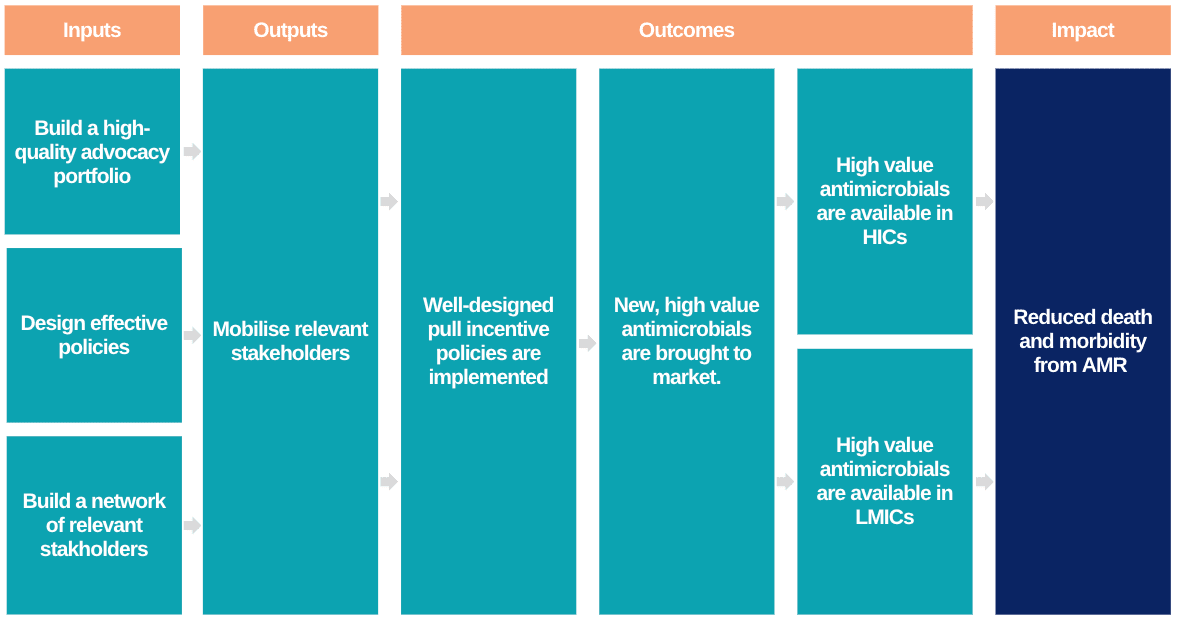
If you are unfamiliar with what we do, I would recommend reading our post from last year's marginal funding week, but here is a quick refresher:
Right now, our immediate priority continues to be getting a sufficient and well-designed pull incentive with strong global access conditions implemented in the EU. To accomplish this, we have been working at both the EU and member state level, targeting specific policy vehicles such as the EU General Pharmaceutical Legislation, EU Biotech Act, the Critical Medicines Act, Multi-Year Financial Framework, and updates to national level policies (e.g., AMR national action plans).
We decided to focus on the EU because it represents one of the largest markets for antibiotics and offers several strong policy windows to exploit. However, if high leverage opportunities arise, we will also often support organisations working on similar policies in other countries or other antimicrobial R&D ecosystem strengthening initiatives. For instance, we’ve provided analysis for the Australian Antimicrobial Resistance Network (AAMRNet) and the Swiss Roundtable on Antibiotics. Their advocacy efforts—supported in part by our work—have already driven important progress, including concrete commitments toward national pull incentive schemes.
Beyond our work in the European Union, one of the biggest strategic shifts we have made this year has been our engagement in consulting work for mission-aligned organisations. We’ve found that we can use these engagements to both deliver valuable outputs and shape the priorities of more influential actors in the AMR ecosystem. In the past year, we’ve been commissioned by organisations like the World Bank, Novo Nordisk Foundation, Union for International Cancer Control, and SECURE (a WHO initiative).
An important strategic shift we plan to make in 2026 comes from two important observations we have made about the nature of policy work:
So, because policy capital transfers across adjacent domains, it often makes sense to place more than one bet in roughly the same space. For less than a doubling of cost, you can often more than double the expected impact. Over the past two years, we’ve built substantial policy capital and are now seen as credible operators in this space. In the coming year, we plan to identify and explore additional high-impact policies where that capital can be leveraged. [1]
Most notably, we received a grant from the Founder’s Pledge Catalytic Impact Fund to investigate cost-effective interventions that would increase access to both existing and novel antibiotics in LMICs. This funding allows us to explore opportunities beyond our core EU-focused pull incentive work—while still staying within the same antimicrobial R&D and access ecosystem where our existing expertise, relationships, and credibility carry over.
With that context, our priorities moving into 2026 are:
Some wins from our first year included:
This year:
Our total budget for 2026 is $280,000. We have already secured ~50% of this budget and are looking to raise the additional $140k.
Here are some examples of what different amounts of marginal funding contributions towards this target would allow us to accomplish:
Overall, we continue to believe that ARMoR is a good bet if you want to cost-effectively save lives and reduce the growing burden of antimicrobial resistance.
Please reach to [email protected] if you have any questions, comments, feedback, or are interested in supporting our work! Thank you for your time and consideration!
If you have suggestions for high-impact biosecurity or global health R&D policies we should consider (particularly in Europe), get in touch at [email protected]



"$950 per life saved globally and $6,200 per life saved when just considering the EU." Incredible numbers!