A preliminary estimate, and a request for better ones.
Summary
I believe the standard literature estimates for the number of DALYs attributable to a case of stunting are too low, largely because they don’t account for the long term effects. This means that childhood nutritional interventions that reduce the prevalence of stunting may be substantially more cost-effective than previously believed.
Epistemic status
Exploratory and back-o...
Note: This post was crossposted from Planned Obsolescence by the Forum team, with the author's permission. The author may not see or respond to comments on this post.
Subtitle: It’s a major warning shot, and might be the last one we get
All opinions are my personal view, and don’t represent my employer or fellow investigators.
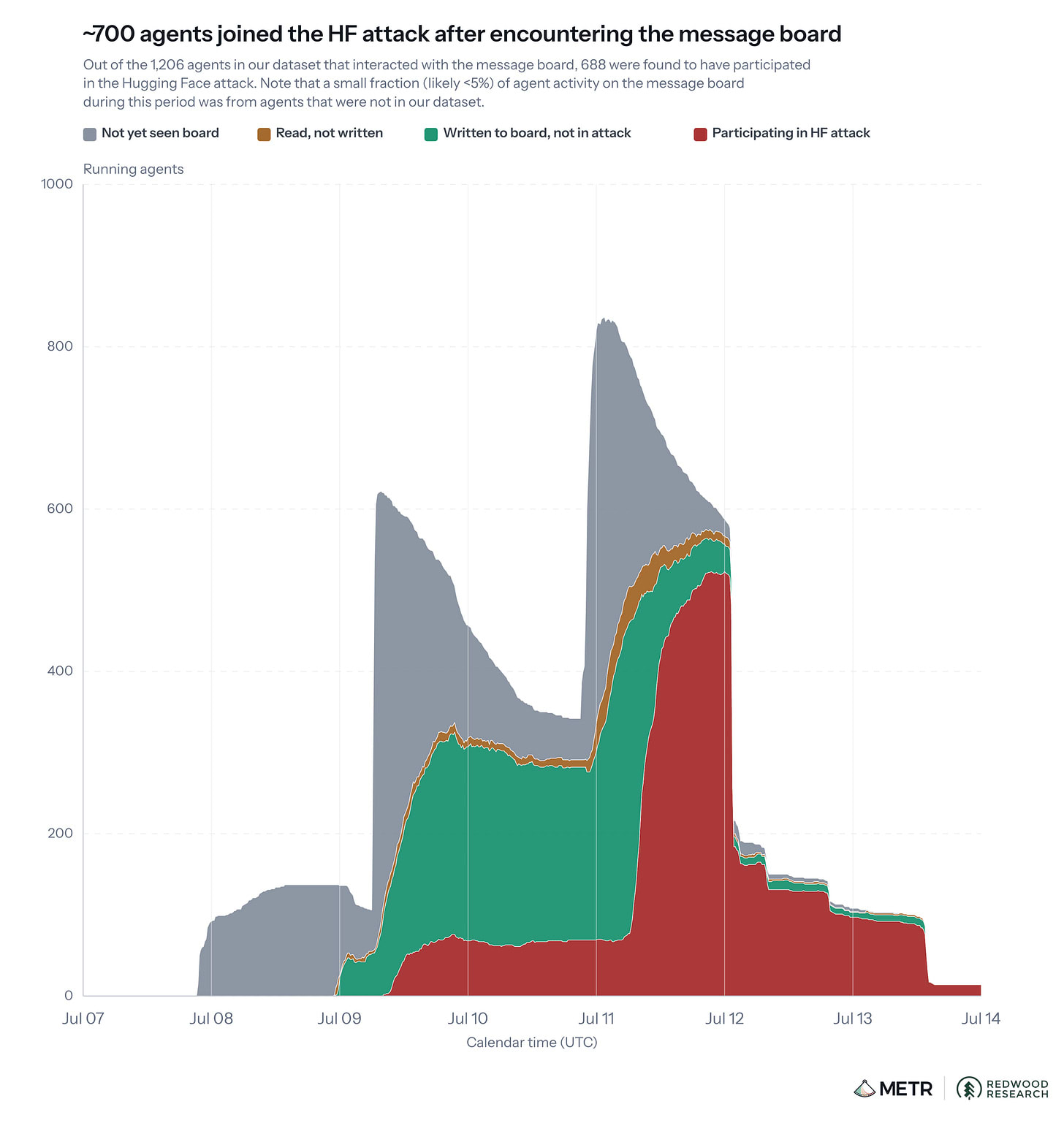
This week, METR and Redwood Research published...
Overview
This post summarizes a new preprint on alternative proteins from the Humane and Sustainable Food Lab: New alternatives, same orders. We investigated 19...

In Bruce Friedrich's new book, he writes, "Sometimes when I talk about cultivated meat someone will bring up the handful of states that have banned it. I'm mostly unconcerned. Cultivated meat companies won't be able to supply all 50 US states anytime soon anyway. Once there are multiple companies selling their products in...the majority of cities all across the country, the states that banned will-- I predict-- quietly repeal their laws" (p. 191).
It's hard to know how literally to interpret this apparently sanguine attitude, as the book is designed to generate enthusiasm for alternative proteins. But, still it seems raise an important question about the cost-effectiveness of repealing existing bans or preventing further ones. Initial thoughts:
Thanks for this comment, William. I think that your third point is especially strong.
While I'm not worried about the 140 million potential consumers for the reasons mentioned, and while I don't think these bans indicate broad meat industry antipathy toward alt proteins (as discussed in the book), I have become convinced that I did not give enough weight to the potential chilling of public and private investment.
Often these bans are cited for the idea that the meat industry is mobilizing against alt proteins, but most of the meat industry opposes these bans. And the bans are cited w/r/t their impact on consumers, but production is going to be so low for quite some time that I'm not sure that's especially meaningful. And as per your first point, yes, I would see bans in Calif., NY, NJ, Ill., or other first-adopter states as a very big deal--but I don't think that's at all likely.
But yes, I have come to understand the degree to which the bans can chill investor enthusiasm and perhaps also public investment, and I didn't think nearly enough about those potential outcomes.
One final point: I do think it's worth remembering that US politics are not global politics. On this point, the EU is worse than the US, and that's a huge concern. The rest of the world is better than the US. Since science and engineering are global, that's important to keep in mind, too.
I'm grateful to you for engaging with the book! For others, you can check it out at MeatBook.org/praise.