Comments
This post is aimed at future university group organizers, but others (e.g. funders, other fieldbuilders) might find it valuable
We’re Lucy and Josh, co-founders of UBC AI Safety at the University of British Columbia (UBC) in Vancouver, Canada.
In May 2024, we attended a three-day workshop in the Bay Area called Global Challenges Project, where we met some AI safety university group organizers. They showed us that starting our own group would be achievable and impactful. We noticed that despite having a strong computer science program at UBC, there was no visible AI safety community on campus or in our city. In our final year of undergrad, we changed that.
Here’s an overview of this post:
This is a long post. Sections are readable in isolation, so please feel free to skim and jump between sections.
Before the academic term started, we wrote down these goals for the year:
Spend time operationalizing your goals, and make a plan to track your progress on those metrics (e.g., attendance and survey responses). These goals aren’t well specified, making it hard to measure success.[1]
That said, on almost all metrics, we exceeded expectations. Here are some concrete things that happened in our first academic year:
Why the strong interest?
(This section reflects Josh's personal assessment based on limited evidence — Lucy and others on the team may have different views.)
We know ~7 former group participants who are now actively working in AI safety. Several others are applying for relevant entry-level roles, internships, and upskilling programs. Correlation does not equal causation, but we’d guess UBC AI Safety played a causal role in at least some of these career decisions.
But given the strong interest we’ve seen, I (Josh) would have expected more of our members to be actively pursuing AI safety careers.
One of the arguments that convinced me to start UBC AI Safety was the multiplier effect. I put some weight on an optimistic hypothesis: because university students often put so little thought into their career choice, exposing them to strong arguments about AI risk will be enough to cause many to pursue AI safety careers. We got some data that goes against that hypothesis.
After the first and last session of our technical intro program, we had participants anonymously rate their agreement[2] with this sentence: “I intend to pursue a career mitigating global catastrophic risks from advanced AI.”[3]
Session 1 (22 responses):
Session 7 (16 responses):
The difference isn’t big. We might have had a modest impact on participants’ career plans, but it seems unlikely that our impact was big. As a facilitator, I didn’t get the qualitative impression that people were changing their career plans, either.
This was surprising for me. I came in believing AI has a double-digit chance of causing extinction within a decade, making AI safety extremely urgent and important. I was confused why our participants seemingly weren’t seeing it that way.
What might explain this?
Other AI safety groups facilitate career change by creating a pipeline of programs that take people from curious to getting great opportunities. We took a step in this direction in the form of our technical upskilling program based on the ARENA curriculum. A couple of alumni expressed interest in applying to AI safety fellowships but we haven't heard about any acceptances yet.
We also tried twice to get our technical intro program participants to do project sprints but saw little interest. The first attempt was an optional project component during reading break. A few participants expressed interest, but no one actually did any projects. The second was more like a mini hackathon, and only two people showed up. What went wrong? Reading break wasn’t the best time for a project sprint, and our mini hackathon was held in the week before finals with no mentorship. And instead of asking students to take extra time out of their busy schedules midway through the program, we could have made the project sprint a mandatory component of the program and communicated this upfront.
To improve this, our successors are planning to:
Do the Pathfinder Fellowship. Before the school year started, we did FSP, now called the Pathfinder Fellowship. This gave us the resources we needed to prepare for the year, including help applying for funding,[4] planning, and setting up systems for our group.
Make a website. Josh made a website, which has paid dividends. He used this template. It took less than a day to set up and didn’t require writing any code. We recommend other groups do this; it makes your group look official and allows people to find you by Googling [your university name] + “AI safety.”
Use relevant university clubs, Slacks/Discords, and events to build your initial team. We didn’t know many others interested in AI safety at UBC, so we found people to join our leadership team by asking around at relevant events, at UBC’s EA Club, and in relevant Slack/Discord channels. We asked everyone we talked to if they knew others who might want to join us, but most didn’t. Nonetheless, we quickly formed a committed and skilled team of four. We’re incredibly grateful for our luck!
Consider hosting a launch event. Early in the school year, we hosted a launch event. We promoted it quite a bit and ended up with over 50 attendees, which blew us away. With four team members, uncertain funding, and a lot of homemade sandwiches, we put on a successful event. Three people offered to volunteer with us during the event, two of whom became core team members by the end of the year. Without really understanding this at the time, our demonstration of competence attracted other competent people.
Decide which risks your group is about. Our leadership team had a variety of concerns about AI, from extinction to autonomous warfare to deepfakes. We decided to be explicitly inclusive of all these concerns, with an emphasis on catastrophic and existential risk. We didn’t realize this would result in extinction risk-focused people being consistently outnumbered in our group. This led to a tug-of-war where most of our members wanted us to talk more about the present-day risks, which was not our intention when starting the club. If you want to focus your group on catastrophic risks, consider starting small, solidifying large-scale risks in the culture of the group, then expanding.
Try hard to avoid wasting time with meetings. As we onboarded more people to our team, we moved from inviting everyone to weekly leadership meetings by default to only people who needed to attend. This freed up time for our volunteers and made meetings more productive.
The planning fallacy hits harder than you think. Riding the wave of our launch event’s success, we tried to do too much too quickly. Team meetings produced more good ideas than we had capacity to execute. We prioritized ruthlessly, but even then, our programs took more time and energy to run than we thought.
Find venues early. We continuously struggled to get venues for our events and program meetings. We decided not to become an official UBC club because it involved annoying bureaucratic red tape. However, being an official university-affiliated club would have given us access to booking more venues easily. Save yourself from the continuous headache by doing what it takes to book good locations early at your university, whether that means making friends with grad students or professors, emailing student residence building managers, finding students with special booking privileges, etc.
Do succession planning early. We knew we were graduating, and we knew we had limited time to identify successors to take over the group, but it was still hard. Reach out to chat with your most engaged members 1-on-1 and check for interest and fit. Then, before the school year is over, have every team member write thorough documentation for their role. Finally, celebrate the hand-off — we regret not doing an end-of-year leadership social.
In first semester (Sept-Dec), we ran:
In second semester (Jan-Apr), we:
We chose our programs based on conversations with our FSP mentors, inspiration from other AI safety university groups, and facilitator preferences. We think we could have made our decisions more carefully.
Choose your programs systematically. Move from “Should we run a hackathon or a talk?” towards “Should we introduce more people to AI safety or try to produce a research output?” What does the world need, and what is your group ready to do? We’d recommend asking the following questions:
Our technical intro program involved:
For readings, we used the AI Safety Atlas (see our session plans here). Many other university groups use a combination of sources, like BlueDot Impact’s courses. We’re not sure which is a better choice.[5]
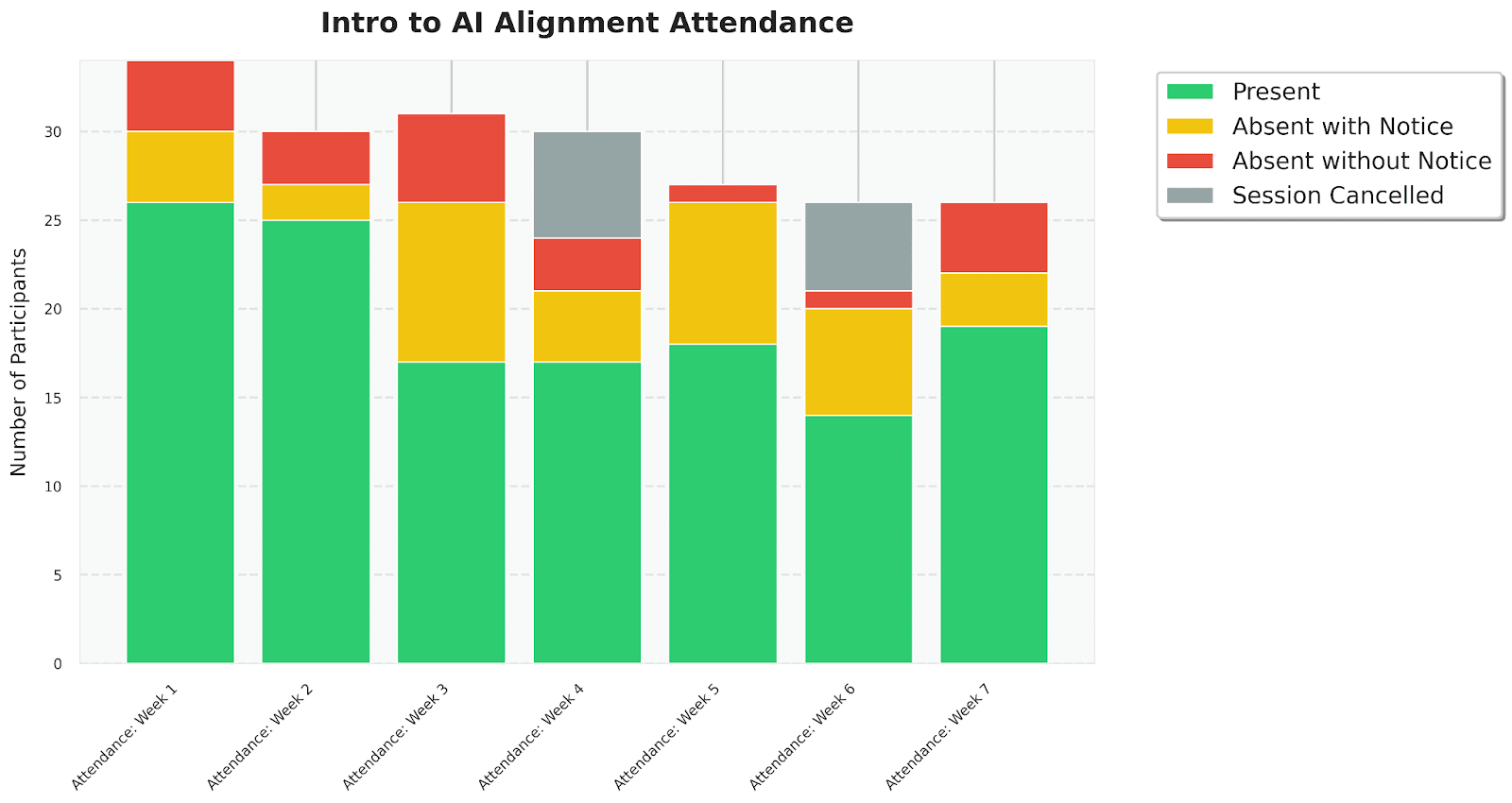
In our first term, we got 58 applications, which was way more than expected. We accepted 32 of them and made four groups, grouping people by availability and rough level of technical knowledge.
Term 1 attendance (Oct-Nov):
In term 2, we got 26 applications,[6] which we made into two groups. Only one participant from term 1 wanted to become a facilitator for term 2, which is less than we were hoping.
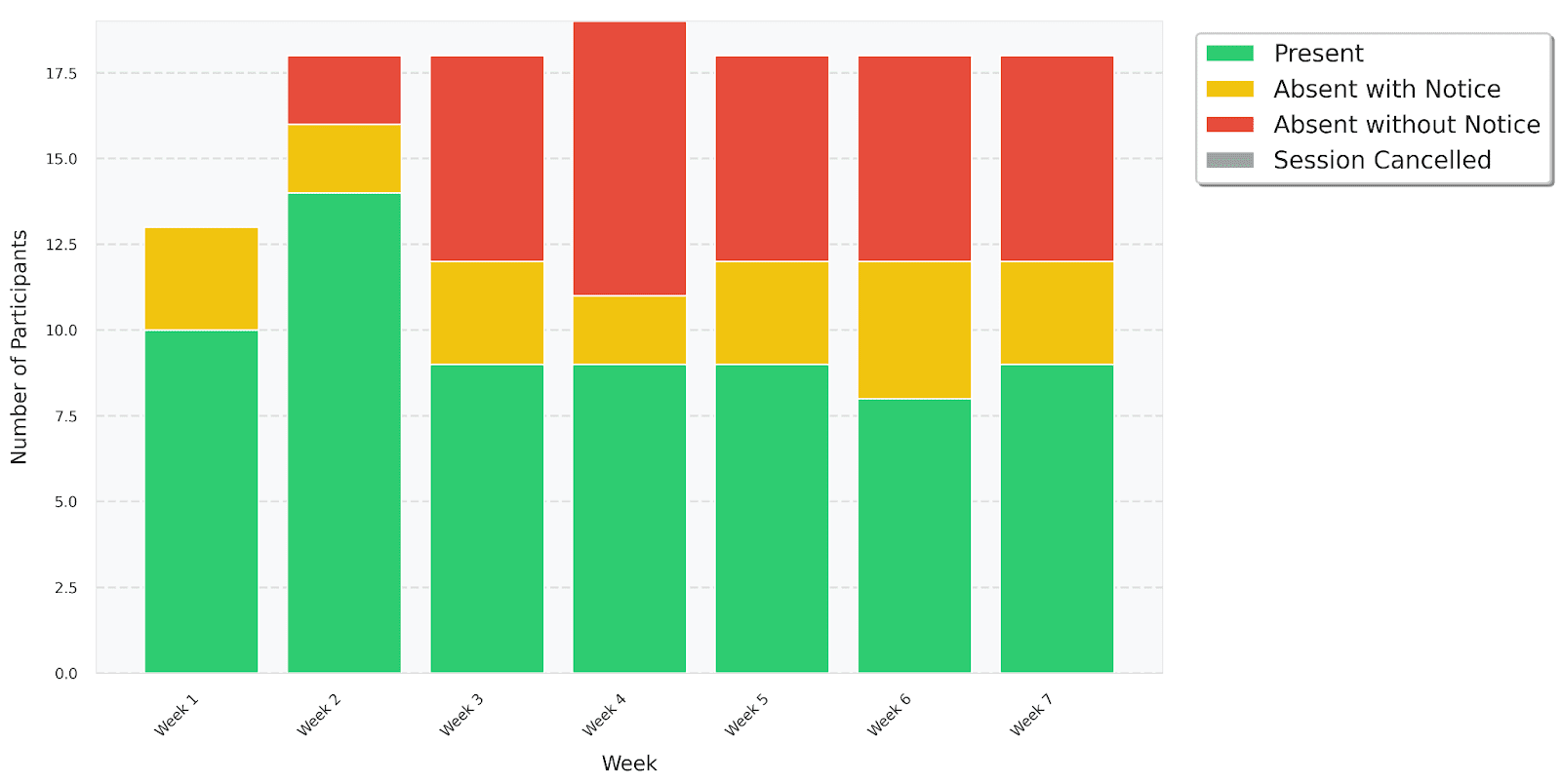
Term 2 attendance (Jan-Mar):
From what I’ve heard from other AI safety university groups, this is a pretty strong retention rate. We’re not sure why this is. One potential explanation is that not many clubs at UBC offer free meals.
We didn’t have facilitators to lead a governance intro program (like BlueDot’s AI Governance curriculum), so we opted for a weekly AI policy reading group.
Attendance was on a drop-in basis. We averaged around 5 attendees per session. We’d recommend running a higher-commitment program if you can.
For our reading group, facilitators chose readings and made a session plan every week. This took around 2-4 hours per week. See our session plans below:
First semester:
Second semester:
You’re welcome to use our program plans as you see fit. If you want to see a detailed breakdown of what aspects of the reading group went well and areas for improvement, reach out to us at [email protected].
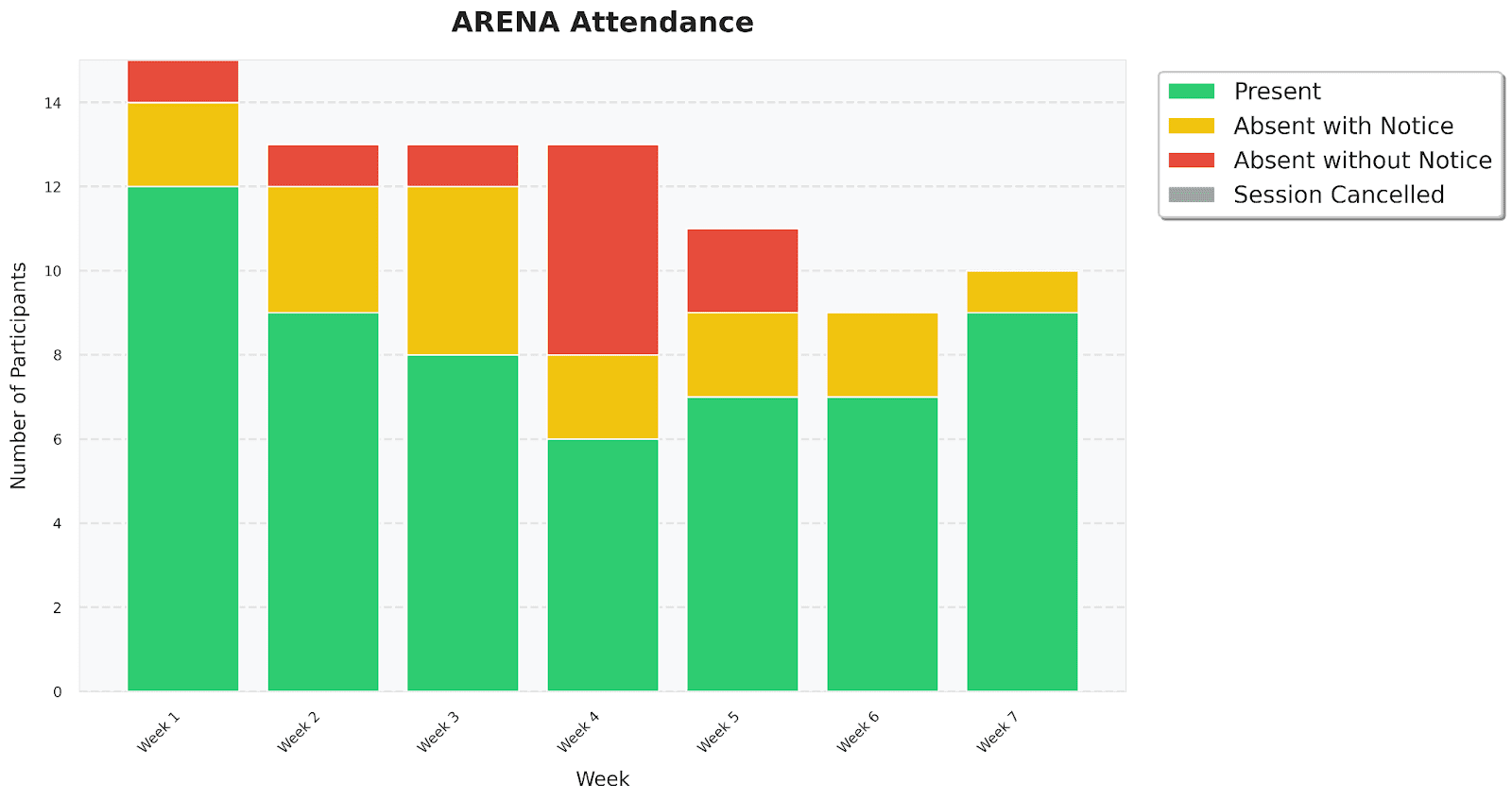
We ran a technical upskilling program based on the ARENA curriculum. We got 26 applications and accepted 15. Across 7 weeks, we met for 4 hours from 5-9pm on Thursday nights, with dinner provided.
We expected a sharp decline in the attendance, as other AI safety groups warned us might happen, but we were pleasantly surprised.
Here are the (lightly edited) reflections from our facilitator and TA, Justice, a CS PhD Student specializing in rare event simulation for RL and safety-critical systems.[7]
Is there anything you did to improve retention/prevent dropout?
We fortunately did not have much dropout throughout the term, which was great. I attribute it mostly to luck as I know that other AI safety university groups have had high attrition rates, and I don't think I did anything particularly novel to maintain retention. Providing food was probably the most important factor. I was also lenient about people's time, meaning that if people needed to come late or leave early, that was fine. Lastly, unlike groups at other universities, participants in our accelerator worked primarily independently and only pair-programmed when they were stuck on the same problem. While this meant that people got out of sync, it may have led to more "investment" in the material as they solved essentially all of the problems themselves.
How far did people get through the curriculum?
People only got halfway through Chapter 0. The average for other AI safety university groups was halfway through Chapter 1, I believe. But they were meeting for 8 hours per week while we only met for 4. A couple people are still meeting weekly over the summer and I expect them to get halfway through Chapter 1 by September.
How important do you think your background was for running the program?
My background definitely helped a lot for answering questions, giving advice, and providing broader context as the material is technical. I don't think it's absolutely necessary for facilitators to be active ML researchers in order to facilitate, but it certainly helps. A person who has completed the notebooks themselves and is well-versed in PyTorch should be able to facilitate.
What worked well?
I booked two rooms, one where people could ask questions without worrying about disrupting others and one for quiet work. This was helpful for those who wanted to avoid distractions. I also incorporated breaks in which we stretched and played short games.
What would you do differently if you were to run the program again?
5-9pm on Thursday is late and the students came into each meeting already tired from lectures all day and week. 8 hours on a Saturday or Sunday would have been more productive. It would be more difficult to fit into one's schedule, but dedicated students would have gotten more out of the program.
What do you think was the opportunity cost of your time running this program?
Instead of the accelerator, I would have TA'd, but the accelerator was a better use of my time because I got to review more practical fundamentals than I would have from TAing a course. Also, I spent less time overall doing the accelerator than I would have TAing, which gave me more time to do research. The ideal alternative would have been to get paid to do AI safety research directly, but unfortunately my LTFF application was rejected. In general I would recommend that AI safety researchers work directly on AI safety research instead of facilitate; however, because facilitating is not as cognitively demanding as being a participant (we're helping, not solving problems), if an AI safety researcher felt that spending a Saturday facilitating would not be detrimental to their productivity doing direct AI safety research the next week M-F, then facilitating could be fun and impactful.
If you’re thinking of running an AI safety technical research upskilling program, see this doc for insights from other groups (thanks to Jeremy Kintana for putting the doc together!).
This was an experimental program somewhere between a reading group and a social. The idea was roundtable AI safety discussions every two weeks with topics crowdsourced from participants. Sessions were 1.5 hours, included basic refreshments, and drew around 6-9 attendees on average.
Participants had very diverse perspectives, which made it difficult to keep everyone on the same page during discussions. In general, we’d recommend hosting socials instead.
We ran five major events across two semesters: three semi-structured social/networking events, one speaker event, and one one-day project sprint. Below are some lessons we learned about hosting good events. Feel free to reach out for reflections on specific types of events if you are planning one!
Decide on the goal of your event and its target audience. Similar to when choosing programs, this will guide the many logistical decisions you’ll need to make. Rather than just hoping people show up, do a target audience exercise. Think about their knowledge of AI, familiarity with AI safety, career stage, degree level, life stage, social group, etc. This will help you choose the event location, timing, and format. To give an obvious example, if your event is meant to help students consider careers in AI safety, don’t schedule it during exam week.
Add structure. Speaking from experience: at unstructured events, newcomers often feel lost without knowing who to talk to or who the organizers are, and conversations with random people are often not useful and hard to leave. Structure can help. For example:
Structure keeps the event moving and gives people a natural point to find someone new to talk to. We’ve included an example event plan in the footnote.[8]
Get the details right. Besides structured activities, there are lots of small things that improve the quality of an event:
Look at the space and plan your setup before the event. If your tech setup is complicated and crucial to your event, we’d highly recommend doing a tech rehearsal.[9]
There is no perfect event. Not everyone is going to resonate with your event, and that’s okay. Focus on getting through to the core group of people who would resonate. A good rule of thumb is that if the event went 80% well by the metrics that matter to you, it was a success.
What we did:
Some tips:
We found faculty outreach difficult. We attended a few networking events with AI research groups, reached out to faculty from personal connections, and cold emailed a few professors with publicly legible AI safety history. Our efforts were limited because of time constraints and lack of clearly aligned faculty members.
We were supported by Open Philanthropy's university group funding program. Most of our budget went towards food.
Some lessons we learned:
Providing free dinner to members isn’t normal for UBC clubs — most have very little funding. This made the dinners we provided even more valuable to participants. To lower costs and stay close to the norm, we ordered pretty basic meals ($10-13 CAD per person per meal).
Group organizing can be a great gateway to the rest of the field of AI safety, so we’d encourage you to make time for your personal career development. This makes even more sense if timelines to AGI are short.
Run programs that support your learning. For example, our policy reading group facilitators often chose topics relevant to their own interests. If you don’t already have a similar program, you could start a low-effort, informal reading group to tackle the papers you’ve been meaning to read anyway. This way, you can do fieldbuilding and personal career growth at the same time. All you need are a few (accountability) buddies interested in the same readings.
Run co-working sessions. Similarly, you can organize simple coworking sessions for personal projects or applications to fellowships like MATS. These can be motivating and can help create a “working on AI safety” norm in your group.
Apply for AI safety opportunities. Lucy did the Pivotal Fellowship in London during second semester. This was a great chance for her to work on AI safety full-time, and it enabled connections between our group and the wider world of AI safety. During this time, other members of our leadership team took on more responsibilities. The team restructured to have program leads for each of our programs, and this worked out since most people were organized and didn’t need much oversight.
Talk to people working in AI safety. Being an AI safety group leader gives you a credential that can make it easier to reach out to professionals in the field. People are often more generous with their time than you expect, especially if they can share insights that are valuable to you. We recommend having a low bar to connect with them for the benefit of your group and career development.
Finally, check out these resources if you haven’t already:
We started UBC AI Safety hoping to get 1-3 students excited about the field. Instead, we ran programs for 50+ participants, built a 12-person leadership team, and established the first visible AI safety presence at our university.
In our experience, university group organizing doesn’t reliably change students’ career plans, nor is it the most efficient use of an experienced AI safety researcher’s time. But it could be a great decision if you're early in your AI safety journey, want to build a community where none exists, or learn by teaching. For us, organizing was the entry point that connected us to the broader field, and we’re proud of what we built.
We're passing off UBC AI Safety to capable successors and moving on to direct work in AI safety. AI safety moves fast, and what worked (or didn’t) for us might not apply next year. If you're starting a group, steal what's useful from this post, ignore what isn't, and share your own lessons when you're done.
If you have questions or feedback, you can reach out to us at [email protected]
Thanks to Neav Topaz, Rebecca Baron, Sana Shams, Justice Sefas, Chris Tardy, Amy Au, Dong Chen, Rishika Bose, and Vassil Tashev for your feedback and contributions on earlier drafts of this post.
What does “really excited” mean? What is “high-quality”? What counts as “working on AI safety”?
On a five-point scale from Strongly disagree to Strongly agree.
This is data from the first semester only; I (Josh) forgot to do this in the second semester… Gah.
The Pathfinder Fellowship now provides funding as part of the program.
An advantage of the AI Safety Atlas over using a combination of materials from various sources is that the difficulty of each chapter is relatively consistent. A challenge with education is that in a given classroom, some students will be bored while others are lost. BlueDot Impact might assign a simple blog post followed by a technical paper, leaving individual students both bored and lost depending on the specific reading. On the other hand, a couple of students said in our feedback forms that they wanted a variety of readings because they wanted to hear different perspectives on AI safety.
Based on what we hear from other AI safety university groups, it’s normal to get far less interest in second-semester programs. This could be a reason to launch your AI safety group in the first rather than the second semester.
Justice was a great fit for this role because he takes AI safety seriously, previously participated in MATS, and had time to work through the ARENA curriculum on his own before the program started.
Abridged version of our launch event plan:
7pm - 7:15pm - Sign in and mingle
7:15pm - 7:30pm - “Jubilee Activity”
We say a statement, e.g., “I am hopeful about the development of AI”, “I feel burnt out trying to keep up with AI news”, and participants spread themselves out on a spectrum from “agree" to "disagree." 3 minutes for discussion with neighbours, and share with the group if time.
7:30pm - 7:45pm - Presentation about AI safety by leadership team
7:45pm - 8:00pm - Food served
8:00pm - 8:30pm - Semi-structured discussion
We scattered pieces of paper with conversation topics around the room and let people choose where to go based on what they wanted to talk about.
8:30 - 9pm - Feedback form, group sharing, closing
The “Jubilee Activity” enables quick connections with new people and gives attendees a sense of the opinions or feelings of other people in the room. The presentation aimed to demonstrate the stance of the group, and set the tone for what we are about.
The Jubilee activity was a hit, but the pre-defined topics were less useful than expected. Feel free to use our activities. In any case, the core message is: think about which activities would best foster connections and contribute to your goals.
We hosted an in-person speaker event with a Zoom speaker and messed up the audio. We wasted 10-15 minutes of everyone’s time fixing the problem during the event. This could have been avoided if we had done a tech rehearsal beforehand.


Executive summary: A reflective, practice-heavy retrospective from the founders of UBC AI Safety reports strong early demand (50+ participants, 12 leaders, active Slack) but modest career conversion, and offers concrete, cautiously framed advice on program design, outreach, operations, and successor planning for university AI safety groups.
Key points:
This comment was auto-generated by the EA Forum Team. Feel free to point out issues with this summary by replying to the comment, and contact us if you have feedback.