This is the second in a series of four posts on drug policy reform ('DPR'). In this post section 2 discusses six different ways DPR may do good. Section 3 anticipates several objections one might make against DPR if you doubted it would have a positive impact. I note these objections focus on whether DPR is good or bad in absolute terms, rather than whether it is better or worse than other causes EAs might consider. I compare DPR to other causes in part 4 in the series.
2. Six different ways drug policy reform might benefit the world
The reader should note my research into these is incomplete and of varying depths. I welcome suggestions and corrections. I’ve left out the argument the War on Drugs causes pollution and deforestation. This is for reasons of space and because I doubt it has a large effect.[1]
2.1 Improved treatment for mental health
Mental illness is a huge cause of worldwide suffering. There are many mental illness - depression, anxiety, schizophrenia, anorexia, bulimia, etc. - but let’s just concentrate on the two largest, depression and anxiety. These each affect over 250m people each year.[2] I’ll use the term ‘mental health(/illness)’ to refer just to depression and anxiety unless I specify otherwise. (I’ve previously argued mental illnesses may cause more misery than poverty, although I stress nothing rests on which is bigger; we are really interested in cost-effectiveness on the margin, which I discuss later.)
Treatment for mental health tends to come in two forms. You are sometimes offered psychotherapy, such as cognitive behavioural therapy (‘CBT’), dialectical behaviour therapy, behavioural activation therapy, mindfulness-based stress reduction and so on. This involves visiting a therapist, usually weekly, for a couple of months or longer. Or you can be offered drugs, such as antidepressants (i.e. prozac). Often, people are offered both.
Therapy is often, but not always, effective: CBT it works about 50% of the time for depression (I don’t yet have figures for anxiety).[3] Such interventions aren’t cheap per person if you’re comparing them to things like deworming pills, bednets and vaccines. In the UK, it costs the government about £750 to provide a course of CBT.[4] This will be cheaper to deliver the developing world. Basic Needs, the biggest mental health charity in the developing world, claims it cost $14 per participant per month to provide their services.[5] Unfortunately “hardly any published evidence exists on the cost-effectiveness of population-based or community-level strategies in or for low-income and middle-income settings” so there’s nothing very useful to lean on (although I suggest some simplistic estimates in section 6 which is in part 3).[6]
With anti-depressants, a meta-analysis found they have minimal or no benefit over a placebo for mild to moderate depression but, for patients with very severe depression, the benefit is substantial.[7]
About 20% of those treated for depression respond to neither therapy or anti-depressants, and are thus classed as having ‘treatment resistant depression’ (‘TRD’). [8] Many that have depression successfully treated also eventually relapse (29% within 1 year and 54% with 2 years).[9]
Drug policy reform is important for mental health because, perhaps counter-intuitively, recent research suggests several schedule I drugs (i.e. those not allowed for use in treatment) may actually be effective treatments for mental illnesses. In several small clinical trials conducted in just the last few years, there’s very promising evidence that LSD helps with anxiety,[10] that psilocybin (‘magic mushrooms’) and ketamine alleviate depression,[11] and that MDMA (‘ecstasy’) aids recovery from Post-Traumatic Stress Disorder (PTSD).[12] There may be other trials I’m unaware of and I would welcome directions to things I’ve missed.
While these have been small clinical trials with just tens of participants, the results are extra-ordinary. As one example, Carhart-Harris et al. (2015) gave a single dose of psilocybin to 12 people with moderate to severe depression classified as treatment-resistant. The subjects had been depressed for a mean average of 17.8 years, a rather long-time. They found:
Psilocybin was well tolerated by all of the patients, and no serious or unexpected adverse events occurred. The adverse reactions we noted were transient anxiety during drug onset (all patients), transient confusion or thought disorder (nine patients), mild and transient nausea (four patients), and transient headache (four patients). Relative to baseline, depressive symptoms were markedly reduced 1 week (mean QIDS difference −11·8, 95% CI −9·15 to −14·35, p=0·002, Hedges' g=3·1) and 3 months (−9·2, 95% CI −5·69 to −12·71, p=0·003, Hedges' g=2) after high-dose treatment. Marked and sustained improvements in anxiety and anhedonia were also noted.[13]
For those curious, the procedure was that the patients were given the psilocybin in relaxed clinical setting accompanied by 2 psychiatrists who “adopted a non-directive, supportive approach, allowing the patient to experience a mostly uninterrupted inner “journey”.”[14]
This raises some questions: how do such drugs work? If they are so useful, why are they illegal? How does the current legal situation impede research?
I won’t discuss the first question. That’s too much of a detour for this post and I invite the reader to follow my references.
The short answer to the second one is largely ‘politics’ and ‘contingent historical facts’. At this point it’s important to note that, in the UK at least drugs have both a ‘class’ and a ‘schedule’. Class (options: A, B, C) is a criminal classification, with class A drugs being the one you received the harshest punishment for (e.g. heroin is class A, cannabis class B). Schedule (options: 1-5) is a classification of their medical use. Schedule 1 refers to those with no perceived medical value, such as psychedelics, and their use is limited to research. Roughly, the higher on the schedule (i.e. closer to 5) a drug is, the easier it is for doctors and patients to get access to. See this for further explanation. (The USA uses one metric, Schedule 1-5, which encompasses both legal status and medical use.)
Here, I’m just talking about scheduling (medical use); I’ll come back to criminal classifications later. The present situation regarding scheduling is one where some psychoactive drugs, such as opiates and some stimulants (amphetamines) can be used to treat things like pain and attention-deficit disorders, respectively. Others, such as cannabis, MDMA (ecstasy) and psychedelics (e.g. LSD, magic mushrooms) are schedule one substances that are stringently controlled and not available for medical use.[15] As Nutt et al. explain:
The reasons for decisions that were made about which drugs should be controlled under this legislation seem to be unclear and inconsistent and may have been made for political rather than health-related reasons. This is because for many drugs the decisions were made before modern scientific methods allowed a proper understanding of their pharmacology and toxicology. As a result, the decision to list MDMA, psilocybin and LSD as United Nations Schedule I drugs was not based on any consideration of their physical harms but on the assumption that there were no medical benefits [emphasis added]. Indeed, recent analyses have shown that there is no relation between the harms of a range of psychoactive drugs and their current legal status in the United Kingdom.[16]
Whilst the medical benefits of, say, heroin as a painkiller have been long-known, this is not true for drugs like LSD. When the War on Drugs started in the 60s, this (now-outdated) medical understanding was ossified into law. The scheduling is now somewhat self-justifying: it’s hard to conduct research into drugs to show they’re useful, and because there’s no evidence, the drugs remain in schedule 1. Further, because such drugs are in schedule 1, the public assume they must be very dangerous. In fact, population studies have found no associated link between a use of mental health problems and psychedelics (a category of hallucinogens including LSD, mescaline, psilocybin).[17] I haven’t looked into to population studies of the health effects of other, non-psychedelic drugs, like amphetamines, but those aren’t necessarily the ones that I’m arguing should be rescheduled. I suggest those who want a fuller historical explanation should read the Nutt et al. paper cited.
The current legal situation makes it much harder to do research. Quoting the same paper:
For example, in the United Kingdom, it is much harder to study cannabis, MDMA and psilocybin than it is to study heroin, even though heroin is a more dangerous drug in terms of its medical and societal harms than these other drugs. However, the recognized therapeutic properties of heroin allow its medical use in the United Kingdom (although not in the United States), and hence it is placed in Schedule 2. Current UK regulations permit all hospitals to hold heroin and other opioids but require each individual hospital to obtain a licence for Schedule 1 drugs; UK Home Office data show that currently only three (out of several thousand) UK hospitals have such a licence. Applying for a licence takes about 1 year, costs many thousands of pounds and, once granted, is subject to regular police reviews. As a consequence, many researchers who would like to work on these pharmacologically fascinating substances cannot afford to do so.
Drug policy reform, by rescheduling these medically promising drugs, offers enormous potential upsides. It would make it much easier to research how effective these drugs are. If they turn out to be even fractionally as good as they appear, this would provide new, cheaper, more effective treatments for a big (if not the biggest) cause of unhappiness. As a recent paper puts it:
Serotonergic psychedelics operate through unique mechanisms that show promising effects for a variety of intractable, debilitating, and lethal disorders, and should be rigorously researched.[18]
Whilst there is a public outrage when governments refuse to pay for a single child’s cancer drug because they are too expensive, there is no outcry for governments to grant access to drugs that could change hundreds of millions of lives. The war on drugs is getting in the way of the war on misery.
I’d add treating mental health issues, in addition to reducing misery, could bring substantial economic gains. Evidence shows they are associated with a loss of employment, absenteeism, poor performance within the workplace and premature retirement.[19] Mental illnesses tend to have other co-morbidities which make them an economic cost to health systems.[20]
2.2 Better medications for pain (section written by Lee Sharkey)
There are several potential ways that rational reform of drug policies might benefit pain therapy. Before delineating those ways, I should note that some countries, especially the United States and others, have a problem of over-accessibility to opioid medications (e.g. morphine) resulting in an opioid crisis. There are no easy solutions to this crisis, and clinicians and policymakers are reconsidering the recommended uses of opioid pain medications. I won’t deal further with this clinical question here, but will say that the discussion below presumes the continuing improvement of clinical practices and other measures to avoid increases in access to opioids leading to increases in their abuse.
Opiates are essential medicines for the treatment of moderate to severe pain, such as in some postoperative patients, patients with significant injury, patients in need of palliative care, and more. Yet around 80% of people live in countries with low or non-existent access to these essential medicines because of overzealous restrictions on their acquisition, distribution, and use.[21] The International Narcotics Control Board (INCB) estimates that 92% of all morphine is consumed in America, Canada, New Zealand, Australia, and parts of western Europe— only 17% of the world’s population.[22] There appear to be no data on the total number of patients in need of pain relief who do not receive adequate therapy; indeed, such a number would be controversial as there is no global consensus on the ‘correct level’ of opioid consumption on a per capita or even individual patient basis, although there is agreement that it is too high in countries like USA and too low in many low-middle income countries. A lower bound for the number of patients in preventable suffering can be found using figures for palliative care alone, in which the most important tool is opioid painkillers: Of the annual 40 million people in need of palliative care, only an estimated 14% receive it.[23] This rough estimate of course omits the many patients in need of strong painkillers for non-palliative care reasons. I discuss how difficult it is for many people to acquire effective pain relief, and the suffering they experience without it, in greater depth in this my EA forum article and won’t repeat that here in the interests of brevity.
States maintain these tight restrictions with the intention of protecting their citizens against drug abuse, to ensure safe clinical use and to avoid medications entering the illicit drug supply chain. In countries with low access to controlled pain medications, appropriate liberalisation of drugs policies are needed (1) to enable trained medical staff to use existing pain medications safely and effectively while maintaining compliance with regulations and avoiding their diversion and abuse (for more detailed discussion see the afore-mentioned EA forum article)[24] and (2) because it isn’t clear that drug prohibition, including of opioids, is having the desired effects. The unintended consequences of prohibition, and alternatives to it, are discussed in below sections.
More generally, it’s not sufficient to impose extreme restrictions on strong painkillers on the grounds they might cause harm. Very many medical procedures, such as surgeries, have the potential to harm a patient, but go ahead because the expected benefits substantially outweigh the expected harms. In particular, the benefits and risks of painkillers are not rationally balanced in countries where there is low to zero access. which is a majority.
Drug policy reform may also allow us to better understand current pain medications and develop new treatments and uses. Recent years have seen an increase in research on scheduled drugs for pain therapy, especially for cannabis and cannabinoids. Leaving aside the less substantiated claims about the powers of these drugs (of which there are many), the evidence is clear that they offer meaningful relief for patients with chronic pain, patients with nausea resulting from chemotherapy, and patient with pain and spasticity from multiple sclerosis, but significant research gaps remain.[25] Despite clear evidence, in the United States, cannabis remains in the schedule I drug category, and therefore has no officially accepted medical use. Contradictions between scheduling and clinical evidence ensures that research gaps remain hard to fill, including research on the cardiorespiratory, cognitive, or social effects of a widely used substance. More speculatively, there may be safe ways to use other drugs in pain management, but heavy restrictions on research prevent us from knowing. Ketamine is already a widely used painkiller (and for that reason continues to enjoy no international controls under international drug conventions); there is a small amount of evidence that LSD might be useful in pain therapy;[26] and psychedelic-assisted psychotherapy in pain management and palliative care is a field of great untapped potential. Lastly, there is some evidence that some schedule I drugs might be useful for the treatment of addiction which might help mitigate the risks of using existing opioid painkillers.[27] It is plausible that other currently-illegal drugs have therapeutic uses in pain management and palliation, but drug policy reform will be essential to scale up research.
2.3 Improving public health (all sections hereafter written by Michael Plant)
The main argument for making drugs illegal is that this protects the public from dangerous, harmful substances. Therefore, so the thought goes, it’s necessary to criminalise drug use and even imprison users to act as a deterrent because the alternatives, decriminalisation or even legalisation, would result in more harm overall.
I’ll give five reasons why this argument is less convincing than it seems and probably false.
First, making drugs illegal can make drug taking more dangerous. Governments regulate alcohol, whereas recreational and addicted drug users can’t be sure of the purity or strength of what they’re buying. I haven’t found figures yet, but I assume a large proportion of drug-related deaths are accidental, rather than deliberate, and caused by people taking too much of the wrong thing, or mixing drugs out of ignorance of their combined effects (UK figures show more than 50% of drug-related death involve opiates, presumably few were intentional).[28] Purer, measured versions could be provided by either 1) legalisation of drug or 2) having health services give addicts what they are addicted to, or a suitable substitute (sometimes called ‘shooting galleries’ in the UK).
This still leaves the worry that decriminalising or legalising drugs, even if it makes the drugs safe(r), would be worse overall because it would cause more people to take them. This is clearly an empirical question. Useful evidence comes from Portugal, which decriminalised drugs in 2001. More precisely, the new law maintained the status of illegality for using or possessing any drug for personal use without authorization. However, the offense was changed from a criminal one, with prison a possible punishment, to an administrative one if the amount possessed was no more than a ten-day supply of that substance. To be clear, Portugal decriminalised drugs (no jail time), but didn’t depenalise them (you still get a fine) or legalise them (you can’t buy them legally in shops).
What happened? From The Economist:
The Cato Institute, a libertarian American think-tank, published a study [in 2009] of the new policy by a lawyer, Glenn Greenwald.[29] In contrast to the dire consequences that critics predicted, he concluded that “none of the nightmare scenarios” initially painted, “from rampant increases in drug usage among the young to the transformation of Lisbon into a haven for ‘drug tourists', has occurred.”
Mr Greenwald claims that the data show that “decriminalisation has had no adverse effect on drug usage rates in Portugal”, which “in numerous categories are now among the lowest in the European Union”. This came after some rises in the 1990s, before decriminalisation. The figures reveal little evidence of drug tourism: 95% of those cited for drug misdemeanours since 2001 have been Portuguese. The level of drug trafficking, measured by numbers convicted, has also declined. And the incidence of other drug-related problems, including sexually transmitted diseases and deaths from drug overdoses, has “decreased dramatically”.[30]
Decriminalising doesn’t seem to make the problem worse and may make it better. This might seem surprising, but I invite the reader to reflect on how many people really want to ruin their lives with drugs and, of those that are inclined to do so, how many are really stopped from taking them by the threat of criminal sanctions.
A third health benefit of decriminalisation is that addicts can seek treatment. If asking for help with your problem might land you in jail, you probably won’t ask for help. Again, a quote from the Economist on the Portuguese situation:
Officials believe that, by lifting fears of prosecution, the policy has encouraged addicts to seek treatment. This bears out their view that criminal sanctions are not the best answer. “Before decriminalisation, addicts were afraid to seek treatment because they feared they would be denounced to the police and arrested,” says Manuel Cardoso, deputy director of the Institute for Drugs and Drug Addiction, Portugal's main drugs-prevention and drugs-policy agency. “Now they know they will be treated as patients with a problem and not stigmatised as criminals.
The number of addicts registered in drug-substitution programmes has risen from 6,000 in 1999 to over 24,000 in 2008, reflecting a big rise in treatment (but not in drug use). Between 2001 and 2007 the number of Portuguese who say they have taken heroin at least once in their lives increased from just 1% to 1.1%. For most other drugs, the figures have fallen: Portugal has one of Europe's lowest lifetime usage rates for cannabis.[31]
Indeed, whilst people might worry DPR would lead to more addiction, the DPR may help reduce drug addictions. Studies suggest LSD may an effective be a treatment for alcoholism[32] and magic mushrooms for tobacco addiction.[33] In one study, 12 of 15 smokers (i.e. 80%) quit tobacco after 2-3 does of psilocybin (i.e. biological tests showed they had not smoked in 6 months); to the best of my knowledge, this result is unheard of in addiction treatment.[34] Even if some drugs are addictive (heroin), this isn’t true across the board. We should be careful not to put all ‘illegal drugs’ into a single mental category and assume they are all equally bad. This is not something people seem to do with legal drugs: we can understand aspirin, ibuprofen, alcohol, caffeine and tobacco are different substances with different effects.
The fourth point is a counter-factual one. Banning dangerous substances as a precautionary principle can have perverse effects if it causes people to take a more dangerous drugs instead. A curious case is that of mephedrone. From Nutt et al. (2013) again:
A more recent and equally controversial amphetamine analogue is mephedrone (also known as 4-methylmethcathinone). This drug was first synthesized in 1929, but was little used until the 2000s, when it was resurrected in Israel as an octopamine analogue to provide a biological control approach for aphids on plants (hence the slang name ‘plant food’). It became widely used in Israel by young people, and although there were no reported deaths or serious harms, it was banned by the Knesset. Soon after, it spread to the United Kingdom as a ‘legal high’, where it went by various names such as MCAT, drone and miaow-miaow. It became very popular as it was sold in pure form (in contrast to MDMA, which was often of particularly poor quality) and, being legal, could be readily ordered over the Internet. As with MDMA, many media articles claimed that mephedrone has dangerous adverse effects. Coupled with unfounded police suggestions that it had led to deaths, this resulted in mephedrone being banned despite the lack of any real evidence of harm.[35] It was subsequently discovered that the rise in recreational mephedrone use in the United Kingdom in fact had some unexpected benefits, particularly a spectacular fall in the number of deaths due to cocaine use by over 20% in 1 year.[36] This surprising finding could be explained by the fact that many cocaine users switched from cocaine to mephedrone, which is less toxic. Mephedrone thus seems to have saved more lives than it claimed, suggesting it has potential as a substitute for cocaine, like methadone is for heroin. Its illegal status and the fact that many analogues of mephedrone were banned under the same legislation means that this potential is now unlikely to be investigated, let alone realized[37]
This brings me to my final point about consistency. There seems to be little obvious link between the legal classifications of drugs and how independent experts assess their harmfulness. Two large, independent studies conclude alcohol is the most dangerous when harms to others and harms to users are combined, which they rate as more dangerous even than heroin and crack cocaine.[38][39]
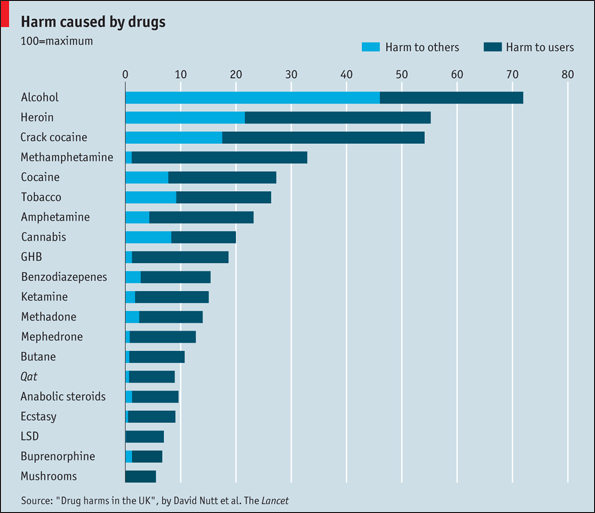
If we are to be consistent, we should ban alcohol and tobacco as they seem more dangerous than most(/all) illegal drugs. Smoking, as we all know, kills, which is pretty harmful. Drunkenness causes fights, injuries, stupidity and alcoholism ruins lives and leads to many deaths too. People know this, but seem not to mind, perhaps due to status quo bias (“better the devil you know…”).
The rejoinder to this is “but, if we make drugs legal, people will think they’re safe.” Arguably, this already happens and is a substantial problem. People drink and smoke, rather than take other drugs, perhaps in part because they believe they are safe. If alcohol and tobacco are more harmful than the drugs people would otherwise have used instead, then our current drug policies foreseeably increase harm, rather than reduce it.
I haven’t yet thought much about how big the happiness gained from health might be.
2.4 Fuelling crime, corruption, instability and violence
The international War on Drugs produces crime, corruption, conflict and instability. This is different at different parts of drug trade, so I’ll distinguish drug-producing and drug-consuming countries in turn.
Here’s a summary of the problems for drug-producing countries from the Global Commission on Drug Policy:
Illegal drug profits fuel regional instability by helping to arm insurgent, paramilitary and terrorist groups. The redirection of domestic and foreign investment away from social and economic priorities toward military and policing sectors has a damaging effect on development. […] For instance, the opium trade earns paramilitary groups operating along the Pakistan-Afghanistan border up to $500 million a year […] Estimates of deaths from violence related to the illegal drug trade in Mexico since the war on drugs was scaled-up in 2006 range from 60,000 to more than 100,000
The illicit drug trade creates a hostile environment for legitimate business interests. It deters investment and tourism, creates sector volatility and unfair competition (associated with money laundering), and distorts the macroeconomic stability of entire countries.
In Colombia, approximately 2.6 million acres of land were aerially sprayed with toxic chemicals as part of drug crop eradication efforts between 2000 and 2007. Despite their destructive impact on livelihoods and land, the number of locations used for illicit coca cultivation actually increased during this period.
The illicit drug business also corrodes governance. A 1998 study from Mexico estimated that cocaine traffickers spent as much as $500 million a year on bribes, more than the annual budget of the Mexican attorney general’s office. As of 2011, Mexican and Colombian drug trafficking groups launder up to $39 billion a year in wholesale distribution proceeds.[40]
We might think the solution to all this is simply a more aggressive War on Drugs to finally put the cartels out of business. This, however, flies in the faces of economic reality. The demand for drugs is huge and persistent:
Drug prohibition has fuelled a global illegal trade estimated by the UNODC to be in the hundreds of billions. According to 2005 data, production was valued at $13 billion, the wholesale industry priced at $94 billion and retail estimated to be worth $332 billion. The wholesale valuation for the drugs market is higher than the global equivalent for cereals, wine, beer, coffee, and tobacco combined.[41]
Drug enforcement can exacerbate the problem. Economic logic dictates this would raise prices and cause more criminal groups to enter the market. Successfully removing one group causes others to fight for market share.[42] What’s more, the War on Drugs has not succeeded:
UNODC’s ‘best estimate’ for the number of users worldwide (past year use) rose from 203 million in 2008, to 243 million in 2012 – an 18 per cent increase, or a rise in prevalence of use from 4.6 per cent to 5.2 per cent in four years.
Global illicit opium production increased by more than 380 per cent since 1980, rising from 1,000 metric tons to over 4,000 today. Meanwhile, heroin prices in Europe fell by 75 per cent since 1990 and by 80 per cent in the US since 1980, even as purity has risen[43]
I don’t have anything like a full estimate of how many people the drug trade effects and how much misery could be removed by drug policy reform, but this seems quite large in scale.
I would note those who currently support charities like AMF and Give Directly because they think, amongst other things, such charities usefully contribute to economic development and human progress, should be interested in drug policy reform for these very same reasons. It looks like the international war on drugs really sets back development in a major way and stopping it would be a potentially strong candidate for a systemic change solution that would alleviate lots of poverty. It may, in fact, be better at this than either AMF or GD, but I haven’t done any analysis on this yet.
Moving to the drug-consuming countries (which can also be drug-producing countries) drug prohibition causes several problems. Much street crime is related to the drug trade: rivals gangs who fight for control of the market and robbery committed by addicts seeking money to fund their habits. I don’t yet have good figures for either of these, but one source I found suggested about 30 percent of crimes leading to arrests in the United Kingdom had as their motive the need to find money for crack or cocaine [44] and another source claimed that in 2004, 17% of U.S. State prisoners and 18% of Federal inmates said they committed their current offense to obtain money for drugs[45] (I haven’t yet established where those sources got their figures from). If drugs were legal, that would remove the financial incentives for criminal activities, and if addicts were treated, or given access to drugs (via so-called ‘shooting galleries’) that should reduce the number of drug user committing crimes in the first place.
Another concern is that efforts to crack down on the trade involve turning millions of otherwise law-abiding drug users into criminals. It seems grossly disproportionate to put people behind bars, particularly as a criminal record can potentially ruins lives (such as by making it hard to find work). Spending time in jail may ‘harden’ prisoners and make them more likely to commit other crimes. I don’t yet have any data or estimates on the impact of this, but one example would be Timothy Tyler who was sentenced to life in prison aged 24 for selling LSD.[46] He was granted clemency by Barack Obama after 22 years and will be released in 2018. Pursuing drug users takes a huge amount of time and effort by police, courts and prisons that could be better redirected elsewhere. I discuss some of this further in the next section.
For those motivated by social justice, an additional reason to be in favour of drug policy reform as the drug law enforce seems to disproportionally effect the world’s poor and minorities. For instance, in the US, African Americans make up 13 per cent of the population. Yet they account for 33.6 per cent of drug arrests and 37 per cent of people sent to state prison on drug charges.[47]
2.5 Raising government revenue, reducing wasteful expenditure, enhancing fairness
At the moment, governments around the world spends lots of money fighting the war on illicit drugs through both international and domestic law enforcement. At the same time, governments gain no money from the trade of illegal drugs, because those operate on the black market. This contrasts with tobacco and alcohol, where governments don’t fund a war against them but do raise lots of money from people buying them.
If governments decriminalised drug use, they would have to spend much less money putting people in jail. Jail is expensive: UK Government spend around £40k a year per prisoners.[48] If governments legalised drug use and then taxed it, they could raise lots of revenue to spend on other policies. Current and projected tax revenues from legal cannabis in some US states is large; it California the state estimates it will raise £1bn in revenue annually.
There’s an additional argument to be made here on fairness grounds. Currently, at least in the UK, if you drink too much and get yourself in a fight or cause yourself health problems (e.g. cirrhosis, broken bones), it’s the government (I.e. the taxpayer) who foots the bill, at least of health care is socialised. In some ways, this isn’t that unfair because the government taxes alcohol consumption so alcohol drinkers, at least a group, pay for the costs of alcohol abuse. An Institute for Economic Affairs (a UK think tank) report finds:
The direct costs of alcohol use to the government in England, including the NHS, police, criminal justice system and welfare system. Taken together, they amount to a gross cost of £3.9 billion per annum (in 2015 prices) revenues from alcohol taxation in England amount to £10.4 billion, leaving an annual net benefit to the government of £6.5 billion.[49]
Whereas the same does not hold for drug abusers. The government picks up the costs for their activities, but because drugs are illegal, drug users (as a group) contribute nothing in taxes. If drugs were legalised and taxed, this would seem fairer. Again, I don’t have estimates of the figures involved. I also note governments that wish to legalise some drugs do not need to legalise all of them. Different drugs have different effects and should be assessed by their individual effects. There’s nothing inconsistent in legalising cannabis but deciding heroin is too addictive and dangerous to be legal, though in both cases policy decisions ought to be based on the evidence.
2.6 Recreational benefits and a liberty argument
The final argument I want to suggest is also quite obvious. One reason to make drugs more available is because people might enjoy them. Many people seem to enjoy alcohol and find nothing problematic about using it. Unless we can identify particular reasons to make a drug illegal, such as it being highly addictive and harmful, the obvious thought is that we should give people the choice and let them decide for themselves if they want to use them or not.
An objection to this line of reasoning is that drugs are potentially dangerous and we should instead apply a precautionary principle. However, I’m not sure what this precautionary principle would be. I can’t be ‘ban things that could be dangerous’[50] because many things, like driving, riding horses, extreme sports and alcohol are dangerous and we think it’s better to let people do them anyway at their own risk.
It can’t be ‘ban things until we have academic studies showing they increase happiness overall’ either.[51] That’s also too strong. Do we have evidence horse-riding or parachutes increase happiness?[52] We don’t, nor do we think we need it. If we require evidence of the positive effects of drugs, there is some available: in a trial, 14 months after taking psilocybin over 50% of the subjects rated the experience as among the top 5 most meaningful and significant of their lives.[53]
Another option would be ‘ban drugs until we have evidence they increase happiness overall’. This is slightly narrower, but it’s problematically ad hoc. Why should this principle apply just to drugs? Even we did use this principle, I note it implies we should also ban tobacco and alcohol.
I’m not sure what a good precautionary principle would look like and I leave this here.
The other argument in this category is a liberty-based one. Simply, the thought is we should allow people to do what they want unless it harms other people; hence unless we can show a type of drug use harms others, it should be legal. Here we would need to discriminate based on the drug and, as I suggested before, it’s not obvious alcohol or smoking would remain legal on this basis.
I note two possible objections to the recreational argument here. First, that making drugs legal would remove the excitement recreational experience have from doing something illicit. This is possibly true, although it seems very trivial. If we buy it, we may also want consider making other things, such as sex, illegal so that people find it more exciting too.
Second, there’s something apparently contradictory in claiming DPR wouldn’t be bad because it wouldn’t increase drug use (as I suggested above in the context of health), whilst also claiming DPR would be good because it would increase drug use (in a recreational context). This is only apparently contradictory. The thought is DPR would lessen the problems associated with drug addiction by treating addicts, but could increase non-harmful recreational use of safer, regulated drugs. The position is really no more contradictory than claiming alcoholism is bad, but moderate drinking is harmless or even good for happiness.
3. Objections – who should oppose drug policy reform?
Drug policy looks very promising. This finding has surprised me, so I’ll anticipate five objections against DPR here before getting into discussion of its comparative tractability and neglectedness in the following sections. These objections are not in any particular order if importance.
First, you could just think concerns about something else, such as the far future or animals, dominates. I produce some cost-effectiveness estimates on DPR in section 6 and I’ll delay discussion this problem until then.
Second, you might be really concerned the health risks from decriminalising or legalising drugs are much greater than I’ve suggested. It’s possible I’ve missed something and I would welcome further evidence. This shouldn’t put you off the whole area instantly; you’d still need to weight up the costs against the benefits. This wouldn’t give you a reason to object to the rescheduling of drugs for research purposes though.
Third, we might wonder how sensitive DPR is to your moral views: are there some positions that, if you endorse them, would lead you to think DPR is uninteresting or objectionable? I’ll run through some options and suggest DPR should be widely acceptable. It’s not sensitive to your account of well-being, what you think ultimately makes someone’s life go well for them. Whilst hedonists think well-being consists only in happiness, all plausible accounts of well-being will value happiness; it’s not clear I’m suggesting anything non-hedonists will find objectionable. I am not, for instance, suggesting we force feed members of the public drugs against their knowledge (nor, for what it’s worth, does it look like this would increase happiness anyway, so the hedonist would also object to this too). My conclusions don’t change if you’re a prioritarian (you believe happiness for each person has diminishing moral value) because presumably the worst off in terms of happiness are those in great emotional or physical pain.[54] There’s no objection on Scanlonian contractualist grounds that the gain to each individual would be trivial; alleviating emotional and physical pain would be large for each individual considered separately.[55] Negative utilitarians, those who value decreasing unhappiness more than increase happiness, should find much to like as DPR is likely to decrease lots of unhappiness.[56] And my suggestions don’t contravene any obvious non-welfarist principles I can think of, such as equality or preserving the environment; indeed, use of psychedelics predicts pro-environmental behavioural.[57] Those motivated by fairness, social justice or protecting rights have things to get their teeth stuck into: making users pay for their costs, reducing the criminalisation of minorities, and protecting the human rights of the mentally ill, respectively.[58]
However, I suppose one could make sort of purity-based argument that drug use is itself morally bad even if it doesn’t harm anyone. The difficulty with this would be finding a non-ad hoc justification for claiming some drugs (e.g. heroin) and not others (e.g. caffeine) are bad. Or, again for purity reasons, would might think drug liberalisation, of one form or another, is still bad even if it reduces harm. This seems pretty implausible as a moral principle and faces the levelling-down objection.[59]
Fourth, there’s the concern that, if drugs were legalised, this would give corporations strong incentives to get people addicted to drugs in a similar way to how ‘Big Tobacco’ do in many parts of the world. My suggestion here is to roll out the same sort of regulatory regime there is the UK, where you have heavy taxes, age restrictions, a ban on advertising and plain packaging of cigarette packs. Companies would only be allowed to sell particular chemical compounds, thus mitigating the potential fear they would develop more addictive versions of existing drugs.[60]
Fifth and finally, you might find yourself in a state of deep scepticism with regards to everything I’ve said, even if you aren’t sure where the argument has gone wrong. To some extent, I share this feeling: I’d thought drugs were dangerous and therefore keeping them illegal was the best option. It’s therefore surprising to reach the conclusion drug policy reform might a huge opportunity to improve happiness. However, I now think my earlier beliefs were lazy assumptions produced by internalising societal fears about drugs, rather than something based on any evidence or serious consideration. I would encourage those who are sceptical of my conclusions to also question how evidence-based their reaction is. I would very much welcome counter-arguments to everything I’ve said: if I’m missed important facts or reasoning and drug policy reform is a terrible idea then I don’t want to be advocating for it.
Links to the articles in this series:
Part 1 (1,800 words): Introduction and Summary.
Part 2 (8,000 words): Six Ways DPR Could Do Good And Anticipating The Objections
Part 3 (3,000 words): Policy Suggestions, Tractability and Neglectedess.
Part 4 (3,500 words): Estimating Cost-Effectiveness vs Other Causes; What EA Should Do Next.
[1] For more, see Count The Costs, “The Alternative World Drug Report,” 2016, http://www.countthecosts.org/alternative-world-drug-report.
[2] Theo Vos et al., “Global, Regional, and National Incidence, Prevalence, and Years Lived with Disability for 301 Acute and Chronic Diseases and Injuries in 188 Countries, 1990–2013: A Systematic Analysis for the Global Burden of Disease Study 2013,” The Lancet 386, no. 9995 (2015): 743–800, doi:10.1016/S0140-6736(15)60692-4.
[3] Keith S. Dobson et al., “Randomized Trial of Behavioral Activation, Cognitive Therapy, and Antidepressant Medication in the Prevention of Relapse and Recurrence in Major Depression.,” Journal of Consulting and Clinical Psychology 76, no. 3 (June 2008): 468–77, doi:10.1037/0022-006X.76.3.468.
[4] Muralikrishnan Radhakrishnan et al., “Cost of Improving Access to Psychological Therapies (IAPT) Programme: An Analysis of Cost of Session, Treatment and Recovery in Selected Primary Care Trusts in the East of England Region,” Behaviour Research and Therapy 51, no. 1 (January 2013): 37–45, doi:10.1016/j.brat.2012.10.001.
[5] Basic Needs, “Basic Need Annual Report,” 2016, http://www.basicneeds.org/what-we-do/our-impact/.
[6] Patel, V et al. (2015). Addressing the burden of mental, neurological, and substance use disorders: key messages from Disease Control Priorities. The Lancet. These figures should be treated with caution. As the authors note, p1681, Vikram Patel et al., “Efficacy and Cost-Effectiveness of Drug and Psychological Treatments for Common Mental Disorders in General Health Care in Goa, India: A Randomised, Controlled Trial,” The Lancet 361, no. 9351 (2003): 33–39.
[7] Jay C Fournier et al., “Antidepressant Drug Effects and Depression Severity: A Patient-Level Meta-Analysis.,” JAMA 303, no. 1 (January 6, 2010): 47–53, doi:10.1001/jama.2009.1943.
[8] Jambur Ananth, “Treatment-Resistant Depression,” Psychotherapy and Psychosomatics 67, no. 2 (March 13, 1998): 61–70, doi:10.1159/000012261; Bradley N Gaynes, “Identifying Difficult-to-Treat Depression: Differential Diagnosis, Subtypes, and Comorbidities.,” The Journal of Clinical Psychiatry 70 Suppl 6, no. SUPPL. 6 (2009): 10–15, doi:10.4088/JCP.8133su1c.02.
[9] Jeffrey R. Vittengl et al., “Reducing Relapse and Recurrence in Unipolar Depression: A Comparative Meta-Analysis of Cognitive-Behavioral Therapy’s Effects.,” Journal of Consulting and Clinical Psychology 75, no. 3 (2007): 475–88, doi:10.1037/0022-006X.75.3.475.
[10] Peter Gasser, Katharina Kirchner, and Torsten Passie, “LSD-Assisted Psychotherapy for Anxiety Associated with a Life-Threatening Disease: A Qualitative Study of Acute and Sustained Subjective Effects,” Journal of Psychopharmacology 29, no. 1 (January 2015): 57–68, doi:10.1177/0269881114555249.
[11] See e.g. Robin L Carhart-Harris et al., “Psilocybin with Psychological Support for Treatment-Resistant Depression: An Open-Label Feasibility Study,” The Lancet Psychiatry 3, no. 7 (July 2016): 619–27, doi:10.1016/S2215-0366(16)30065-7; Stephen Ross et al., “Rapid and Sustained Symptom Reduction Following Psilocybin Treatment for Anxiety and Depression in Patients with Life-Threatening Cancer: A Randomized Controlled Trial,” Journal of Psychopharmacology 30, no. 12 (December 30, 2016): 1165–80, doi:10.1177/0269881116675512; Roland R Griffiths et al., “Psilocybin Produces Substantial and Sustained Decreases in Depression and Anxiety in Patients with Life-Threatening Cancer: A Randomized Double-Blind Trial,” Journal of Psychopharmacology 30, no. 12 (December 30, 2016): 1181–97, doi:10.1177/0269881116675513.on psilocybin and Polly Taylor et al., “Ketamine—the Real Perspective,” The Lancet 387, no. 10025 (2016): 1271–72, doi:10.1016/S0140-6736(16)00681-4; Rebecca B. Price et al., “Effects of Intravenous Ketamine on Explicit and Implicit Measures of Suicidality in Treatment-Resistant Depression,” Biological Psychiatry, vol. 66, 2009, doi:10.1016/j.biopsych.2009.04.029; Olivia F O’Leary, Timothy G Dinan, and John F Cryan, “Faster, Better, Stronger: Towards New Antidepressant Therapeutic Strategies,” European Journal of Pharmacology 753 (April 2015): 32–50, doi:10.1016/j.ejphar.2014.07.046. on ketamine.
[12] Peter Oehen et al., “A Randomized, Controlled Pilot Study of MDMA (±3,4-Methylenedioxymethamphetamine)-Assisted Psychotherapy for Treatment of Resistant, Chronic Post-Traumatic Stress Disorder (PTSD),” Journal of Psychopharmacology 27, no. 1 (January 2013): 40–52, doi:10.1177/0269881112464827.. I note PTSD is distinct from either depression or anxiety. PTSD seems to affect about 3.6% of people in a given year, retrieved from
http://www.who.int/mediacentre/news/releases/2013/trauma_mental_health_20130806/en/
[13] Carhart-Harris et al., “Psilocybin with Psychological Support for Treatment-Resistant Depression: An Open-Label Feasibility Study.”
[14] Ibid.
[15] David J. Nutt, Leslie A. King, and David E. Nichols, “Effects of Schedule I Drug Laws on Neuroscience Research and Treatment Innovation,” Nature Reviews Neuroscience 14, no. 8 (June 12, 2013): 577–85, doi:10.1038/nrn3530.
[16] Ibid. In support of the last claim about the mismatch between harm and legal status, the author cites the following two studies: David Nutt et al., “Development of a Rational Scale to Assess the Harm of Drugs of Potential Misuse.,” Lancet (London, England) 369, no. 9566 (March 24, 2007): 1047–53, doi:10.1016/S0140-6736(07)60464-4; David J Nutt et al., “Drug Harms in the UK: A Multicriteria Decision Analysis.,” Lancet (London, England) 376, no. 9752 (November 6, 2010): 1558–65, doi:10.1016/S0140-6736(10)61462-6.
[17] Pål-Ørjan Johansen and Teri Suzanne Krebs, “Psychedelics Not Linked to Mental Health Problems or Suicidal Behavior: A Population Study,” Journal of Psychopharmacology 29, no. 3 (March 5, 2015): 270–79, doi:10.1177/0269881114568039; Zoe Cormier, “No Link Found between Psychedelics and Psychosis,” Nature, March 4, 2015, doi:10.1038/nature.2015.16968.
[18] D. E. Nichols, M. W. Johnson, and C. D. Nichols, “Psychedelics as Medicines: An Emerging New Paradigm,” Clinical Pharmacology and Therapeutics 101, no. 2 (2017), doi:10.1002/cpt.557.
[19] D McDaid, M Knapp, and C Curran, “Mental Health III: Funding Mental Health in Europe,” 2005, http://apps.who.int/iris/bitstream/10665/107633/1/E85489.pdf.
[20] BJ Miller, CB Paschall III, and DP Svendsen, “Mortality and Medical Comorbidity among Patients with Serious Mental Illness,” Focus, 2008, http://focus.psychiatryonline.org/doi/abs/10.1176/foc.6.2.foc239.
[21] Marie-Josephine Seya et al., “A First Comparison Between the Consumption of and the Need for Opioid Analgesics at Country, Regional, and Global Levels,” Journal of Pain & Palliative Care Pharmacotherapy 25, no. 1 (March 15, 2011): 6–18, doi:10.3109/15360288.2010.536307.
[22] International Narcotics Control Board, “Annual Report 2014,” 2014, https://www.incb.org/incb/en/publications/annual-reports/annual-report-2014.html.
[23] “Palliative Care,” WHO (World Health Organization, 2016), http://www.who.int/mediacentre/factsheets/fs402/en/.
[24] This problem is not just restricted to the developing world, e.g. “Doctor Arrested For Illegal Distribution Of More Than Ten Thousand Oxycodone Pills, Resulting In One Known Death | USAO-SDNY | Department of Justice,” accessed July 17, 2017,
https://www.justice.gov/usao-sdny/pr/doctor-arrested-illegal-distribution-more-ten-thousand-oxycodone-pills-resulting-one.
[25] Engineering, and Medicine National Academies of Sciences, The Health Effects of Cannabis and Cannabinoids (Washington, D.C.: National Academies Press, 2017), doi:10.17226/24625.
[26] E C KAST and V J COLLINS, “STUDY OF LYSERGIC ACID DIETHYLAMIDE AS AN ANALGESIC AGENT.,” Anesthesia and Analgesia 43: 285–91, accessed July 17, 2017, http://www.ncbi.nlm.nih.gov/pubmed/14169837.
[27] Roni Jacobson, “A One-Dose Psychedelic Fix for Addiction?,” Scientific American Mind 28, no. 1 (December 8, 2016): 10–11, doi:10.1038/scientificamericanmind0117-10.
[29] Glenn Greenwald, “Drug Decriminalization in Portugal: Lessons for Creating Fair and Successful Drug Policies | Cato Institute,” 2009, https://www.cato.org/publications/white-paper/drug-decriminalization-portugal-lessons-creating-fair-successful-drug-policies.
[30] Economist, “Treating, Not Punishing | The Economist,” The Economist, 2009, http://www.economist.com/node/14309861.
[31] Ibid.
[32] Teri S Krebs and Pål-Ørjan Johansen, “Lysergic Acid Diethylamide (LSD) for Alcoholism: Meta-Analysis of Randomized Controlled Trials.,” Journal of Psychopharmacology (Oxford, England) 26, no. 7 (July 2012): 994–1002, doi:10.1177/0269881112439253.
[33] Matthew W Johnson et al., “Pilot Study of the 5-HT2AR Agonist Psilocybin in the Treatment of Tobacco Addiction.,” Journal of Psychopharmacology (Oxford, England) 28, no. 11 (November 2014): 983–92, doi:10.1177/0269881114548296.
[34] Albert Garcia-Romeu, Roland R Griffiths, and Matthew W Johnson, “Psilocybin-Occasioned Mystical Experiences in the Treatment of Tobacco Addiction.,” Current Drug Abuse Reviews, 2014, doi:10.2174/1874473708666150107121331. I thank Aaron Nesmith-Beck for informing me of this study.
[35] David Nutt, “Perverse Effects of the Precautionary Principle: How Banning Mephedrone Has Unexpected Implications for Pharmaceutical Discovery.,” Therapeutic Advances in Psychopharmacology 1, no. 2 (April 2011): 35–36, doi:10.1177/2045125311406958.
[36] S Bird, “Mephedron and Cocaine: Clues from Army Testing,” Straight Statistics [Online], 2011, http://www.straightstatistics.org/article/mephedrone-and-cocaine-clues-army-testing.
[37] Nutt, King, and Nichols, “Effects of Schedule I Drug Laws on Neuroscience Research and Treatment Innovation.”
[38] Nutt et al., “Development of a Rational Scale to Assess the Harm of Drugs of Potential Misuse.”; Nutt et al., “Drug Harms in the UK: A Multicriteria Decision \Analysis.”
[40] “Global Commission on Drugs Policy,” 2014, http://www.gcdpsummary2014.com/.
[41] Ibid.
[42] Ibid.
[43] Ibid.
[44] J. F. Rischard, High Noon?: Twenty Global Problems, Twenty Years to Solve Them (Basic Books, 2002).
[46] I thank Eli Nathan for this story.
[47] R Allen, “Global Prison Trends 2015. Penal Reform International,” 2014, http://www.unodc.org/documents/ungass2016//Contributions/Civil/PenalReform/Drugs_and_imprisonment_PRI_submission_UNGASS.pdf.. Further, globally, more women are imprisoned for drug offences than for any other crime. One in four women in prison across Europe and Central Asia are incarcerated for drug offences, while in many Latin American countries such as Argentina (68.2 per cent), Costa Rica (70 per cent) and Peru (66.38 per cent) the rates are higher still.
[48] K Marsh, “The Real Cost of Prison | Opinion | The Guardian,” The Guardian, 2008, https://www.theguardian.com/commentisfree/2008/jul/28/justice.prisonsandprobation.
[49] C Snowden, “Alcohol and the Public Purse: Do Drinkers Pay Their Way? – Institute of Economic Affairs,” 2015, https://iea.org.uk/publications/research/alcohol-and-the-public-purse-do-drinkers-pay-their-way.
[50] Arguably, this principle is dangerous and should itself be banned.
[51] I note this principle is also self-refuting. Someone who wanted to impose it would need to show, in advance, the principle increase happiness overall, which he couldn’t do until she’s imposed it and collected some results.
[52] Indeed, Nutt argues ‘equasy’ (horse-riding) is a dangerous addiction. D J Nutt, “Equasy-- an Overlooked Addiction with Implications for the Current Debate on Drug Harms.,” Journal of Psychopharmacology (Oxford, England) 23, no. 1 (January 2009): 3–5, doi:10.1177/0269881108099672.
[53] R. R. Griffiths et al., “Psilocybin Can Occasion Mystical-Type Experiences Having Substantial and Sustained Personal Meaning and Spiritual Significance,” Psychopharmacology 187, no. 3 (August 7, 2006): 268–83, doi:10.1007/s00213-006-0457-5.
[54] D Parfit, “Equality and Priority,” Ratio, 1997.
[55] T Scanlon, What We Owe to Each Other, 1998.
[56] Toby Ord, “Why I Am Not a Negative Utilitarian,” 2013, http://www.amirrorclear.net/academic/ideas/negative-utilitarianism/.
[57] Matthias Forstmann and Christina Sagioglou, “Lifetime Experience with (Classic) Psychedelics Predicts pro-Environmental Behavior through an Increase in Nature Relatedness,” Journal of Psychopharmacology, June 20, 2017, 26988111771404, doi:10.1177/0269881117714049.Matthew M. Nour, Lisa Evans, and Robin L. Carhart-Harris, “Psychedelics, Personality and Political Perspectives,” Journal of Psychoactive Drugs, April 26, 2017, 1–10, doi:10.1080/02791072.2017.1312643.
[58] I note Gabriel discusses whether effective altruism will satisfy advocates of rights, justice and priority in “Effective Altruism and Its Critics,” Journal of Applied Philosophy, 2016. I haven’t tried to show DPR is the best cause area if you value those things, only that DPR doesn’t appear bad by such lights.
[59] Larry Temkin, “Equality, Priority, and the Levelling down Objection,” The Ideal of Equality, 2000, 126–61.
[60] I thank Sam Hilton for this point (personal correspondence).



Although the sample size was very small (15), if psilocybin was effective for tobacco cessation, it seems it will have potential to "save" 7 million people/year.
Recently, I wrote an article on the distribution of E-cigarettes for smoking cessation, but psilocybin seems more effective than e-cigs, and possibly more cost-effective than AMF, or other GW-recommended charities.
Also, psilocybin might be a substance that may be good to start DPR campaign, as we have a very good reason (tobacco cessation) to do DPR on that substance.
I hadn't made that link, but yes, that could be an additional reason to get excited about DPR.