Note: This post was crossposted from the Coefficient Giving Farm Animal Welfare Research Newsletter by the Forum team, with the author's permission. The author may not see or respond to comments on this post.
Subtitle: On vegan advocacy, effective altruism, and FIFA
I turn 40 today. Here are some hot takes.
On factory farming
1. Our biggest challenge is salience. If factory farming led the evening news, it wouldn’t last lo...
Impressions from the 21st Annual U.S. Cluster Headache Patient Conference, organized by Clusterbusters.
On the morning of the last day of the conference, E. was hanging out with other “clusterheads” outside the conference hotel when he started having a cluster headache attack. Before he could go back to his hotel room, J. offered E. his DMT v...
TL;DR:
The movement has an evidence problem. To solve it, for each intervention we need to know:
* What types of evidence that intervention needs
* What types of evidence different sources can give us
In this post, we outline a framework for evidencing an intervention through five stages:
...
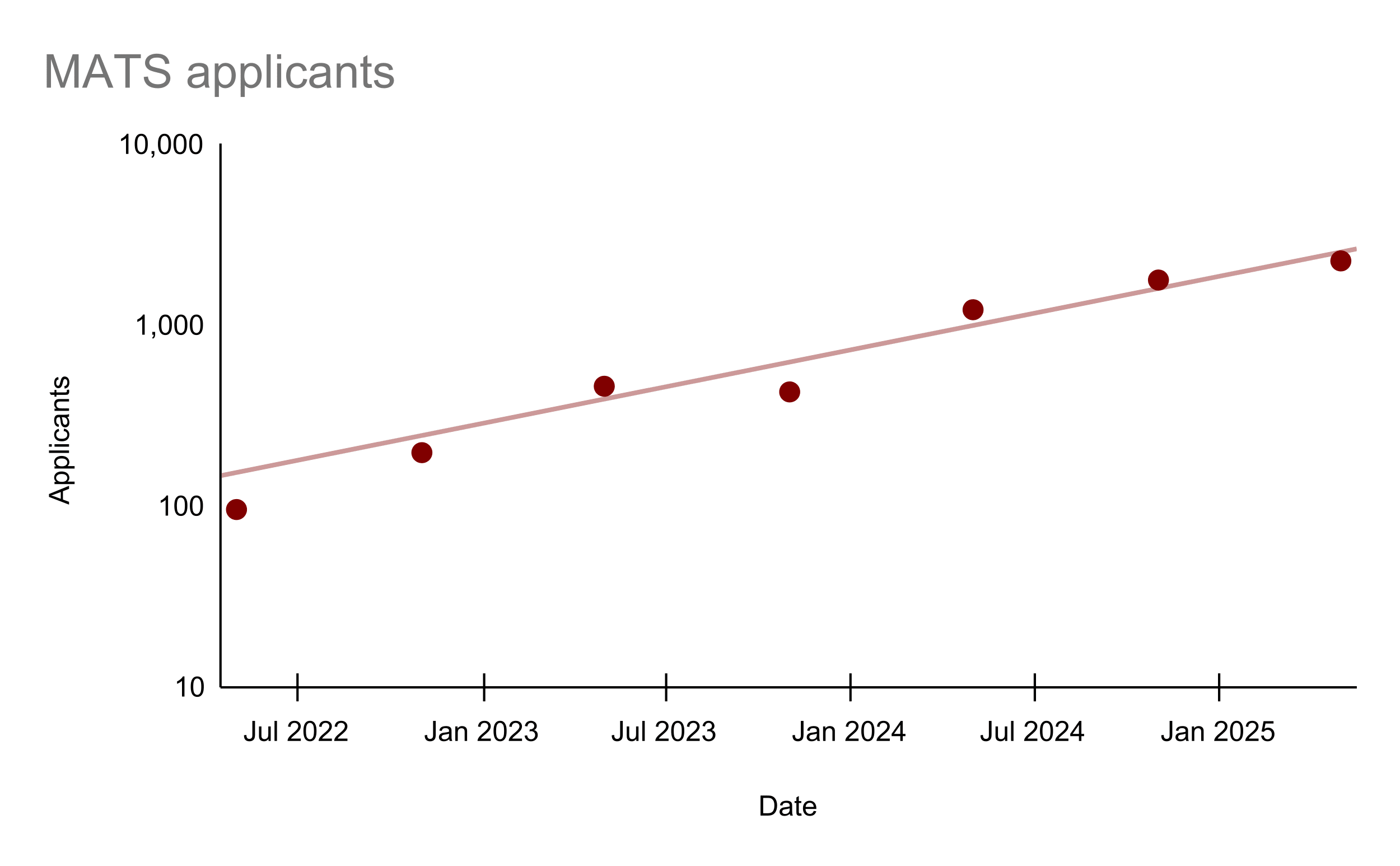


As part of MATS' compensation reevaluation project, I scraped the publicly declared employee compensations from ProPublica's Nonprofit Explorer for many AI safety and EA organizations (data here) in 2019-2023. US nonprofits are required to disclose compensation information for certain highly paid employees and contractors on their annual Form 990 tax return, which becomes publicly available. This includes compensation for officers, directors, trustees, key employees, and highest compensated employees earning over $100k annually. Therefore, my data does not include many individuals earning under $100k, but this doesn't seem to affect the yearly medians much, as the data seems to follow a lognormal distribution, with mode ~$178k in 2023, for example.
I generally found that AI safety and EA organization employees are highly compensated, albeit inconsistently between similar-sized organizations within equivalent roles (e.g., Redwood and FAR AI). I speculate that this is primarily due to differences in organization funding, but inconsistent compensation policies may also play a role.
I'm sharing this data to promote healthy and fair compensation policies across the ecosystem. I believe that MATS salaries are quite fair and reasonably competitive after our recent salary reevaluation, where we also used Payfactors HR market data for comparison. If anyone wants to do a more detailed study of the data, I highly encourage this!
I decided to exclude OpenAI's nonprofit salaries as I didn't think they counted as an "AI safety nonprofit" and their highest paid current employees are definitely employed by the LLC. I decided to include Open Philanthropy's nonprofit employees, despite the fact that their most highly compensated employees are likely those under the Open Philanthropy LLC.