[Crossposted from my Substack. The full article can also be found on the EA Forum here.]
Introduction
Advice is important. It can help you solve a problem, or to make better decisions. But not all advice is equal, and not all advice should be followed. So how can you tell whether (or how much) you should follow a certain piece of advice?
Below you'll find a framework for evaluating advice, and a link to a workbook version you can copy and use. For more detailed information, see the full 'Advice on Advice' article.
The Vowel Framework for Evaluating Advice
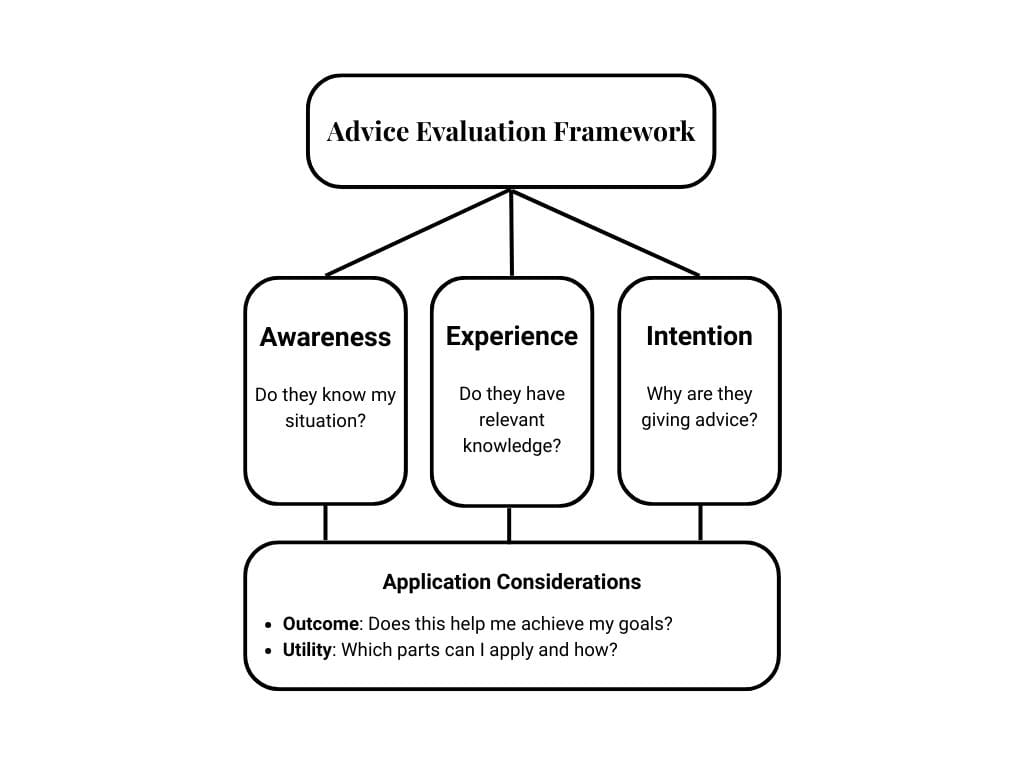
The Framework in Detail
The sections below expand on each element of the framework with practical considerations.
Remember: It is still important to appreciate that someone has taken the time to help you, even when evaluating their advice critically. You can value someone's input while still determining how much it applies to your specific situation and how best to implement it.
Source Considerations
Awareness
Key Question:
Do they know my situation, and what assumptions are they making?
Important Considerations:
- How you frame the situation and what information you give them influences the advice you receive
- There may be important information or context that both you and the advice giver are unaware of
- Consider the (likely) target audience of the advice and what assumptions are being made about your background, capabilities and resources
An Example:
For one-to-many communication (e.g. in an article on the internet), think about the target audience of the piece and what assumptions they are likely to be making about the reader.
Experience
Key Question:
Do they have experience in or knowledge of a comparable situation?
Important Considerations:
- Think about how you might assess how much experience someone has, as this may not be obvious
- Experience may lead to more useful advice, but also to bias
- People with less experience can also offer valuable perspectives
An Example:
A senior professional may have a lot of very useful expertise about priorities within a field… and less knowledge of the current early-career job hunt.
Intention
Key Question:
Why are they giving me the advice, and what are their intentions?
Important Considerations:
- Consider what incentives the advice giver has and therefore what outcomes they might be trying to direct people towards
- Emotional state and personal experiences may affect advice given
- Do not judge intention from communication style alone, as this may be influenced by factors such as culture or neurodiversity
An Example:
If someone advises you to ‘just take any job to get started’ in an area, consider whether it might come from their anxiety rather than strategic planning based on your goals.
Application Considerations
Outcome
Key Question:
Would this advice help me achieve my goals, or different goals?
Important Considerations:
- Assumptions about your background, circumstances and resources may influence what outcome people advise you towards
- The less common your goal is, the less likely standard advice is to apply and the more specific you should be about what you are trying to do
- The advice may be very good advice to achieve a goal that you do not have
An Example:
When considering graduate study to develop practical skills for industry impact, advice you receive about what to prioritise (e.g. teaching experience or maximising publication count) might instead be optimised for academic career advancement.
Utility
Key Question:
Which parts of this advice can I apply, and how should I go about applying it?
Important Considerations:
- Depending on your goals and (current) resources, you might need to adapt some of the advice or to take a different approach
- Not all advice is equally valuable so consider how to prioritise the advice you receive, e.g. benefit to effort ratio, when it is most valuable to do, any low-cost actions that may reduce uncertainty
- The reasoning behind the advice can be valuable even if their recommendation is not, so consider ‘why’
An Example:
When switching careers, advice to join a coding bootcamp contains valuable reasoning about skill development, but you might instead decide to take free online courses and build small projects that help you gain similar skills while better matching your financial situation or learning style.
Your Circumstances and Mindset
The context in which you receive advice significantly affects how you should evaluate it, for example:
- Match effort spent evaluating advice to the stakes involved, for example spending more time assessing advice for important decisions with long-term consequences
- Be aware of your emotional state when receiving advice, as feelings like anxiety or excitement can make you more or less inclined to follow it than you otherwise would
- During difficult or crisis situations receiving good advice becomes more valuable, yet recognise that both giving and receiving helpful advice becomes more challenging, requiring additional care in evaluation
For more detailed information on the above, particularly on evaluating advice during challenging personal or professional situations, see the full article which explores this in greater depth.
Workbook
A slightly modified version of the above sections have been summarised into a Google Doc, to make it easier for you to copy and use if you would find it helpful. You can access it here.
Conclusion
The above factors can help you critically evaluate advice that you receive… including this advice itself. Follow this framework to the extent that it is useful for you based on your goals, and use it as a starting point rather than a definitive approach.
If you found this summary valuable, the full ‘Advice on Advice’ article explores several areas in greater depth including: the influence of emotional states on advice, how your background and goals influence advice suitability, approaches to prioritise implementing advice you receive, how crisis situations change both giving and receiving advice, and my reasoning and motivations for putting this together to help you assess its quality.


Executive summary: This post presents a thoughtful, moderately confident framework—the VOWEL framework—for evaluating advice based on factors like source, experience, and relevance to one's goals, along with a practical workbook to help users apply it; the author encourages critical engagement with advice, including their own.
Key points:
This comment was auto-generated by the EA Forum Team. Feel free to point out issues with this summary by replying to the comment, and contact us if you have feedback.