A note for the more AI-focused readers, which I've left out of the post because it's a different conversation. If your views on AI are such that you think ~everyone should be working on it, broad timelines be damned, then you won't find this post persuasive. But we'd still like to help you! There are plenty of ways for AIM to help with short-timelines work, that you may not be aware of:
Lots of people are trying to start incubators right now, in causes we work on and in ones we don't, like AI safety and catastrophic biorisks. Within EA, we have the most incubation experience(?), so many of them come to us for advice. We plan to help them a lot more through:
Publishing learnings: Taking more time to distill and publicly share our institutional knowledge (see our shiny new substack).
Advising: Bespoke support for new incubators throughout their journey, with our exec team carving out time for this from now on. For example, we're starting to work closely with Catalyze, an AI safety incubator staffed by AIM alumni and working out of our London office.
Incubating incubators: The founder of a South American incubator is currently shadowing our program to see how it works from the inside. We're in talks with others about doing the same, and might pilot a version of the program built specifically for people starting incubators.
Partnering: We're open to partnering with others, as long as it doesn't pull us away from our core work of launching charities.
We've heard it said: "If AIM took AI seriously, it would pivot to incubating AI safety organizations." I don't think that's right. Incubating AI safety organizations isn't our comparative advantage: we have close to zero institutional knowledge about AI safety (how to research it, how new organizations in the space should navigate it, and so on), and pivoting would mean starting again on everything we've learned about incubating the kinds of charities we already launch. But we can and should help the people who do have that advantage. Those causes need different things from ours, and we'll have more impact helping other incubators do it well than doing it ourselves, especially because incubation can very easily go badly.
If you're starting or running an incubator, in AI safety or anywhere else, and think we could be useful, we'd love to hear from you here.
I'd be interested in more of us trying to spell out the cruxes that would make an EA land into something AIM-shaped or near-termist-charity-shaped. For example, you might think "broad timelines, therefore industrial policy around AI adoption in lower-income countries".
Much of this is just rehashing the old debate about systemic vs marginalist interventions, but I think that debate is important and might be worth revisiting given our newfound knowledge of AI and the additional years we've gained for evaluating the track record of EA projects.
To make my small contribution here, I for the most part have been trying to act as a long timelines guy, and that has led me to grant myself the title of "AI uplift consultant" and faff around trying to see where AI adoption is most important and help out with that.
("doing basically the same thing we've been doing so far" is a very tempting conclusion, and I frequently try to push back when I catch it, especially for my own plans)
Actually, have not the biggest chances for EA to matter come from being early on very big things (corporate campaigns on animal welfare, YIMBY, pandemics, AI)?
To the extent we think there's enough time to be early on something, my first guess would be to look into the still weird and unacknowledged things, and human-health-focused charities don't quite fit my conception of that (but maybe interbrate welfare is?)
The Economist says that as effective altruism “has become stronger, [it] has become stranger”. I would put it the other way round: it grew stronger because it was willing to be strange
TL;DR: No, but you might, if you leave it too late: We’re hiring for seven roles, and the people who join now will shape what a much bigger AIM becomes. The first step is cheap -- an expression of interest form.
My worry
I rejoined[1] AIM in February. The team/culture and growth plans are more exciting to me than ever, but when I look at trends outside of AIM, in particular in AI capabilities, I’d be lying if I hadn’t asked myself if I came back at the wrong time..
The worry goes something like this: A new charity takes about five years to reach its peak scale, and some kinds of benefits (e.g. from education, or some policy changes) can take a decade to materialize[2]. If AI transforms the world before then[3], the majority of the new charity’s impact will go unrealized. So is starting new charities the best thing you can be doing with your career right now?
I grappled with this myself for months. I tried to put aside the sunk cost fallacy and consider whether I should be doing something else. My answer is that there's nowhere else I'd rather be right now. I hope you’ll come join me. This post will explain why.
Broad timelines imply a portfolio of bets, and AIM is an important bet within it
No one knows with certainty when (or whether) AI will transform the world.
Maybe the business side fails: the AI industry is super leveraged, so if it doesn’t sustain an unprecedented growth rate and if new investors aren’t convinced, the house of cards could collapse.
Maybe public pressure and political intervention slows progress (which could in turn bring the financial house of cards down).
So instead of thinking in terms of short or long timelines, we should think in terms of broad timelines – a probability distribution. Even if your modal timeline is short, you should want the world to be making a portfolio of bets that maximise impact in expectation across that probability distribution. That includes bets that pay off most on longer timelines.
Your own career is one bet in that portfolio, and you should consider your comparative advantage when you make it. To choose an obvious example, if you have a track record scaling health programs in low-income countries (unusually rare and valuable experience) maybe don’t pivot to AI safety? But less dominating advantages, like having spent years steeped in a given cause (through work, study or volunteering) should factor into your bet too[4]. And experience isn’t the only kind of comparative advantage: plenty of roles, like marketing and comms (IMO), are more a matter of aptitude than experience.
[I recognize there are plenty who won’t find this persuasive, because they think the probability distribution is such that basically everyone should be doing short-timelines work. This post isn’t for you (but check out a comment I’ve left, which specifically IS for you). This post is for people whose timelines are consistent with people doing work that has impact over more than just a few years, and who have been waiting for someone to tell them it’s okay to be the ones doing that work. It IS okay! 🌈]
AIM is an important bet to have in our portfolio. I’m sure you’re sick of hearing about it by now, but a bunch of increased funding is already committed to highly impactful charities, with even more expected. We have a great opportunity and responsibility to deploy it as effectively as possible. If we get this right, we could make unprecedented progress on the world’s biggest problems, even eradicating some of them like humanity did with smallpox. But there are limits to how many programs existing organizations can run, and how far they can scale the ones they have. So we need a pipeline of ambitious new organizations to fill the gap.
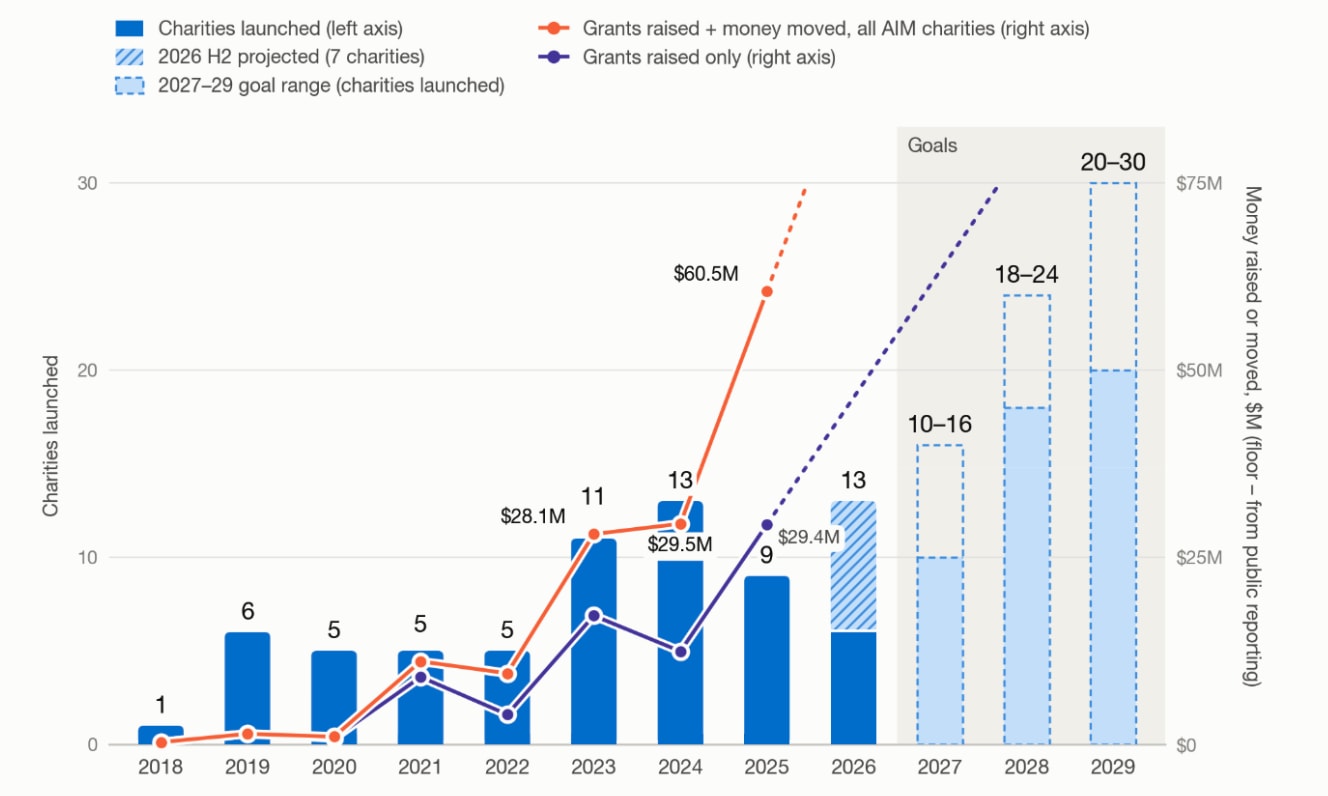
Building that pipeline is what AIM does, and we've gotten pretty good at it (although we still have a lot more room for improvement). We've been refining our approach since 2018, having launched 69 charities, with 13 of the 16 that are old enough and in scope having been funded by GiveWell, 10 receiving funding from Animal Charity Evaluators, and several becoming pioneers in their fields, like LEEP in lead exposure and Shrimp Welfare Project in shrimp welfare.
Joining now means helping shape what AIM becomes.
Our plans are more ambitious than ever: We want to launch more charities, and better ones. Much like venture capital, charity incubation is hits-based: most of our charities are great, but a small number become field leaders so impactful that they account for the majority of our impact. To scale our impact, we want more of those field leaders.
The plan:
First, we’ll increase the chance that any given charity becomes one, through initiatives to improve the quality of our incubation (getting more ambitious charities up and running, faster) and to give our existing charities more support to scale up and reach their potential.
Then we’ll increase the number of bets we make by launching more charities.
We’re asking ourselves: what would it take to triple the number of charities we launch each year, and raise our hit rate at the same time?
We have the funding. We've just raised (pending due diligence) $21.5M for the next 3-4 years For context, our entire budget for 2026 is about $3M. So the world needs new charities now more than ever, and the money for us to incubate them is there. The hard part is doing three things at once: launching far more charities each year (see the chart below), raising their quality, and investing significantly more in supporting the charities we’ve already launched. That’s daunting, but doable with the right team 🤝
Our impact hinges on this hiring round. Talent is heavy-tailed: the gap between the best and second-best applicant for a job is often big. And because we’re about to grow fast, the people who join now will shape the processes, research methods and support programs that a bigger AIM will run on. So if you end up being our best applicant (and I’m certain that you are!), you can make a big difference to AIM’s trajectory.
And then there’s the people and culture
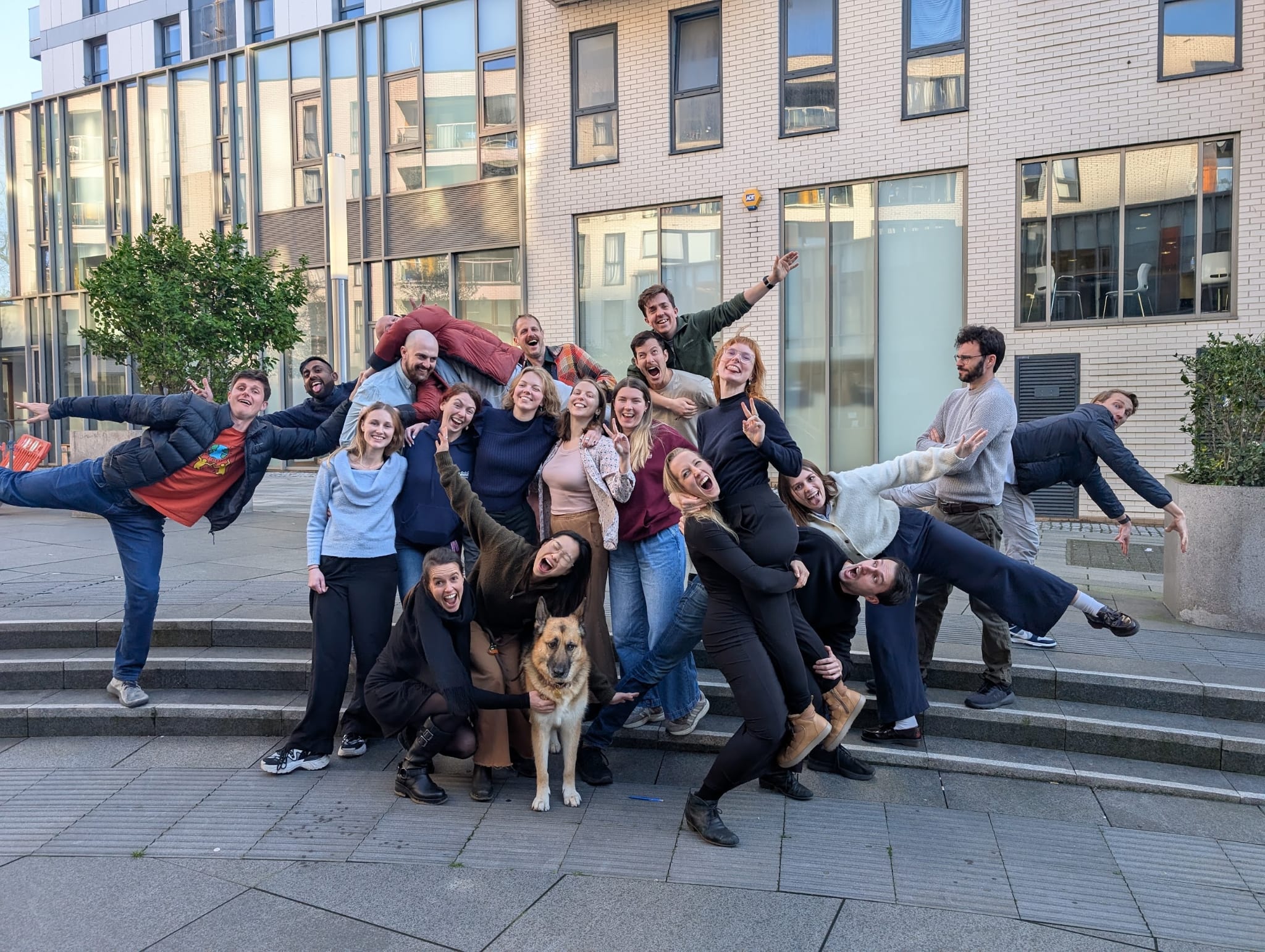
I can be a bit of an impact-maximising robot. And yet one of the biggest reasons that there’s nowhere else I’d rather be is that at AIM, I can bring my whole self to work, and I trust and feel cared for by my colleagues.
Of course there is an impact case one can make for this: I care a lot about helping beneficiaries, but from moment to moment at work, I’m not tapping into all the suffering in the world for motivation (and I think that’s healthy). Mostly, what motivates me is wanting to do right by my team. That motivation is a lot stronger when your team is a bunch of fucking excellent humans that you care deeply about. Stronger motivation makes for better work (<-- insights like this are why they pay me the big bucks).
But let's be real: the main reason I care about having great people and culture is that it makes AIM a great place to work. When I moved from earning to give to working at a charity, I suspected that working alongside value-aligned people might be an upside. Boy was that an under-statement! I find it makes a massive difference to my experience. But working alongside value-aligned people isn't much of a unique selling point on this forum.. so allow me to explain what’s special about AIM’s people and their values:
They take their principles seriously. This is the only reason our crazy salary policy works: At AIM, staff ask for the salary they need, and there’s no negotiation. The top of our range is more than double the bottom. “But everyone will ask for the top of the range!”, approximately everyone warned us before we rolled it out. It’s true that nothing stops them. We just ask staff to practise salary restraint (i.e. ask for what you need rather than the most you could get, since every dollar we don’t spend on ourselves can go towards helping beneficiaries instead), and then we trust them. So far, that trust has been well placed: Instead of uniformly shifting up, salaries have spread out according to need.
They're also particularly warm and authentic.
^It’s hard to convey warmth and authenticity through a blog.. this is the best I’ve got!
Then there's the incubation program, which brings a steady stream of amazing new people to meet every cohort. I find it hard not to let the people in the AIM cinematic universe displace the rest of my social world.. the average quality of human is so damn high.
So why haven’t you applied yet?
We’re hiring for seven roles. There’s no deadline, but we’re itching to get hiring so we can get incubating! As such we’ll review applications on a rolling basis.
Some roles lean more senior:
1) Senior Research Manager (Animal Welfare): Lead our animal welfare research end to end, deciding which ideas become the next field-leading animal charities. This is hands-on research with a path into leading a growing team.
2) Senior Research Manager (Global Health & Development): As above. We’re looking both for people with more of a development economics background and classic global health background. for GHD.
^^ I just want to interrupt to emphasise how cool I think it is to be a researcher at AIM.. You recommend a set of charities that should exist, and within months, hot-shit co-founders will be dedicating their careers to building them. Very few research jobs have such a short, direct line from recommendation to action. Get hyped!
3) Special Projects Officer, Strategy: Work with our Chief Growth Officer and exec team to help us figure out what to build next and build it. Should we launch a fund? Should we incubate other incubators? How do we best support our existing charities to 10x their scale? This role is ideal for a sharp generalist, and consulting or strategy experience is a plus.
Others are a great way in, whether you’re early in your career or switching fields:
4) Marketing & Content Associate: Tell AIM’s story, and our charities’ stories, to the people who’ll become our next founders. You’ll own our ~20k mailing list, our new website, our social media and our founder application campaign. It's a creative, writing-led, hands-on role with a lot of variety.
5) Recruitment & Selection Associate: Help us sift a mountain of applications for the rare people who have what it takes to found a charity. Help us make our selection process more accurate over time. No recruitment experience needed: If you're curious about people and like fixing noisy rubrics, this is for you.
6) HR & Finance Associate: Own the people-and-money admin that keeps AIM running: contracts, payroll, onboarding, receiving grants and disbursing seed funding. This is for someone who likes to get the details right, and ideally likes automating them too. London preferred.
7) Visiting Research Fellow, Global Health: A five month fellowship embedded in our research team, for people with a background in global health, policy, epidemiology or medicine. You'll work on the same questions our research managers do, with more feedback and guidance. Past fellows have gone on to Prevail, Animal Charity Evaluators, Giving What We Can, Giving Green, Shrimp Welfare Project and AIM itself.
To pre-empt some misconceptions that might stop you from applying:
You don’t need to be deep in EA, though you do need to care about doing the most good, and be comfortable with numbers and uncertainty.
You don’t need to have done the job before. Some of our best hires hadn’t. Our first filter looks at your background and how you think about impact, and from there we assess mostly through test tasks and a paid work trial, so how well you do the work counts for more than what you’ve done before.
You don’t need to move to London. Most roles are remote-friendly. But if you’d like to, we’ll try to make it happen (we offer visa sponsorship and relocation support for most).
Not sure which role fits, or think you’d be great at something we haven’t listed? Fill in the expression of interest form anyway.
The process:
Taking the first step is trivially easy: Fill out our expression of interest form (5 mins). We’ll review applications on a rolling basis.
From there, each stage asks a bit more of you:
First a 30-minute role-specific application
Then a 2–3 hour test task
An interview and references, and
A paid work trial for the final one or two candidates.
We only invite you to the next stage if we think you have a good chance of passing it.
Questions? Check out the job descriptions with more detail here or shoot us a note at [email protected],
Nothing for you? Many of our charities are scaling and hiring too: Probably Good maintains a list of their public job opportunities here.
To close
Did I rejoin Ambitious Impact at the wrong time? I don’t think so. But you could join at the wrong time, if you leave it too late: The people who join in the next year will determine AIM’s future. Our leverage and upside potential is reeaaally high. We need your talent to help us actually realize it.
I first worked at AIM from August 2022 to December 2023, then went through the Incubation Program myself and co-founded FarmKind in early 2024 where I worked until January 2026.
For example, with primary school education interventions, one of the main benefits is on future livelihoods after finishing school. Or for example, bans on cruel farming practices often have long phase-out periods to make them acceptable to industry, such that wins can take a decade to help their first animal.
Perhaps it just solves certain problems such that some charities aren’t needed any more. Perhaps it just changes the world in ways that cause the charity’s theory of change to break down (e.g. it was built assuming a Nigerian health system and government that now looks completely different). Perhaps we’re all dead and can no longer be helped.
On the surface, this runs counter to some in the AI safety space who argue that plenty of people can pivot into the cause quickly, without specialist experience. But I don’t think we disagree much. I believe that many AI roles don’t need deep technical expertise. But even the more bullish takes, that speak of getting into AI safety in three months, point out that you should lean on the skills you already have (or can build quickly), and that people without relevant experience may need a year in an intermediate role first – i.e. they acknowledge the significance of comparative advantage.
Note: This post was crossposted from the Coefficient Giving Farm Animal Welfare Research Newsletter by the Forum team, with the author's permission. The author may not see or respond to comments on this post.
Subtitle: On vegan advocacy, effective altruism, and FIFA
I turn 40 today. Here are some hot takes.
On factory farming
1. Our biggest challenge is salience. If factory farming led the evening news, it wouldn’t last lo...
Impressions from the 21st Annual U.S. Cluster Headache Patient Conference, organized by Clusterbusters.
On the morning of the last day of the conference, E. was hanging out with other “clusterheads” outside the conference hotel when he started having a cluster headache attack. Before he could go back to his hotel room, J. offered E. his DMT v...
TL;DR:
The movement has an evidence problem. To solve it, for each intervention we need to know:
* What types of evidence that intervention needs
* What types of evidence different sources can give us
In this post, we outline a framework for evidencing an intervention through five stages:
...




A note for the more AI-focused readers, which I've left out of the post because it's a different conversation. If your views on AI are such that you think ~everyone should be working on it, broad timelines be damned, then you won't find this post persuasive. But we'd still like to help you! There are plenty of ways for AIM to help with short-timelines work, that you may not be aware of:
Lots of people are trying to start incubators right now, in causes we work on and in ones we don't, like AI safety and catastrophic biorisks. Within EA, we have the most incubation experience(?), so many of them come to us for advice. We plan to help them a lot more through:
We've heard it said: "If AIM took AI seriously, it would pivot to incubating AI safety organizations." I don't think that's right. Incubating AI safety organizations isn't our comparative advantage: we have close to zero institutional knowledge about AI safety (how to research it, how new organizations in the space should navigate it, and so on), and pivoting would mean starting again on everything we've learned about incubating the kinds of charities we already launch. But we can and should help the people who do have that advantage. Those causes need different things from ours, and we'll have more impact helping other incubators do it well than doing it ourselves, especially because incubation can very easily go badly.
If you're starting or running an incubator, in AI safety or anywhere else, and think we could be useful, we'd love to hear from you here.