Comments
This is part one of a two-part series. Part two is available here.
“Incubator” is a very vague term[1]. It tells you very little about what the organization actually does. All it tells you is that they cause new projects to exist. But that’s the outcome. The activities that get you there can vary enormously.
This is a framework for people who want more good organisations to exist. When trying to get a particular type of impactful project to exist, we recommend asking: What blocks these projects from existing? Then build the thing that removes those blockers.
Historically, AIM’s Charity Entrepreneurship Incubation Program (CEIP) has been built around the following roughly ranked list of things that unblock founders (with a lot of detail and nuance within each of them): (1) a well-researched charity idea, (2) an excellent co-founder, (3) permission to do it [founding is scary, and sometimes we can give them the confidence that they’re a good fit], (4) training and mentorship, (5) funding, (6) support with operational hurdles.
The list will differ based on the target audience of founders (e.g. experienced founders might not need confidence/permission) and context (maybe funding isn’t a blocker, but choosing the right project is). Two of our findings probably transfer, though: (1), program applicants tend to misjudge where our biggest value-add lies. They overrate the formal learning and the seed funding and underrate the attitudes we instill and the community of peers. And (2), not every blocker needs to be solved by teaching. When a charity idea calls for super strong interpersonal skills, we vet for them rather than trying to build them in an 8 week program.
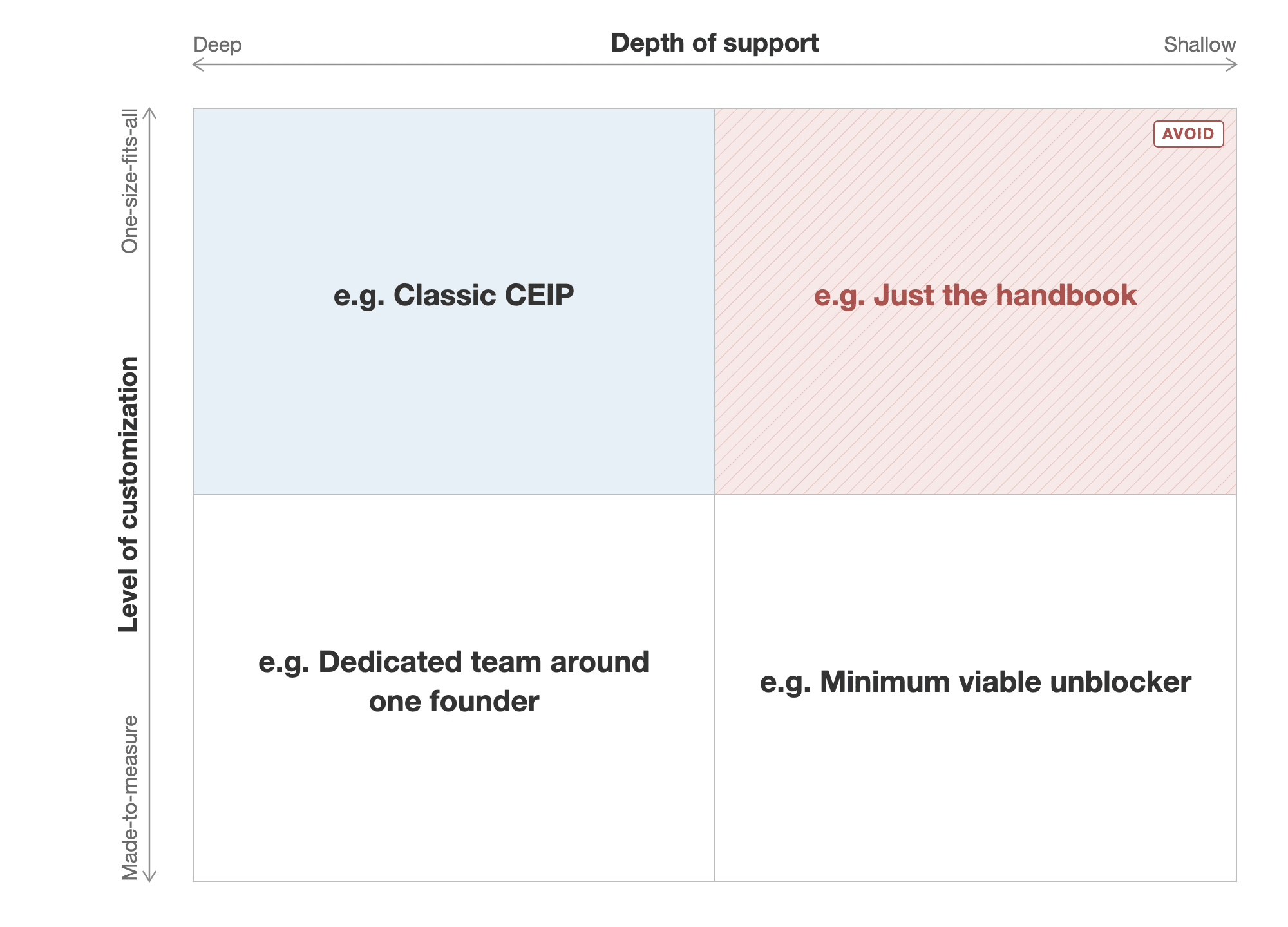
Once you know the blockers, two design questions follow: how much support each founder gets, and how much of it is the same for everyone. Omg it’s time for a 2x2 🤠!
Example: CEIP. The program is designed so that a sufficiently talented generalist can launch a field-leading charity, armed with an excellent co-founder and a well-scoped charity idea, even with no entrepreneurship or non-profit experience. This works because (a) we recruit generalists who share roughly the same blockers, so we can build one program and run it every cohort, and (b) the program is extensive enough that people can disregard what they already know, so covering too much costs little.
Example: handing someone the CEIP handbook and wishing them luck. What a handbook can deliver (some commonly applicable advice and a shallow overview of the requisite skills) is what people tend to overrate. We’ve had a handbook for many years and think it has been a useful accompaniment to our program, but has never individually led to a new charity being launched. It’s also probably a relevant signal that we haven’t updated it in over 5 years despite us thinking we could write a much “better” one now! Avoid this quadrant[2]
Example: the minimum viable unblocker (MVU). This approach involves finding founders with one thing stopping them from launching a field-leading charity, and removing that blocker. They may already have founding experience, funding and/or a charity idea they have a comparative advantage in. Perhaps all they need is to be connected to a key stakeholder, or help recruiting a difficult-to-find profile through your network, or a nudge towards the version of their intervention that’s most impactful. We ran some experiments with this, and we updated positively that sometimes very low-cost interventions (e.g. a couple of high-value connections) can indeed provide strong value to founders launching an organisation, though we’re unsure if organisations that are not deeply embedded in our ecosystem and that we don’t provide continued support to will have similar long-term growth and survival rates.
Example: a dedicated team wrapped around one founder, supporting them however they need: strategic thought partnership, dedicated hiring, ops or research capacity, bespoke connections and training. There is no fixed program; what gets delivered is whatever this founder and this idea turn out to require. The reason to go deep is that you think the marginal return on the investment is there, because the bet is sufficiently high upside, and marginal support increases the chances of success (e.g. by keeping the org on the right path). This is the most expensive approach, per org incubated.
We think incubators can thrive in virtually any position on this matrix except shallow/one-size-fits-all[3].
The two most critical “inputs” an incubator requires are founders and ideas. We find it a helpful simplification to think of each having either ‘generalist’ or ‘specialist’ types.
Founders: Our talent thesis is that above a minimum idea-quality bar, founder quality explains more of the variance in charity outcomes than idea strength, training, or post-program support.
Charity ideas:
Much to Aidan’s delight, this generates another 2x2 🎉
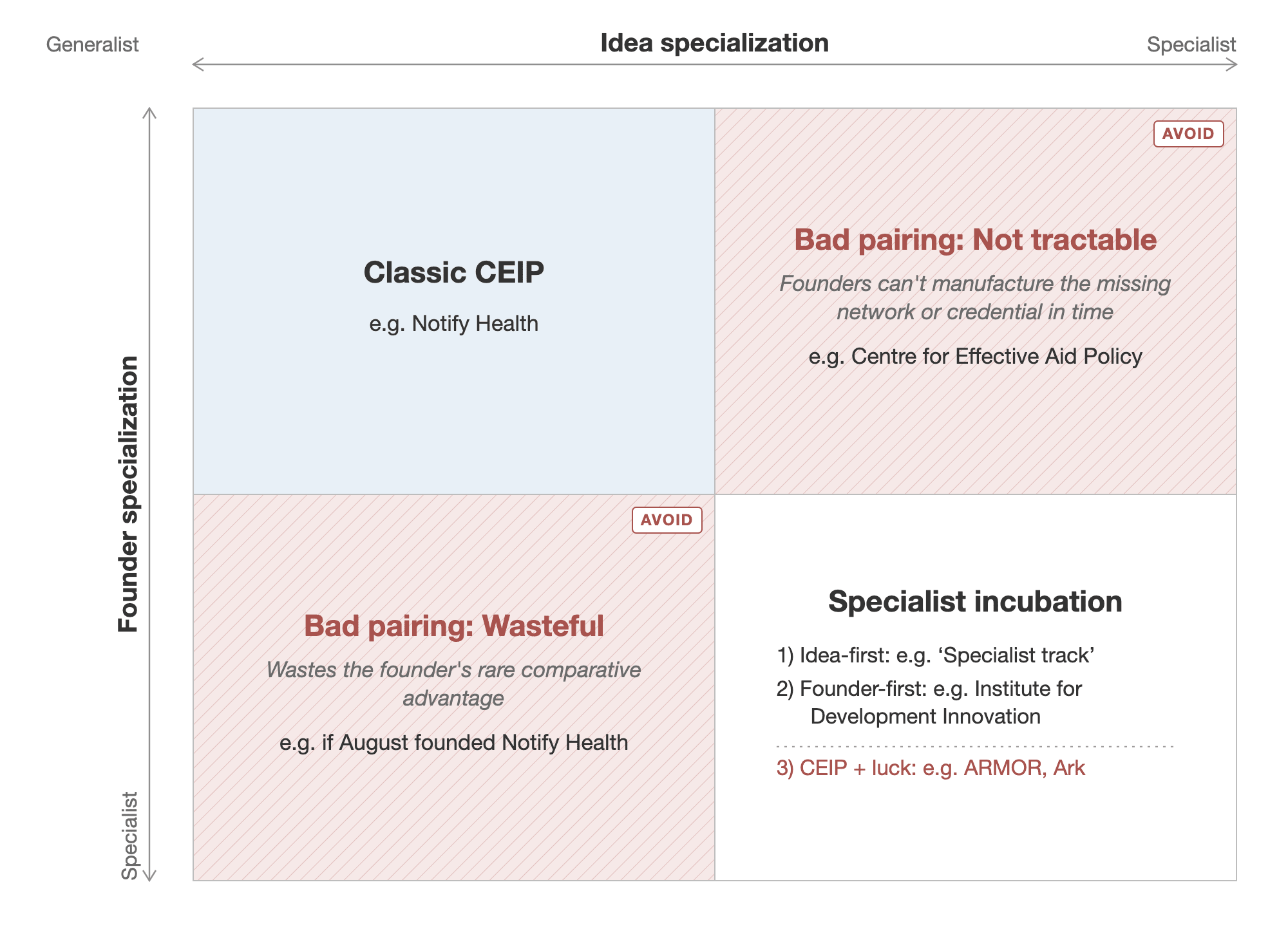
1. Generalist founder <> generalist idea
This is CEIP’s bread and butter (e.g. Notify Health). It’s counter-intuitive to people that someone with no relevant experience for a charity idea is a good choice to found it, but our track record shows that for many, many charity ideas, this model works. Excellent founder talent is very rare. Specific skills/knowledge/experience are often easy for talented founders to acquire. So general founder talent is often the bottleneck. Moreover, working with generalists makes it far easier to do co-founder matchmaking (because any founder can plausibly work with any other founder on any charity idea, and success depends not just on the individual skillsets of the founder, but also the extent to which these founders can collaborate and complement each other)
2. Generalist founder <> specialist idea
Historically, our talent thesis has been that a talented enough generalist can found just about anything. We now think that was a mistake. While it’s true far more often than you’d expect, there are lots of exceptions. Pairing generalist founders with specialist ideas led to organizations like Centre for Effective Aid Policy who shut down after realising their founders weren’t the right fit. This was a bad use of excellent founders’ time. Avoid
3. Specialist founder <> generalist idea
This is viable, but wastes the founder’s specialism (e.g. if a born HNWI-fundraiser had founded Notify Health instead of a philanthropic advisory). Avoid
4. Specialist founder <> specialist idea
This is the best way to found specialist ideas and use specialist founders. So far when AIM has incubated charities in this quadrant it’s generally been a happy accident. For example David McKinney co-founded ARMOR: we underrated the extent to which his pharma industry background and extraversion made him a specialist founder that was especially well suited to this idea.
There are two main approaches to specialist founder <> specialist idea incubation:
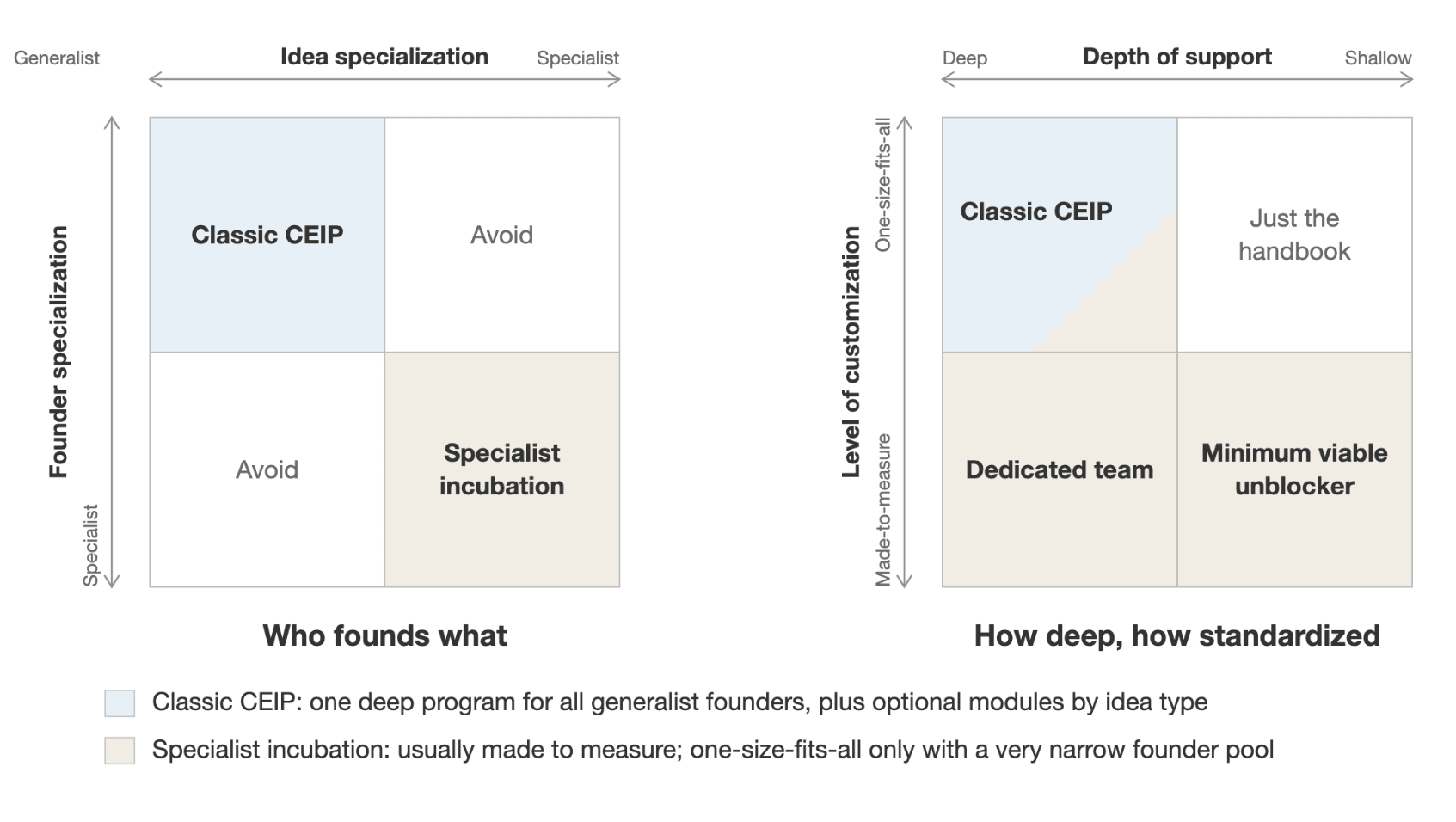
Classic CEIP sits in the top-left of both grids: generalist founders on generalist ideas, given deep, one-size-fits-all support. That works because the main blockers generalists face are predictable enough that one program can cover all of them, with each founder skipping what they already have. It is what lets us take people with no founding or charity experience and get them launching field-leading charities, adding to the founder/charity talent pool rather than squeezing more out of the existing one.
Specialist incubation usually ends up in the made-to-measure row, not because it has to, but because of pool size. You could run a one-size-fits-all program for specialists if you picked a target audience narrow enough that they all need the same blockers removed (e.g. Chinese nationals with entrepreneurial experience who want to found animal welfare organisations in China). In practice that pool may be too small to be able to find enough exceptional founders to build a program around.
How deep to make your specialist incubation depends on how many blockers your target audience of founders need removed. Just one blocker: the “minimum viable unblocker” approach works. A few blockers: a light bespoke track that keeps the transferable parts of a standard program (attitudes, peer community, ops scaffolding) and tailors the rest (usually co-founder matching and idea scoping). Many blockers: you might build an entire bespoke program or build a dedicated team around the founder, but this would only be worth using your limited incubation capacity when the bet is high-upside enough to justify the investment. In either, don’t underrate the value of providing a commitment device for people to actually get out into the world, building their organization.
If you’re launching an incubator, don't start by picking a model. Start by asking what is actually stopping the projects you want to exist from existing, and succeeding, and design from there.
These frameworks provide a menu of option spaces, each with their own upsides, trade-offs, and uncertainties. We’re very excited about more incubators trialing and learning from different approaches; if you’re working one one, get in touch. We'd be happy to share more of our thinking and to learn from your experience so we can improve.
Another less vague, but still unhelpfully vague term is "venture studio". In our experience, this term is used very differently by different people, describing everything from a studio that generates ideas in-house and hires CEOs to run them, to a holding company operating the ventures itself, to a shared ops team serving several founders. If someone proposes a venture studio, to understand what they mean we’d ask which founders it serves, which blockers it removes, and how deep the support they provide will be.
We recommend against shallow, one-size-fits-all incubation. If you wanted to make the case for it, that case would go something like: “This is highly scalable. This allows you to go big on the number of potential projects supported, and even if you help each only a little bit, that adds up”. But impact is heavy-tailed. What matters is the field-leading projects. You’re better off providing deep support to give orgs the best chance you can of being field-leaders, or going shallow but targeted at the most promising projects where there really is one key blocker to being a field-leader.
See previous footnote.



Absolutely love the specialist/generalist 2x2. I've thought about that a bit and tried to express it at times, and your framing certainly makes that easier!