Comments
Thanks for this. I have two initial thoughts which I'll separate into different comments (one long, one short - guess which one this is).
OK so firstly, I think in your evaluation phase things get really tricky, and more tricky than you've indicated. Basically, comparing a shorttermist cause area to a longtermist cause area in terms of scale seems to me to be insanely hard, and I don't think heuristics or CEAs are going to help much, if at all. I think it really depends on which side you fall on with regards to some tough, and often contentious, foundational questions that organisations such as GPI are trying to tackle. To give just a few examples:
- How seriously do you take the problem of complex cluelessness and how should one respond to it? If you think it's a problem you might then give every 'GiveWell-type' cause area a scale rating of "Who the hell knows", funnel them all out immediately, and then simply consider cause areas that arguably don't run into the cluelessness problem - perhaps longtermist cause areas such as values spreading or x-risk reduction (I acknowledge this is just one way to respond to the problem of cluelessness)
- Do you think influencing the long-run future is intractable? If so you may want to funnel out all longtermist cause areas (possibly not including extinction-risk cause areas)
- Are you convinced by strong longtermism? If so you may just want to funnel out all 'short-termist' cause areas because they're just a distraction
- Do you hold a totalist view of population ethics? If you don't you may want to funnel out all extinction-risk reduction charities
Basically my point is, depending on answers to questions such as the above, you may think a longtermist cause area is WAY better than a shorttermist cause area, or vice versa, and we haven't even gone near a CEA (which I'm not sure would help matters). I can't emphasise that 'WAY' enough.
To some significant extent, I just think choice of cause area is quite personal. Some people are longtermists, some aren't. Some people think it's good to reduce x-risk, some don't etc. The question for you, if you're trying to apply a funnel to all cause areas, is how do you deal with this issue?
Most research organisations deal with this issue by not trying to apply a funnel to all cause areas in the first place. Instead they focus on a particular type of cause area and prioritise within that e.g. ACE focuses on near-term animal suffering, and GiveWell focuses on disease. Therefore, for example, GiveWell can make certain assumptions about those who are interested in their work - that they aren't worried by complex cluelessness, that they probably aren't (strong) longtermists etc. They can then proceed on this basis. A notable exception may be 80,000 Hours that has funnelled from all cause areas, landing on just longtermist ones and
So part of me thinks your project may be doomed from the start unless you're very clear about where you stand on these key foundational questions. Even in that case there's a difficulty, in that anyone who disagrees with your stance on these foundational questions would then have the right to throw out all of your funnelling work and just do their own. (EDIT: I no longer really endorse this paragraph, see comments below).
I would be interested to hear your thoughts on all of this.




My shorter (and less strong) comment concerns this:
I don't believe that every cause area naturally lends itself to starting a charity. In fact, many don't. For example, if one wants to estimate the philanthropic discount rate more accurately, one probably doesn't need to start a charity to do so. Instead, one may want to do an Econ PhD.
So I think viewing the end goal as charity incubation may not be helpful, and in fact may be harmful if it results in EA dismissing particular cause areas that don't perform well within this lens, but may be high-impact through other lenses.
Great point.
I think my take is that evaluation and ranking often really makes sense for very specific goals. Otherwise you get the problem of evaluating an airplane using the metrics of a washing machine.
This post was rather short. I think if a funnel became more capacity, it would have to be clarified that it has a very particular goal in mind. In this case, the goal would be "identifying targets that could be entire nonprofits".
We've discussed organizing cause areas that could make sense for smaller projects, but one problem with that is that the number of possible candidates in that case goes up considerably. It becomes a much messier problem to organize the space of possible options for any kind of useful work. If you have good ideas for this, please do post!
OK, I think that's probably fine as long as you are very clear on the scope and the fact that some cause areas that you 'funnel out' may in fact still be very important through other lenses.
It sounds like you might be doing something quite similar to Charity Entrepreneurship so you may (or may not) want to collaborate with them in some way. At the very least they might be interested in the outcome of your research.
Speaking of CE, they are looking to incubate a non-profit that will work full-time on evaluating cause areas. I actually think it might be good if you have a somewhat narrow focus, because I'd imagine their organisation will inevitably end up taking quite a wide focus.
I agree with this.
I think one could address that simply by tweak the quoted sentences to "It has been determined that it's most likely a good idea to start object-level work on a specific cause/intervention (e.g., starting a charity, starting a new programme in an existing org or government, doing independent research and advising key decision-makers). Now the hard work begins of actually doing that."
(I'm also not sure the implementation stage will always or typically be harder than the other three stages. I don't specifically believe the opposite; I just feel unsure, and imagine it varies.)
One minor quibble with your comment: I think "do an Econ PhD [and during this or afterwards try to estimate the philanthropic discount rate]" should probably not by itself be called "implementation". It's more object-level than doing prioritisation research to inform whether someone should do that, but by itself it doesn't yet connect to any "directly important" decisions. So I'd want to make some mention of later communicating findings to key decision-makers.
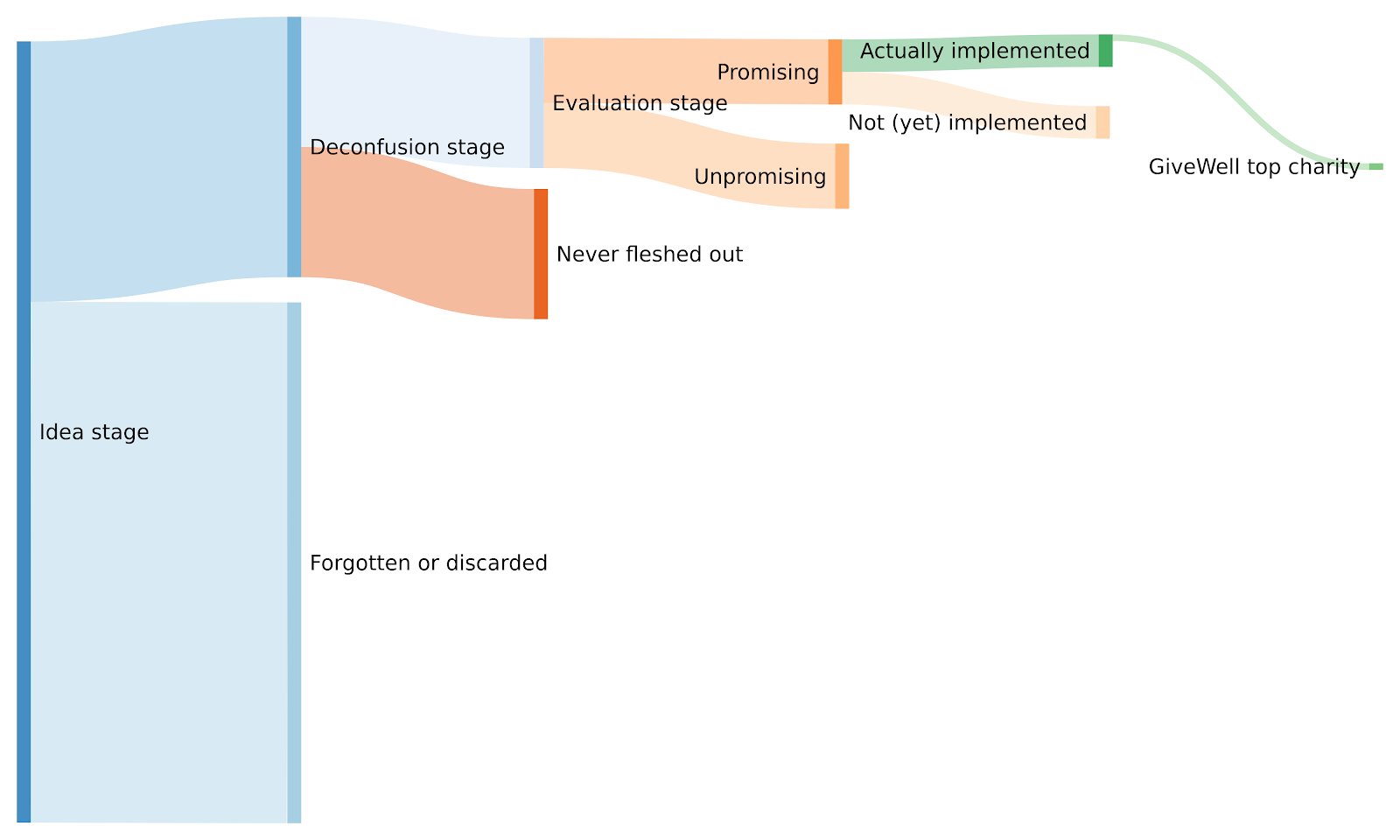
[Btw, thanks for this post, Nuño - I found it clear and useful, and liked the diagram.]
That's all fair. I would endorse that rewording (and potential change of approach)
Makes sense, thanks, changed.