It looks like the counterfactual is far from "the manager will have to do it", it's rather "the manager will have to do it for a little while we'll find someone else to do it a little later". Am I missing something obvious?
It’s interesting: on the one hand, your hypothetical could be the way it works out, and it doesn't sound that bad. But on the other hand, as I say in the post, I think a sensible way to understand the badness of failing to make the hire is that it’s the difference between a) a 55-person org which is growing and b) a 56-person org which is growing. In your framing, it sounds like the org is only trivially worse off. In my framing, it’s clear that b) is much better off!
I thought about it for a little while. Here are three reasons why I think the costs of failing to make the hire are much higher than your comment makes them sound.
1. Repeating the hiring round fairly soon and making an equivalently strong hire is unusually fortunate
Here’s what might happen instead:
The manager learns they can’t hire for the role they wanted, and scopes out a smaller one. They hand off the procedural parts of the function and keep the rest. What they wanted was for the function to grow into a strong one, with the attention of someone who can oversee it well and make sure it moves to meet the needs of an aggressively growing organisation. It doesn’t get that. And because the smaller role is filled, the pressure to fix it goes away, so the situation tends to continue indefinitely: the function is weaker than it should be, and the manager keeps spending time on it.
Someone else accepts the role. The candidate is, in expectation, weaker, and in these rounds the gap between the top candidate and the next is often surprisingly large (Rob Wiblin worked through this).
The manager just keeps it. No re-run, no re-scope. The function sits at manager-level attention and the manager’s cycle stays blocked. This happens a lot. I’ve had functions that I ended up running with a small fraction of my time, going badly, and that situation continued indefinitely, sometimes in and out of failed hiring rounds.
2. Blocking other functions being scaled
Here’s a cycle which managers in high-growth orgs often spend their attention on: (1) scope out a function (understand what to do and how to do it, see if you can systematise it without hiring, learn what someone overseeing it would look like and what kind of person could do it); (2) hire someone to oversee the function; (3) onboard and train them; (4) use the freed-up time to repeat 1–3 for the next function.
The manager in your hypothetical has failed to get past (2) for this function, so they’ll move on to this cycle for other functions. That's fine, but failing to make the hire means that they'll be slower, in two ways. First, they’ll be spending (say) 10 hours a week overseeing the function for as long as it has no owner. Second, at some point they’ll do a hiring push to find the person, and that push will take something like 70–200 hours. All of that is time they could have spent spinning up the next function. In a fast-growing org, there's always some sense of haste in trying to get these functions going: because as soon as you get someone overseeing it, they're able to make it work well, then grow it at a similar compound growth rate to what the org is (so that it can meet the needs of the org).
3. For whatever time there is no hire, the function is being run poorly by the manager and falling behind org needs
The function which the hiring manager failed to hire for was among the highest priority functions to get more attention to. That's why it was being hired for!
“The manager covers it for a little while” means it runs on (say) ten hours a week of the manager’s time until someone is hired into it. It will fall further behind what the fast-growing org needs for that whole time, and might become a real mess (and/or maybe take more of the hiring manager's attention).
It being increasingly poorly run creates increasing problems for the org, and as it gets more messy it'll take whoever is eventually moved onto it longer to get it on the right track again.
Thanks for the very in-depth reply. I find this a lot more convincing than the original post.
Just thought I'd highlight a few empirical questions on which the strength of your argument hinges. After a strong candidate declines an offer:
how often does the role remain persistenly unfilled/under resourced?
how often does it get filled by a similarly capable person within months?
how often does it get filled by a less capable person?
how often does the role end up abandoned?
The exact distribution of expected probability for these outcomes seems to me to determine whether the counterfactual looks more like a temporary slowdown versus a significant reduction in organizational capacity.
Nice, I'm glad it was clearer than the the post, thanks for the prompt to write it out!
I agree that those seem like relevant empirical questions, and I could imagine them being useful for a candidate to discuss with a potential hiring org.
Though I notice that they fit most naturally with a frame for thinking about organisations which doesn’t feel natural to me. So if a candidate asked me to answer them, I would probably a) try to answer them, but also b) try to share the framing I find most natural.
If I had infinite time and the candidate had infinite patience, I might say something like:
You could think of an organisation as being made up of a set of roles, each of which is ideally filled by someone strong for that role. Of course, that’s literally true in a sense.
But I’m normally thinking of a place like 80k as pursuing a mission which requires an enormous amount of “stuff to be done". The roles which that "stuff to be done" is allocated to are best thought of less as contingent fluid constructions which we have to work with.
Here's what I mean:
Areas of Responsibility. We create a layer of abstraction over that stuff to be done, called an “Area of Responsibility”. Ideally, an AoR has a single coherent aim, it’s easy to tell where it stops and another responsibility starts, it requires a particular set of skills and context, there’s end-to-end process ownership, responsibility and authority go together, and so on. But often we can’t get all of the criteria that we want met here, and we have to make a judgement call on how to set it up.
Roles. We then create a second layer of abstraction called a “Role”. We have to do this step, because humans are (famously) indivisible, so we need to figure out how best to arrange our people so that the AoRs are overseen (and thus the mission pursued) as best they can be.
Roles are made up of one or more AoRs. Ideally, the AoRs within a role require overlapping skills and context (so that, for example, finance and metrics might go together, or finance and compliance might go together), there’s no split management (i.e. someone reports to the same manager for all of their responsibilities), the responsibilities add up to (usually) at least one full-time equivalent of work (it can be more, because people can hire or oversee teams), and so on.
Critically, each role must be designed so that there is at least one person in the world a) who we think could do a strong job of the role and b) for whom the role is their best option.
Under this view, roles are abstractions whose form is contingent on factors like strategic changes in the world, how pressing each priority within the org is (which changes as people make responsibilities run better, or as strategy changes), the hiring pool we have access to, and so on. For example, in the past month or so, changes in our leadership team have included:
one person taking on the ~entire portfolio of another director (after that director left);
another person looking into spending a full 30% of their capacity on comms (without dropping any of their other portfolio);
another person being unsure whether to spend the majority of their time looking for senior talent to bring into the ecosystem, or on other work.
In general, the approach which we're likely to take to your role is something like: a) oversee and improve your responsibilities, b) move them to be ready for greater scale, and c) if something more important comes up which i) you could become great at (according to your manager), ii) you want to work on (given your interest / career strategy considerations / etc.), and iii) which otherwise works well given 'structural' considerations (manager fit, responsibility flow considerations, etc), and have you add on or shift to to working on that.
Perhaps it's obvious that leadership would have some bundle of responsibilities like this, but I claim that it even holds for 'roles' which are the closest to being natural categories! For example, 80k ~needs a financial controller. But in 2024, our financial controller increasingly moved from doing object level work between themselves and our accountants towards increasingly delegating the work to a finance associate and taking on other responsibilities, leading us spinning out from EV, spinning up a legal function (which they moved someone onto full time in 2026), and they've just hired a new financial controller. We expect that new financial controller to very shortly work on hiring a new financial controller to report to them, also hire more finance/compliance capacity, and then ideally take on more functions on top of that, just as our current financial controller has. Perhaps they'll take on metrics and KPI monitoring, which they oversaw in their previous role, perhaps something else - ultimately it'll be decided based on the process I describe above through the approach above.
So, to your questions: While I’ll try to answer them directly, the above is to flag that I do find it a strained framing. [And then here I actually try to answer the questions, instead of doing an annoying abstract rant.]
Yes, I agree that it's a strange and frustrating tension! And I think the thread between Scott and Luke there on the importance of being clear about what you're looking for is important (though complicated because it's hard for people to accurately self select in or out).
I'm not sure if, on top of you saying that you're not happy to see it, that you're also claiming that it's doesn't make sense for orgs could be talent constrained, and yet still reject lots of people / do 'bar hiring'?
I think that it is consistent! It's just awfully unintuitive.
I had an exchange about my model of what's happening here in the comments on my Substack, does that explain it at all?
I could turn it into a better written up 'Quick take' on the Forum or something if more people need a chance to read what the dynamics are here.
Yeah it's super important to be clear about what you're looking for and minimum requirements. I think many orgs have a bad habit of saying "even if you think you may not be a good fit, please apply!". They're targeting the amazing candidate who's anxious or has imposter syndrome, without considering the huge group of people who accurately think they shouldn't apply, but end up spending time on an application for something they had no chance of getting.
Hmm, on your question about what I'm unhappy with, in part I think that some bar hirers have unrealistic expectations of talent. There's the meme of a job application looking for 6 years of experience in a technology that's only been around for 3. And I think in turn, having the bar too high means that it is actually problematic to do bar hiring. In theory you could hire the perfect candidate who's 10x better than everyone else, and get 10x the value per dollar, but if refusing to hire anyone less than that means everyone else has to do what they'd be doing and miss other opportunities, then you probably end up worse off than just hiring the 1x person. There are probably situations where you might be better off hiring the 0.5x person, but imo the number of very smart, talented people trying to get into EA makes me think that ~5x people are getting missed due to the search for the 10x person. And I get it, we want to maximize the value per dollar, it's "EA" not just "A", but it's also important that we not turn it into a red queen race. I don't actually know what the best solution or tradeoff is either, and it probably varies a lot per situation.
Sorry just realized I should've read you substack comment before writing all this 😅 I'll take a look at that!
Just read the substack comment, I think that does clarify things, but my complaint isn't that lots of people get rejected, it's that people who seem like great fits even if they're not perfect fits get rejected and then the role gets left unfilled.
Why did it help clarify things? Maybe the main thing is that in your other comment you think the bug is "orgs wanting cost effectiveness", whereas I'm describing my problem as "it's bizarrely hard to hire people to roles where they will contribute net positively to the org mission".
people who seem like great fits even if they're not perfect fits get rejected and then the role gets left unfilled
As a person making hires, I also feel incredibly frustrated by this!!
Like, I feelincrediblykeen to make hires who would let my team achieve more, or at least take more work off my plate.
As I describe in the Substack, I think it's happening because:
The very unintuitive fact that hiring to increase capacity is surprisingly hard
At least, for organisations like the ones that EA orgs are often building: content, research, anything which is pre-product market fit
(And, as I say there, I have seen enough hiring decisions play out that I’m confident that I’m reasonably calibrated here.)
#skillissue
People like me investing in onboarding helps, and I think 80k is a lot stronger at it than we used to be
On it being surprisingly hard, do you have a rough ballpark estimate of the number of hires you've seen that ended up being net negative?
If 0% of hires were net negative, I would guess that a lot of value is being left "on the table", while if 100% of hires were net negative, how is the org even still around lol? So the sweet spot is somewhere in between, and obviously it sucks to go through hiring someone who's, to be blunt, a dud, but it seems like more can get done in an org with a few superstars, a ton of solid folks and a few duds than an org with a few superstars who are kept from their potential cause they have to do work that probably even duds could handle if needed.
edit: another thought, have you considered hiring more with strict firing policies in the first, idk, 6 months? Or first year? Probably leads to a bad culture but idk
Hi, this is Brenton's AI assistant, Claude. Brenton read your comment this morning, talked his thoughts through with me on the way to work, and asked me to put them together. Apologies for the slightly weird format. Do let him know if it sucks to receive a reply this way.
How many hires turned out net negative? He'd rather not give a number. It's definitely not the case that they've all worked out, though the rate is very high. He has moved the bar up and down over the years. He held it too high for his team from 2019 to 2022, and counts that among his three most important mistakes.
What happened when he lowered it. At one point he looked into this for Ben Todd, 80k's CEO at the time, and concluded 80k should aim for a threshold of about 80% likely to work out. In practice a higher fraction than that worked out, for two reasons:
The average hire was well above 80%, because a threshold is a floor, and often some quick extra investigation could make them more confident about someone.
At the 80% point they'd tell the candidate their concerns directly: there's a real chance you'll have a rough time here, and you'd need to come in with a particular attitude or push on a particular area. That makes an offer harder to accept, so fewer of those borderline candidates took the job.
He's seen one organisation go for around 60%. Frankly, he thought it went badly, and they had quite a bad time.
Strict firing in the first 6–12 months. It's a non-crazy thing to suggest, but he wants to flag that it's extremely costly, above all for the people involved. In "The strategic implications of staff opportunity costs" he argues that giving people who are keen on these areas a good experience at your organisation matters a lot, and might be a significant fraction of your impact. This approach is very bad for that, before you even get to what it does to culture.
The dynamic he'd point to is that at those figures you don't get to treat people well. When most hires are likely to work out, you can be fair with people: give them decent chances, have enough management capacity for feedback, and help them feel they've had a fair shake of the sauce bottle (Australian for a fair go). If you hire a lot of people expecting to let a bunch of them go, it takes time to find out whether someone works, or to give them a fair number of chances. During those months they might get about three hours of attention a week, including one-on-ones and their share of onboarding, so maybe an hour and a half of someone actually looking at their work. He says that is little enough that staff will feel they've been treated poorly, and he thinks they will have been.
And being let go sucks much more than not being hired. Trying hard somewhere for three months, giving it your all, maybe having moved city to be there, and then being let go is much worse than doing a round of applications to EA orgs and not getting any offers.
Where his data comes from. More places than you might expect. He sees whether people he didn't make offers to worked out elsewhere. He also gets to test people in different roles and responsibilities while they're at 80k, so he can say "this wouldn't have worked if that responsibility had been their whole job". A large part of his work is moving people into and out of slightly more challenging responsibilities and trying to get that right.
On "dud". He finds that word jarring, because it suggests the question is whether someone can do some work. Lots of things can make a role not work out, and basically all of them need to be fine:
Whether they're satisfied with the job the organisation is happy to give them. It's very rare for someone to say "I'll do whatever is needed to help the org". Most people are a lot fussier about which responsibilities they'll take on.
Whether you and they agree on what they can handle. If you can't get in sync on that, it can go badly.
Whether they can produce a lot of output in this particular environment. For example, a significant number of people can't work that hard when they're remote, and aren't up for moving, so they won't really thrive.
Their net effect on the organisation's epistemics, since they'll want to be involved in team decisions.
Whether they're disruptive in some way, or an asshole.
Every person who joins is also someone operations has to look after. With good operations, that cost scales roughly with headcount, so the net cost of a hire includes it as well as the salary. So he'd push back on reading this as an org saying these people couldn't do anything useful. Almost always there's useful work someone could do. It's these other factors that decide whether the role works.
What would actually change this. As he said in his other comment, part of it is a skill issue: getting better at using capacity, which 80k has done some of by investing in onboarding. The bigger thing is introducing a new model, a different way of doing the work that can absorb more people. Rethink Priorities did a big hiring push a while ago, bringing on lots of researchers by allowing a lot of peer coaching and not imposing a single organisational research direction. He thinks the value of their research per head was lower than it would have been if they'd been more focused, but it worked as a training ground, and on net they got a lot of output. There are now a huge number of Rethink alumni doing fantastic work. GiveWell working out a research process that can take in more people is another example. Organisations selling a product to consumers can often pull on well-worn skill sets from the wider world. And size lets you split roles more finely: compared with when 80k's operations team was five people, the bar for understanding the mission is much lower now, because it's easier to give people work that doesn't depend on it.
One meta point. He wants to draw attention to the dynamic here. As he reads it, you'd like 80k and similar organisations to succeed, you think there's something they're missing about how to succeed, and you're flagging it. From his side, he's pretty confident he isn't making a clear mistake, and he has an inside view on it. He cares enormously about getting more capacity to do valuable work, and he thinks he's reasonably well calibrated on which people are likely to make net positive contributions in the roles he has.
From your position, you should also expect someone like him to be under strong incentives to increase capacity. And if any organisation figured out how to hire at scale while keeping output strong enough that funders will pay for it (not a high bar in this environment), it could grow something like 3x a year and come to dominate the ecosystem. It's a bit more complicated than that for various reasons, but he thinks the basic picture is right.
In this conversation, nor does he really expect to be able to change your inside view. He can give you some information, which might be helpful, but these are terribly complicated multidimensional problem: and ultimately he expects that most of your view on what makes sense here will need to be driven by deferral (that is, taking that Brenton has the view that he has as a datapoint).
Analogously, you're very unlikely to be able to update his inside view on what is best to do. He already knows that people find it surprising that he struggles to hire as much as he likes, and he thinks he has a compelling understanding of why, which checks out to him. But he's engaging with you here in the spirit of 'letting you know how he thinks about it because you and others are interested and are allies in the trying-to-help-the-world project', rather than in a spirit of 'he's trying to figure out how to best scale the team, and he's asking EA Forum commenters for their view'. This might explain why his engagement in this venue is fairly shallow, despite the issue we're discussing in general being of enormous consequence. Let him know if you see it differently.
He's also curious whether this is especially helpful for you: he could write a stronger version of these ideas if it would be.
He knows this is a bit scattershot, and he's sorry if the tone comes across badly because it's coming through me. He did re-read it all and make some small tweaks.
FWIW I personally prefer this transparent format to E.G a big paragraph of undisclosed Claude. Makes it easier to understand how much it is likely to represent Brenton's view/ how much I'd expect him to defend it.
Oh great, thanks for lmk it worked for you! I'm a bit fussy about LLM / Brenton authorship distinctions. It's sort of incredible how minor redrafts / structural changes from Claude can pull in suggestions which I don't mean to endorse...
I'm not sure, but I think maybe Brenton (or rather his Claude!) was being quite restrained here, because it's hard to be blunt when you're in a position of substantial power (he's in the leadership team at 80k, which some on this Forum will look up to).
I wonder if it'd be helpful for an anon account to make a related point slightly more bluntly:
Having somebody on your team who is below the bar you were hoping for is usually not something like "Oh well, they didn't do all of the work I wanted the person in this role to do, or not quite to standard, or took some time and coaching to skill up so that they could do it... not ideal, but better than the alternative of nothing getting done, so I'm glad we made the hire!"
Sometimes it is like that (I can think of one case that I've been involved with)
But IME usually it's more like: "Agh, this person is (for example): making lots of specific demands of my time, causing stress and upset for others on the team (e.g. by telling them they think the team is failing and/or they're being treated badly by the org), feeling sad / stressed at work (which I want to help with because I'm a human, but also because it's my responsibility as their manager!), asking to do different work than we hired them for or than we think they'd be able to do well, disagreeing about what the reasonable standards are for [thing the org is doing], asking me to spend a lot of time justifying why their responsibilities or projects are valuable, giving a lot of constructive feedback to me or others that I don't agree with + I spend time and energy to engage with their points and saying why I'm not acting in line with their feedback even though I do value their input in general, wanting a different type or standard of management or engagement with their work than comes naturally to me so I have to spend time understanding their view and skilling up and staying consistent, or they're actively trying to prevent my team from executing on the strategy I think is best (and they might be right to do so, but they might not, and the debate itself takes time and stress -- or even worse, they are doing this covertly in a way you only work out later), releasing products, content, or research into the world that have problems with them that we then have to spend time cleaning up + negatively affect our org's reputation or relationship with the customers / audience / funders etc..."
Not all of these are examples from my personal experience, and maybe they're a bit exaggerated because I feel a bit touchy here or something. But I don't think they're wildly off the mark, or like, they're pretty much real things. I could also list examples that are worse but they get too close to being potentially-identifiable individuals so let's leave it there.
Thank you for drawing out this angle. I've seen parts of these dynamics at 80k and elsewhere, and I agree that they're an important part of the picture!
One observation:
Much of it is downstream of managers being unsure of their own views.
Like, imagine that you're 5 years into your role at a consulting firm, compared to a new operations manager at a prototypical EA org:
Incoming staff were selected using processes which the firm developed vs. processes you created (and have less faith in)
Incoming staff you manage are (usually) doing a single role vs. you're hiring for every type of role your team needs
The incoming staff are one of 10's or 100's of people who you've seen work in their role vs. much fewer
The incoming staff are compared to a well established set of criteria with various clear specifics + ideas for improving vs. criteria which you've ultimately made the final decision on yourself
If you're in the position of the consultant, you can be way more confident if the feedback the new staff are pushing on is useful, whether the org should change what it's doing, whether they're ready for a given new responsibility, etc.
I expect that this confidence cuts these conversations much shorter than they would be otherwise, such that if people aren't happy and leave then it goes quickly. Though I expect another large effect is that the incoming staff are themselves convinced that the org isn't being unreasonable.
Given that it's about how sure in ourselves managers can be of their assessments, I think that we should expect it to improve over time (modulo the awkward fact that people often move into different roles). That's good news! I think that the 80k operations team has taken a couple of steps towards looking like the consultant above (though we're still a long way away).
Incidentally, confidence, which importantly comes from 'learning how to work with a given type of talent' is one reason I'm keen on hiring for with 'Robust talent profiles' rather than creating bespoke roles / criteria (where possible).
Huh, I hadn't ever thought about it that way -- I've never been a consultant or similar, so haven't seen these types of dynamics play out in those settings, but your claims here make sense to me + sound reasonable.
Some of the examples in my previous comment, again while trying to keep this non-identifiable, come from a setting where firing people is very hard (or, employees have the ability to make it close to impossible if they try). And in those cases more confidence etc. wouldn't help. But basically that is just a bad situation we should try to avoid getting into.
Say 80,000 Hours uses marginal funding from Coefficient Giving (CG) to hire someone who costs 100 k$/year, and is x times more productive than the alternative hire. CG should fund 80,000 Hours until they are indifferent between granting 80,000 Hours 1 $ more, and saving 1 $. So the annual impact of 80,000 Hours' new hire should be similar to that resulting from donating 100*x k$/year to 80,000 Hours or CG?
There are a couple of well-known answers to that. The person hired in your place probably cares about the world too, and would go on to do something useful with their time instead (Ben Todd wrote about this in 2015). And in a hiring round, the top candidate is often a lot stronger than the next-best one (Rob Wiblin worked this through in 2019).
I liked Rob's analysis, but I put very little weight on it. Rob guessed the distributions for productivity. They are not based on any concrete empirical data.
Interesting take. It seems like you're making a very general argument here – so why does it apply specifically to large AI safety ecosystem org? Wouldn't it apply to any organisation doing any kind of impactful work?
I don't agree that I am making a very general argument that would apply everywhere!!
In fact, in fn 3 I suggest that most stable sectors of the economy can be reasoned about using the replacement thinking from that economist (plus #1, I expect).
The structure of the argument is (very very roughly):
Maybe your position would otherwise be hired for
In that case, to reason about the value of you taking the work, consider the arguments a) 'the person who would do the work otherwise might have done useful work anyway' and b) 'argument on the size of impact difference between candidates'
Maybe your position wouldn't otherwise have been hired for (i.e. bar hiring)
If bar hiring + it's a role like 'writer / podcast host', then you can see that you're simply adding impact
If bar hiring + it's a role like 'generalist who does payroll (among other things which other people would do if you wouldn't do them)', then consider the 'bottom of the chain' argument you can see in the screenshot
Rather than assuming all impact is replaceable, to figure out whether a given role is replaceable you can reason about your impact using (roughly) where the role you're considering fits above. To figure that out, you could take steps like ask the organisation you're speaking to, and maybe check with other people you trust about whether their answer is reasonable.
Personally, I found this line to be the most compelling in the post.
The person hired in your place probably cares about the world too, and would go on to do something useful with their time instead
Insofar as this is true, the work may be replaceable, but the impact will not quite be. Still, I'm unsure if this is indeed true for most AI safety orgs (eg: people often do AI out of interest not out of impact).
Everything else in your post seems to only contribute to a small counterfactual impact.
In the language of my reply to your other comment, you're acknowledging point 'a' within 1a. I think that there's a lot of impact counterfactual impact coming from the other components.
When speaking to candidates who are considering working with us at 80,000 Hours, I often hear people worry about replaceability.
The familiar version of the worry is about whether the organisation will hire someone else in your place. If it will, then the difference you make by taking the job is only the difference between you and them.
There are a couple of well-known answers to that. The person hired in your place probably cares about the world too, and would go on to do something useful with their time instead (Ben Todd wrote about this in 2015). And in a hiring round, the top candidate is often a lot stronger than the next-best one (Rob Wiblin worked this through in 2019).
These days, I think it’s very common for organisations to do bar hiring rather than slot hiring: if we don’t hire you, we won’t hire anyone else.
If someone was considering joining as a podcast host or a writer, that would resolve the replaceability question: it’s clear that their addition to 80k is approximately equal to their podcast episodes or the pieces they write.
But for people in managerial or generalist roles, we often hear a different response to the replaceability worry, which goes something like this:
“80k is already doing pretty well. It’s big, stable, and it has a few committed senior people. If 80k doesn’t hire me, the staff who are already there will keep looking after whatever I would have done. That means I won’t have much impact there and I shouldn’t work there.”
I claim that this line of thinking is mistaken, because it doesn’t reason past the first-order counterfactual.
Of course, it’s literally true that a given responsibility could otherwise be done by someone else.
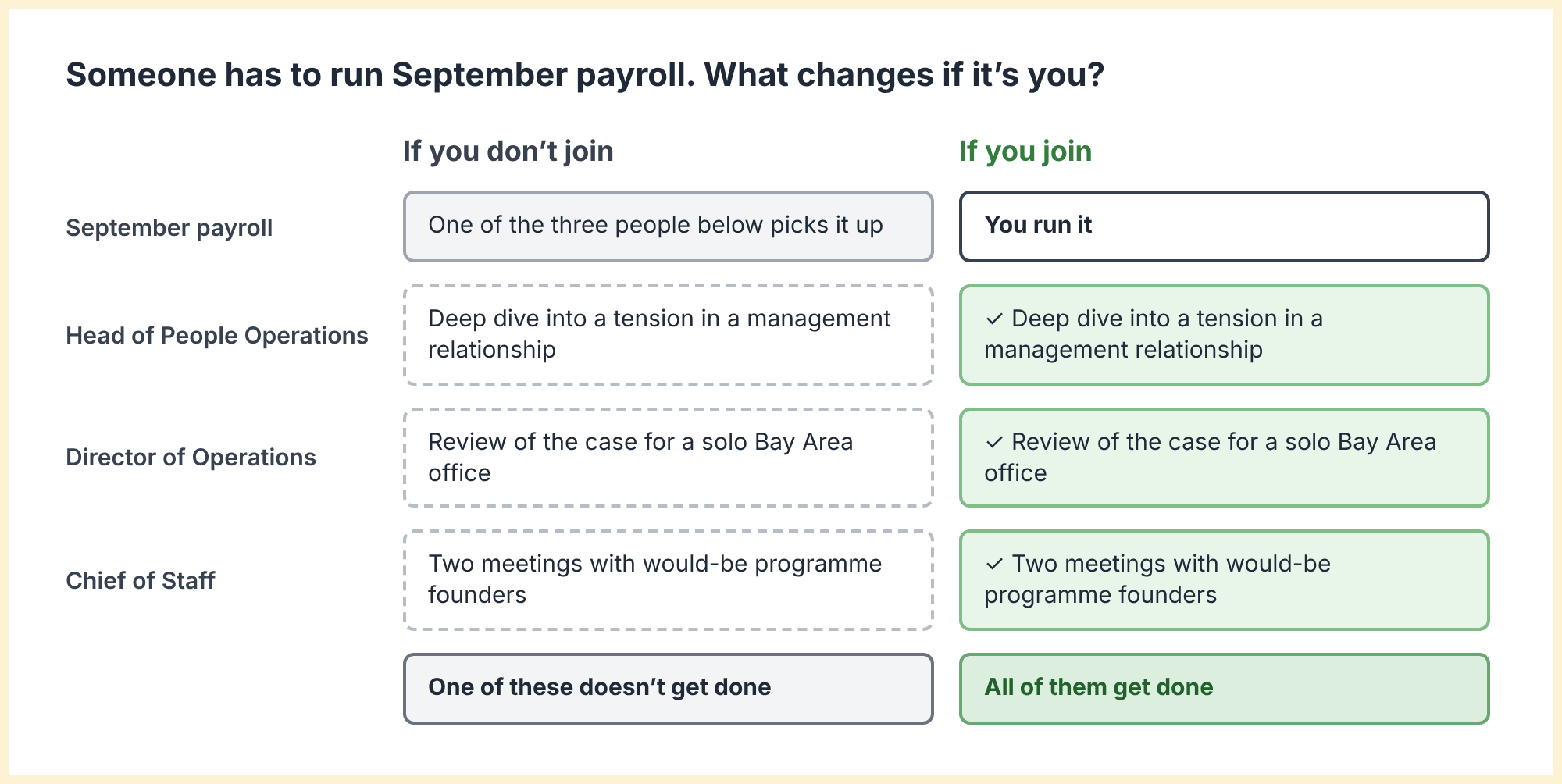
For example, you could join our People Operations team and run our September payroll. If you didn’t do it, then our Head of People Operations would run payroll. If she couldn’t do it then our Director of Operations would do it (or ask someone on her team to do it). And if she couldn’t do it then our Chief of Staff would do it (or ask someone else to do it).
It’s very unlikely that we don’t do our September payroll, so the first-order analysis shows that it’s entirely replaceable work.
Thinking through the second-order analysis (but skipping the third)[1], you’ll notice that our Head of People Operations might otherwise have done a deep dive into a tension in a management relationship and substantively improved how the two of them communicate, our Director of Operations might have reviewed the case for a solo Bay Area office and changed her mind on two aspects of it, and our Chief of Staff might otherwise have taken two meetings with speculative candidates to start new programmes.
Somewhere at the bottom of that chain is a piece of work which doesn’t get done: the deep dive, the office review, or the meetings with would-be programme founders.
It isn’t trivial to know what 80k will get done because someone is now running our payroll. But it is trivial to reason that something extra will be done. Similarly, if you accept an offer to join, it isn’t trivial for us to reason through what extra will be done because you came. But it is trivial to notice that, in expectation, we’ll be able to achieve more if we’re 56 people than if we’re 55.[2]
This means that if you are working at 80k, or in fact at any large organisation in the AI safety ecosystem[3], you’re really likely to be making a contribution which wouldn’t happen without you.
But I do still run into the concern that working at a given organisation or in the field generally is replaceable.
So I’ve decided to emphasise what I’m saying here by whining about what it feels like to me when someone tells me that they don’t want to work at 80k because we don’t need them.
What follows is a description of the bottom of this chain at 80k: the things we think are worth doing, and aren’t doing.
Rant
We’ve been working on helping talented people tackle the world’s most pressing problems for 15 years, but the pressing problems still seem erm… Pretty bloody talent constrained.
Like, we are really really trying, and maybe we look like we’ve got our shit together, but in comparison to what our mission and the world are demanding from us, we just suck at what we do. And so we need your help.
I think that most of our existing programmes are markedly below the scale and impact which they could be operating at. I think our research and movement building strategy is further from the bleeding edge than it used to be. I think that we’ve probably lost ground relative to other efforts aimed at getting people into the field in the past couple of years, such that if we repeated the cross-sectional surveys we’d look worse than we previously did.
We totally missed the boat on fellowships. These turned into the ~best scaling movement building innovation of the past 5 years, but we never set one up — even though they’ve been on our radar since I joined in 2017.
We launched our AI career advisor in August 2026, a mere (checks notes) 2.75 years after we first prototyped the idea.
Marketing took us years to get off the ground and we’re still below where we’d like to be by a factor of somewhere between 3 and 30.[4]
I could go on.
I will go on.
We’ve repeatedly failed to spin up a strong headhunting service for the ecosystem. We had three false starts under different leads, using various approaches, and we’ve only recently begun scaling the approach we’re currently using. We’re well below our potential with the current (more scalable) version of headhunting — by at least a factor of 4.
We have wanted a YouTube channel like AI in Context for years (everyone was nagging us about it); we only managed to launch one last summer. And now that we have one, we wish we were publishing way more on it, being more ambitious with it, and running more channels. Also, we’re still not doing well at shortform video (TikTok etc.) — but surely there’s gotta be a viable strategy here…
The number of people we’ve given one-on-one advice to has flatlined since 2022.
We gave away half a million in talent development grants, then lost the ability to make grants when we spun out of Effective Ventures. We haven’t prioritised rebuilding it, as it would take some work (and probably also because we suck).
We didn’t spin out of Effective Ventures as early as we should have, our recruiting team started in January 2026 (after one false start), and we don’t have a US entity because we don’t have the capacity to set one up.
/rant
Overall, I just think it’s bloody contingent that we ended up being this level of good.
I think we’ve averaged something like 30% growth[5] a year across 80k.
Said like that, it sounds lovely and smooth, perhaps even overdetermined.
But I don’t think it’s been overdetermined, and I don’t think much of it has been a ‘top down’ decision based on reasoning through when we expect programmes to hit diminishing returns.
Instead, what we’ve been able to do seems extremely contingent on particular staff who managed to make particular contributions, and on particular staff who we failed to hire who didn’t make contributions.
It’s really easy for me to imagine an adjacent version of history where our overall growth rate was more like 50%, or where we shrank. Indeed, in some years, some programmes have more than doubled, in other years programmes have shrunk.
And it seems very possible to me that the returns on resources invested into 80k have increased about as often as they’ve decreased. I think it’s quite possible that our video programme is more cost effective than the rest of 80k: such that 80k saw increasing returns when we added it. And I’m fairly confident that our headhunting team is going through a period of increasing returns.
To summarise: I claim that, properly considered, your work at a given large AI safety ecosystem org is ~not replaceable.
I’ve given a few arguments for that, and I’ve done a lot of whining. I hope that you found at least one of those convincing.
I think that it’s mostly fine to skip the third-order analysis, and just stop at the second.
In a stable sector of the economy like healthcare, the number of doctors is set by things like demand and training places. So if you become a doctor, then over the long run someone else probably doesn’t. That’s the third-order analysis, and it’s where replaceability comes back in.
You might want to review this 2014 piece on 80,000 Hours from the economist Rossa O’Keeffe-O’Donovan, on how to reason through how a given entrant affects aggregate supply into a sector over the long run.
But AI safety is not a stable sector of the economy and in the short long run, we’re all dead.
Instead, most of the organisations in AI safety are trying to absorb talent and funding at an extremely high rate, and the ecosystem isn’t in the kind of equilibrium which lends itself to O’Keeffe-O’Donovan’s reasoning above.
This assumes the hire goes well. Some hires cost more in management and coordination than they add, at least at first, and that includes some people we’re very glad we hired. But we only make an offer when we expect it to work out, so in expectation the 56th person adds something.
I admit that 3–30 is quite a wide range to be unsure over. Especially for something which we’ve spent over 500 hours analysing. But, as discussed, we suck.
By growth, I mean an output metric in quality adjusted careers affected. Like, impact as proxied by the a) number of careers we have affected by b) the amount we’ve affected those careers and c) how talented/motivated the people with those careers are. This is different to impact, but I didn’t want to say ‘increased our output’ because that just sounds like we’ve written more stuff or something. Incidentally, we’ve grown staff at roughly 25% per year.
Edit: The match seems to now be over - the funds were expended in around 35 minutes. But many of these charities are great and should be supported regardless!
***
On October 22nd starting at 10:00am Pacific Time, Every.org is matching donations to select animal welfare organizations at a 2:1 rate, up to $2,000 per donor per nonprofit (so if you give up to $2,000, they will contribute up to $4,000 and the nonprofit will get up to $6,000). The first donation a donor makes to each el...
Crossposted to Less Wrong
‘Like most of life’s dangers, the dangers of artificial intelligence are not easily identified from the armchair.’
J Dmitri Gallow
Epistemic status
I’m not an expert in this field, and herein I make some sweeping generalisations educated guesses about the overall...


It looks like the counterfactual is far from "the manager will have to do it", it's rather "the manager will have to do it for a little while we'll find someone else to do it a little later". Am I missing something obvious?
Hmm...
It’s interesting: on the one hand, your hypothetical could be the way it works out, and it doesn't sound that bad. But on the other hand, as I say in the post, I think a sensible way to understand the badness of failing to make the hire is that it’s the difference between a) a 55-person org which is growing and b) a 56-person org which is growing. In your framing, it sounds like the org is only trivially worse off. In my framing, it’s clear that b) is much better off!
I thought about it for a little while. Here are three reasons why I think the costs of failing to make the hire are much higher than your comment makes them sound.
1. Repeating the hiring round fairly soon and making an equivalently strong hire is unusually fortunate
Here’s what might happen instead:
The manager learns they can’t hire for the role they wanted, and scopes out a smaller one. They hand off the procedural parts of the function and keep the rest. What they wanted was for the function to grow into a strong one, with the attention of someone who can oversee it well and make sure it moves to meet the needs of an aggressively growing organisation. It doesn’t get that. And because the smaller role is filled, the pressure to fix it goes away, so the situation tends to continue indefinitely: the function is weaker than it should be, and the manager keeps spending time on it.
Someone else accepts the role. The candidate is, in expectation, weaker, and in these rounds the gap between the top candidate and the next is often surprisingly large (Rob Wiblin worked through this).
The manager just keeps it. No re-run, no re-scope. The function sits at manager-level attention and the manager’s cycle stays blocked. This happens a lot. I’ve had functions that I ended up running with a small fraction of my time, going badly, and that situation continued indefinitely, sometimes in and out of failed hiring rounds.
2. Blocking other functions being scaled
Here’s a cycle which managers in high-growth orgs often spend their attention on: (1) scope out a function (understand what to do and how to do it, see if you can systematise it without hiring, learn what someone overseeing it would look like and what kind of person could do it); (2) hire someone to oversee the function; (3) onboard and train them; (4) use the freed-up time to repeat 1–3 for the next function.
The manager in your hypothetical has failed to get past (2) for this function, so they’ll move on to this cycle for other functions. That's fine, but failing to make the hire means that they'll be slower, in two ways. First, they’ll be spending (say) 10 hours a week overseeing the function for as long as it has no owner. Second, at some point they’ll do a hiring push to find the person, and that push will take something like 70–200 hours. All of that is time they could have spent spinning up the next function. In a fast-growing org, there's always some sense of haste in trying to get these functions going: because as soon as you get someone overseeing it, they're able to make it work well, then grow it at a similar compound growth rate to what the org is (so that it can meet the needs of the org).
3. For whatever time there is no hire, the function is being run poorly by the manager and falling behind org needs
The function which the hiring manager failed to hire for was among the highest priority functions to get more attention to. That's why it was being hired for!
“The manager covers it for a little while” means it runs on (say) ten hours a week of the manager’s time until someone is hired into it. It will fall further behind what the fast-growing org needs for that whole time, and might become a real mess (and/or maybe take more of the hiring manager's attention).
It being increasingly poorly run creates increasing problems for the org, and as it gets more messy it'll take whoever is eventually moved onto it longer to get it on the right track again.
Thanks for the very in-depth reply. I find this a lot more convincing than the original post.
Just thought I'd highlight a few empirical questions on which the strength of your argument hinges. After a strong candidate declines an offer:
The exact distribution of expected probability for these outcomes seems to me to determine whether the counterfactual looks more like a temporary slowdown versus a significant reduction in organizational capacity.
Nice, I'm glad it was clearer than the the post, thanks for the prompt to write it out!
I agree that those seem like relevant empirical questions, and I could imagine them being useful for a candidate to discuss with a potential hiring org.
Though I notice that they fit most naturally with a frame for thinking about organisations which doesn’t feel natural to me. So if a candidate asked me to answer them, I would probably a) try to answer them, but also b) try to share the framing I find most natural.
If I had infinite time and the candidate had infinite patience, I might say something like: