Far-UVC is something people have
talked about for years in a "that would be great, if you could buy it"
sort of way. Coming soon, once someone actually makes a good
product. But the future is now, and it costs $500.
Many diseases spread through the air, which is inconvenient for us as
creatures that breathe air. You can go outside, where the air is too
dilute to spread things well, but it's cold out there, and sometimes
wet. You can run an air purifier, but cleaning lots of air without
lots of noise is still the world of DIY projects. Ideally you could just
shine some light, perhaps in the 222-nm
range, which would leave people alone but kill the viruses [1] and
bacteria. Yes, let's do that!
Last year if you asked "if far-UV is so great, why isn't it
everywhere?" one of your answers would be:
There are very few providers, and hardly any of them sell an
off-the-shelf product. You usually can't just buy a lamp to try it
out—you have to call the company, get a consultation, and often have
someone from the company come install the lamp. It's a lot of overhead
for an expensive product that most people have never heard of.
This has changed! You can buy an Aerolamp for $500,
shipped. Proudly displayed at Thanksgiving:
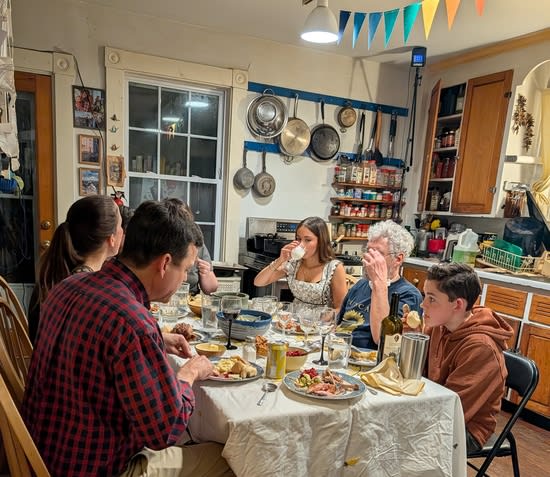
Here are four
silently cleaning a whole lot of air at a dance I help organize:
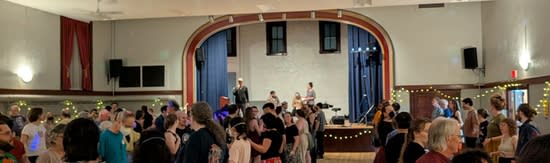
At $500 this is out of (my) Christmas gift range, but I think we're now
at the point where dances, churches, offices, rationalist group
houses, schools, etc. should consider them.
(I have no stake in Aerolamp and they're not paying me, I'm just very
excited about their product.)
[1] Ok, yes, I know viruses "can't be killed" because they're "not
alive", but far-UVC causes them to become unable to infect and
replicate which is close enough to "killed" for me.



Thanks for the post! On faruvc.org, you say:
The two lamps you recommend on that site are Aerolamp (500 USD for one lampp) and Nukit Torch (345 USD for 4 smaller lamps). Do you have any sense of:
The Nukit torches put together have about half the output of Aerolamp. I expect Nukits (and most other non-USHIO KrCl bulbs) to last about 1-2k hours while the USHIO bulb should last 10k-14k hours. All published at reports.osluv.org
There's no other salient differences. Multiple small lamps spread out the light more and are easier to set up portably, and might be safer in low-ceilinged (<8ft) spaces. If you plan to use the lamps intermittently (like at one-off events and appointments, a few times a year or a few hours at a time) then the torches may make more sense. EDIT: The old torches are discontinued now, V2s to come soon, and might have better output/lifetime characteristics. Exciting if so!
I estimate that an Aerolamp in a 250 sqft room will deliver about 1000 CFM CADR with respect to flu/covid, while a high-quality air purifier will deliver ~250 quietly or ~400 loudly. So an Aerolamp is roughly twice as cost effective on a $/CFM basis (in quiet mode) or on par (in loud mode).
That being said--and I say this as an Aerolamp founder--absolutely, absolutely get an air purifier first, and a far-UVC lamp as an additional supplement. I like the Levoit 200S personally. For one thing all estimates of far-UVC efficacy are based on the assumption of a well-mixed room--an air purifier will provide that, eliminate any air chemistry concerns from the UVC, and will provide other health benefits as well.
I have downloaded and looked at the tests from Aerolamp and Nukit Torch.
Aerolamp does show a consistent output and seems to be a well thought out design for its use: larger rooms, giving overhead exposure, not close to people so mainly ceiling mounted.
The Nukit Torch was modified for continuous use, while it is not designed for that. I am not sure that leads to completely objective test results.
My question is: What is the basis for your assessment that the expected lifetime of your product is 10 to 14 times longer?
Moreover, with all the electronic components that are nowadays incorporated in modern lighting equipment it is not only the "bulb" that can fail. Many "20.000 to 50.000 hours"-LED products from reputable manufacturers have shown to fail after only a few 1000 hours or less. And often the LED's themselves are OK but the power supply or ballast failed somewhere.
So I am wary of these claims without knowing the testing method.
This paper shows up to 10k hours for the Ushio B1 bulb: https://www.jstage.jst.go.jp/article/lsj/50/7/50_394/_pdf this poster extends the data and shows an L70 of around ~13.5k hours: https://cdn.shopify.com/s/files/1/0694/8637/9189/files/240617_Yagyu_ICFUST_Poster2V2.pptx?v=1751931924 I've also seen a fair amount of testing from OSLUV that makes me personally believe these publications--Ushio sank 10 years of R&D into their emitter, and it's really good. It's also expensive, limited in some ways, and only available from one manufacturer, but it definitely seems to have great stable output and impressive lifespan. But fair point about the electronics--the lifetime estimate is based on the bulb lifetime. Aerolamp hasn't even existed for 10,000 hours. This is why we have a no-questions-asked return/replace policy--if your lamp fails we'll send you a new one.
Thank you for the links, very helpful. Also interesting to see that the lamp consists of 4 separate bulbs. I suppose that will help with the longevity as every bulb makes a 1/4 of the output, where as other designs might to lead to "overdrive", improving temporary maximum output but at a cost of earlier degradation.
When do you think the Aerolamp will be available outside the USA?
Yeah I think that is part of it! Excimer lamps are really cool. They do all sorts of other stuff too, monkeying with the glass composition, gas mix, voltage waveform, etc. It's pretty optimized--I'm hopeful that other bulb manufacturers will copy them(/have the market incentive to bother copying them), a lot of these optimizations are totally public information that's been published in journals since the 90s.
I'm hopeful that we can start a slow rollout of international shipping in the next few days/weeks, we're setting things up with DHL right now
I think the biggest difference between the Aerolamp and Nukit is the bulb: the Aerolamp uses a Care222 bulb which I expect to last much longer.
It depends on how important it is to you to minimize noise, and how big the room is (since filter-based purifiers clean a given amount of air per minute while UVC depends on the size of the space). https://illuminate.osluv.org/ is not super user-friendly, but will calculate the CADR-equivalent for you of a given UVC setup.