Comments
Our ecosystem is bottlenecked by people who have deep context and relevant skills.
This means that the time of people with context and relevant skills is very valuable: usually more valuable than their salary.
When taking this effect into account, it turns out that:
- The net cost to the ecosystem of an organisation made up of high-context and relevant-skill people is much larger than the financial costs of that organisation.
- The net cost to the ecosystem of an organisation which trains many staff might be much lower than the financial costs of that organisation.
- The return curves of these organisations can get pretty whacky, in a way which will sometimes affect strategic decisions.
- Giving your staff a good experience in the ecosystem and enabling them to increase their context / skills is important: it’s likely a meaningful fraction of your organisation’s impact.
Here are some hypothetical figures to illustrate what these effects might look like.
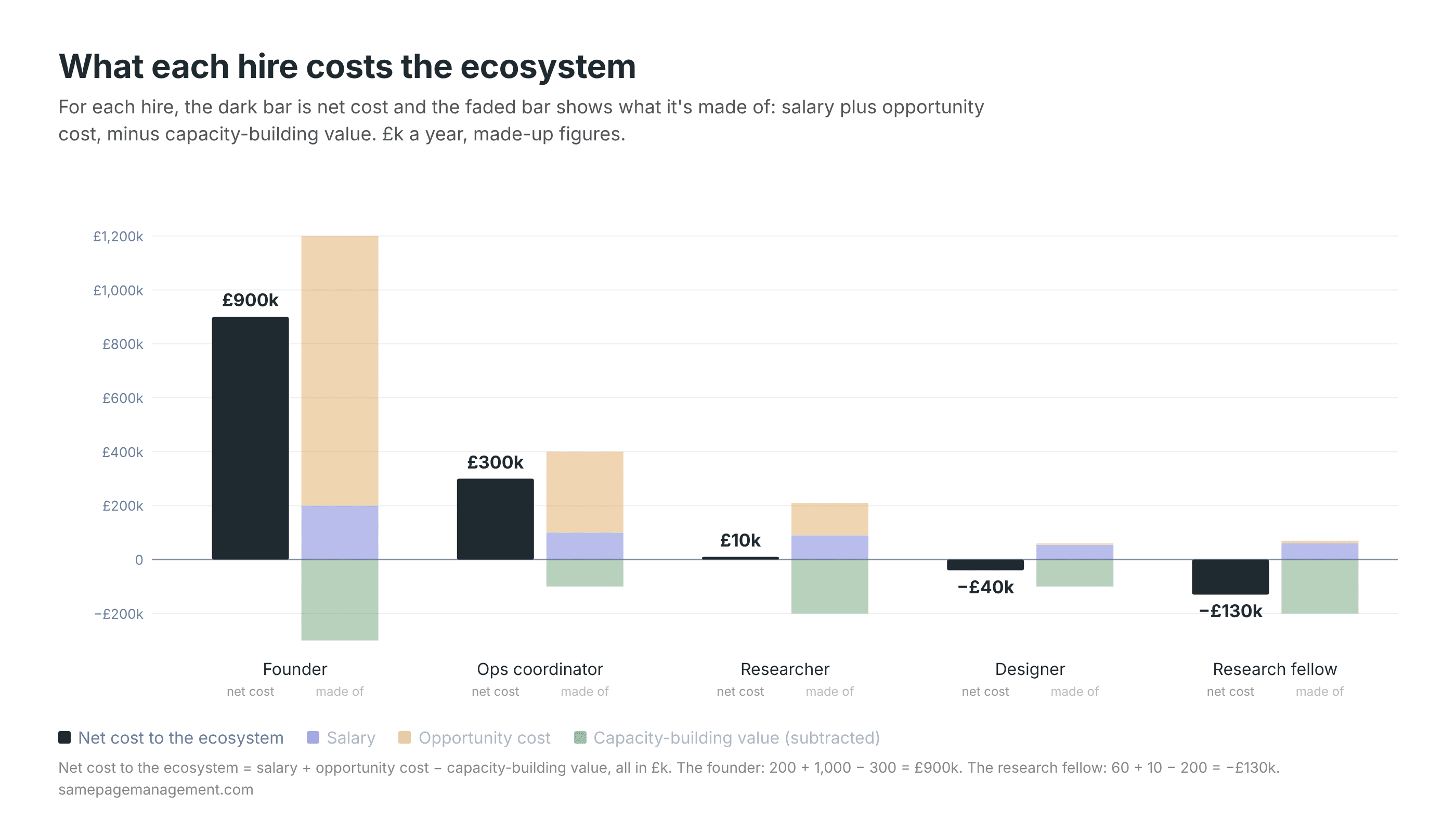
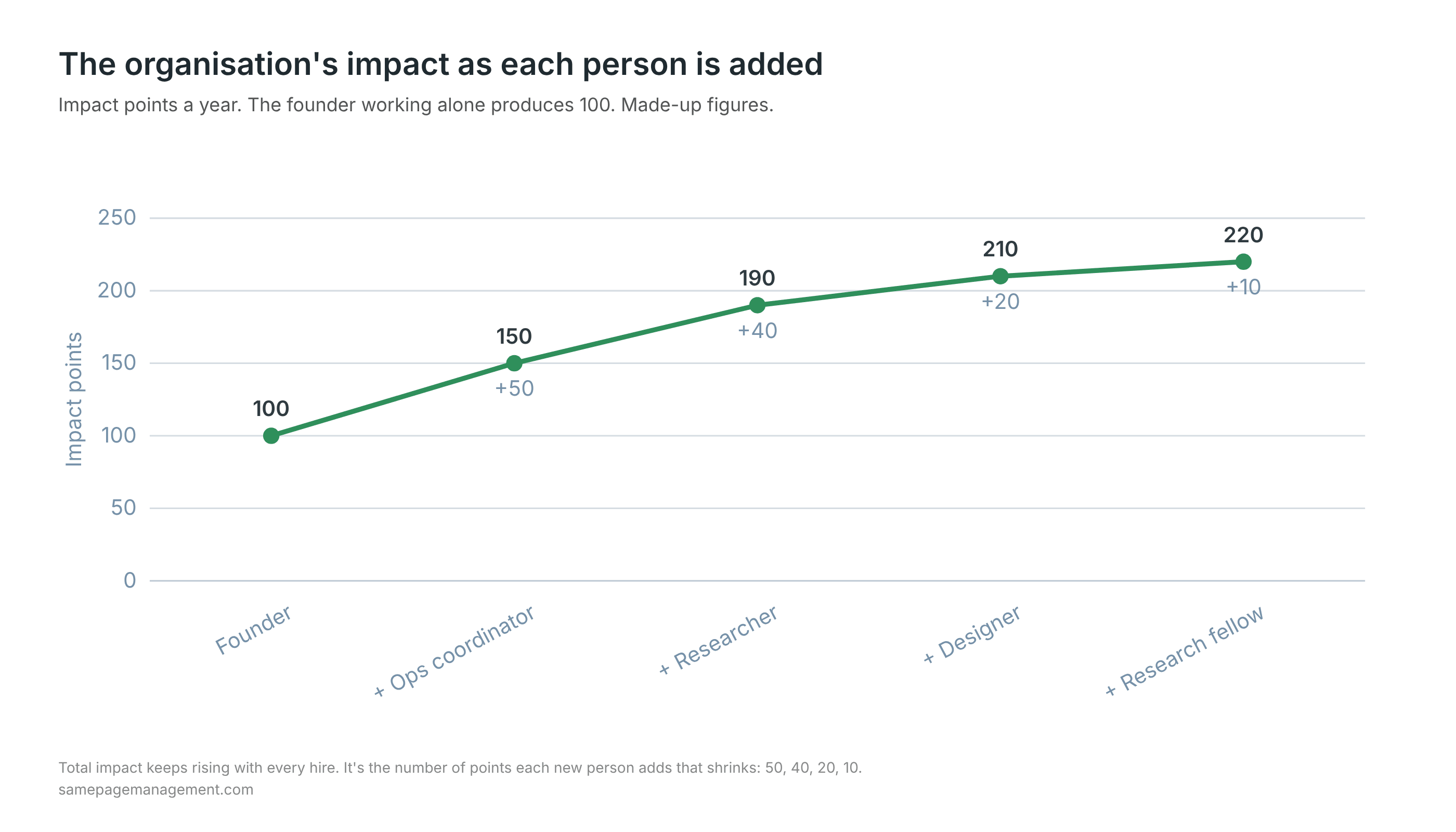
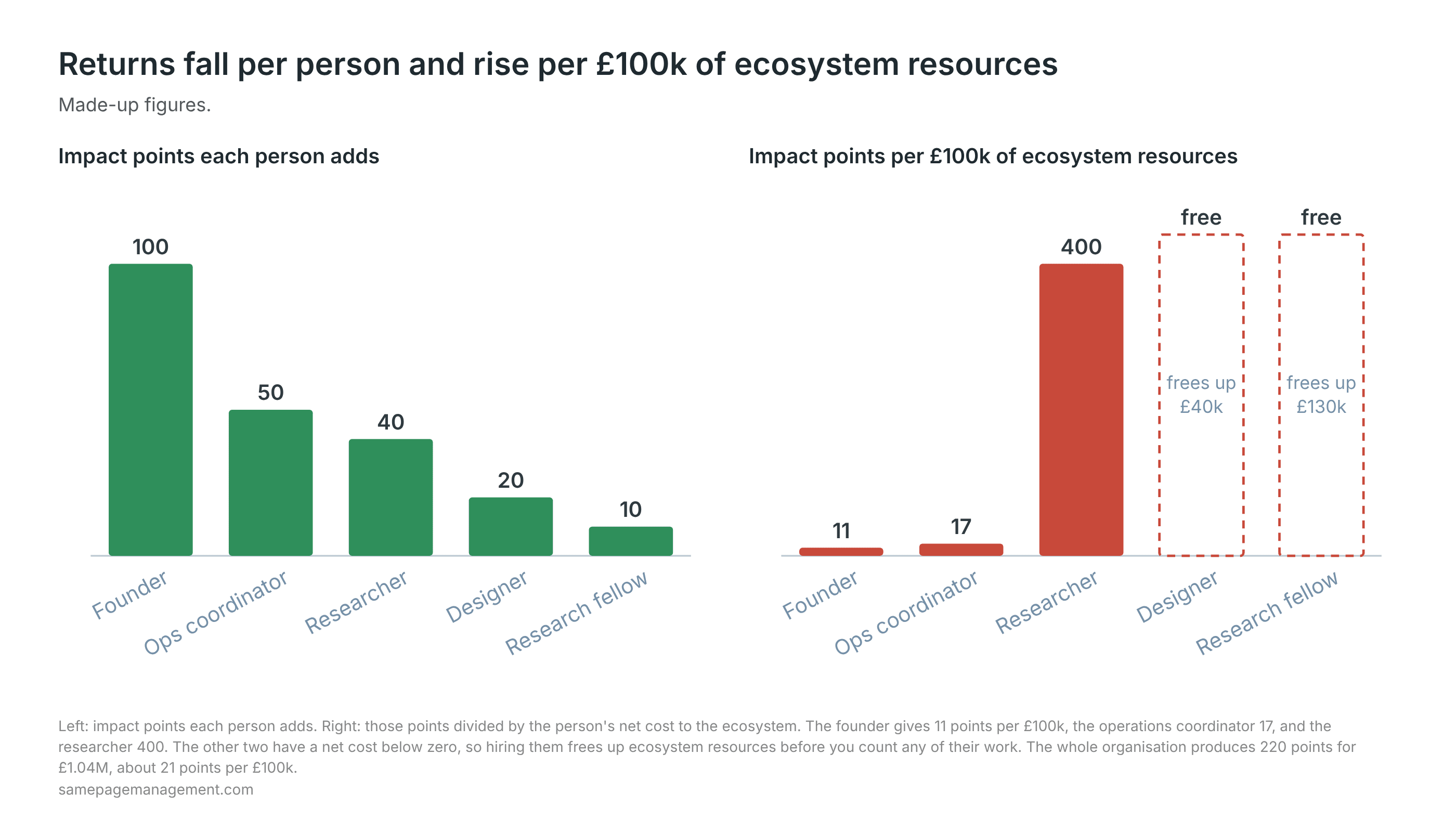
If you’d like, you can play around with these figures here.
The rest of the post is focused on better explaining the above and belabouring implications. I expect that if the above is intuitive to you and you’ve already absorbed the strategic implications, then you should skip reading further.
What a hire costs
Let’s consider the net costs to the ecosystem of an organisation employing a staff member:
- Salary
- Opportunity cost
- Best quantified from the point of view of aligned funding: roughly, how much an aligned funder would be willing to pay for the impact they expect this person could produce if they weren’t working at their current org.
- Capacity-building value
- Working at the organisation affects the expected value of the rest of that staff member’s career: they gain skills and context, and based on their experience there, the job increases/decreases their inclination to remain in the ecosystem.[1]
- They’re also an easier hiring decision for the next organisation: they know that they’re a good fit for the work and they’ve learned how to do it, and their first employer in the ecosystem is able to vouch for these facts.[2]
So the net cost of a hire to the ecosystem is their salary, plus their opportunity cost, minus the capacity-building value added by them being employed by you.
A worked example
Let’s imagine you’re a generic organisation in our ecosystem with five staff. The figures are made up (they’re the ones in ‘What each hire costs the ecosystem’ above; you can play around with them here).
The founder’s opportunity cost to the ecosystem is very large, because this person would otherwise be founding another organisation, or running some other critical project. In fact, most of their cost is from opportunity cost, rather than their salary.
There’s a large capacity-building benefit, as their career capital (skills, connections, credentials, and financial runway) increases through their work.
The operations coordinator is the same.
For the two researchers and the graphic designer, the most important term is capacity building: because there was a chance they wouldn’t work in the ecosystem if they didn’t take your role. Working for you makes them more likely to take a role in the ecosystem after they leave your workplace.
For the researcher who came to the field mid-career, it brings the net cost down to about £10k. For the research fellow and the graphic designer, their capacity-building value is larger than their salary plus their opportunity cost, so their net cost to the ecosystem is below zero.
Why the return curves get whacky
If you include the opportunity costs of people who have been in the ecosystem for a long time, and the benefits of training people new to the ecosystem, the economics can change a lot!
Properly considered, the lean organisation staffed by a few old-timers turns out to be very expensive in ecosystem resources, while a very financially expensive organisation staffed by loads of people new to the ecosystem turns out to be ‘cheap’. They might even pay for their financial cost in capacity-building value.
To compare returns, I’ve said that the founder working alone would produce 100 impact points a year. Each hire then adds some points as they join: 50 for the operations coordinator, 40 for the researcher, 20 for the graphic designer, and 10 for the research fellow. Per person, the returns go down. But per £100k of ecosystem resources, they go up. The founder produces 11 impact points per £100k they cost the ecosystem, the operations coordinator 17, and the researcher 400. The other two cost the ecosystem less than nothing, so they’re free before you count any of their work.
Here are those return-on-investment graphs again. Look at all this silliness:
Put your own numbers in
I’m somewhat confident that the effects described above hold.
The specific figures I used are totally made up though: if you’d like to get a sense of how these effects should change your strategy, you can play with a model here — brentonmayer.com/talent-leverage.
- ^
You likely should be making people a) higher in context and relevant skills and b) more likely to work in the ecosystem. So be a great place to work. Don’t burn people out or give people shitty employment experiences. If working in the ecosystem is miserable, people will leave it and we’ll lose capacity. Also, develop your people a lot. One thing I like from 80k’s annual feedback round is a question that goes something like: “What advice could you give this person that would most increase their long-term career impact?” It’s a good question to be asking about everyone who works for you!
(Separately: there are also organisational and operational costs of having the extra person, which I’ll skip enumerating or accounting for.)
- ^
In the terms of my post on transaction costs, all three costs of hiring them have come down. Discovery: the ecosystem knows they exist. Trust: their first employer can vouch for them. Transfer: they already know how the work is done.

Someone messaged me flagging that this post (and the default parameter values I chose) suggests an odd implication around talent development.
Given that currently some orgs are highly talent dense, either we need to:
They thought that my post here suggests #1. Instead, I think we should continue to accept #2, because I think some orgs do indeed have >10x more impact than others, even when they have similar staffing scale.
That happens through effects like, specific orgs having particular resources/connections, particular orgs working on projects which are so pressing that a marginal increase in speed is extremely valuable, etc etc.