Note: This post was crossposted from the Coefficient Giving Farm Animal Welfare Research Newsletter by the Forum team, with the author's permission. The author may not see or respond to comments on this post.
Subtitle: On vegan advocacy, effective altruism, and FIFA
I turn 40 today. Here are some hot takes.
On factory farming
1. Our biggest challenge is salience. If factory farming led the evening news, it wouldn’t last lo...
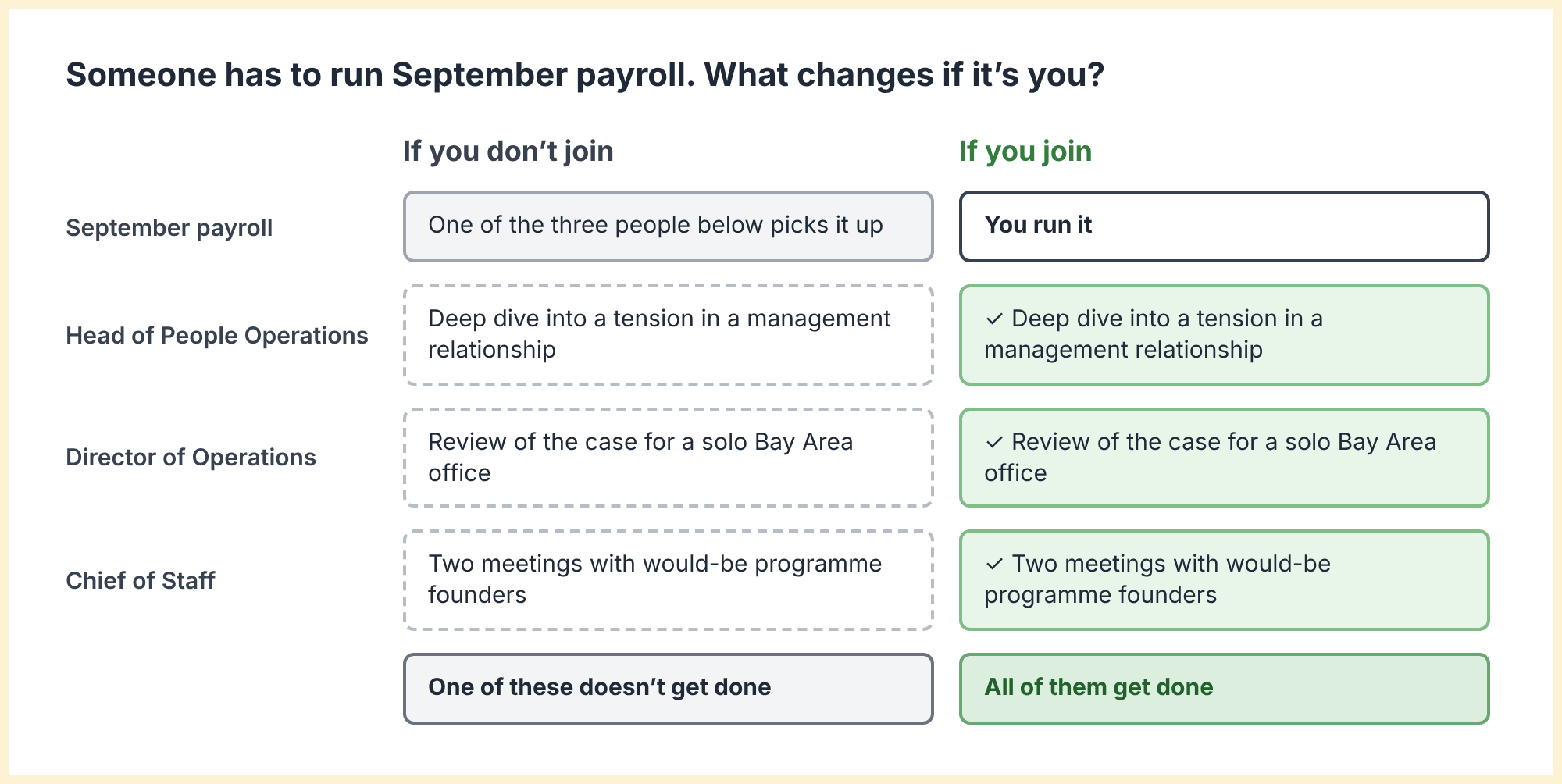
When speaking to candidates who are considering working with us at 80,000 Hours, I often hear people worry about replaceability.
The familiar version of the worry is about whether the organisation will hire someone else in your place. If it will, then the difference you make by taking the job is only the difference between you and them.
There are a couple of well-known answers to that. The person hired in your place probably cares about the world too, and would go on to do somethi...
> TL;DR: No, but you might, if you leave it too late: We’re hiring for seven roles, and the people who join now will shape what a much bigger AIM becomes. The first step is cheap -- an expression of interest form.
My worry
I rejoined...

Drew -- thanks very much for sharing this list. I agree that anybody trying to get stuff done within or through an organization or subculture can benefit from reading good business books.
I would offer the caveat that a lot of business books have an odd mix of strengths and weaknesses, which seem endemic to the genre. (I'm generalizing here, as an interested observer who read a couple of hundred books on management, marketing, and advertising when I was writing my stuff on the psychology of runaway consumerism and economic signaling.)
On the upside, good business books tend to be short, clearly written, engaging, motivating, and unpretentious -- they're intended to be read on airplanes by busy, ambitious middle managers.
On the downside, many business books offer strongly worded advice based on no empirical data, or second-hand outdated psychology studies, or cherrypicked pop statistics about particular products, ads, or markets. (You would not believe how many billion-dollar ad campaigns are based on obsolete psychology theories and flashy findings that have failed to replicate.) So, these books are often worth reading, but the empirical claims need to be taken with some degree of skepticism!
As a follow-up post, it might be helpful for you to focus on a couple of your key categories and add a couple of sentences for each book about your most memorable/useful/actionable takeaways.
Echoing this, I've also found that many business books are simply variations of "here is what worked for me in this specific situation, which I am now proselytizing as a general rule." I do wish that there were more business books that were explanations of business research, or popularizing of academic papers.
For organizational psychology I have found the works of Adam Grant to be quite good at explaining the research