Note: This post was crossposted from the Coefficient Giving Farm Animal Welfare Research Newsletter by the Forum team, with the author's permission. The author may not see or respond to comments on this post.
Subtitle: On vegan advocacy, effective altruism, and FIFA
I turn 40 today. Here are some hot takes.
On factory farming
1. Our biggest challenge is salience. If factory farming led the evening news, it wouldn’t last lo...
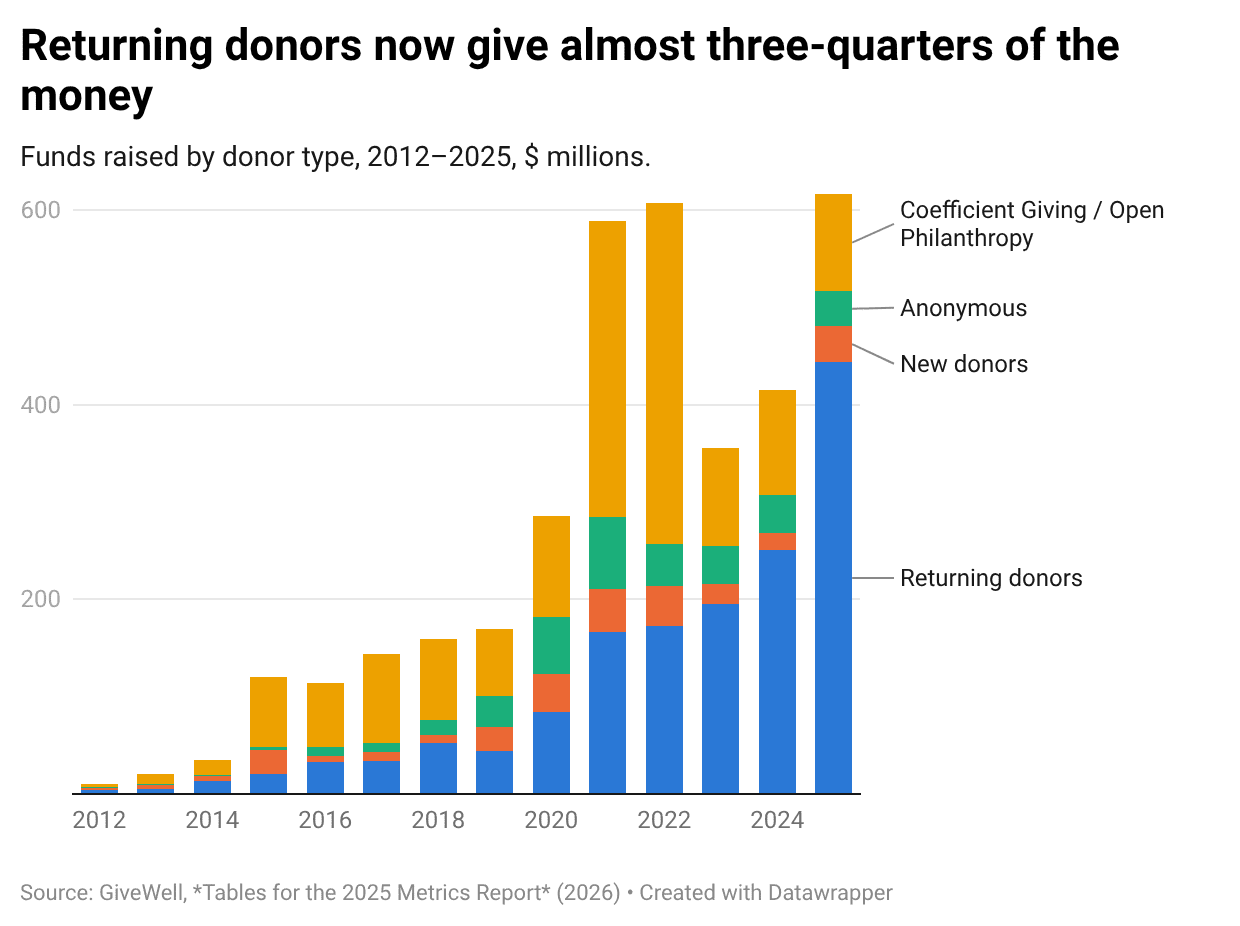
Previously: GiveWell raised less than its 10th percentile forecast in 2023 · GiveWell fundraising up 17% in 2024
GiveWell has published its...
Summary
Over the course of a year, the Fieldshaper program develops you into a field-leading grantmaker. You’ll steward $1,000,000 in grant capital, receive a $125,000 annual stipend, and deploy that capital within a sub-field of one of three key areas (farmed animals, global health, or philanthropic infrastructure); building the track record to become a grantmaker who can shape a field.
Role Details
* Title: Grantmak...


I'm a bit late to the party here, but just listened to the episode. Really enjoyed it and found it thought provoking, so thanks to Phil Trammel and the 80k podcast.
I had a couple of questions, so here's hoping Phil's still monitoring this post! Or, if not, that someone else is happy to answer these questions.
Anyway, just wanted to share the thoughts I'd had in case anyone has good answers or is interested in discussing.
Thanks again for the podcast.
Cheers
Glad you liked it, and thanks for the good questions!
#1: I should definitely have spent more time on this / been more careful explaining it. Yes, x-risks should “feed straight into interest rates”, in the sense that a +1% chance of an x-risk per year should mean a 1% higher interest rate. So if you’re going to be
then you should be roughly compensated for the risk. That is, under those circumstances, if investing seemed preferable to spending in the absence of the heightened risk, it should still seem that way given the heightened risk. This does all hold despite the fact that the heightened risk would give humanity such a short life expectancy.
But I totally grant that these assumptions may not hold, and that if they don’t, the heightened risk can be a reason to spend more! I just wanted to point out that there is this force pushing the other way that turns out to render the question at least ambiguous.
#2: No, there’s no reductio here. Once you get big enough, i.e. are no longer a marginal contributor to the public goods you’re looking to fund, the diminishing returns to spending make it less worthwhile to grow even bigger. (E.g., in the human consumption case, you’ll eventually be rich enough that spending the first half of your fund would make people richer to the point that spending the second half would do substantially less for them.) Once the gains from further investing fallen to the point that they just balance the (extinction / expropriation / etc) risks, you should start spending, and continue to split between spending and investment so as to stay permanently on the path where you’re indifferent between the two.
If you're looking to fund some narrow thing only one other person's interested in funding, and you're perfectly patient but the other person is about as impatient as people tend to be, and if you start out with funds the same size, I think you'll be big enough that it's worth starting to spend after about fifty years. If you're looking to spend on increasing human consumption in general, you'll have to hold out till you're a big fraction of global wealth--maybe on the order of a thousand years. (Note that this means that you'd probably never make it, even though this is still the expected-welfare-maximizing policy.)
#3: Yes. If ethics turns out to contain pure time preference after all, or we have sufficiently weak duties to future generations for some other reason, then patient philanthropy is a bad idea. :(
Thanks Phil - appreciate the response! On #1, I think I get it though it's a bit counterintuitive. I take it that the proposition is that permanent (or at least long-term) reduction in x-risk has a sort of 'compounding' impact on expected value, since it reduces risk each year, and therefore would compete with patient investing, but short-term reductions in risk don't have that same 'compounding' benefit and therefore don't compete in the same way with the interest rate (which is assumed to be increase with and therefore be higher than the x-risk rate). And #2 and #3, I think I follow too.
Some interesting ideas to think about... Looking forward to seeing your further work in this area.
Cheers