TL;DR
* GOAL 3 is a social enterprise that created IMPALA, a patient monitoring and digital platform system for low-resource settings. There is also a GOAL 3 foundation that raises funds to ensure underserved communities will be reached.
* A recently completed report from Rethink Priorities calculated IMPALA to have a cost per DALY averted of $7–17 in paediatr...
This month effective altruism has gotten lots of attention, including a cover story in The Economist. It feels pretty surreal to be on the receiving end of it. But I feel grateful these ideas have caught on, and even more grateful for the drive, earnestness, and compassion of so many people who took strange but well-argued ideas seriously and then actually acted on them....
Note: This post was crossposted from the Coefficient Giving Farm Animal Welfare Research Newsletter by the Forum team, with the author's permission. The author may not see or respond to comments on this post.
Subtitle: On vegan advocacy, effective altruism, and FIFA
I turn 40 today. Here are some hot takes.
On factory farming
1. Our biggest challenge is salience. If factory farming led the evening news, it wouldn’t last lo...



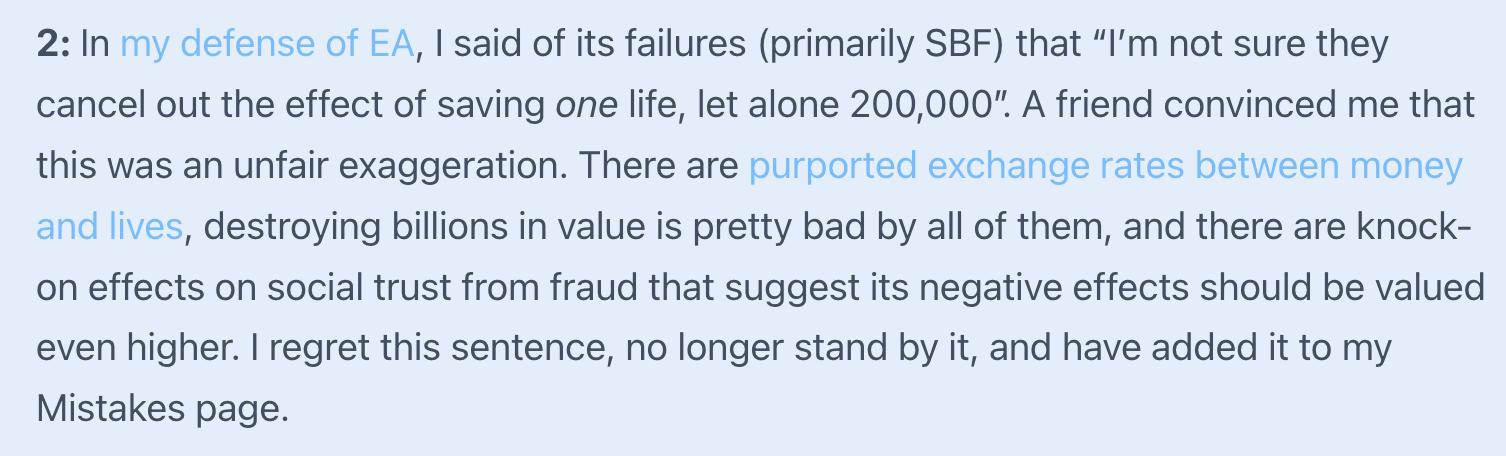
EDIT: Scott has admitted a mistake, which addresses some of my criticism:
(this comment has overlapping points with titotal's)
I've seen a lot of people strongly praising this article on Twitter and in the comments here but I find some of the arguments weak. Insofar as the goal of the post is to say that EA has done some really good things, I think the post is right. But I don't think it convincingly argues that EA has been net positive for the world.[1]
First: based on surveys, it seems likely that most (not all!) highly-engaged/leader EAs believe GCRs/longtermist causes are the most important, with a plurality thinking AI x-risk / x-risk more general are the more important.[2] I will analyze the post from a ~GCR/longtermist-oriented worldview that thinks AI is the most important cause area during the rest of this comment; again I don't mean to suggest that everyone has it, but if something like it is held by the plurality of highly-engaged/leader EAs it seems highly relevant for the post to be convincing from that perspective.
My overall gripe is exemplified by this paragraph (emphasis mine):
I'm concerned about the bolded part; I'm including the caveat for context. I don't want to imply that saving 200,000 lives isn't a really big deal, but I will discuss from the perspective of "cold hard math" .
Now I'll discuss the AI section in particular. There is little attempt to compare the effect sizes of "accomplishments" (with each other and also with potential negatives, with just a brief allusion to EAs accelerating AGI) or argue that they are net positive. The effect sizes seem quite hard to rank to me, but I'll focus on some ones that seem important but potentially net negative (not claiming that they definitely are!), in order of their listing:
My take is that EA has more likely than not been positive, but I don't think it's that clear and either way, I don't think this post makes a solid argument for it.
As of 2019, EA Leaders thought that over 2x (54% vs. 24%) more resources should go to long-term causes than short-term with AI getting the most (31% of resources), and the most highly-engaged EAs felt somewhat similarly. I'd guess that the AI figure has increased substantially given rapid progress since 2019/2020 (2020 was the year GPT-3 was released!). We have a 2023 survey of only CEA staff in which 23/30 people believe AI x-risk should be a top priority (though only 13/30 say "biggest issue facing humanity right now", vs. 6 for animal welfare and 7 for GHW). CEA staff could be selected for thinking AI is less important than those directly working on it, but would think it's more important than those at explicitly non-longtermist orgs.
If Scott had used language like this, my guess is that the people he was trying to convince would have completely bounced off of his post.
I interpreted him to be saying something like "look Ezra Klein et al., even if we start with your assumptions and reasoning style, we still end up with the conclusion that EA is good."
And it seems fine to me to argue from the basis of someone else's premises, even if you don't think those premises are accurate yourself.
I do think it would have been clearer if he had included a caveat like "if you think that small changes in the chance of existential risk outweigh ~everything else then this post isn't for you, read something else instead" but oh well.
I mostly agree with this, I wasn't suggesting he included that specific type of language, just that the arguments in the post don't go through from the perspective of most leader/highly-engaged EAs. Scott has discussed similar topics on ACT here but I agree the target audience was likely different.
I do think part of his target audience was probably EAs who he thinks are too critical of themselves, as I think he's written before, but it's likely a small-ish fraction of his readers.
Agree with that. I also think if this is the intention the title should maybe be different, instead of being called "In continued defense of effective altruism" it could be called something else like "In defense of effective altruism from X perspective". The title seems to me to imply that effective altruism has been positive on its own terms.
Furthermore, people who identify as ~longtermists seemed to be sharing it widely on Twitter without any type of caveat you mentioned.
I feel like there's a spectrum of cases here. Let's say I as a member of movement X in which most people aren't libertarians write a post "libertarian case for X", where I argue that X is good from a libertarian perspective.
I think pieces or informal arguments close to both (1) and (2) are common in the discourse, but I generally feel uncomfortable with ones closer to (2). Scott's piece is somewhere in the middle and perhaps even closer to (1) than (2) but I think it's too far toward (2) for my taste given that one of the most important claims in the piece that makes his whole argument go through may be disendorsed by the majority of the most influential people in EA.