I just updated it (same link) to include a much larger set of papers. The 'other' category now includes papers we may not yet have prioritized, may have deprioritized somewhat (but still found interesting), or may have set aside for other reasons (e.g., slightly outside our scope, not timely for evaluation as part of our model, etc.)
If you see research in the database you would particularly recommend that we focus on, or you want to briefly share some notes about the research, please fill out the relevant fields in our ‘suggest research’ form, flagging this with “[External suggestion]” in the ‘label’ field.
Unjournal: "Research with potential for impact" database
I don't think I posted this here yet and wanted to make sure people are aware of it. Please let me know what you think, how you might use it, how we can make it more useful, etc.
26 Sep 2024 – added 'filter bars'
Why are we sharing our database?
The Unjournal commissions and promotes the public evaluation and rating of research with potential for impact. We mainly cover applied, quantitative social science (see ‘what do we cover’).
Finally, we publish a package of evaluations and ratings on our PubPub page (and in the bibliometric ecosystem)
Because we’re committed to transparency and providing public goods, we’re sharing a live database of “research in our pipeline” below. This may be useful to:
Anyone interested in engaging with The Unjournal (e.g., authors looking to submit their work, researchers and PhD students interested joining our evaluator pool) who wants to get a better sense of our focus
Researchers, students, and professionals exploring research topics, approaches, and paths (e.g., Effective Thesis students), focused on having a measurable impact
Organizations, funders, and policymakers interested in reading and using recent research
Who may want to suggest ‘pivotal questions’ and research relevant to these
(There are some limitations on what columns and rows are shared -- see the link. Remember you need to click to the second page to see the actual database.)
Crossposted to Less Wrong
‘Like most of life’s dangers, the dangers of artificial intelligence are not easily identified from the armchair.’
J Dmitri Gallow
Epistemic status
I’m not an expert in this field, and herein I make some sweeping generalisations educated guesses about the overall...
TL;DR: EA has traditionally deprioritized climate change as a cause area. But a new report from Rethink Priorities, an EA research institute, suggests that specific Earth systems risks driven by climate change could have mortality impacts comparable to major global health burdens, on top of the known damages of climate change.
The report finds that research and governance work on ‘Earth Systems Stabilization’ to establish whether safe options to address th...
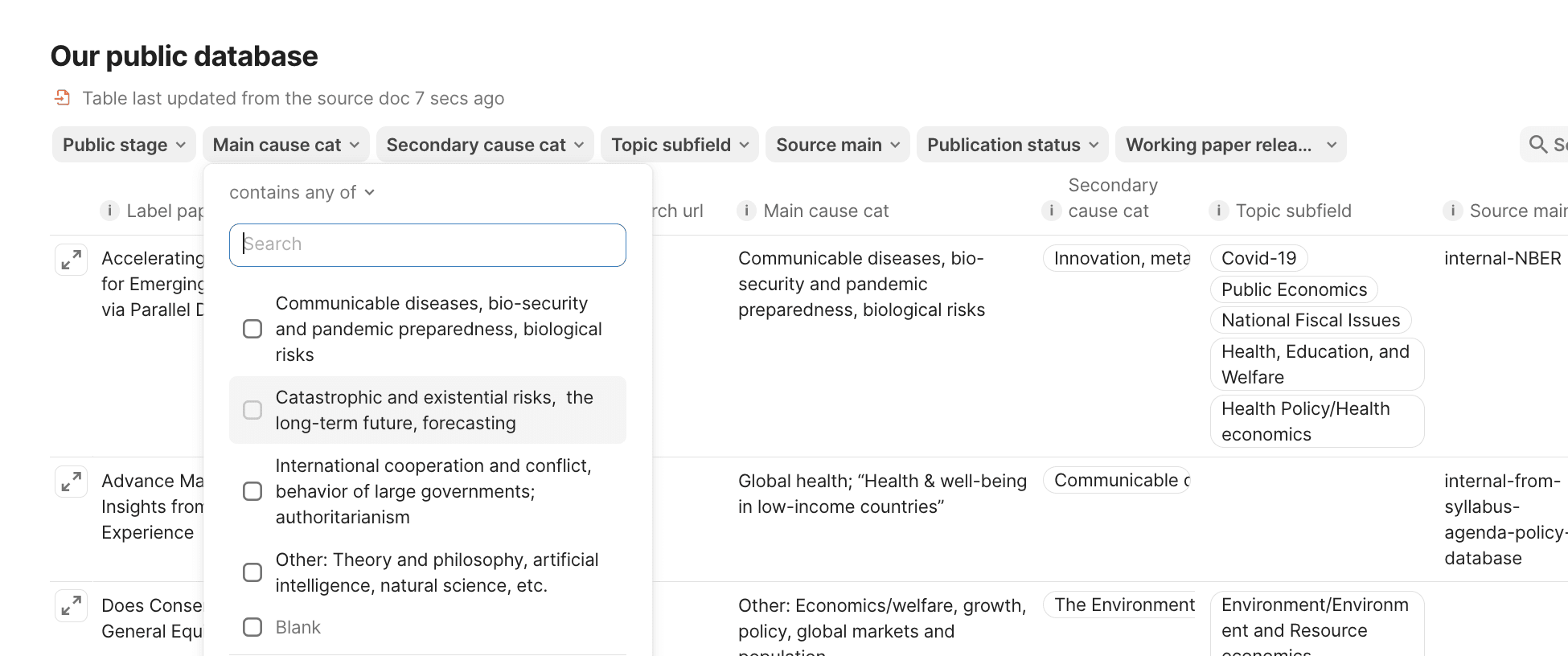



I just updated it (same link) to include a much larger set of papers. The 'other' category now includes papers we may not yet have prioritized, may have deprioritized somewhat (but still found interesting), or may have set aside for other reasons (e.g., slightly outside our scope, not timely for evaluation as part of our model, etc.)
Now grouped by main outcome/cause/field cluster.