Comments
Animal Welfare Fund: 2026 Breakthroughs for animals, and what we want to see in 2027

59
- The EA Animal Welfare Fund saw several breakthroughs for animals in 2026 and for our fund itself. We set out to deploy $20M and we passed it, making more than 80 grants that align with our strategy, that cleared our bar for expected impact for dollar.
- There are three moments this year that cleared our bar as a breakthrough: Asia, Latin America, and Africa now lead the world in new cage-free commitments; the European Commission committed to propose ending cages for laying hens; and Kenya became the first African country to adopt a national fish welfare standard.
- Looking ahead to 2027, we have identified 100 opportunities we would like to fund, all directed toward more breakthrough moments we want to see for animals.
Three breakthroughs from 2026
We try not to use the word breakthrough lightly. For us, a breakthrough is a change that is likely to hold, opens up the door to major impact for animals, and gives advocates a playbook they can reuse and scale. We saw many incredible wins this year, thanks to our grantees and the wider movement. There are too many to list, so we picked three moments to highlight:
Breakthrough 1: Asia, Latin America, and Africa now lead on new cage-free commitments
For years, cage-free progress happened mostly in the US and Europe, even though about 84% of the world's hens are farmed in Asia, Latin America, and Africa. That is changing. In 2026, 87% of all new cage-free pledges were secured in these three regions. A good measure of credit goes to the 80+ member groups of the Open Wing Alliance, who now campaign across 72 countries. This year we were able to support more of them in more places than ever before.
2025 was the largest deadline year so far for companies making pledges, with more than 1,000 pledges coming due worldwide, and another 200+ in 2026. There are good results in Latin America. The region has more than 300 pledges reported as fully implemented, more than any region except Europe and well ahead of North America. While the number of pledges doesn’t necessarily indicate a number of animals helped, we nevertheless see this as an exciting sign of gaining more momentum.
Efforts in Brazil to turn pledges into transitions
Brazil is the world's fifth-largest egg producer, and 2025 was the deadline for many of the nearly 190 companies there with cage-free pledges. Our grantee Fórum Nacional de Proteção e Defesa Animal (Fórum Animal), which we have funded since 2021, combined public pressure with transition support. They built Brazil's most comprehensive public record of which companies report cage-free progress, and with others launched a "Stop Humane Washing" campaign against companies that market welfare claims without changing practice.
Fórum Animal reported 90 of about 200 committed companies had reported progress, up from 69 a year earlier. They also shared that the companies it worked with now report progress covering about 9.9 million hens a year. They are part of the coalition holding these companies to their pledges, which together could help about 34.2 million hens a year.
Brazil is not alone. AWF grantees in several countries across Africa, Asia, and Latin America are working with governments on national cage-free standards and labeling laws, work that could reach up to 27 million hens a year.
Breakthrough 2: the EU committed to propose to end cages
In July, the European Commission's Livestock Strategy committed to propose phasing out cages for laying hens by the end of 2026, alongside an end to the routine killing of day-old male chicks. More than 140 million hens in the EU are still caged, and the regulation would cover all 27 member states.
This has been a long time coming. The Commission first promised to end cages in 2021, after a European Citizens' Initiative gathered 1.4 million signatures, and it delayed the proposal repeatedly. Many groups kept up the pressure. We have funded national campaigns that we think helped build the case for the July proposal.
While this may be a breakthrough for hens and male chicks in Europe, it was also a breakthrough in how our fund works. For years our grant-making budget meant funding Europe one country at a time. This year, when the window opened, grantees we had backed for years were ready to move, and we funded a new coalition within seven days to coordinate pressure in Brussels and in every member state, and funded work in multiple countries at once.
What has happened since. In August, we opened a request for proposals for EU cage-free work, focused on lobbying for the strongest possible proposal and building support for it in the European Parliament and the Council of the EU. We set one goal across all grantees: a proposal with the shortest possible transition period, no open-ended exemptions, coverage for imported products, and finance to help farmers through the transition.
The proposal is not law yet. In early November, advocacy groups welcomed leaked plans to ban cages while criticizing a proposed 12-year transition. We agree that 12 years is too long. Once the Commission publishes its proposal, it must pass the European Parliament and the member states, and we expect this work to continue through 2027.
Breakthrough 3: Africa's first national fish welfare standard
Kenya became the first country in Africa to adopt a national fish welfare standard, and the government credits AWF grantee, One Health and Development Initiative (OHDI), with helping to develop it. We were encouraged to see this standard covers a fish’s whole life, starting in the hatchery. OHDI’s approach was to set up the framework, convene farmers, regulators, and other stakeholders, and build the tools to enforce the standard. It is using that approach in other countries across the continent. In Kenya and one other country where they are working, we think these standards could reach 300 to 500 million fish a year, about as many as all egg-laying hens farmed in the U.S. If all the countries where OHDI works adopt standards, that could rise to 1 billion to 3.8 billion fish a year. At the top of that range, that is more than all the pigs, cattle, and sheep slaughtered worldwide in a year combined.
What this shows us: Kenya shows that a national animal welfare standard can be won in Africa, and it raised our confidence in this route to change. We have started funding more policy work across the continent, for fish and for other farmed animals.
Where we invested in 2026
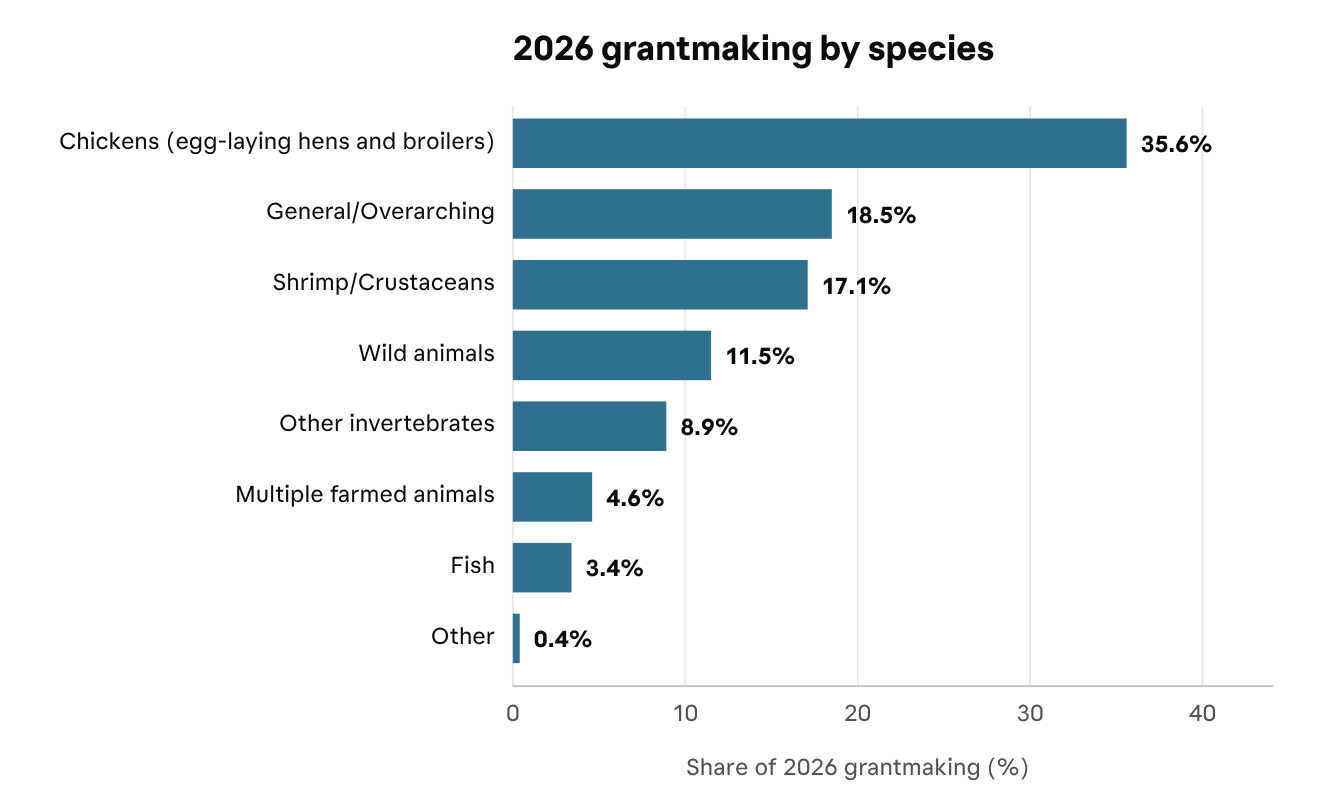
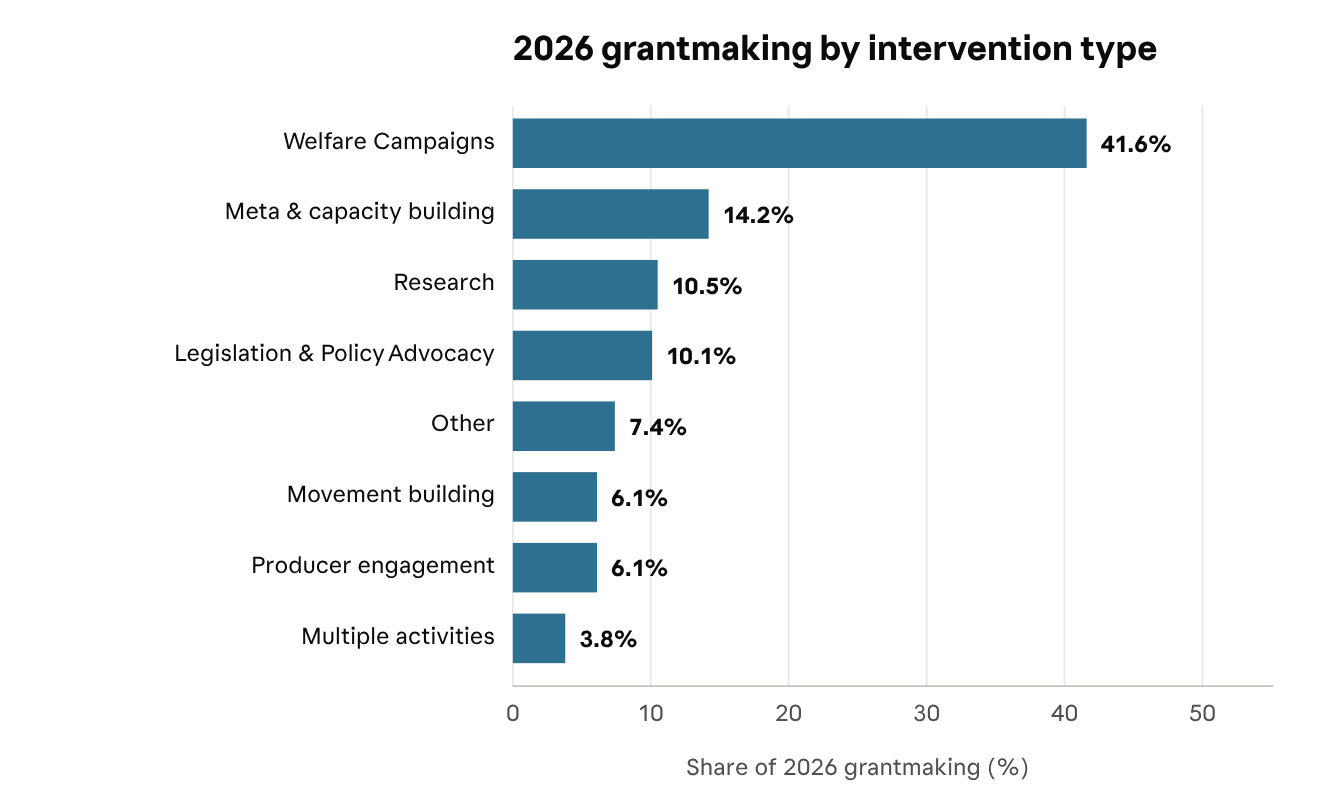
A year ago, I wrote about AWF's strategy and plans. We said we hoped to deploy $20 million in 2026. It seemed ambitious. Thanks to your donations and the work of our grantees, we have already exceeded that goal. As of November 10, we had approved or paid out 84 grants to scale or seed promising interventions for animals.
Here's where we scaled this year, with grants clearing our bar for expected impact per dollar.
Breakthroughs we want to see in 2027
For 2027, we have identified roughly 100 specific opportunities that we would like to fund. These are the breakthroughs we most want our 2027 grantmaking budget to achieve (shared in no particular sequence).
Ending cages for hens, including where most hens live
We plan to put about 30% of our 2027 portfolio into ending cages for laying hens. About 84% of the world's roughly 8 billion farmed hens are in Asia, Latin America, and Africa, where work needs to happen on the demand and supply level. So alongside corporate campaigns and accountability, we will fund producer training, links between buyers and compliant farms, national standards, and labeling laws. In Europe, we will back the push to turn the Commission's proposal into strong law.
Better lives for shrimp
About 440 billion shrimp are killed on farms each year, most of them inhumanely. Much of the work so far has focused on humane stunning at slaughter, including testing whether stunning works as intended, and on early on-farm trials. Next, we want to improve the whole of a shrimp's life. That means building the research base on what good welfare looks like on a farm, and piloting new welfare standards on farms.
Whole-life welfare standards for fish, written into law
What OHDI did in Kenya showed what is possible, and we want to scale these types of interventions, especially those that cover a fish’s whole life. We will also fund on-farm pilots and local university research so that new standards rest on evidence that holds up in a regional context. In Africa alone, this work could eventually cover 1 billion to 3.8 billion fish a year.
Practical interventions for wild animals
In 2027, we want to shorten the time between research on wild animal welfare and interventions that help animals, prioritizing those that are evidence-based, tractable and low-risk.
A movement big enough to do all of this
None of the breakthroughs above happen without skilled advocates and strong organizations, and right now that capacity is one of the movement's biggest bottlenecks. Our grants for movement-wide work increased significantly in 2026. We funded the training and incubation of new campaign groups, helped advocates connect, increased their capacity to help animals, funded forums to increase coordination of their efforts, and addressed the movement’s biggest monitoring, evaluation, and learning needs.
In 2027, we have much more to do: we could seed new charities through incubation, build talent pipelines, fund impact measurement, and help advocates plan for scale and keep impact as they grow. If the movement can double in size or more, our breakthroughs for animals become more reachable.
Thank you
None of this year's breakthroughs came from a single grant. Each followed years of funding to incredible groups that kept building on promising work. What made them possible was the work of inspiring advocates, and steady support from hundreds of monthly donors, many one-time gifts, and larger gifts to our pooled fund. A large, recurring pool of funding is what builds robustness and lets us commit to grantees for several years at once, so they can hire and take on bigger targets with confidence.
If you want to help make 2027's breakthroughs happen:
- Give to the EA Animal Welfare Fund.
- Talk with us about a multi-year or larger gift. Unrestricted gifts let us direct money where it can do the most good, and we are open to discussing restricted gifts too. Email me at [email protected].

