This is a crosspost for this post I created with Claude Fable 5.2 and Opus 5.5.
Summary
This post proposes measuring moral weight by how much uncertainty per second a being removes from its world by steering it towards its own goals.
The problem. Rethink Priorities (RP) estimates how much animals matter mostly by scoring traits, such as play or metacognition, as simply present or absent, then multiplying by the probability that the animal is sentient, as described by Fischer et al. (2024) in Weighing Animal Welfare. Illusionism holds that consciousness is a label applied to certain processes, not an extra property that is either there or not, a view defended by Frankish (2022b) and Tomasik (2009). If illusionism is right, there is no yes-or-no fact for this probability to track.
Preferences as control loops. A system has a preference when it runs a feedback loop: it measures something, compares the reading with a goal it stores itself, and acts to close the gap. Thermostats and bacteria do this. Electrons and rocks do not, nor does anything in fundamental physics.
The metric. Moral weight is how many bits per second of uncertainty a system removes from what it controls by measuring it and acting on the reading, in the environments it typically faces. One bit is the information in one yes-or-no answer. Every loop counts, from cellular ones to the brain, but information shared by several loops is counted only once.
Why this metric. It rests on a result from physics, shown by Touchette & Lloyd (2000): each bit a system learns about what it controls can improve its control by at most one bit. It gives the same total whether two systems are counted separately or as one, and whatever units or scales their variables are measured in. It gives electrons, and all fundamental physics, zero. It needs no extra weights for desires about one's own desires, which would be very hard to set in a non-arbitrary way. Finally, it measures every species in the same unit. So, given the metric, conclusions do not flip depending on whether weights are expressed in human or animal units, a trap known as the two-envelopes problem, discussed by Tomasik (2013) and St. Jules (2024).
The main implication. The metric turns the choice of moral-weight function into an empirical question: how feedback, in bits per second, varies across life. Nobody knows, and investigating this is the priority. If cells of all kinds get similar feedback per joule, moral weight is proportional to the power an organism uses, as in model 2 of Grilo (2026d) with an exponent of 1. Within animals, the evidence points to an exponent near 1 (speculative). Whether effects on microorganisms dominate depends on how their bits per joule compare with animals', and on how actions change the energy flowing through microorganisms. Where these effects could easily be positive or negative, reducing the uncertainty about them is a priority too. If a loop at its goal is neutral rather than good, microbial welfare is never positive, and less microbial activity is better.
Why a new metric
RP's welfare ranges, its estimates of how intensely an animal can fare well or badly relative to a human, treat most capacities as present or absent. This fails if consciousness comes in degrees.
a neurophysiological model, from neuron counts, with 30%;
a simple additive model, the share of a list of traits, such as play and metacognition, judged present, with 60%.
The result is then multiplied by a probability of sentience. Metacognition, play, and the like enter as yes or no, although animals plainly have more or less of them.
Illusionism removes the fact the probability of sentience is about.Tomasik (2009) argues that consciousness "is neither a thing which exists 'out there' nor an ontologically fundamental property of matter; it's a definitional category into which we classify minds". Brian adds: "When we view consciousness as a cluster in thingspace, it becomes natural to see it as coming in gradations".
Illusionism, defended by Keith Frankish among others, is the view that phenomenal consciousness, the felt quality of experience, is not an extra property of the world. The strong sense that it is comes from how brains model their own states. A "cluster in thingspace" is a fuzzy category, like "table": things can belong to it more or less. For animals, Frankish (2022b) argues that this view would "replace a neat but intractable metaphysical question with a messy but tractable empirical one". Frankish (2022a) adds that most experimental work on animal sentience "will be useful regardless of whether one takes a realist or illusionist view".
Kammerer (2022) draws the normative conclusion (see also this EA Forum linkpost). François argues that "given that materialism is true of the mind, phenomenal consciousness is probably not particularly normatively significant". Because there is often no fact of the matter about whether a creature is sentient, sentience is a poor ground for moral status, since "value and moral status themselves must be determinate properties".
François' alternative is desire. François notes that "if even a simple concept of 'desire' is defined functionally, then there is no indeterminacy in whether or not a certain creature desires anything". Defined functionally means defined by what a state does, not by how it feels. François also allows that "[o]n some views, entities as simple as bacteria can" desire in "the most basic way".
The rest of this post makes the functional definition precise and turns it into a number.
Preferences as control loops
A system has a preference when it measures a variable, compares the reading with a goal it stores itself, and acts to shrink the difference.
[embed: node/9e47993b-b567]
The stored goal is what separates a preference from mere physics: it can be reset without changing anything else in the loop.
This is the architecture of perceptual control theory. It gives a literal test for having a preference: can the system be in a state that conflicts with its goal, and act on this because it measured the state?
A thermostat passes, barely. It has a sensor, a set point that can be changed on its own, a comparator, and a heater switch.
E. coli passes. Its receptors sense attractants, its signalling network compares the present with the recent past, and its flagellar motors switch between swimming straight and tumbling.
An electron fails. It moves towards lower potential energy, but this "goal" belongs to the surrounding field, not to the electron. Change the field and the "goal" moves with it. The electron measures nothing. So its settling is open-loop, like a ball rolling downhill.
Calling any minimisation in physics a preference would make every process preference satisfaction, and the concept would no longer pick anything out.
Measuring control in bits
Feedback control has a natural currency: each bit a controller learns about a system can remove at most one bit of that system's uncertainty.
Entropy measures how spread out a system's state is. If a room's temperature is equally likely to be any of N values, its entropy is the base-2 logarithm of N, in bits. Removing 1 bit halves the number of likely states. A thermostat narrows a room's temperature in this way. Without it, the room settles towards the outdoor temperature, which varies with the weather. With it, the room stays in a narrower band whatever the weather.
The bound.Touchette & Lloyd (2000) show that "each bit of information gathered directly from a dynamical systems by a control device can serve to decrease the entropy of that system by at most one bit additional to the reduction of entropy attainable" without that information. Here the dynamical system is whatever is controlled, such as the room, and the control device is the sensor plus actuator. In words:
Uncertainty removed with feedback is at most the uncertainty removed without measuring, plus the information the measurement carries about the controlled variable.
The information the measurement carries about the controlled variable is their mutual information.
The bound has rate versions. The Touchette–Lloyd bound is per measurement. Control theory gives versions per second. The data-rate theorem sets the minimum rate of information needed to control a system, as reviewed by Nair et al. (2007). For suppressing disturbances, Martins, Dahleh & Doyle (2007) extend Bode's integral, and find that the limit with information from a channel "differs from Bode's only by a constant, which quantifies the information rate through the communication system". The next paragraph gives exact forms for two simple cases.
Bits per second have exact forms in two simple cases. Per second, feedback removes the uncertainty that would build up during this second if feedback stopped. In the first case, disturbances are redrawn in steps, as in the worked example below. The Touchette–Lloyd bound applies to each step. So a loop needs at least its steps per second times the base-2 logarithm of how much it narrows the spread. In the second case, disturbances build up continuously, as for a variable jostled by molecular noise, which relaxes at a rate γ without feedback. Kostina & Hassibi (2019) bound the minimum bits per step needed to hold such a variable at a given variance in discrete time, and "For the scalar Gaussian system, (16) holds with equality". In continuous time, this gives γ(s² − 1)/ln 2 bits per second to cut the spread, as a standard deviation, by a factor of s (derived in the next paragraphs, not taken from a source). Holding a variable 10 times tighter takes 143 γ bits per second, and 100 times tighter 101 times as many. Tighter control requires correcting more often, not only more precisely. Which case fits a given loop depends on its disturbances.
The derivation follows in five steps.
The variable. Let x be the controlled variable measured from its goal, such as a room's temperature minus the set point. In a short time dt, x changes by dx = −γx dt + u dt, plus a random kick. The first term is the pull back towards the goal that exists without feedback. The further x is from the goal, the faster it returns, at a rate γ per second. For example, a room loses heat faster the warmer it is than outdoors. The second term, u, is the push the controller adds. The random kicks are the disturbances. They are independent from one moment to the next, with mean 0 and variance 2D dt. So D sets how strong the disturbances are. This model is the Ornstein–Uhlenbeck process.
Variance without feedback. The variance of x, written P, measures its spread. In a time dt, the kicks add 2D dt to P. The pull back multiplies x by 1 − γ dt, and therefore P by about 1 − 2γ dt, which removes 2γP dt from P. The reason is that multiplying a variable by a constant multiplies its variance by the constant squared. Here, this is (1 − γ dt)² = 1 − 2γ dt + γ² dt², and the last term is negligible for small dt. So P changes at a rate of 2D − 2γP. It settles where the two effects balance, at P = D/γ.
Variance with feedback. Suppose the controller measures x and pushes against it in proportion, u = −kx. The total pull back becomes (γ + k)x, which is the model without feedback with γ + k in place of γ. So P settles at D/(γ + k). The spread, as a standard deviation, falls by a factor of s, with s² = (D/γ)/(D/(γ + k)) = (γ + k)/γ. This gives k = γ(s² − 1), where s is the ratio between the spread without and with feedback.
Uncertainty building up if feedback stops. Without feedback, P again changes at 2D − 2γP. It starts from P = D/(γ + k), which means 2D = 2(γ + k)P. So P grows at 2(γ + k)P − 2γP = 2kP, a fraction 2k of itself per second. For a bell-shaped (Gaussian) variable, entropy is half the base-2 logarithm of the variance plus a constant. The natural logarithm of a quantity grows at the quantity's growth rate divided by the quantity, here 2kP/P = 2k per second. A base-2 logarithm is the natural logarithm divided by ln 2. So half the base-2 logarithm of the variance grows at (2k/ln 2)/2 = k/ln 2 per second. So entropy grows at k/ln 2 = γ(s² − 1)/ln 2 bits per second.
The same value as the minimum information needed. Kostina & Hassibi (2019) study a variable that changes in steps. Each step multiplies it by a number a, adds the controller's push, and adds bell-shaped noise. Their result gives the fewest bits per step, R, that the controller must receive about the variable to hold its variance at P. For a single variable and noise of variance σ² per step, it reads R = ½ log2(a²P/(P − σ²)) in the notation used here. A step of length dt of the model above has a = 1 − γ dt and σ² = 2D dt. The natural logarithm of 1 + z is about z when z is close to 0. So, as dt shrinks, the natural logarithm of a² tends to −2γ dt, and that of P/(P − 2D dt) to 2D dt/P. Using D/P = γ + k:
So the bits per second that feedback removes equal the fewest it must gather. The bound is met exactly in this case.
Open-loop and feedback control differ. Open-loop control narrows a system without measuring it. Thick walls or a large water tank steady a room's temperature passively. Feedback control is the extra narrowing that comes from measuring and acting on the reading. Only feedback involves comparing the world with a goal. So only feedback counts as preference satisfaction.
Mutual information depends less on the observer's choices than it looks. Describing a person can take anything from 1 bit (whether they are an adult) to 10 billion bits or more (their genome), depending on what is described. But mutual information is the same whatever units or labels are used for either variable, such as Celsius or Fahrenheit (see the properties of mutual information). In a control loop, moreover, the system itself picks the variable: temperature for a thermostat, attractant concentration for a bacterium.
Entropy removed can depend on how a continuous variable is described. The entropy of a continuous variable's distribution, its differential entropy, is the average, over the variable's values, of minus the base-2 logarithm of their probability density. For a variable spread evenly over a range, this is the base-2 logarithm of the range's width. A switch from Celsius to Fahrenheit shifts the initial and final entropies equally, leaving entropy removed unchanged. However, unlike mutual information, entropy removed can change under other relabellings: differential entropy "is in general not invariant under arbitrary invertible maps" (Wikipedia). Suppose an attractant's concentration would be spread evenly over 1–100 µM (micromolar, or micromoles per litre) under open-loop control, and feedback holds it evenly within 90–100 µM. This removes 3.31 bits of entropy measured in concentration, but 4.61 bits when the same distributions are described in log-concentration. This scale is not arbitrary: "E. coli cells sense the spatial gradient of the logarithmic ligand concentration" (Kalinin et al. (2009)).
Where the numbers come from. In concentration, the width falls from 99 to 10 µM, and log2(99) − log2(10) = log2(99/10) = 3.31 bits. In log-concentration, the same distributions are not spread evenly: they are uniform in concentration, not loguniform. Each step of 1 µM holds the same probability, 1/99 before feedback. However, the higher the concentration, the less log-concentration it spans: 1–2 µM spans ln 2 = 0.693 natural-log units, and 99–100 µM only ln(100/99) = 0.0101. Density is probability per unit of width, which makes it 69.0 times as high in the top step as in the bottom one. In general, take a distribution spread evenly from a to b µM. A small step dc holds probability dc/(b − a). It spans ln(c + dc) − ln c = ln(1 + dc/c) of log-concentration, which is about dc/c when dc/c is close to 0. The density on the natural-log scale is therefore c/(b − a), which piles probability up towards b. Applying the definition above gives 1.36 bits before feedback and −3.25 bits after (derivation below). The difference is 4.61 bits. Differential entropy, unlike the entropy of a discrete variable, can be negative.
The entropy of a distribution with probability density p(x) is minus the average of log2 p(x). Spread evenly over a width w = b − a, the density is 1/w, and:
heven=−∫ba1wlog21wdx=log2w
On the natural-log scale, y = ln c, the density of the same distribution is c/w = e^y/w, and integrating by parts gives:
The first term is the entropy on the concentration scale. The second is the average base-2 logarithm of concentration, 5.27 for 1–100 µM and 6.57 for 90–100 µM.
Relative entropy removes this dependence. The metric measures entropy removed on the scale on which the variable would be spread evenly without feedback. This equals the relative entropy, or Kullback–Leibler divergence, of the distribution with feedback from the one without it. Relative entropy "is invariant under parameter transformations" (Wikipedia): it is the same on every scale, 3.31 bits in the example. It also "is additive for independent distributions in much the same way as Shannon entropy", as choice 4 requires. "Without feedback" means the closest distribution that acting without measuring could produce. Merely shifting the variable, such as by heating constantly, then does not count.
The bound carries over to relative entropy. It holds if actions taken without measuring may be picked at random. Feedback then removes at most as many bits as its measurements carry about the controlled variable. To see why, compare feedback with picking each action at random, as often as feedback does. For each measurement result, both apply the same action: feedback to the distribution the result reveals, the random choice to the one before measuring. On average over results, these two distributions differ by the mutual information, in relative entropy (Wikipedia). Mixing pairs of distributions in the same proportions cannot raise their relative entropy above the pairs' average, nor can acting alike on two distributions increase it. These two properties are the joint convexity and data-processing inequality of relative entropy.
The metric
Moral weight is the rate, in bits per second, at which a system's feedback control removes uncertainty, measured as relative entropy, from all the variables it controls, in the environments it typically faces, with shared information counted once.
Five choices produce this definition. Under illusionism each is a value choice. So the reason for each is given below.
Feedback only. Open-loop narrowing involves no comparison with a goal. Counting it would credit walls and funnels with preferences.
Bits per second, not bits. Holding a variable near its goal is a state, measured in bits. Keeping it there against disturbances requires gathering information continually, at a rate in bits per second. Moral weight, as a value per unit time, calls for the rate. This also captures speed: a system controlling a fast-changing world must process more bits per second, as the rate versions of the bound make precise.
Typical capacity, not peak capacity or current activity. A thermostat in a calm room corrects almost nothing, but it can correct the disturbances its room normally gets. Moral weight should reflect what a system can do in the environments it typically faces. Peak capacity would make weight depend on conditions a system rarely or never meets. Current activity and current error belong to welfare at a moment, not to moral weight. A dormant cell, whose surroundings supply almost no energy, can do almost nothing, and gets almost no weight.
Bits, not states. Bits add across independent systems, whereas numbers of states multiply. Take two independent thermostats, each able to hold 4 states, which is 2 bits each. Together they give 4 bits however they are grouped. Counted in states, they give 8 as two systems but 16 as one, because states multiply. Illusionism says such boundaries are partly arbitrary. So a measure that depends on them is suspect. Bits are also physically basic: by Landauer's principle, each bit of feedback control has a minimum energy cost, which grows with temperature.
Shared information counted once, with no extra weight for higher-order loops. Every loop counts, from cellular homeostasis to the brain. Higher-order loops are loops that set the goals of other loops. Their value shows up as extra control on the variables the system ultimately controls. E. coli's adaptation loop is an example. It is a slower loop, of a type engineers call integral feedback, that resets the goal of the cell's steering towards food (chemotaxis). This lets the cell steer across a wide range of concentrations. Yi et al. (2000) conclude that "integral control in some form is necessary for a robust implementation of perfect adaptation". Counting this extra control credits a higher-order loop with as many bits as the first-order loops it would take to match it. Summing every loop separately would count the same control twice. So the count uses the information about all controlled variables taken together. For independent loops this equals the simple sum.
One consequence of choice 4 deserves a flag. Bits grow with the logarithm of disturbance suppression. Suppressing evenly spread disturbances 100 times is worth 6.64 bits, and 10 k times only 13.3. This holds per correction. Against disturbances that build up continuously, tighter control also needs more corrections per second, and bits per second grow with the square of suppression.
Worked example: two thermostats
On this metric, a sharp, strong thermostat has 6.64 times the moral weight of a coarse, weak one.
Both are idealised controllers whose push back grows in proportion to the error. Each holds a room against the same disturbances, spread evenly over 0–40 °C and refreshed at the same rate. Each is a single loop.
Thermostat A
Thermostat B
Sensor resolution
4 levels (10 °C steps)
256 levels (about 0.156 °C steps)
Information the sensor can gather
2 bits
8 bits
Disturbances reduced by a factor of (assumed)
2
100
Entropy reduction achieved
1 bit
6.64 bits
Within the Touchette–Lloyd bound?
yes: uses 1 of 2 bits gathered
yes: uses 6.64 of 8 bits gathered
Moral weight relative to A
1
6.64
For disturbances spread evenly, as here, cutting their spread by a factor of 100 removes 6.64 bits, the base-2 logarithm of 100. A factor of 2 removes 1 bit. For bell-shaped (Gaussian) disturbances, the same factors remove 5.92 and 0.459 bits, because the narrowed distribution sits where the open-loop one was already most likely. With equal refresh rates, the bits-per-second ratio equals the bits ratio.
Other formulas give other answers for the same two devices. Counting the sensor's bits gives 4 times. Counting distinguishable states gives 64 times. Multiplying bits by how hard each controller pushes back gives 396 times. So even fully specified systems leave a 99-fold spread across formulas. The reasons in the previous section are what narrow it to 6.64 times.
Implications
The metric gives electrons zero, as it does all fundamental physics, and gives bacteria small but real weight. If cells of all kinds get similar feedback per joule, moral weight is proportional to the power an organism uses, as in model 2 of Grilo (2026d) with an exponent of 1. Whether cells do is very uncertain, and measuring feedback in bits per second across organisms matters most.
Individual systems
Electrons and rocks score zero. An electron settles into a low-energy state because the field shapes its motion. This is open-loop: the electron measures nothing and stores no goal of its own. So it has no feedback bits. The same goes for all fundamental physics: particles and fields follow laws of motion, measuring nothing against a stored goal. Feedback appears only in systems built from them, such as thermostats and cells. This matches the intuition of Tomasik (2009), "I personally attach little concern to the particle movements in a rock", and gives it a principled basis.
Bacteria score low per cell.E. coli's chemotaxis pathway, which steers it towards food, gathers information slowly. Mattingly et al. (2021) find that "in shallow gradients, where concentration varies on millimeter to centimeter length scales, cells only get on the order of 10⁻² bits/s". A length scale here is the distance over which the concentration changes by about its own value. Henry and colleagues add that cells "use this information efficiently, performing near the theoretical limit". By the Touchette–Lloyd bound, this rate caps the feedback control chemotaxis can deliver.
Worms and flies have navigation estimates too.Chen et al. (2026), a preprint, estimate the information flowing between sensory input and movement from tracked trajectories of E. coli, the nematode C. elegans, and fruit flies. Worms are "tracked on an agar plate with controlled butanone odor landscape", and flies "in complex or straight smoke plumes". For E. coli, "The inferred information flows are on the same order (≈ 0.01 bit/s) as those measured directly". All the estimates are lower bounds: the authors' coarse-graining "will likely underestimate, rendering the reported information flow here a lower-bound of the true system". Information flow caps feedback control, but a lower bound on it does not bound feedback control in either direction. The text gives no worm or fly values, but "Data and code used to generate figures in work are available".
Human neural control is bounded by what humans sense.Zheng & Meister (2025) estimate that "the information throughput of a human being is about 10 bits/s", while "our sensory systems gather data at ~10⁹ bits/s". Feedback cannot use more information than is gathered. So 1 billion bits/s is a rough ceiling on a person's neural feedback control. Loops inside the brain that regulate other neural activity count only through the control they add over the variables the person ultimately controls (choice 5). So they do not raise this ceiling. Interoception, sensing the body's internal state, adds to this ceiling, but probably far less than vision does. The vagus nerve, the main route for signals from the internal organs, has about 23.3 k fibres on the left side of the neck and 25.5 k on the right (Kronsteiner et al. (2024)), whereas each optic nerve has about 1.2 M (Balazsi et al. (1984)).
One bacterium anchors bits per joule. For bits per joule, E. coli is the anchor. BioNumbers gives an "experimental value of 12e9 ATP/cell on glucose-mineral salt medium", which is 2.83 × 10⁻¹³ W for a cell dividing every 67 minutes on glucose minimal medium (BioNumbers), with 57 kJ released per mole of ATP (BioNumbers). The same entry lists other values, 5.5 × 10¹⁰ and a theoretical 5.9 × 10⁹ ATP per cell, which would give 1.30 × 10⁻¹² and 1.39 × 10⁻¹³ W. So chemotaxis in shallow gradients gathers 35.4 billion bits per joule of the cell's power (7.72 billion to 72.0 billion with the other values). Information gathered caps feedback control. So this is a ceiling for chemotaxis in such gradients. Landauer's principle sets a far higher ceiling for any loop. At 37 °C, it is 3.37 × 10²⁰ bits per joule, the inverse of the thermal energy times the natural logarithm of 2. This is 9.52 billion times the figure for chemotaxis. The range used below is 10 billion to 4 trillion bits per joule, with a loguniform distribution, the upper end allowing all of a cell's loops to deliver 100 times as much as chemotaxis (speculative).
A person's other cells probably exercise more feedback control than their brain. Human cells also run feedback loops, for ions, nutrients, and gene expression, and a reference man has about "3.0·10¹³ human cells" according to Sender, Fuchs & Milo (2016). At 10 billion to 4 trillion bits per joule, the range in the previous paragraph, a person using 132 W, humanity's 1.07 TW in Hoehler et al. (2023) divided by 8.1 billion people, is expected to remove 88.0 trillion bits/s (1.32 to 528 trillion), 88.0 k times the neural ceiling (1.32 k to 528 k). The brain uses about 20 W, and 84.9% of the 132 W is used outside it. On this metric, most of a person's moral weight sits in the cells outside their brain (speculative).
A human signalling pathway gives a second anchor.Nałęcz-Jawecki et al. (2023) stimulated "an epithelial cell line expressing a light-activatable FGF receptor and an ERK activity reporter" with "random light pulse trains". They find that "the MAPK/ERK channel capacity is at least 6 bits per hour". MAPK/ERK is a pathway that relays growth signals from the cell surface. This is the same order as the 36 bits per hour of E. coli's chemotaxis in shallow gradients. However, a person has "≈3·10¹² nucleated cells" (Sender, Fuchs & Milo (2016)). If these share the 132 W, each uses 4.40 × 10⁻¹¹ W, 156 times the power of E. coli. One such pathway per cell then carries 37.9 M bits per joule, 935 times fewer than chemotaxis. Reaching 88.0 trillion bits/s would take 17.6 k such pathways per nucleated cell, all running at capacity. So this expected value is probably too high, unless each cell runs thousands of loops of similar capacity (speculative). The comparison with the brain is more robust. Matching the neural ceiling takes 1.20 bits per hour of feedback control per nucleated cell, a fifth of this one pathway's capacity. Actual neural feedback is also probably far below its ceiling, given the throughput of 10 bits/s.
From the metric to a power law
Moral weight per individual is power times bits per joule. Feedback requires acting, and acting uses energy. A system's feedback rate is therefore roughly its power times the feedback bits it gets per joule. If bits per joule are the same across life, moral weight is proportional to power. Model 2 of Grilo (2026d) "assumes moral weight is proportional to basal metabolic rate (BMR) to the power m", and the same bits per joule across life give m = 1.
Every loop counts, not only neurons. Model 1 of Grilo (2026d) makes moral weight proportional to neurons to the power n. Within the metric, model 1 would follow from counting neural loops alone. Herculano-Houzel (2011) finds that "the estimated average glucose use per neuron within each structure is remarkably constant across species", and that "the overall metabolic cost of a brain can be inferred from its number of neurons". At constant bits per joule, neural loops alone would then give model 1 with n = 1. However, the cells outside a person's brain probably exercise more feedback control than the brain does, and reversing the ranking would require neurons to get far more bits per joule than other cells. The evidence points the other way. The human brain runs on "an energy budget of ∼20 W" (Balasubramanian (2021)), which, with the 1 billion bits/s sensory ceiling, caps neural feedback at 50.0 M bits per joule, whereas E. coli's chemotaxis alone gets 708 times as many. A single human signalling pathway carries 37.9 M bits per joule, close to this cap, and cells run many pathways. The metric therefore favours model 2.
The power that counts is the power used in typical conditions. The metric weighs typical capacity (choice 3), whose closest measurable proxy is the power an organism uses where it lives. Grilo (2026d) uses basal metabolic rate, a resting minimum, at 25 °C. Humanity's metabolism, 1.07 TW in Hoehler et al. (2023), is 132 W per person, 1.60 times the basal 82.8 W in Grilo (2026a). For soil organisms, Grilo (2026d) scales nematode respiration in soils at 10–15 °C to 25 °C with a Q10, the factor by which metabolic rate rises per 10 °C, of 2 to 2.5. Rates in soil are then 2.00 to 3.95 times lower than at 25 °C.
Most soil microorganisms are dormant. For soil bacteria and archaea, "The active microorganisms compose only about 0.1–2% of the total microbial biomass" (Blagodatskaya & Kuzyakov (2013)), and a dormant cell gets almost no moral weight (choice 3). Giving every cell an active cell's power overstates their total power 50 to 1 k times, the inverse of the active share. Grilo (2026d) uses the active rate and averages welfare over all cells, which matches the metric only if dormancy dilutes this average by the same factor.
What sets the exponent
The exponent is probably near 1 within animals. If bits per joule are proportional to power to the k, moral weight is proportional to power to the 1 + k. Cellular loops use most of an animal's power and probably carry most of its feedback. Larger animals mostly add cells, and cells with less power appear to run their loops more slowly but as accurately, which keeps bits per joule constant and k near 0. The mechanisms that lower the exponent act mainly on single loops pushed to high precision or speed, and on neural loops in large brains (speculative).
Mechanism
Effect on the exponent
Evidence
Additivity across independent systems
Favours 1
Bits add across systems, whereas other exponents depend on boundaries
More loops in parallel
None
Data-rate theorem and Shannon–Hartley theorem
Larger organisms adding cells
None
Metabolic scaling across life and among mammals
Loops running slower, as accurately, in cells with less power
None
E. coli adaptation, vertebrate vision, and biomass turnover
Sharper or faster single loops
Lowers it for stepwise disturbances
Thermodynamic uncertainty relation, fly photoreceptors, and language models
Larger neurons and longer wiring
Lowers it for neural loops
Rodent neurons and white matter
Wholes controlling new variables
Raises it
None found
Different bits per joule across lineages
Not captured by one exponent
Soil bacteria against hens, and bacterial chemotaxis against a human signalling pathway
Additivity favours an exponent of 1. Bits add across independent systems (choice 4). A power law with an exponent other than 1 does not: splitting an organism into two halves multiplies its moral weight by 2 to the power of 1 minus the exponent. The factor is 1.76 at n = 0.188, which best fits RP's welfare ranges according to Grilo (2026d), 1.41 at 0.5, and 0.5 at 2. Phil Trammell argues that moral weight "tends to scale superlinearly with inputs like neuron count", partly to avoid a "funny non-monotonicity" when a brain is split into smaller ones. Exponents above 1 also depend on boundaries: counting two independent brains as one would raise their total moral weight. Under the metric, splitting or merging changes moral weight only if control changes.
Parallel loops add bits in proportion to power. In control theory, "the necessary data rate to stabilize a vector system with bounded noise is at least" a sum of terms, "where the sum is over the unstable eigenvalues of A" (Kostina & Hassibi (2019), citing Tatikonda and Mitter). Independent loops therefore add their requirements. Communication shows the same split between adding channels and pushing one channel harder. By the Shannon–Hartley theorem, capacity is "C = B log2(1 + S/N)", bandwidth B times the logarithm of one plus the signal-to-noise ratio. At high signal-to-noise ratios, "the capacity is logarithmic in power and approximately linear in bandwidth": more power in the same channels buys bits slowly, whereas more channels buy them in proportion. Running 10 copies of an artificial neural network on 10 tasks multiplies energy and output alike.
Larger organisms mostly add cells. Across the tree of life, metabolic rate scales with mass to the power 0.95, which "is close to unity and shows that the metabolic rates vary nearly proportionally to the biomass of the organisms, when viewed over the entire tree of life". Among mammals, the exponent is 0.73 (Hoehler et al. (2023)). Within mammals, "rates of cellular metabolism in vivo scale as M(-1/4)", M being body mass, whereas "rates for cells in culture converge to a single predicted value for all mammals regardless of size" (West, Woodruff & Brown (2002)). These differences "appear to be due to proportionate changes in the whole of energy metabolism" (Rolfe & Brown (1997)). Power per unit mass therefore varies little with size across life as a whole, and falls with size among mammals. Either way, a larger organism has more cells rather than more powerful ones.
Loops run slower in cells with less power, but as accurately. For E. coli's adaptation loop, Lan et al. (2012) find that the energy dissipation rate is about a constant times the adaptation speed times "ln(ε0/ε)", the logarithm of how much the error is reduced. This matches the stepwise form of bits per second, steps per second times the logarithm of narrowing, and makes bits per joule roughly constant for this loop. Ganhui and colleagues also confirm that "adaptation slows down as cells gradually de-energize in a nutrient-poor medium without compromising adaptation accuracy". Wang, Lan & Tang (2015) dispute the bound: "there does not appear to be a lower bound on energy dissipation to achieve a given level of adaptation accuracy". Senses also slow with body size. Healy et al. (2013) expected "smaller size and higher metabolic rates" to "favour perception of temporal change over finer timescales", and an analysis "of a wide range of vertebrates" "supported this hypothesis". Across the tree of life, "Mass-normalized energy utilization rates correlate strongly with rates of biomass carbon turnover" (Hoehler et al. (2023)). If a cell's loops run at a speed proportional to its power, at fixed accuracy, bits per joule do not depend on how much power each cell uses, and k is close to 0 for cellular loops (speculative).
Sharper or faster single loops have diminishing returns. For biomolecular processes, "An uncertainty ε requires at least a cost of 2kBT/ε²", kBT being the thermal energy (Barato & Seifert (2015)). Halving the uncertainty, about 1 more bit, quadruples the minimum cost. Against stepwise disturbances, this buys about 1 more bit per step. Against disturbances that build up continuously, bits per second also quadruple, and bits per joule need not fall. Fly photoreceptors show the same pattern. Their peak information rates range "from approximately 200 bits s(-1) in D. melanogaster to approximately 1,000 bits s(-1) in S. carnaria", and "the unit cost (cost per bit) all increase with a photoreceptor's highest information rate", a "law of diminishing returns" (Niven, Anderson & Laughlin (2007)). Artificial neural networks behave alike. Kaplan et al. (2020) find that language-model loss falls as a power of the number of parameters, N, with exponent "αN ∼ 0.076", and that a forward pass "involves roughly" 2N "add-multiply operations" per token. Going from 1 billion to 10 billion parameters, 10 times the energy per token, cuts the loss from 3.43 to 2.88 bits per token, removing only 0.550 more bits. Prediction is not control, but extra power spent on the same variables seems to buy few bits (speculative).
Brains may get fewer bits per joule as they grow. Vertebrates "use 2-8% of their basal metabolism for the central nervous system", a relationship "constant across all classes of vertebrates", with exceptions including primates (Mink, Blumenschine & Adams (1981)). Neural power therefore scales roughly with body power. Within brains, two costs grow with size. Larger rodent brains have larger neurons on the same energy budget per neuron, which "implies that mechanisms must be in place that adjust firing rate with increasing neuronal size", whereas primate brains grow by adding neurons "whose average size remains constant" (Herculano-Houzel (2011)). Long-range wiring also grows faster than the rest: white matter "increases disproportionally faster than the volume of the gray matter", with "an exponent of 4/3" (Zhang & Sejnowski (2000)). Both point to k below 0 for neural loops in larger brains, except perhaps in primates (speculative). Neural loops carry a small share of an animal's feedback, which limits their effect on the exponent.
Integration can add controlled variables. A whole can control variables none of its parts can, such as an animal's position or blood pressure, which would make k positive. Such organism-level loops are few, however, compared with the loops of trillions of cells. Redundancy between loops, counted once (choice 5), works the other way (speculative).
Small departures from 1 matter across lineages. Between major groups, such as bacteria and animals, bits per joule could differ by a factor that no single exponent captures. Over the more than 15 orders of magnitude between a soil bacterium's power and a hen's, an exponent of moral weight on power of 0.95 would give soil bacteria 5.81 times as many bits per joule as hens, and one of 0.9, 33.8 times. The two anchors above point this way. Per pathway, bacterial chemotaxis gathers 935 times as many bits per joule as a human cell's MAPK/ERK pathway. Whether soil bacteria and hens' cells differ as much is unknown (speculative).
From weights to decisions
Marginal cost-effectiveness, not total moral weight, decides. A population's total moral weight matters for decisions only through how much an intervention changes the welfare of its members per dollar. Grilo (2026d) estimates this for 16 spending opportunities, under both models and every exponent from 0 to 2. The metric picks a point on this map, model 2 at m = 1 with the corrections above, only if bits per joule are similar across life, which is very uncertain.
Bits per joule point to where spending buys the most moral weight. Bits per joule are moral weight per unit of power. Suppose the cost of improving a being's welfare by a given fraction of its capacity is proportional to the energy the being uses. Then the beings, biological or digital, with the most bits per joule offer the most moral weight per dollar. How much welfare this buys also depends on how far their loops are from their goals, which bits per joule do not measure.
Effects on soil organisms dominate for the leading intervention up to m = 0.85. This holds under model 2 in the simulation results published with Grilo (2026d), and up to n = 0.95 under model 1. At m = 1, cage-free campaigns lead.
Soil effects would dominate only with far more bits per joule. A soil bacterium uses 5.12 × 10⁻¹⁶ times the power of a hen in Grilo (2026a). Each factor of 10 in the weight of soil bacteria relative to hens is therefore worth 0.0654 in m. Effects on soil organisms would dominate those of cage-free campaigns at m = 1 if soil bacteria and archaea got 129 times as many bits per joule as hens, about the same as lowering m to 0.862. Using the power in typical conditions would raise the factor of 129.
Dominant effects on microorganisms change decisions, even under cluelessness. The effects of choices on bacterial welfare, including their direction, are mostly unpredictable. This is the problem of cluelessness, discussed by Greaves (2016) and Mogensen (2021). The same holds for soil invertebrates. Grilo (2026b) sees "no escape from the uncertainty about the effects on soil invertebrates", and links analyses finding this for interventions from saving human lives to chicken welfare reforms. Even for electrically stunning farmed shrimps, Grilo (2026c) concludes "it may change the welfare of soil invertebrates more or less than that of farmed shrimps". Grilo (2026d) adds: "Whether soil organisms have negative lives, and whether farming worsens them, are close to coin flips". Where effects on microorganisms dominate an intervention's cost-effectiveness, as for donations to the Good Food Institute at m = 1 in model 2, and could easily be positive or negative, the intervention's expected value hinges on this unknown. Reducing the uncertainty then becomes a priority. If feedback scales with power, what matters is how actions change the energy flowing through microorganisms. This energy comes mostly from the plant and algal production they decompose, and can be estimated from data on plant production, soil respiration, and the microbial share of decomposition. Estimating how land-use change alters it is needed under any view of microbial welfare. This research is worth doing only to the extent the uncertainty can be reduced, which is itself uncertain.
The sign of microbial welfare may follow from the metric. Welfare at a moment would be the current control error relative to capacity (see the objections). If a loop at its goal is neutral, welfare is never positive, and more microbial activity means more negative welfare. Interventions that cut the energy flowing through microorganisms would then be good. If a loop at its goal is good, the sign flips. Under illusionism, this is also where hedonic intensity, the usual target of moral weights, would enter the metric, as the size of control errors (speculative).
Within the metric, the two-envelopes problem goes away. Comparing moral weights in human units and in shrimp units can give conflicting expected values, as Shiller (2024) explains. Bits per second is the same unit for every species. Uncertainty becomes ordinary empirical uncertainty about each species' rate, and expected values do not depend on a reference species. With credence spread across several metrics, the problem returns unless their units are fixed relative to each other.
Objections and replies
"This is just a value choice." Under illusionism, every moral-weight metric is. The case for this one is that it passes tests others fail. It does not depend on where boundaries are drawn, scores electrons at zero, has a physical basis, and uses one unit for every species.
"Letting effects on bacteria dominate is absurd." Any metric that counts simple preferences and adds them up linearly will allow for effects on numerous simple organisms dominating. The alternatives have costs. A steep weighting by sophistication needs an exponent that is hard to justify. Adding up weights non-linearly makes total value depend on how the world is divided into individuals. Finally, dominance does not make action hopeless: where the effects of actions on bacteria could easily be positive or negative, the metric calls for research to reduce this uncertainty.
"It counts loops nobody cares about." Cellular homeostasis, the immune system, and motor loops in the cerebellum all count, and the cells outside a person's brain probably exercise more feedback control than the brain does. Restricting the count to loops whose information is shared across the whole brain would be a judgement about which kinds of computation matter. The broad count is one too: every feedback-control computation matters in proportion to its bits per second. The restriction keeps this judgement and adds a second one. Its result would also depend on where the boundary of the whole is drawn, which choice 4 avoids. The metric keeps the broad count.
"Thermostats and machines get moral weight." Machines do get weight if they measure what they control and act against a stored goal. A home thermostat removes far less than a bit per second (speculative). Machine senses can gather a lot: a car's eight cameras at 1080p and 30 frames per second stream 11.9 billion bits/s uncompressed, 11.9 times the ceiling used here for human senses. But the metric counts uncertainty removed by acting, not data gathered, and a car's steering, braking, and engine loops remove far less (speculative). The same caveat makes the human figure only a ceiling. How much feedback control machines exercise in total, and how fast it is growing, is an open question.
"It ignores what makes caring special."Kammerer (2022) holds that "states of caring matter more than the most basic desires". Here, a desire about one's own desires adds weight only through the extra control it provides. Someone who finds this wrong can add a hierarchy weight, at the cost of an arbitrary parameter.
"The logarithm undervalues strong control." Suppressing evenly spread disturbances 10 k times counts only twice as much as suppressing them 100 times. This follows from additivity. Two independent systems that suppress disturbances by factors a and b together suppress them by a times b, and only a logarithm turns this product into a sum. Any measure linear in suppression factors would again depend on how systems are grouped. The logarithm applies per correction. Against disturbances that build up continuously, suppressing them 10 times more takes about 100 times the bits per second.
"Information depends on the environment." It does. E. coli's rate depends on how steep the food gradient is: Mattingly et al. (2021) find that it grows with the square of the steepness, the relative change in concentration per unit distance (they test about 10% to 40% per millimetre). This is why the metric uses typical capacity in the environments a system faces, not the rate in one setting.
"It says nothing about how good or bad a moment is." Correct. It measures weight, the scale of what is at stake. Welfare at a moment would be the current control error relative to this capacity. Whether a loop at its goal is neutral or positively good is an open question, and it decides the sign of microbial welfare.
Open questions
The estimates above rest on few measurements. In rough order of value, the gaps are:
Feedback rates across life. Moral weight is proportional to power only if cells of all kinds get similar feedback per joule, and how bits per joule vary with an organism's power sets the exponent. This also decides whether effects on microorganisms dominate. Information rates have been measured for few loops. For navigation, there are E. coli's chemotaxis and, as lower bounds, odour navigation in C. elegans and fruit flies (Chen et al. (2026)). One human signalling pathway has a measured capacity (Nałęcz-Jawecki et al. (2023)). No animal has a measured total, and humans have an output figure (10 bits/s) and an input figure (1 billion bits/s), but not the feedback rate across all their loops, cellular ones included. Control theory suggests a route: measure each loop's bandwidth and how much it suppresses disturbances, which physiology papers often report for reflexes and posture. Published studies of sensory systems and behaviour could also bound the rates, as E. coli's has been bounded. Natural places to start are bacteria, animal cells whose power is known, and model organisms with well-studied control systems, such as the nematode C. elegans, the fruit fly, and the zebrafish.
Effects of actions on microbial energy flows. Which common actions, such as land-use change, change the energy flowing through microorganisms most, and in which direction. Data on plant production and soil respiration make this tractable. If effects on microorganisms dominate and their sign is unclear, this is where research matters most.
Welfare at a moment. How control error maps to valence, and whether a satisfied loop is neutral or good. The second question decides the sign of microbial welfare.
Note: This post was crossposted from Planned Obsolescence by the Forum team, with the author's permission. The author may not see or respond to comments on this post.
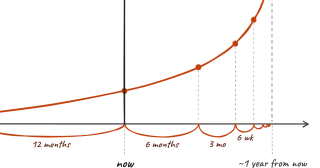
Subtitle: If acceleration compounds, the naive extrapolation implies superintelligence within a year
This post discusses a public METR report on AI R&D acceler...
We’re the co-founders of Better Futures Guide (BFG), a charity evaluator specifically focused on livelihoods. We were founded last year through Ambitious Impact’s Charity Entrepreneurship Incubation Program. We welcome questions, criticism and opportunities for collaboration, in the comments or at [email protected].
...
By Alexander Berger, Chris Smith and Aaron Roesch
Earlier this year, Nan Ransohoff, head of Public Goods at Stripe, published a viral[1] blog post about the coming third wave of American philan...


Not very legible, but interesting. Thanks for sharing!
Hello Hazem. Thanks. I agree the post is not very readable.