This comment section felt a bit brigaded here, which I don't love.
I'm sympathetic to debating strategic disagreements in the animal welfare movement, and appreciate you bringing these ideas up and pushing for what you believe is the right approach.
There were 2 things that stood out to me:
We need to go beyond Peter Singer’s utilitarian approach, which has had a limiting impact on campaigns giving preference to concerns about animal suffering and welfare reforms. What is needed are a deontological philosophy and a holistic, ecological systems approach.
I don't think utilitarianism gives a preference to welfare reforms — it's that welfare reforms have a strong track record of being effective, while these other approaches don't. Peter Singer himself wholeheartedly embraces animal liberation, literally! If the utilitarians thought that things beyond welfare reforms would work, and were cost-effective, they'd do them. It isn't because of their principled commitment to utilitarianism that they disagree.
Secondly, I think that many of the donors and EAs would stop being EA donors or EAs at all if deontology became the norm. At least speaking for myself, I am not aligned with EA because it is EA, but I'm aligned with EA because it is more aligned with my values (which are very utilitarian). I suspect this is true for many EA-motivated people. If EA changes, it doesn't mean the donors will change their values.
The campaign was inspired by: (1) the “AI Windfall” entering the animal movement
I think an important question for people who aren't excited about new funding entering the space going to welfare reforms is "why are these new donors are interested in funding animal welfare work at all?"
I think the answer is because cage-free campaigns, etc. demonstrated that helping animals at scale was possible, and because welfare-motivated advocates demonstrated that something could be done to help animals effectively.
No animal welfare advocate controls where these donors give — if the movement today decided to pivot to plant-based advocacy and stop doing welfare stuff, it's plausible significantly less money would be donated to helping animals. There isn't a pot of unlimited money controlled by animal advocates — there are donors who have specific values and priorities, and organizations who will make the case to those donors that their work should be funded. The pitch should be to the donors (who actually will decide these things), not to EA as a whole, and has to overcome the fact that you're pitching against the thing that might have gotten many of them excited about animal advocacy in the first place.
Thanks for your thoughtful and engaging comments. I appreciate going into the reasoning of the philosophical ideas as well as interests and institutions (the 3 Is).
The philosophy used is the starting point before speaking about strategies and campaigns because it limits what the focus is. The focus on utilitarianism and thus welfare results in looking at reforms in factory farms rather than taking a strong anti-factory farming position. This is not effective in a holistic, ecological systems perspective,we are trying to show in the Beyond Cage-Free Open Letter and Report because welfare campaigns like cage-free eggs and "welfare tech" tend to treat animal rights (animal as subjects or persons), climate change, freshwater and land use, biodiversity, health, pandemic risk, and food security as externalities and thus don't count all they should. They also tend to fixate on one animal welfare reform at a time and unfortunately there are multiple atrocities hens face, for example, and PETA's White Paper shows that several improvements in hen welfare may cause new suffering in other areas so total welfare isn't improved. The argument is we need a holistic math for animals and if we did so, plant-based food system change campaigns are necessary.
Why don't we choose this win-win solution then?
My background is in political science and we use the 3 Is to look at human constructed ideas, interests and institutions that shape our views, attitudes and behaviours. Ideas like philosophies can act as barriers. Utilitarianism is very useful and helpful but it also has limits. It's a bridge to far for individual rights. The classic critique of utilitarianism is that it can be oppressive for the individual as in the Gladiator analogy (in Rome, the joy of crowd could be taken to outweigh the suffering of the gladiators). Also, it make assumptions that one can accurately predict and properly weigh consequences in the future based on one's calculations and decisions. Deontology or philosophy of duty to respect a subject-of-a-life and to do the right thing in the present needs to be added so that animals are not treated like commodities and get legal rights of personhood (this goal was vital in other social movements from anti-slavery to the women's movement). It changes the focus on the animal protection movement beyond welfare tweaks in factory farms to an anti-factory farming and anti-animal exploitation stance and thus favours a shift to a plant-based food system.
In addition, we need to adopts a complex systems worldview (like in Fritjof Capra's The Turning Point - depicted in the film Mindwalk, or more recent one described in books like George Monbiot's Regenisis, Kate Raworth's Doughnut Economics, and Tim Lenton's Positive Tipping Points) to address the existential polycrises we face.
This takes us to interests and institutions. The AI donors may in myopic terms prefer to work with Big Ag (and make profits creating robots and machines for factory farms and slaughterhouses and increase their efficiency and profitability) but it's not ultimately in their or anyone's interest because of climate change, water use, societal instability, food insecurity and so forth. So we need to organize people power, organizations and experts across sectors, and policy makers to change the system and incentive structure so everyone does the right thing. Those at the top of different systems might have the wrong incentives so we need to help them through organizing to do the right thing. It's not their fault, it's the system that pushes people in directions that aren't always ideal for living beings and their survival and flourishing. Hence we launched this Beyond Cage-Free campaign. It's not easy. There's a lot of anxiety that comes with challenging the 3Is - ideas, interests and institutions. It starts with the understanding that everyone who is mentally sane has good intentions but systems shape attitudes and behaviours in not great directions sometimes. The way to reduce that anxiety is to try to be as constructive and positive as possible in promoting a paradigm shift and to alter how interests are perceived and try and construct big tent institutions that are inviting and inclusive.
With regard to your second point, many esteemed EA folks are not leaders in Anthropic. For example, @Holden Karnofsky helped start Giving Well and then Open Philanthropy Project which became Coefficient Giving. The hope is to convince Anthropic leaders like Holden and Coefficient Giving leaders like AMA: Lewis Bollard, Open Philanthropy to adopt a holistic complex systems approach to evaluate the most necessary funding needs in our time. There is no doubt among Earth System and climate scientists like Johann Rockstorm that we need to shift away from animal agriculture to plant-based food systems to address the animal, climate and planetary boundary crises. Animal agriculture produces the majority of the greenhouse gas food emissions and is the leading cause of biodiversity loss, land use, freshwater use, acidification and nitrogen and phosphorus and nitrogen use. Kate Raworth, an Oxford economist and vegan, adds humanitarian crises to planetary boundary concerns in her doughnut economics. It would be great for all of us to get together and use Claude and Open AI to assist in a new systems calculator and choose projects to help us solve our cascading crises and truly produce a better world for animals (human and nonhuman).
This is a comment critical of your approach in this article. I am sympathetic to the broader claim you are making, that the EA movement should be more systems-change focused. However, I don't think your target audience will hear that message for the issues stated below. Please hear this from the perspective of an ally recommending a tactical shift.
This article does not meaningfully engage with any of the actual reasons why most people in the EA movement take a different approach to helping animals than what you recommend. You make a great case for the importance of shifting our food system, but the vast majority of EAs who work on animal welfare already believe this.
The real challenge is tractability: what can we do that will actually work? This is left unaddressed.
Your calls to action are also unlikely to be effective.
On your first point, if you tell anyone with a strong moral commitment, "I know what you should do, but you'll have to fundamentally change your moral theory to believe it's a good idea," they're going to drop your suggestion, not the moral theory. For example, I feel confident that no one on this forum could entice you to become a utilitarian using the merit of shrimp welfare campaigns.
The thing is, you don't need to convince anyone to stop being a utilitarian. If you have good reason to believe that changing the food system will be what's best for animals and people (you do, your article is about this), then that means utilitarians should change the food system. IF there's a tractable way to do it.
The other two calls to action are generic and don't suggest any real change. They imply that the reason why we have failed to change the food system already is that we haven't formed coalitions or made plans to do so. Clearly, we have done these things. The movement is still losing, badly. Animal consumption is rising and veg*nism is flat. We all want to change these trends, and we need more than a call to come together to fix them.
I think a lot of people entering the EA space, many of them young, are open to exploring and incorporating different philosophies.
Utilitarianism is great and practical in so many ways and I think most of us use it daily to guide our actions.
But deontology or the philosophy of duty and doing the right thing in the present is also a daily instinct for most of us. It is also a very persuasive philosophy. Tom Regan's "The Case for Animal Rights" is worth reading. He argues animals have animal rights and are a subject-of-a-life with intrinsic value. This suggests an abolitionist approach and a duty to intervene by animal rights advocate (ARA). Animals are subjects-of-a-life because (1) they are aware of the world and (2) they care what happens to you independent of others caring. Reagan presents
Reagan's Ten Conditions for individuals to be considered a subject-of-a-life:
1. a being with beliefs
2. desires
3. perception
4. a memory
5. sense of the future (including their own future)
6. an emotional life including feelings of pleasure and pain
7. has preference and welfare interests
8. the ability to initiate action in pursuit of their desires and goals
9. a psycho-physical identity over time (an individual with a history)
An individual animal has welfare here in the sense that their experiential life fares well or ill for them logically independently of the utility (i.e., if things go well or badly for them and it doesn’t matter how others value it).
Jeffrey Masson adds to this call for a broader philosophical tradition for EAs. He asks What is “a good life”? “An animal, much like a human, can only be happy when it is living under conditions that allow it to express its natural behaviour and feel the emotions that accompany that behaviour.” Animal farms create unhappiness: they prevent an animal from living the way s/he evolved to live. “Adequate, tolerable, bearable” is not good enough (certainly not good enough for our own living standards). How should farm animals live? Only farm sanctuaries provide “a good life”. We need to focus on the number of animals in the food system and stop breeding them.
Complex system thinking also suggests "scalability" (for real and optimal progress) should take into account animal subjects-of-a-life, the climate crisis, health, pandemic risk, and food security and not treat them as externalities.
Plant-based food campaigns align with all these deontological traditions. Coefficient Giving (AMA: Lewis Bollard, Open Philanthropy) is exploring other philosophies. There is an openness.
1) Your post argues for the importance of work beyond welfare campaigns but doesn't explore tractability; most EAs would fully endorse the importance of that work but are skeptical of most approaches to enact systems change. As a result, your post doesn't address the actual objection.
2) Your post calls for people to move beyond utilitarianism as a way to solve the problems you highlighted with the current EA approach. However, you're speaking to an audience that likes the current approach, so all this does is make your ask to change even more demanding. Not only are you asking a change in approach, but you're asking a change in belief.
3) Your call to change moral theories is unnecessary. You're already making the claim that animals and people would be better off if we shifted our approach. If argued successfully, that would compel a utilitarian to shift their approach, so you don't actually need to change anyone's moral theory.
4) The other calls to action seemed to be suggesting more of the same things that advocates have been doing for years with no clear sign that things will be different, let alone better.
Your reply does not address points 1, 3, and 4. I would be curious to hear your thoughts on those points: What would you say to an EA who fully endorses the importance of reforming the food system as a whole but doesn't believe it is possible at the scale you describe (particularly given how animal consumption continues to rise and veg*nism is flat)? Do you agree that asking people to change moral theories (not just their approach) decreases the effectiveness of your ask among committed utilitarians? Why or why not? If so, why is it worth the cost? What makes your plan and coalition different from what has been tried before?
You did partially address point 2, though indirectly. I think you are probably correct that there are new people entering EA spaces who are uncertain of their moral philosophy and will be considering philosophies other than utilitarianism, the typical (though not universal) lean of EAs. However, this post is clearly targeting a broad and influential audience. You will not reach that audience by insisting that everyone change their moral theory, not their approach. Thankfully (re: point 3), I don't think you have to.
The rest of your comment focuses on arguments in favor of moral philosophies outside of utilitarianism and restates your case for more holistic change under those philosophies. Beyond some straw manning[1] and some definitional quibbles[2], you make a reasonable case. However, for the reasons I gave above, I don't think this is the case you need to be making.
The strongest part of your argument is pushing people to consider "animal subjects-of-a-life, the climate crisis, health, pandemic risk, and food security". In theory, utilitarians should consider all of these points, but in practice, many utilitarian EAs focus almost exclusively on animals. I think a post about how the EA movement is missing these other categories of risk and is undercutting the value of work outside of welfare reforms would be impactful and well-received. However, it would need to be paired with arguments about tractability, since that's the key sticking point.
Implying that utilitarians believe that "adequate, tolerable, and bearable" are good enough is inaccurate. Utilitarians try to maximize welfare of animals, and the focus on welfare campaigns over systems change comes from a belief that systems change is much less likely to work. Again, the disagreement comes from tractability, not importance, but your argument is centered around the latter.
Regan or Masson's frameworks, as stated, don't seem contrary to what utilitarians consider in practice. Based on the line "An individual animal has welfare here in the sense that their experiential life fares well or ill for them logically independently of the utility (i.e., if things go well or badly for them and it doesn’t matter how others value it)," it seems like you may be conflating utility to others with utility in the context of utilitarianism. Utilitarians are notoriously bad at choosing words that mean what they sound like they mean, so this isn't on you. "Welfare"/"utility" refers to literally anything that would make a sentient being regard their subjective experience better or worse, including everything you talk about when discussing Regan and Masson's work.
Earlier this year, I attended a forum where I listened to several talks about cage-free campaigns. It was interesting, but it also left me with more questions than answers.
The campaigns were presented as a way of pushing companies to meet certain minimum animal welfare standards. At the same time, I heard campaigners acknowledge that once those commitments are made, there are often very limited ways to actually monitor what happens across the supply chain.
As an activist, that made me think about the message we are communicating. If we tell people that animals are better off because a company has moved away from cages, are we also unintentionally reinforcing the idea that the problem is the cage rather than the exploitation itself?
I’m not saying that improving conditions for animals is meaningless. Of course, being confined in a cage and having somewhat more space are not the same experience. But I started wondering whether our campaigns should be judged only by the welfare improvement achieved within the existing system, or also by whether they help move society toward breeding fewer animals for food.
From a communications perspective, I think this distinction matters enormously. The way we frame a campaign can shape what people understand the problem to be. If the message is simply “cage-free is better,” the conversation can stop at improving the conditions of exploitation. If the message is “why do we need to breed these animals for food in the first place?”, it opens a much broader conversation about the food system itself.
That is one of the reasons I find the Beyond Cage-Free discussion valuable. For me, the interesting question isn’t whether welfare campaigns have achieved anything. It is whether, after everything we’ve learned from them, we should be asking ourselves what comes next.
Thanks for this, Anita. The UK egg study alongside the PETA white paper makes a strong case that welfare reforms within animal agriculture can carry environmental trade-offs that plant-based change avoids. The point about measuring impact by the total number of animals bred into the food system, rather than animals spared from cages, is a useful shift in framing for funders.
Thanks Aromastoff. The UK egg study is very enlightening on the environment and the greater number of hens (1.6 million) needed each year for cage-free compared to conventional battery. The PETA report provides an important comprehensive look at the multitude of welfare issues. Both reports and the Open Letter make a strong case for pivoting to plant-based food system change as the main priority.
Thanks for posting. I think the welfare evidence is more mixed than the PETA paper suggests. Welfare Footprint's analysis (https://welfarefootprint.org/laying-hens/) agrees that keel bone fractures are the main problem in cage-free aviaries, but still estimates substantially less time in pain per hen than in cages. I'd be interested in how you weigh that.
Thanks @Jack White 🔹 for the good references. Regarding the second the authors conclude there isn't great data yet but there is great interest in recent years which is encouraging. They write: "we observe many fruitful collaborations between researchers and advocacy organizations, as shown by the large number of nonprofit white papers in our sample." and "many promising designs and interventions still await rigorous evaluation. For instance, no study that met our criteria evaluated extended contact with farm animals [144], manipulations to the price of meat [145], activating moral and/or physical disgust [146], watching popular media such as the Simpsons episode “Lisa the Vegetarian” [147] or the movie Babe [148], and many categories of choice architecture intervention [149]." UK's Project Slingshot is working on the "activiating moral and/or physical disgust" criteria and is attempting measurement. AMA: Lewis Bollard, Program Director of Farm Animal Welfare at OpenPhil is providing support for this approach.
The found a couple of choice architecture studies useful. The psychology and persuasion studies not so convincing yet.
With respect to your first reference, I'll take a look and speak to PETA's White Paper authors (Amber Canavan and Prof. Vasile Stanescu). My own take right now is there are multiple atrocities in factory farms and animals are bred and exploited without their consent. None of us would want to replace ourselves for them because in the western tradition the individual is sacrosanct and has rights. Applying the Golden Rule, we need to treat others as we'd like to be treated. For me it's not about weighing and shifting welfare pains but being treated like a subject-of-a-life with animal rights. This suggests we pivot beyond cage-free to plant based food system change as the main priority. Thanks again for references.
Thank you, Anita, for opening this much-needed conversation. I think your letter invites us to rethink how EA approaches animal well-being and, importantly, what we count as success. Alongside improvements in living conditions, we should ask whether an intervention reduces the number of animals bred into the food system and how it affects planetary health. Animals spared from exploitation, climate impacts, land and water use, and biodiversity deserve a place in that assessment.
In our work with cities and universities in Spain, I see how this broader ambition can translate into practical changes in procurement, menus, and access to plant-based meals. I’d love to see more funding support these pathways, with success metrics that capture their benefits for animals, people and the ecosystems we all depend on.
It was a pleasure to be part of the team of experts drafting the report! Now, the work is on our communities and on individuals to make small but powerful changes in their choices. And, of course, the action is also on the funding organizations that have the political and economic power to promote the necessary dietary and production shifts we must address for a flourishing future for humans, non-human animals, and the more-than-human world! ✨🌱
This is brilliant. In the Global South, we are already experiencing the impacts of climate change through increasingly severe heatwaves, floods, droughts, wildfires, and disruptions to food systems. At the same time, animal agriculture is a significant contributor to greenhouse gas emissions and puts substantial pressure on land, water, and biodiversity.
We urgently need to move beyond fragmented approaches and toward a holistic food-systems approach that addresses climate, biodiversity, food security, public health, and animal suffering together. If our goal is genuinely to help animals, we should also be working to reduce the number of animals bred into systems that exploit them in the first place. Plant-based food-system transformation offers an important pathway to address these interconnected challenges.
Thank you for your great plant-based work in India and Asia @Naman Dedhia. You've shown along with Chef Jaya that plant-based meal replacement in schools is healthy, delicious and cost effective. It is scalable.
The Global South has been ahead of the West in terms of healthy eating but in recent decades large corporations such as Cargill, KFC etc. and their allied nonprofits like Heifer International as well as growing wealth dynamics (the push and pull) have led largely plant-based societies to eat more meat, dairy and eggs. The Standard American Diet (SAD) has spread worldwide. We need to reverse that not only in the US, where the population has become more sick and obese, as a result, but also avoid it spreading globally. This SAD diet has also produced the Standard Global Farm. George Monbiot, author of Regenesis, shows how this has led to a less resiliant food system and call for a shift to a plant-based food system.
Thank you, Anita, for your insightful article. As an animal rights activist living in Türkiye, I witness the effects of climate change becoming more severe every year. Floods, wildfires, extreme heat, and other climate-related disasters are increasingly becoming part of our daily lives. The first victims are often animals—especially those kept on farms and in barns, whether they are confined in cages or not. When disasters strike, these animals have little or no possibility of escaping. Protecting animals from the impacts of climate change is therefore essential to protecting their rights.
At the same time, scientific research increasingly documents the enormous impact of animal agriculture on the climate and the wider planetary crisis. This makes it clear that we cannot address the climate crisis by focusing only on fossil fuels. Even if we could halt fossil fuel use overnight, we would still need to transform the food system and reduce the environmental pressures created by industrial animal agriculture.
That is why a holistic approach matters. We need solutions that address the challenges together rather than treating them as separate problems.
This is also why it is so important to support activists and organizations already working on the ground. We need to be able to continue this work rather than constantly having to look for other jobs to sustain ourselves. In Türkiye, we have been working for years to promote a transition towards a plant-based food system. We are seeing changes, and awareness is growing, but the transformation is still not happening as quickly as we need.
At the heart of this conversation is a simple question: If we do not need eggs to thrive, why do we need cages at all?
I'm heartened by you and your team at your NGO work on plant-based food demonstrations in communities, cafes, and restaurants. There is a way forward. Turkey has experienced climate changes that have been devastating to wildlife and farmed animals plus the earthquake. You've first hand witnessed this and rescued dogs, chickens and other animals. It's so important to work to mitigate climate change through diet change. AMA: Lewis Bollard, Open Philanthropy it's so important to support people and groups in the frontlines.
For 3 years I've been actively participating in events linked to Effective Altruism, always with enormous enthusiasm, commitment and from a deeply professional perspective. Therefore, after reading the PETA report and reflecting on the arguments raised in this letter, I must say that it has generated a deep surprise and, above all, sadness.
It's difficult for me to understand that such important spaces within Effective Altruism can provide promotion and even economic support to initiatives focused on "cage-free" systems, when there is evidence that indicates that these alternatives aren't necessarily positive for hens or chickens and that, in certain aspects, even aggravate their situation. To this, of course, are added the environmental and health impacts that we cannot ignore either.
Precisely because Effective Altruism invites us to think in terms of impact, evidence and real consequences, I think we've the responsibility to review our priorities when new information shows us that certain strategies may not be producing the results we expect.
It is not simply a question of making an activity more "humanitarian" whose foundation's still the exploitation of animals. It's about asking ourselves, with honesty and coherence, what changes can really understand the most defenseless of this system.
With the information we've available today, we must act consistently. It isn't enough to "improve" the conditions of the farms if we continue to support a system that needs to breed and exploit billions of animals.
The challenge should be much deeper: reduce - to eradicate - our dependence on livestock and actively accompany the transition to a food system that's ethical, healthy, sustainable.
We're human people who have the ability to change and I think that should be, precisely, the essence of evidence-based thinking: having the humility to review our strategies, recognizing when something does not work as we expected and directing our resources towards what can generate the greatest possible positive impact.
If we really have the tools to build a better future, we also have the responsibility to use them!
Thank you Alexis for your strong dedication to animal liberation and climate action.
The PETA White Paper was release less than a year ago and most people have not read it yet. The Beyond Cage-Free Open Letter attempts to summarize the White Paper in a table to make it easier for people to have an overview of it. There are multiple atrocities in a factory farm and it's very difficult helping animals in this situation as none of us would want to take their place even if one or two atrocities are removed but multiple ones remain in place and none of us want to be treated as a means instead of an end. That's why it's an impossible situation and so very sad.
The best way out of this is for the EA community to broaden it's philosophy beyond a focus on welfare and suffering towards animal rights, deontology and animals as a subject-of-a-life as Tom Reagan argues in "The Case for Animal Rights". This philosophy will refocus our movement on plant-based food system change as the main priority. But as you say, even from a utilitarian focus on welfare, the PETA White Paper shows how welfare improvements like cage-free lead to other welfare deterioration like worse air quality, more injurious pecking, keel bone fractures, and fungal diseases.
We also need holistic systems thinking to treat climate change and other environmental and health concerns. They should never be treated as externalities.
The "AI Windfall" provides a great opportunity to adopt a broad philosophical approach. Thank you for your work in this throughout LATAM!
Thank you, Anita, for this brilliant article and for speaking up for holistic change of our systems.
The UK egg study you mentioned is a good example of the necessity of systemic changes as it shows that welfare reforms like cage-free don't just fall short for hens, they can also increase emissions, land use and even the number of animals bred.
Funders and organizations need to explore together how resources could shift toward systemic changes. It's crucial for tomorrow.
This is why the Beyond Cage-Free Open Letter is necessary. I'm proud to be a signatory, and I encourage everyone to read it and sign it: https://beyondcagefree.org/
Thank you @Vanille Victoria Ashkanovna for your inspiring plant-based food system change work in France and Europe. I think it's a great opportunity for animal protection and environmental and health movements to get together and ask @Holden Karnofsky and other donors at Anthropic to use their LLMs to develops a complex systems approach for helping animal, climate, environmental, health, and food security advocates in plant-based food system change. We need to move way Beyond Cage-Free. We can do it together!!
My personal story: As a lifelong animal lover, it was obvious that I wouldn't pay for cage eggs, so cage free / organic and free range production came very conveniant. I was so deep in carnism, that even the knowledge about maseration of male chicks didn't stop me.
But when found out that chicks are suffocated with CO2 (like pigs are), that was too much for my conscience to bare - so I switched purchasing eggs from small (< 80 birds altogether) henhouse. They killed roosters with an ax. After a while that didn't feel okay either.
So, against my will I became vegan. Now it seems so silly how stubborn I was. If EA follows logic in reducing suffering, it would encourage veganism, by normalizing it as a default instead of "extremism". Words matter. Change is made by actions. Funding is a real drive for change.
@Soili Kasanen 🔸 thanks for sharing your wonderful story of awareness and evolution. I too went through a buying cage-free phase for years. I became a vegetarian and only in 2004 a vegan after I learned about the milk indsutry's spearation of calves and their killing. I assumed before that animals weren't killed (somehow) and never really thought about it from the animals perpective what their journey was. If someone told me I'd change right away. Students at Queen U who were followers of Gary Francione called me out and I then researched dairy milk and changed. I'm grateful to the students! :)
Thank you to Anita, Robert Grillo (founder of Free from Harm), and many others for their wonderful work on this letter and new coalition.
The mission and vision must be to remove animals from the food system, not to pour the majority of funding into better ways to exploit and kill them. The real animal liberation movement dares to advocate boldly for the rejection of all animal farming, slaughterhouses and exploitation; for all earthlings and our planet.
This Open Letter is a necessary and urgent step towards inspiring more advocates and funders to do that. I urge everyone to read it, sign, and speak up.
Thanks Lia, you're passion, knowledge and dedication are infectious. Thank you for publishing a blog for In Defense of Animals (IDA). Living in the Bay Area as you do you can see the focus on welfare tech and I know how difficult it is when the metric should be reducing the number of animals in the food system and not optimizing factory farms for efficiency and impossibly welfare - as no person would want to live in a factory farm and have machines breed, confine, feed and kill you.
Definitely a holistic systems approach is needed to help animals, climate and environmental protection, reduced pandemic risk, food security and health. It's a win-win. Thanks for your inspiring work in Brazil.
Thanks @Valezca for your plant-based food advocacy in Mexico. Mexico is a great opporunity with a climate and food conscious President that just shifted the national food guidelines to 92% plant based but this needs to be implemented in schools, unis, hospitals and other institutions. They need a national action plan for plant-based food. AMA: Lewis Bollard, Open Philanthropy your help here would be momentous.
Nice article with much to agree. I do think the association with heterodox "edgy" theories like consequentialism and utilitarianism does alienate the regular folks audience a bit, and framing these issues in more traditional moral language seems to be the most effective way to reach out to a broader audience. I've been thinking on why shock strategies like PETA's backfire so often and I've come to the conclusion that people need small contexts with small wins to create rapport with a cause; just flooding them with the inhumane cruelty of our food systems can make one feel disgusted but powerless, given the overwhelming quality of the challenge. Even small actions can have differential outcomes to welfare and those are most easily achievable in the short and medium term, as well as promising ones to turn a dial on awareness in the long run
Hi @Bruno Monteiro Do you see small wins in plant-based meal replacement as motivating. @Naman Dedhia and Chef Jaya went into multiple schools in Bhutan and made the menu entiredly vegan and these are documented in 2 Vlog series (one in April and one from last month) on Plant Based Treaty's IG and YouTube. Chef Jaya says people are so open to plant-based, more than we might think. She make delicious, nutritious and cheaper meals. I think it's these kind of programs that could be scaled AMA: Lewis Bollard, Open Philanthropy
The “AI Windfall” Could Fix Our Broken Food System
Newly launched Beyond Cage-Free Open Letter offers suggestions on how to solve the animal and climate emergencies.
Today, more than ever, nonprofits and funders need to pivot to a holistic systems approach focusing on plant-based food transformation as the main priority because it has a needed multiplier effect that can solve the animal and climate emergencies. Plant-based food system change offers a win-win pathway to help simultaneously address animal exploitation and suffering, climate change, freshwater and land use, biodiversity, food security, and reduced pandemic risk.
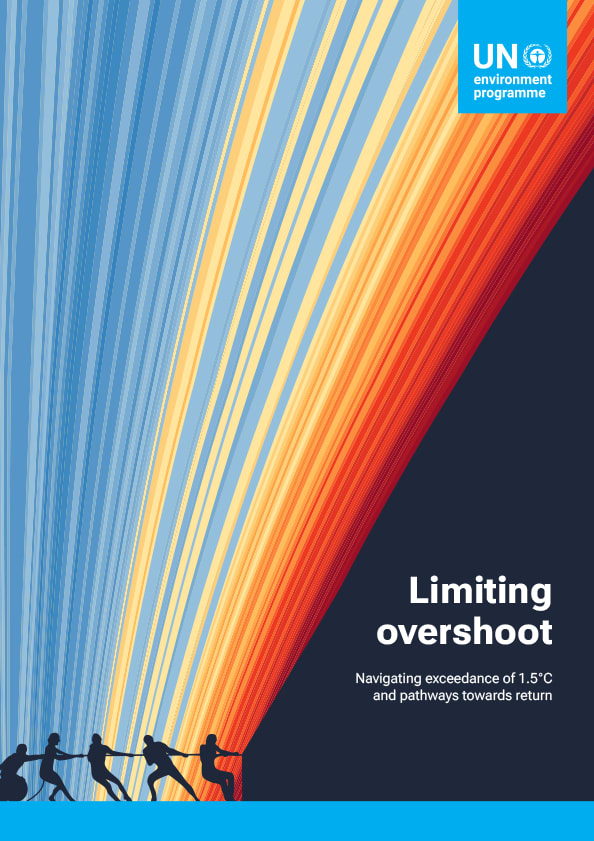
We live in a time of deepening animal and climate emergencies. These are not just words but very real existential risks. The United Nations Environment Program’s Limiting Overshoot - Navigating exceedance of 1.5°C and pathways towards return report, released on September 2, 2026, states that we are inevitably going to crash through the 1.5 limit within the next three to five years. This will result in more extreme weather events and increased suffering for animals and people. Droughts, floods, wildfires, heat waves, and elongated disease vectors in a warming world are already devastating animals and humans, and it will get much worse.
UNEP’s cover shows a collective attempt at holding back the catastrophic global warming and negative tipping points we are heading towards. We can turn the Titanic around by shifting to renewable energy and a plant-based food system.
Scientists have been warning humanity to turn the Titanic around repeatedly. Earth Systems scientist Johan Rockström, head of the Potsdam Institute, was on the BBC’s Climate Question this month answering, “So can we bring the planet’s temperature back down quickly?” Rockström repeated that the 1.5 Celsius warming limit is not a political target but a scientific limit. His team mapped 16 key climate tipping points, and even crossing 1.5 C most coral reefs will disappear, there will likely be massive glacier melt and collapse like we saw in Nepal. Further global warming could risk Greenland and West Antarctic Ice Sheet collapse, the loss of the Amazon rainforest, and collapse of the North Atlantic overturning of heat. The problem is that we are heading not only to 1.5 this decade, but 3.3 by the end of the century, and that would mean much more extreme weather, greater instability, and also crossing more tipping points. Rockström says, “We have to turn this around very, very rapidly… we know that if we scale the solutions of healthy food, clean energy, better consumption and production patterns, it will give us a more prosperous and more equitable and more modern and attractive future. So we are sitting with the winning story and it’s definitely worth the effort of doing everything.”
Already, we see signals that the food and ecological systems are getting less resilient, and human and nonhuman animals are facing the impacts. The food system contributes one third of the world’s greenhouse gases, and animal agriculture is the primary cause of the methane emergency, biodiversity loss, land use, acidification, and phosphorus and nitrogen pollution. This, in turn, causes heat waves, flooding, and droughts, which cause suffering to farmed animals and wildlife. The Open Letter highlights the stark suffering imposed by climate change impacts on millions of hens, billions of wildlife, and quintillions of insects as well as billions of humans this century. We need to mitigate climate change as a central priority to reduce animal and human suffering. For example, here are some of the signals:
This summer’s heatwave killed 2.5 to 3 million chickens and turkeys in France, overwhelming carcass collection services in Brittany and Pays de la Loire, the country's two largest chicken farm regions.
One billion sea creatures were slowly cooked and killed in the warming oceans off the coast of western Canada during the 2021 heat dome, which had the hottest recorded temperatures in Canada. These included intertidal animals—such as mussels, clams, sea stars, and barnacles.
Three billion wild animals were killed or displaced by the Australian mega wildfires in 2019-2020. The wildlife toll included 143 million mammals, 2.46 billion reptiles, 180 million birds, and 51 million frogs, according to the World Wide Fund For Nature.
Global warming directly threatens and harms the lives of quintillions of insects due to changes to ecosystem niches. According to an article in Science, “with current pledges, corresponding to ~3.2°C warming, climatically determined geographic range losses of >50% are projected in ~49% of insects, 44% of plants, and 26% of vertebrates.”
Mangrove forest cover is being removed in Indonesia to expand shrimp farms, reports BBC’s Climate Question’s special segment “Where have all the mangroves gone?” Instead of funding shrimp welfare campaigns the emphasis should be on preventing new shrimp farms from forming by promoting plant-based alternatives.
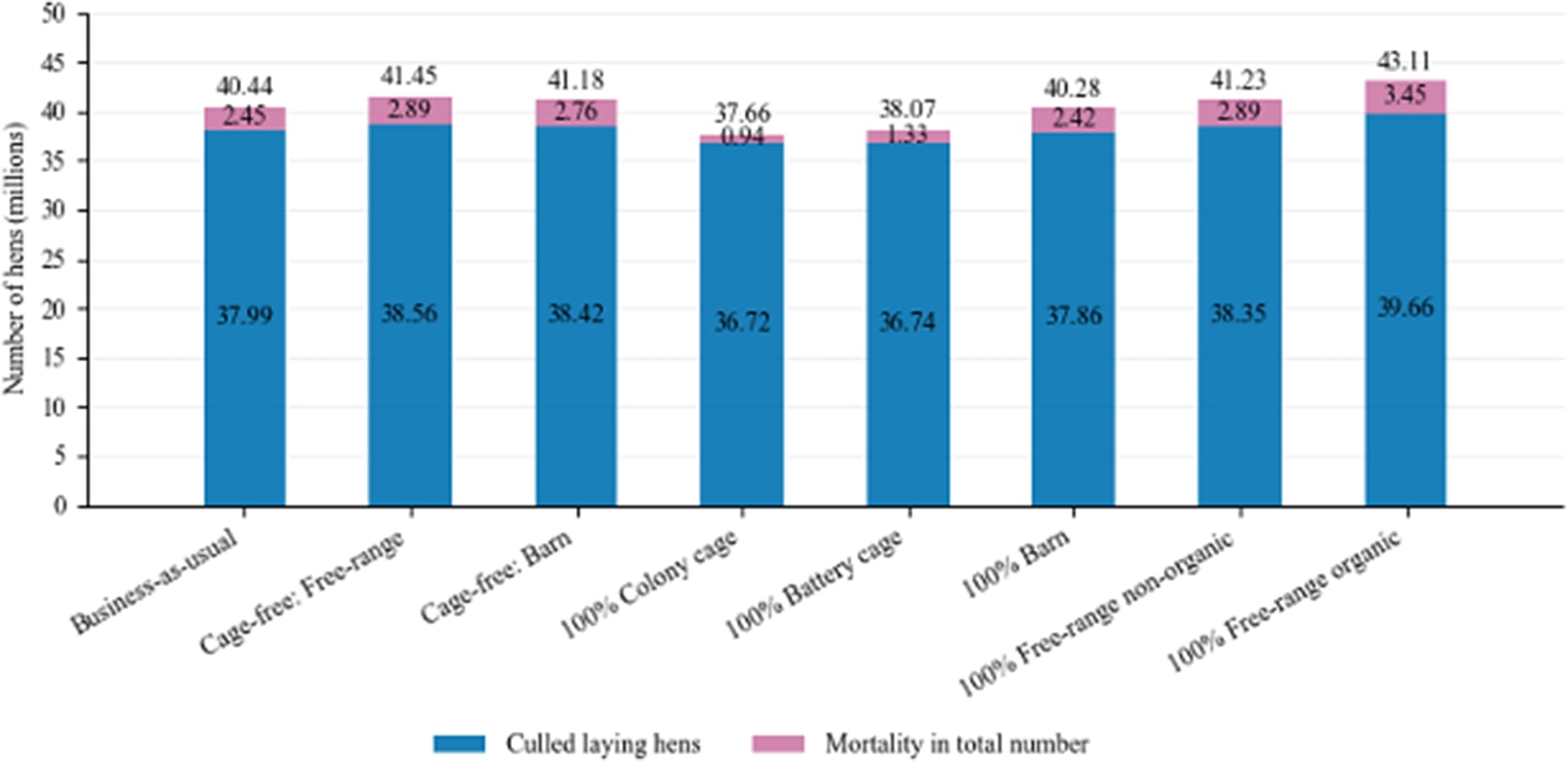
A 2026 UK egg industry study found that converting the UK’s egg supply to organic free-range would nearly double greenhouse gas emissions compared to a fully caged system. Cage-free systems would require 1.68 million more hens to match the same quantity of eggs produced from battery cage systems. Animal welfare improvements within animal agriculture exacerbate environmental harms. Cage-free egg systems increase greenhouse gas emissions, eutrophication, acidification, and land use relative to caged systems. Plant-based foods, on the other hand, offer a pathway that avoids this select-welfare–environment trade-off and performs better across all animal and environmental protection indicators.
Welfare outcomes under different national egg-production scenarios. The business-as-usual scenario estimates the hen population required to maintain national egg production at 2022 levels. Seven alternative scenarios are modelled: cage-free free-range, cage-free barn, fully furnished cage, barn, free-range, organic, and battery-cage systems. The total hen population is divided into hens slaughtered at the end of the laying cycle and hens that died during production.
The campaign was inspired by: (1) the “AI Windfall” entering the animal movement which provides a great opportunity to reduce animal exploitation and suffering and simultaneously address climate change, health, food security, and reduced pandemic risk, and (2) a talk by PETA's Tracy Reiman at the Animal Vegan Advocates (AVA) Summit in Toronto this past May. See PETA’s White Paper on the Failure of Cage-Free Housing Systems to Reduce Overall Hen Suffering, which found that the welfare of hens in cage-free egg systems is “either marginally improved, unchanged, or, in some respects even worsened.” Chickens raised in cage-free systems face higher rates of keel bone fractures, cannibalism, injurious pecking, feather loss, much worse air quality, and are at a higher risk of bacterial and fungal infections.
Animal welfare, climate & health concerns
Caged
Cage-free
Plant-Based
Breeding to maximize egg production at the expense of hen well-being (ovarian cancers, egg blockages, and prolapses)
Same
Same
Best
Killing of male chicks
Same
Same
Best
Beak searing (“trimming”)
Same
Same
Best
Induced molting
Same
Same
Best
Disruption to biological rhythms due to lighting
Same
Same
Best
Overcrowding and smothering
?
?
Best
Hen mortality
?
?
Best
Footpad dermatitis
?
?
Best
Inability to spread wings and preen
Worse
Better
Best
Inability to turn around
Worse
Better
Best
Inability to forage
Worse
Better
Best
Inability to build nests
Worse
Better
Best
Risk of bacterial and fungal infections
Better
Worse
Best
Social hierarchy stress and conflict
Better
Worse
Best
Poor air quality leading to pulmonary, tracheal, skin, and eye injury
Better
Worse
Best
Injurious pecking, feather loss, and cloacal cannibalism
Better
Worse
Best
Keel bone injury due to falling and aggression
Better
Worse
Best
Mass killing due to infectious disease
Better
Worse
Best
Greenhouse gas emissions
Better
Worse
Best
Eutrophication potential
Better
Worse
Best
Acidification potential
Better
Worse
Best
Land use
Better
Worse
Best
Communicable disease
Worse
Worse
Best
Risk of zoonotic disease*
Worse
Worse
Best
Antibiotic resistances
Worse
Worse
Best
Food borne illnesses
Worse
Worse
Best
Poverty and inequality
Better
Worse
Best
Protein efficiency
Worse
Worse
Best
Access to food
Better
Worse
Best
Affordability
Better
Worse
Best
AI’s third wave philanthropy
No
No
Yes
*free range is even worse for the risk of spreading zoonotic diseases (during an outbreak, free range chickens need to be moved indoors)
Recommendations
(1) Broaden the Effective Altruism philosophy beyond utilitarianism and adopt a new impact metric focused on reducing the total number of animals bred into the food system.
We need to go beyond Peter Singer’s utilitarian approach, which has had a limiting impact on campaigns giving preference to concerns about animal suffering and welfare reforms. What is needed are a deontological philosophy and a holistic, ecological systems approach. Deontology is a philosophy of duty and rights: in this context, an animal is not merely property and a commodity but an individual or a subject-of-a-life with rights and personhood.
In a holistic systems approach, the key metric would be the number of farmed animals used in the food system. At present, cage-free campaigns are based on the number of animals spared from cages, a method which does not encourage a reduction in the total number of animals that are bred and leads to an increase in environmental impacts.
Peter Singer also made the case for ending factory farming in his book, The Most Good You Can Do: “eliminating or decreasing the consumption of animal products will benefit animals, reduce greenhouse gas emissions, and lessen the chances of a pandemic resulting from a virus evolving among the animals crowded into today’s factory farms, which are an ideal breeding ground for viruses. That therefore looks like a high-priority strategy.”
(2) Develop an “Action Plan for a Plant-Based Future” that addresses both supply and demand
Developing a plan that includes a shift in farm subsidies towards fruits, vegetables, grains, legumes, nuts, and seeds; public information campaigns; city and national action plans for plant-based food; alternative protein innovations; plant-based procurement at institutions such as councils, universities, schools, and hospitals; plant-based days like Meat Free Mondays; science-based country food guidelines; and plant-based by default. Plant-based meal replacements are cost-effective, like New York City defaulting to plant-based meals in public hospitals saving over $500,000 a year.
(3) Create a High Ambition Coalition for Plant-Based Food Systems Transformation to bring people and organisations together around a shared goal: moving away from exploitative animal farming and towards the transition to plant-based food systems. Convene funders, animal protection organizations, plant-based food system advocates, climate scientists, public health experts, and food justice organizations for open dialogue on how philanthropic funding for plant-based food system change can generate benefits across multiple societal challenges.
The world is facing mounting polycrises due to animal, climate, biodiversity, and potential public health emergencies. Cross-sectoral collaboration is essential to meet these unprecedented challenges and to maximize the impact of social movements and philanthropic funding.
I was born at the end of the cold war, unaware of the danger we were emerging from. Duck and cover drills (as if those could protect schoolchildren from a nuclear blast) were a curiosity of the past.
The farmer-poet Wendell Berry, who wrote about the dread of nuclear war, died recently. From his 1968 “The peace of wild things”:
When despair for the world grows in me
and I wake in the night at the least...
Summary
Over the course of a year, the Fieldshaper program develops you into a field-leading grantmaker. You’ll steward $1,000,000 in grant capital, receive a $125,000 annual stipend, and deploy that capital within a sub-field of one of three key areas (farmed animals, global health, or philanthropic infrastructure); building the track record to become a grantmaker who can shape a field.
Role Details
* Title: Grantmak...



This comment section felt a bit brigaded here, which I don't love.
I'm sympathetic to debating strategic disagreements in the animal welfare movement, and appreciate you bringing these ideas up and pushing for what you believe is the right approach.
There were 2 things that stood out to me:
I don't think utilitarianism gives a preference to welfare reforms — it's that welfare reforms have a strong track record of being effective, while these other approaches don't. Peter Singer himself wholeheartedly embraces animal liberation, literally! If the utilitarians thought that things beyond welfare reforms would work, and were cost-effective, they'd do them. It isn't because of their principled commitment to utilitarianism that they disagree.
Secondly, I think that many of the donors and EAs would stop being EA donors or EAs at all if deontology became the norm. At least speaking for myself, I am not aligned with EA because it is EA, but I'm aligned with EA because it is more aligned with my values (which are very utilitarian). I suspect this is true for many EA-motivated people. If EA changes, it doesn't mean the donors will change their values.
I think an important question for people who aren't excited about new funding entering the space going to welfare reforms is "why are these new donors are interested in funding animal welfare work at all?"
I think the answer is because cage-free campaigns, etc. demonstrated that helping animals at scale was possible, and because welfare-motivated advocates demonstrated that something could be done to help animals effectively.
No animal welfare advocate controls where these donors give — if the movement today decided to pivot to plant-based advocacy and stop doing welfare stuff, it's plausible significantly less money would be donated to helping animals. There isn't a pot of unlimited money controlled by animal advocates — there are donors who have specific values and priorities, and organizations who will make the case to those donors that their work should be funded. The pitch should be to the donors (who actually will decide these things), not to EA as a whole, and has to overcome the fact that you're pitching against the thing that might have gotten many of them excited about animal advocacy in the first place.
Hi @abrahamrowe
Thanks for your thoughtful and engaging comments. I appreciate going into the reasoning of the philosophical ideas as well as interests and institutions (the 3 Is).
The philosophy used is the starting point before speaking about strategies and campaigns because it limits what the focus is. The focus on utilitarianism and thus welfare results in looking at reforms in factory farms rather than taking a strong anti-factory farming position. This is not effective in a holistic, ecological systems perspective,we are trying to show in the Beyond Cage-Free Open Letter and Report because welfare campaigns like cage-free eggs and "welfare tech" tend to treat animal rights (animal as subjects or persons), climate change, freshwater and land use, biodiversity, health, pandemic risk, and food security as externalities and thus don't count all they should. They also tend to fixate on one animal welfare reform at a time and unfortunately there are multiple atrocities hens face, for example, and PETA's White Paper shows that several improvements in hen welfare may cause new suffering in other areas so total welfare isn't improved. The argument is we need a holistic math for animals and if we did so, plant-based food system change campaigns are necessary.
Why don't we choose this win-win solution then?
My background is in political science and we use the 3 Is to look at human constructed ideas, interests and institutions that shape our views, attitudes and behaviours. Ideas like philosophies can act as barriers. Utilitarianism is very useful and helpful but it also has limits. It's a bridge to far for individual rights. The classic critique of utilitarianism is that it can be oppressive for the individual as in the Gladiator analogy (in Rome, the joy of crowd could be taken to outweigh the suffering of the gladiators). Also, it make assumptions that one can accurately predict and properly weigh consequences in the future based on one's calculations and decisions. Deontology or philosophy of duty to respect a subject-of-a-life and to do the right thing in the present needs to be added so that animals are not treated like commodities and get legal rights of personhood (this goal was vital in other social movements from anti-slavery to the women's movement). It changes the focus on the animal protection movement beyond welfare tweaks in factory farms to an anti-factory farming and anti-animal exploitation stance and thus favours a shift to a plant-based food system.
In addition, we need to adopts a complex systems worldview (like in Fritjof Capra's The Turning Point - depicted in the film Mindwalk, or more recent one described in books like George Monbiot's Regenisis, Kate Raworth's Doughnut Economics, and Tim Lenton's Positive Tipping Points) to address the existential polycrises we face.
This takes us to interests and institutions. The AI donors may in myopic terms prefer to work with Big Ag (and make profits creating robots and machines for factory farms and slaughterhouses and increase their efficiency and profitability) but it's not ultimately in their or anyone's interest because of climate change, water use, societal instability, food insecurity and so forth. So we need to organize people power, organizations and experts across sectors, and policy makers to change the system and incentive structure so everyone does the right thing. Those at the top of different systems might have the wrong incentives so we need to help them through organizing to do the right thing. It's not their fault, it's the system that pushes people in directions that aren't always ideal for living beings and their survival and flourishing. Hence we launched this Beyond Cage-Free campaign. It's not easy. There's a lot of anxiety that comes with challenging the 3Is - ideas, interests and institutions. It starts with the understanding that everyone who is mentally sane has good intentions but systems shape attitudes and behaviours in not great directions sometimes. The way to reduce that anxiety is to try to be as constructive and positive as possible in promoting a paradigm shift and to alter how interests are perceived and try and construct big tent institutions that are inviting and inclusive.
With regard to your second point, many esteemed EA folks are not leaders in Anthropic. For example, @Holden Karnofsky helped start Giving Well and then Open Philanthropy Project which became Coefficient Giving. The hope is to convince Anthropic leaders like Holden and Coefficient Giving leaders like AMA: Lewis Bollard, Open Philanthropy to adopt a holistic complex systems approach to evaluate the most necessary funding needs in our time. There is no doubt among Earth System and climate scientists like Johann Rockstorm that we need to shift away from animal agriculture to plant-based food systems to address the animal, climate and planetary boundary crises. Animal agriculture produces the majority of the greenhouse gas food emissions and is the leading cause of biodiversity loss, land use, freshwater use, acidification and nitrogen and phosphorus and nitrogen use. Kate Raworth, an Oxford economist and vegan, adds humanitarian crises to planetary boundary concerns in her doughnut economics. It would be great for all of us to get together and use Claude and Open AI to assist in a new systems calculator and choose projects to help us solve our cascading crises and truly produce a better world for animals (human and nonhuman).