First of all, brilliant title. :D I think you make a really strong case and I agree with most of it, especially the framing of taste and price as science and engineering problems that only need to be solved once and can then scale globally.
One addition: I'd argue nutrition belongs on the list of hard problems of alternative proteins alongside taste and price, especially if the goal is to replace most or all conventional meat and bring animal numbers down close to zero in the long term.
Today's plant-based and cultivated meats haven't reached nutritional parity with conventional meat. That may not matter much if people only swap in some of these products, but it does if they are meant to replace conventional meat entirely. For example, someone who mostly eats conventional meat and occasionally plant-based meat doesn't need the plant-based meat to provide B12, iron or zinc. Someone who replaces conventional meat with it does, and conventional meat provides many nutrients beyond these. Both adoption and retention depend on how nutritious these products are perceived to be and whether they actually provide the nutrients people need.
Nutrition also fits your framework well: it's a science and engineering problem that can be solved once and then scale. But it needs to be someone's explicit goal, just like taste and price.
Plant-based meat: In the book, I note that plant-based meat is already much healthier on the issues that are most important for people in developed countries: heart disease, cancer, obesity, diabetes, etc. All of the products that did well on NECTAR’s palatability tests are lower in fat and saturated fat, higher in fiber, lower in caloric density, and higher in protein (protein/energy).
My guess is that these benefits will be sufficient to keep people in developed economies coming back (once the products are at taste and price parity), though I agree that fortification with B12, zinc, and iron would be a great idea. It’s also a very easy thing to do, and Impossible already does it. As the products get better and come down in price (or even sooner), I could see a voluntary standard for this put in place (and I would add protein to that).
Cultivated meat: The two pioneers are both medical doctors (Uma Valeti, who founded the first cultivated meat company, Upside Foods; and Mark Post, who produced the first cultivated burger, back in 2013, with a $1 million grant from Sergey Brin); they’re also both committed to ensuring nutritional superiority for cultivated meat. I think that’s a universal view.
Developing economies: Your point is even more important in, e.g., India and other developing countries, where micronutrient deficiency is a big problem. In chapter 1 of Meat, I share my conversations with Sarah LaHaye from the Global Alliance for Improved Nutrition about this precise issue. I think fortified plant protein and mycoprotein could be a key tool in the toolkit of global development agencies and similar. There’s some great work happening in this regard, and I’ve had some excellent conversations with people at Harvest Plus (the folks that put biofortification on the map) and others about it. This is also central to GFI India’s strategy.
Two questions about alternative meats recur most often on the EA Forum: Can plant-based and cultivated meat reach taste and price parity with conventional meat? And if they do, will people eat them
Of course, there is no dispute that PTC are important factors in people's food choices, but research in food psychology demonstrates these are not the sole or primary factors.
This is related to the second question you ask but not quite the same. I'd be glad to read your thoughts on the evidence Jacob adduces against the hypothesis. (And I am happy to focus the discussion on P & T rather than C.)
Jacob notes (and you quote): “there is no dispute that [price and taste] are important factors in people's food choices.”
I believe Jacob’s main point is that taste and price will not, by themselves, lead to broad adoption of plant-based meat. That’s true of course, but taste and price are still essential.
He does claim that they are “not the … primary factors” for consumer choice.
I think that’s just wrong: They are primary factors—both with regard to consumer food choice generally and also w/r/t consumer choice related to plant-based and cultivated meat.
You say, “I'd be curious to read your thoughts on the evidence Jacob adduces against the hypothesis.”
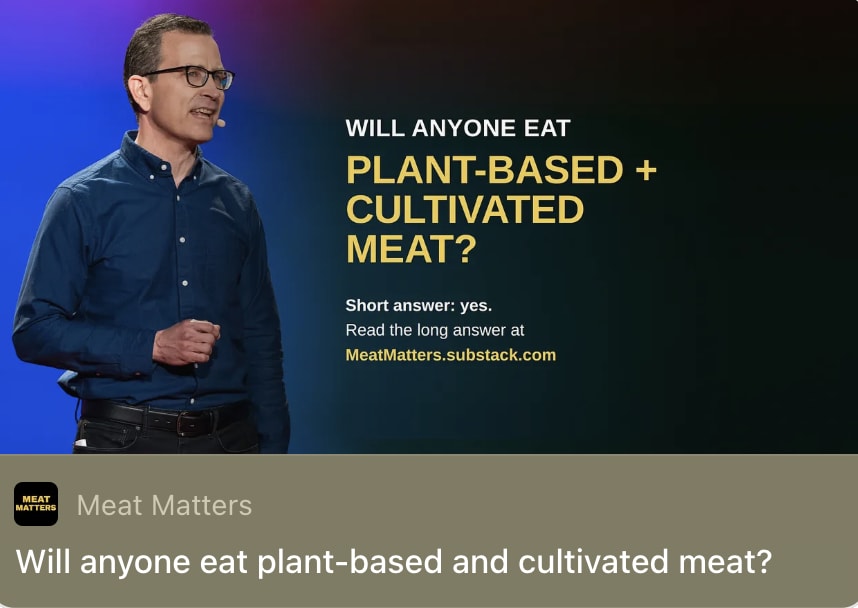
I believe that my Meat Matters essay on consumer adoption (Will anyone eat plant-based and cultivated meat?) replies to Jacob’s piece holistically, but let me know if you think something is missing, please.
That said, you can also read my full response here (as well as my back-and-forth with Jacob). (Warning: It’s long, and it's a point-by-point response. I think the Meat Matters essay is likely the better option here.)
In short: “I think that the discrete choice experiments indicate the opposite of what [Jacob suggests], and so too the three commercial case studies and Malan field trial, once more information is added to the analysis.”
I don't understand. We already have the technology to replace meat with legumes. It's already cheaper. Taste is comparable if you flavour them well. All that is missing is public will. I think people don't want to switch because then they would have to admit they were doing something bad their whole lives before. This will still be the case with meat alternatives.
You’re right that legumes are cheaper and can be delicious. I’ve eaten that way since 1987. But advocates have been making exactly this case for more than 50 years, and meat consumption is at record highs in the US and globally.
We're farming and slaughtering ~108 billion more vertebrate animals today than we were just 20 years ago, and that number just keeps going up. So I think we should reconsider whether just telling people to eat beans is our best course of action.
In chapter five of Meat, I hypothesize that food choices mostly happen in what Daniel Kahneman called system 1 thinking: fast and instinctive. Our values live in system 2. That’s why people tell pollsters they’re eating less meat and then order the chicken sandwich.
If you haven't read it yet, I hope you'll check out this essay, which explains why I think plant-based and cultivated meat can replace industrial animal meat. Please look, in particular, at the section on animal protection: "For people who love meat and care about animals, i.e., almost everyone." I think you'll have some of your preconceptions challenged.
Hi Bruce. I don't mean to say that telling people to eat beans will be most effective. I believe the underlying cause of people not going vegan is cognitive dissonance. Switching away from meat for ethical reasons requires us to admit that we think it is morally wrong to eat meat, and that we have been doing something morally wrong our whole lives thus far. I think this is what stops people, and I think cultured meat and plant-based alternatives don't fix this root cause.
Hey Elizabeth, it's great you love legumes! As a personal annecdote, I find it feels like a large sacrifice both flavor- and nutrition-wise to swap meat for beans. I would happily pay a premium for cultivated meat that reached parity in those two dimensions. Perhaps I'm typical minding here, but it feels like surely more people would be willing to switch once cultivated meat was also a similar cost. And even for people who are feeling cognitive disonnence, wouldn't you expect them to have an easier time getting past that if it didn't require them to immediately make a large sacrifice in their day-to-day eating?
Hi Lynette, I do agree that there are probably people who would be willing to switch to cell cultured meat, but there are also lots of people who wouldn't. As evidence of this, many states in the USA and some European countries have already banned cell cultured meat sales. So that's why I don't believe it is a silver bullet.
Thanks Elizabeth - Interesting. That's not my impression at all. I'm curious why you think that and also what you disagree with about my response andhere (in the section that is directly on point, flagged in my previous comment).
Actually, I'll go ahead and paste the relevant section:
For people who love meat and care about animals, i.e., almost everyone
In Meat, I tell the story of my friend Gene Weingarten, a two-time Pulitzer prize winner for the Washington Post, who (in addition to his award-winning features for the Post’s Sunday Magazine) wrote a weekly humor column for decades. A few of his columns had to do with how much he would love to stop eating meat, but how hard that is for someone who really loves the taste (which describes nearly everyone).
If you are a vegetarian, you almost certainly know dozens of people like this.
Other notable thinkers who feel (or felt) that eating meat is deeply immoral but also impossible to give up: Richard Dawkins, Sam Harris, and the late Charles Krauthammer, all of whom have made the case that industrial animal farming is a moral atrocity that future generations will view with the same sort of incredulous outrage we now feel about slavery.
Dawkins and Harris have both spoken about how enthusiastic they would be to switch to cultivated meat, even if it came with a hefty price premium, and Gene has said precisely that to me directly on multiple occasions.
The general public may not consider factory farming to be our generation’s moral scourge that is on par with slavery, but they do care about farm animal welfare. When farm animal protection measures land on state ballots, they pass by wide margins, even in conservative states like Arizona and Florida, both of which voted to ban gestation crates.
Anti-cruelty is so bipartisan that across ideologies, people will even vote against their financial interests in order to protect farm animals: When California banned cages and crates in 2008, the opposition flooded the airwaves with the message that voting yes would raise the price of eggs and pork. That won over the state’s two most important newspapers, the Los Angeles Times and San Francisco Chronicle, as well as the state capital’s daily paper, the Sacramento Bee, and others—all of which ran “vote no” editorials, with a focus on food prices.
Both liberals and conservatives voted overwhelmingly to ban crates and cages anyway; they saw confinement practices as simply indefensible, regardless of the cost of bacon and eggs. The vote was a landslide: 63.5-36.5%. Notably, conservatives turned out in droves that year to ban gay marriage (in the most LGBTQ-friendly state in the country): 52%-48%.
Those results are backed up by consumer research across the US and globally: Across a 14-country study that included the US and China, 87% of respondents said farm-animal welfare was important to them and 80% expressed support for strong anti-cruelty laws for farm animals. See also here, here, and here.
If an animal-free option matched meat on taste and price, I think you’d see meaningful adoption from people who would be relieved to stop participating in something they already dislike but don’t feel they can give up.
Hi Bruce, I did read the section of the essay. There are a lot of points where I don't agree so it's hard to discuss properly in a comments section.
When people say they want to give up meat but can't live without the taste - this seems like a flimsy argument to me and so I think it must be rooted in cognitive dissonance. The key components of flavour from meat we enjoy are fat and acid - fat and acid can easily be replicated with plants. People already use plants to make meat taste better such as plant oil, salt, pepper, oregano, and so many more. If really has meat such a wonderful taste we can't give it up no matter how atrocious we think it is, why would we need to add plants to improve the taste? Further - studies show that when we tell someone that a meal is vegan is decreases their perception of the taste. Taste is highly subjective and easily changes over time.
I believe that support for "anti-cruelty" protections against farm animals is another symptom of our cognitive dissonance. These kinds of practices enable us to say "I think this might be wrong, but it wasn't too wrong because they didn't do xyz-horrible-practice" and we continue putting off addressing the root cause of the cruelty.
If cell cultured meat will only be adopted if it matches on taste and price then it is a flimsy solution. Some places already ban cell cultured meat. Supermarkets already inflate the price of some products to lower the price of others. As mentioned above, taste is also dependent on psychological factors. We can't guarantee that cell cultured meat will ever meet taste and price expectations.
I hope this makes some kind of sense, so hard to communicate in this format.
I think its much more complex than cognitive dissonance, and to truly address the problem you have to push yourself beyond that simplistic reduction to understand the user who's behavior you're trying to change.
At least 4 other reasons I can think of: 1. Cultural traditions - That have sometimes persisted hundreds of years or longer, and go far beyond what we eat every day. How people gather, celebrate, mourn, and more with their people may have deep roots around meat. 2. A cook's repertoire - It takes a long time to develop a cooking style and understanding how meals come together, how to vary them, etc. To remove a central component of these takes time to re-learn how to build this out and become low-effort gain. 3. Flavor, texture, more - For most, eating isn't utilitarian to get nutrition, and is also one of the few things able to be enjoyed almost universally, regardless of income. No one wants to eat bland approximations of something else, or a bunch of mush. It takes work to replace meat's role in a meal regarding the variations in flavor, texture and more it can deliver. In particular, this is where plant-based has struggled, and cultivated meat has a real opportunity to address. 4. Awareness - Or a version of Hanlon's razor, "never attribute to malice that which is adequately explained by ignorance". Don't assume that everyone has been presented with the information you have, and even if they have, it was presented in a way that was made engaging (rather than adversarial and shaming...) or that they could truly connect to the scale or impact.
Thanks for your comment Paul, I agree I am being a bit reductionist. There are certainly other reasons that contribute. But I do believe that cognitive dissonance underlies the reaosns you list. For example
Cultural traidtions - most cultures ate meat pretty rarely compared to today's standards only until recently. For example, I am half greek and grew up believing that eating a lot meat was somehow part of my culture. In fact, my father's generation is probably just the first greek generation to eat meat on a daily basis. Looking at real traditional greek cook books, almost every meal is vegan or vegetarian. We never had access to the amount of animal products that we have today. I think to say that eating animal products at every meal like most people do in modern western society is a very surface-level tradition. If it is not really a tradition then why do we call it that?
cook's repertoire - i agree it takes time to switch to vegan and learn all new recipes, it's hard.
flavour texture, more - studies show that simply labelling food as vegan makes it taste worse than if you never mentioned it was vegan. I wonder if the perception that vegan food cannot match animal products is psychological? The key flavour components we like about meat are fat and acid, which can be replicated using oil and citrus/vinegar.
Awareness - most people know from sometime in childhood that meat is a dead animal. Why don't people connect with this information?
With the AI windfall, mental health may be taken increasingly seriously by mainstream EA. There’s increasingly room to explore the cause area and answer some of the biggest uncertainties; at the same time, costs of the most effective interventions are continuing to fall. StrongMinds is now treating for ~$35, about a third of GiveWell’s best guess from a few years ago, and is expected to...
Summary: The actions taken this decade may be exceptionally important for the future of civilization, but we should be unusually hesitant to proclaim that any course of action is “best.” Still, we should try to think carefully about how we'll influence the future.
This post was written as part of an introduction to a new reading group I’m starting called “Doing Good in the Age of AGI.” If you want to follow along, the full curriculum can be found ...
Unless plant-based or cultivated meat reaches taste and price parity with conventional meat, the amount of farm animal suffering will grow, with no end in sight.
If we succeed with plant-based meat, we can significantly decrease conventional meat production and the suffering it causes. If we succeed with cultivated meat, we have a real shot at eliminating industrial animal agriculture.[1]
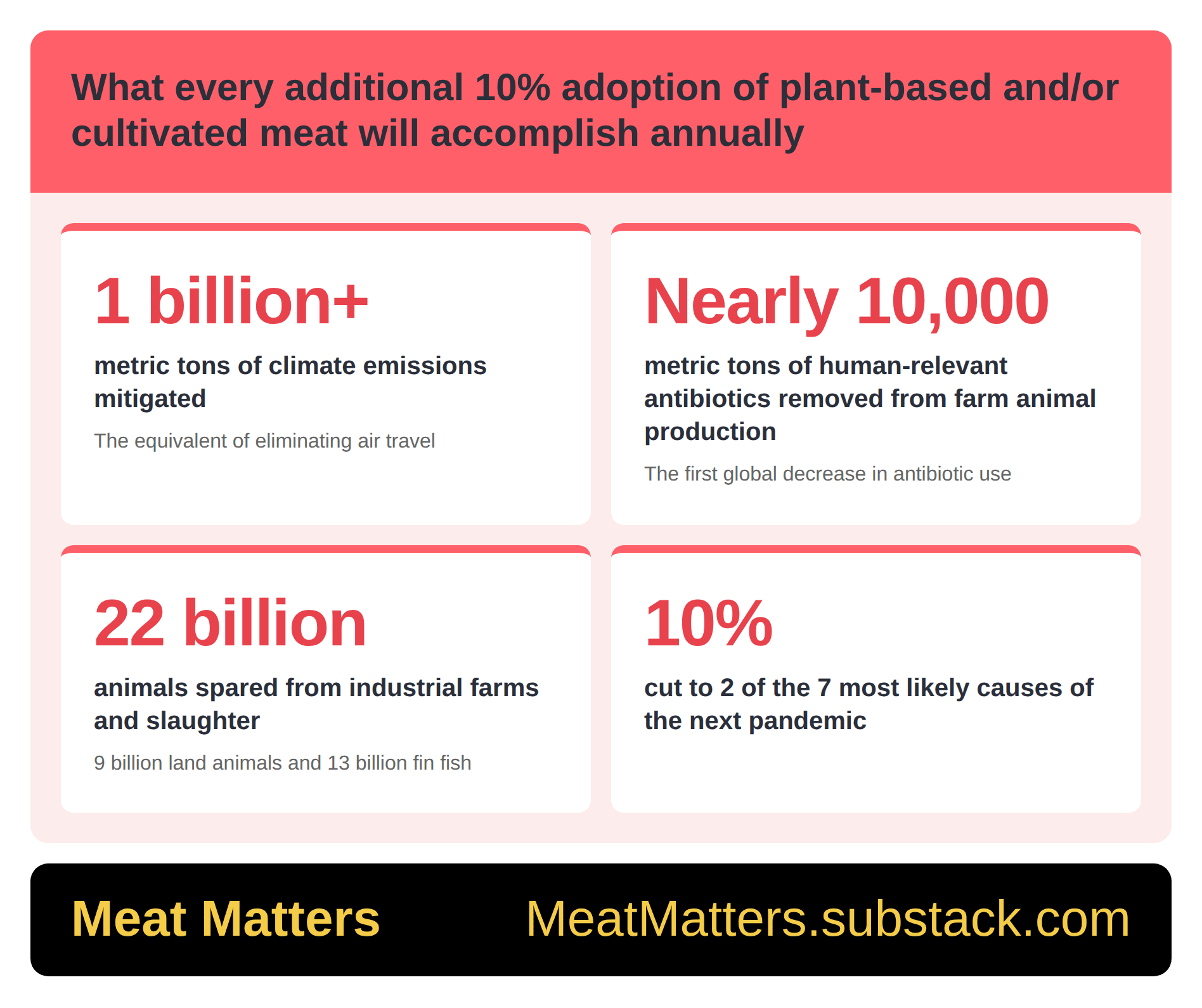
Even if we fall short of that goal, every 10 percent of conventional meat that we displace spares about 22 billion vertebrate animals a year, cuts about 1 billion metric tons of greenhouse gas emissions, spares roughly 130 million hectares of land from grazing animals or growing animal feed, pulls about 10,000 metric tons of medically relevant antibiotics out of the food chain, slashes naturally occurring pandemic risk, and more.
For anyone who wants to make the world better, this is a chance to help solve some of its biggest problems. The obstacles are real. So is the cost of waiting.
Since I'm writing for the EA Forum, I'll focus on animals.
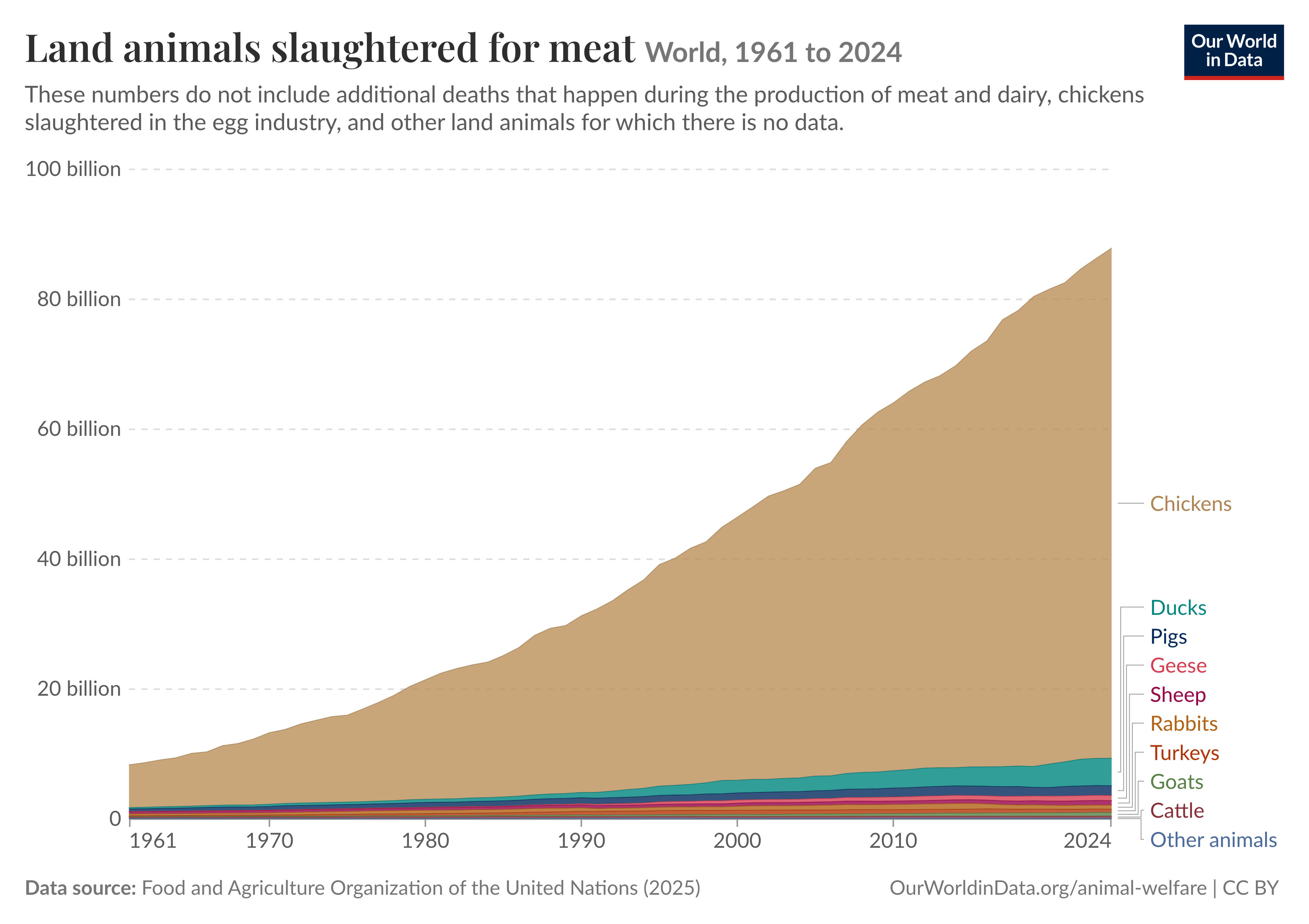
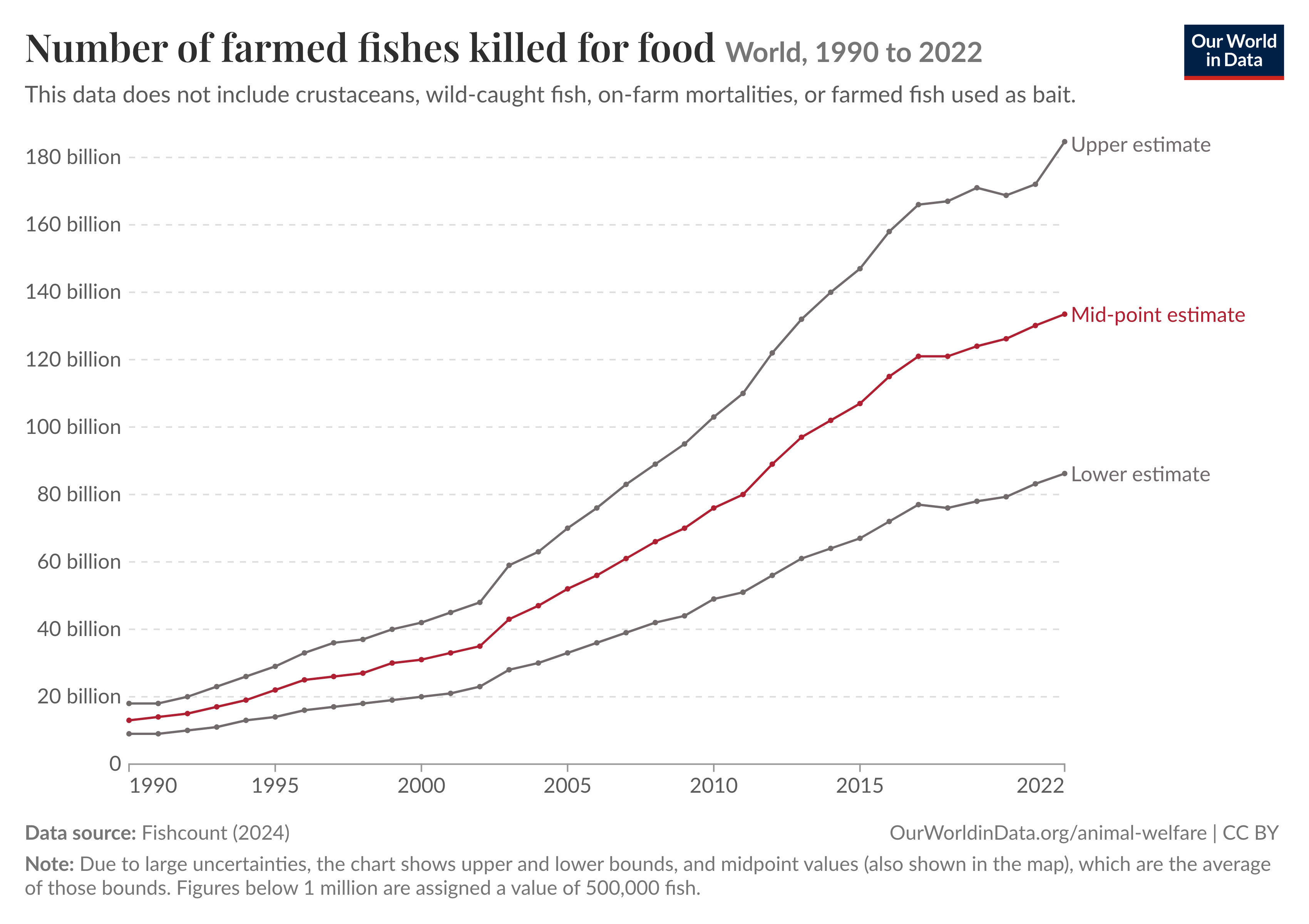
The number of animals farmed and slaughtered for human food is staggering, and it keeps growing.
And those numbers keep climbing, setting new global records almost every year since 1961, when the UN FAO started keeping track (there's been exactly one down year for farmed fish, and not a single down year for land animals).[3]
In the four decades since I adopted a vegan diet, global land animal meat production hasmore than doubled, and the number of slaughtered land animals hasmore than tripled (because of the small-body problem: disproportionate increases in chicken consumption, and chickens are small). Thenumber of farmed fish has grown roughly tenfold over a slightly shorter timeframe.
It’s impossible for the human mind to grasp numbers this big or suffering at this scale. But it’s worth trying, because every single one of these 220 billion animals matters as much as any cat or dog we know personally, and almost all of them are leading lives of misery and then dying horribly.
Alternative proteins are our best (and perhaps only) hope to reduce the number of animals farmed and slaughtered for food.
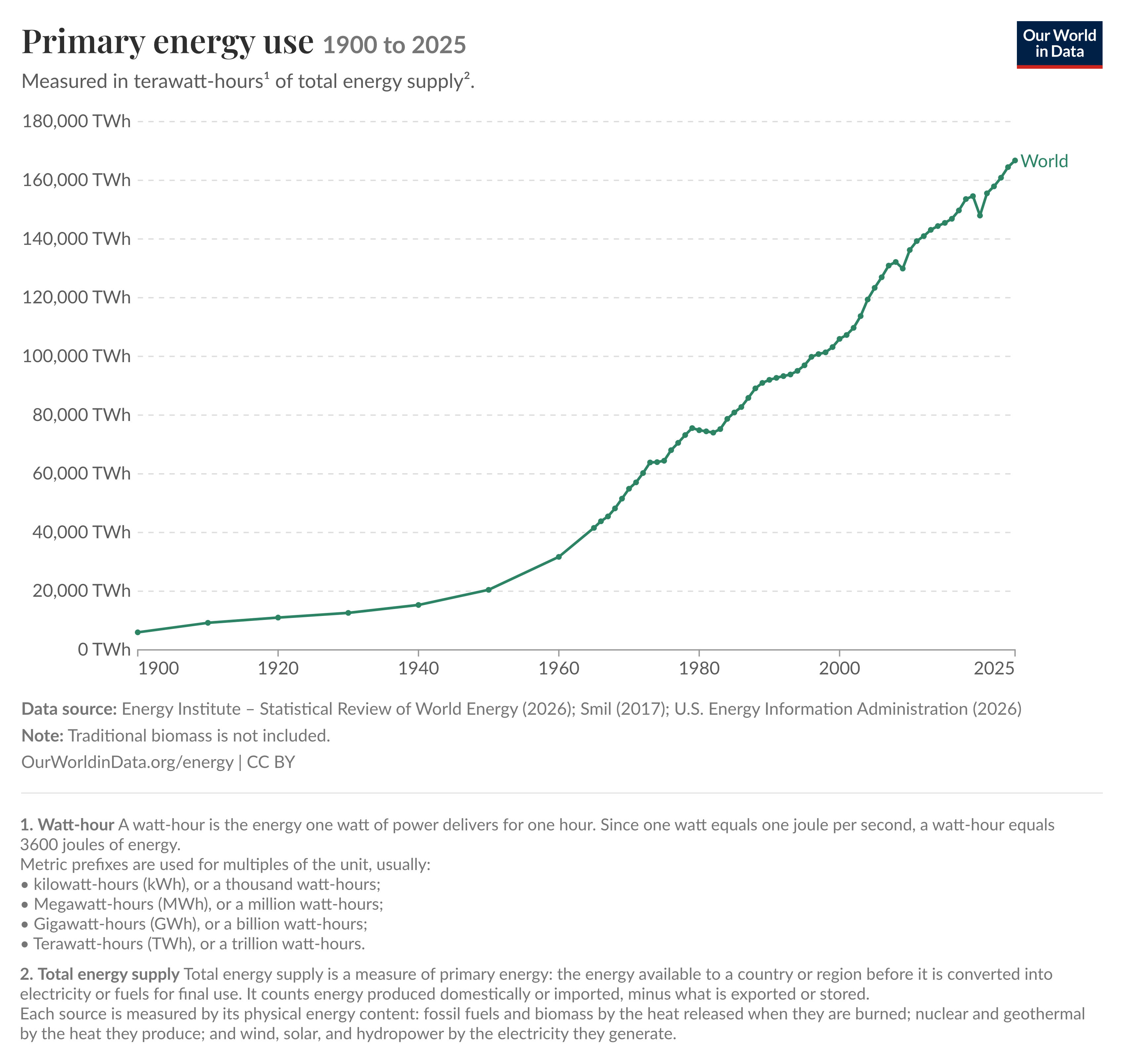
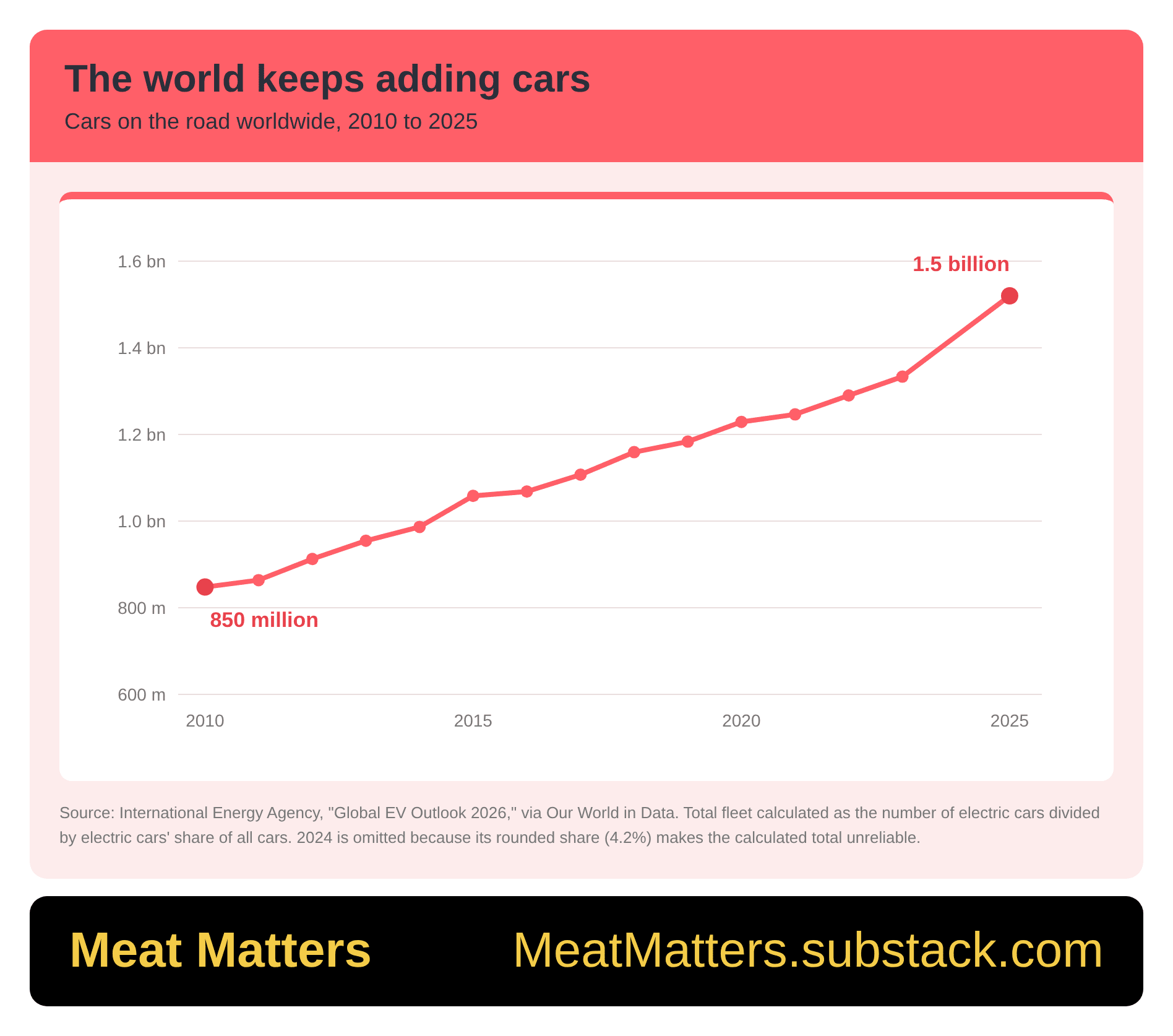
Plant-based and cultivated meat are to animal agriculture what renewable energy and electric vehicles are to fossil fuels and gas-powered cars: market-based solutions that change how we meet demand. The world is going to consume more energy and drive more miles as it gets wealthier. It’s also going to eat more meat. That’s why we need renewable energy, EVs, and alternative meats.
The goal of these supply-side interventions is to give people what they want, made differently and at a lower price: In addition to encouraging consumers to us less energy, drive less, and eat less or no meat, we can change how energy is produced, cars are powered, and meat is made. The trick is to eliminate what Bill Gates calls "the green premium": the difference in price and experience between the more environmentally friendly product and its conventional counterpart.[4]
Why diet change advocacy is not enough
For more than half a century, environmentalists, doctors, nutritionists, and animal activists have begged the public to eat less meat. Those efforts have surely slowed the growth of meat consumption, and I would like to see them continue and improve.[5]
But they have not reversed the long-term rise in global meat production (they have not come anywhere close), and it’s hard to imagine that changing. Even in the United States, the top 10 years for meat production arethe most recent 10. And all projections of global meat consumption into the future agree that, barring a global recession or something similar, both per capita and total meat consumption will keep rising through at least 2050.[6]
So let's take a page from the environmental movement: Let's figure out how to make meat that consumers love, but less expensive and without the suffering.[7]
The goal: Plant-based and cultivated meats that taste the same or better and cost the same or less, compared to conventional meats
The supply-side approach scales in a way nothing else does: Diet-focused progress has to be won over and over and over--person by person, cafeteria by cafeteria, or government by government. A campaign that works in Germany or Denmark has to be rebuilt everywhere else. There's not a market mechanism that will cause success in one area to naturally scale to other areas.
With alternative proteins, the hard problems are taste and price, and those are science and engineering problems. Solve them once, and industry and governments everywhere have reasons to spread them globally: profits and more robust and resilient supply chains for companies, GDP and food security for countries, as I discuss in chapters 9 and 10 of my recently released book Meat, which Publishers Weekly named a top ten new release in science earlier this year.
We’ve seen this before: The price of solar panels has fallen by 99.7 percent over the past fifty years and by 63.5 percent in the last ten, because the US, Japan, Germany, and China invested in it. Today countries that spent nothing at all on the research are building solar farms at prices very few people predicted just 10 years ago.[8] The Human Genome Project was funded mainly by the US government and carried out by 20 institutions in 6 countries. Its results were made public and now underpin medicine everywhere.[9] We can do the same thing for meat, with public investment in open-access research (GFI’s top priority worldwide).
Eliminating the most egregious abuses is important, but it’s not enough.
One area where advocates are making progress is farm animal welfare. And make no mistake: If you were a hen in a cage or a mother pig in a crate, you would want advocates working hard to get you out. I am extremely supportive of this work, which earns a significant chunk of my personal philanthropy.
But getting rid of the worst abuses (through welfare campaigns) and reducing the number of animals subjected to any abuse at all (through alternative proteins) accomplish different things.
Welfare improvements are deeply meaningful, but even with them, conditions on industrial farms stay atrocious, both physically and mentally. These improvements matter so much precisely because conditions are the stuff of nightmares, whether for animals on land or inwater.
Welfare wins are also hard to scale globally. Most have come in the United States and the European Union, which account for aboutone-fifth of land animals slaughtered (17.3 of 87.9 billion) and just north of1 percent of aquaculture (1.5 of 141 million metric tons).[10] Winning elsewhere is harder, and a victory in one country does not carry over to the next.
So we need both: reducing the suffering of animals on farms now through welfare campaigns, and reducing the number of animals farmed through alternative meats that reach taste and price parity with conventional meat. Plant-based meat can substantially decrease the number of animals factory farmed, and cultivated meat has a real shot at cutting that number to zero, as I discuss here.
The Forum’s top two questions: Will it work, and will people eat it?
Two questions about alternative meats recur most often on the EA Forum: Can plant-based and cultivated meat reach taste and price parity with conventional meat? And if they do, will people eat them? My first twoMeat Matters articles tackle these questions. Here are the short versions:
Scientific viability: More than 100 companies and hundreds of university scientists around the world are working to get cultivated meat to taste and price parity; those numbers are up from one (Upside Foods) and two (Mark Post and Marianne Ellis) just 11 years ago. At that point, Upside had raised just $125,000, which was all the private funding cultivated meat had ever received. Since then, costs have fallen by orders of magnitude, government funding and scientific progress have surged, and cultivated meat has gone from a $330,000 burger to full meals served to hundreds of people. I talk about why that's all quite mind-blowing inmy first Meat Matters post.
This feels a lot like solar and EVs a decade ago, when solar reached one percent of global electricity generation and EVs reached one percent of new car sales. For some cultivated meat companies, the central challenges now are regulatory approvals and securing the financing required to scale production. Those challenges are substantial, and success is far from certain, but the progress is deeply encouraging.[11]
Consumer acceptance: Consumer research suggests substantial interest in plant-based and cultivated meat, with good reason to expect that interest to grow further once products compete on taste and price (no product comes close right now).[12] At that point, benefits for food safety, the environment, global health, and animals can become additional reasons to choose them. On top of that, the economic and food security benefits give the meat industry and governments strong incentives to send price- and taste-competitive alt meats shooting up the adoption S-curve. I develop this argument here.
Will AGI or TAI solve cultivated meat? Let's make it happen!
Some effective altruists expect artificial general intelligence (AGI) or transformative AI (TAI) to solve the taste and price challenges for alternative meats, and so they wonder: What's the point of work on alternative meats now?
I’d love for that to happen, but I see at least three problems with waiting for it.
Second, work we do now can make alternative proteins easier to advance with AI. We need much better data before machine learning can be maximally useful, we need trained scientists, and we need functioning companies. And then technical breakthroughs still have to become products: Facilities need financing, production needs scaling, and products need regulatory approval. They also need political support and the public’s trust. All of that requires an ecosystem, and that requires work right now.
Third, speed matters. Every month, more than 18 billion vertebrate animals are farmed and slaughtered, each capable of feeling pain in much the same way we do. Animal scientist (and slaughterhouse designer) Temple Grandin has argued that they feel fear much more intensely than we do; in many cases, it’s incapacitatingly bad. And bioethicist Bernard Rollinhas argued that pain may be worse for non-human animals, because they don’t know that it will end; in the moment, their suffering is their entire world.
My AI dream: a frontier lab takes on cultivated meat
Rather than wait for AGI to make meat without animals, let’s ask the people building it to help now. The science and engineering have advanced far enough that I think a frontier lab (e.g., the life sciences teams at Anthropic or OpenAI, or Google DeepMind) could solve the core challenges of making cultivated meat affordable, as I discuss here (and in much more depth in Meat).
With their budgets, expertise, and connections, they could build the science and engineering roadmap for cheap cultivated meat and hand it to the world. With a bit more investment, they could speed up today’s startups or launch new ones, creating a thriving cultivated meat industry.
Most of the labs’ life sciences work focuses on medicine, and that work matters. But cultivated meat is a biology problem too, and solving it would end more suffering than almost anything else they could take on: hundreds of billions of vertebrate animals a year.
And think about how cool it would be to change the very nature of nature by removing the need for live animals as a precursor to the production of animal meat.[13]
If you’re at a frontier lab and want to talk about making this happen, please get in touch.
There is no plan B for reducing farm animal numbers, so let’s go all-in on alternative proteins.
If alternative meats fail, trillions more vertebrate animals will live miserable lives and die painful, terrifying deaths. Even if success were inevitable eventually (and I don't think it is), speed is a moral imperative: Every second, the world slaughters 2,800 land animals and 4,100 farmed finfish.
I believe that cultivated meat could eventually replace all industrial animal meat. But we don’t have to get anywhere near that goal to make an enormous difference. Displacing even 1 percent of conventional meat production means 2.2 billion fewer vertebrate animals each year living and dying in misery.
I think a lot about the history of science and engineering, and how much progress has depended on hundreds of people each making specific choices at specific moments. In retrospect, breakthroughs can look inevitable. But behind them are people who chose to work on a difficult problem, fund an uncertain idea, or champion a technology before its promise was obvious.
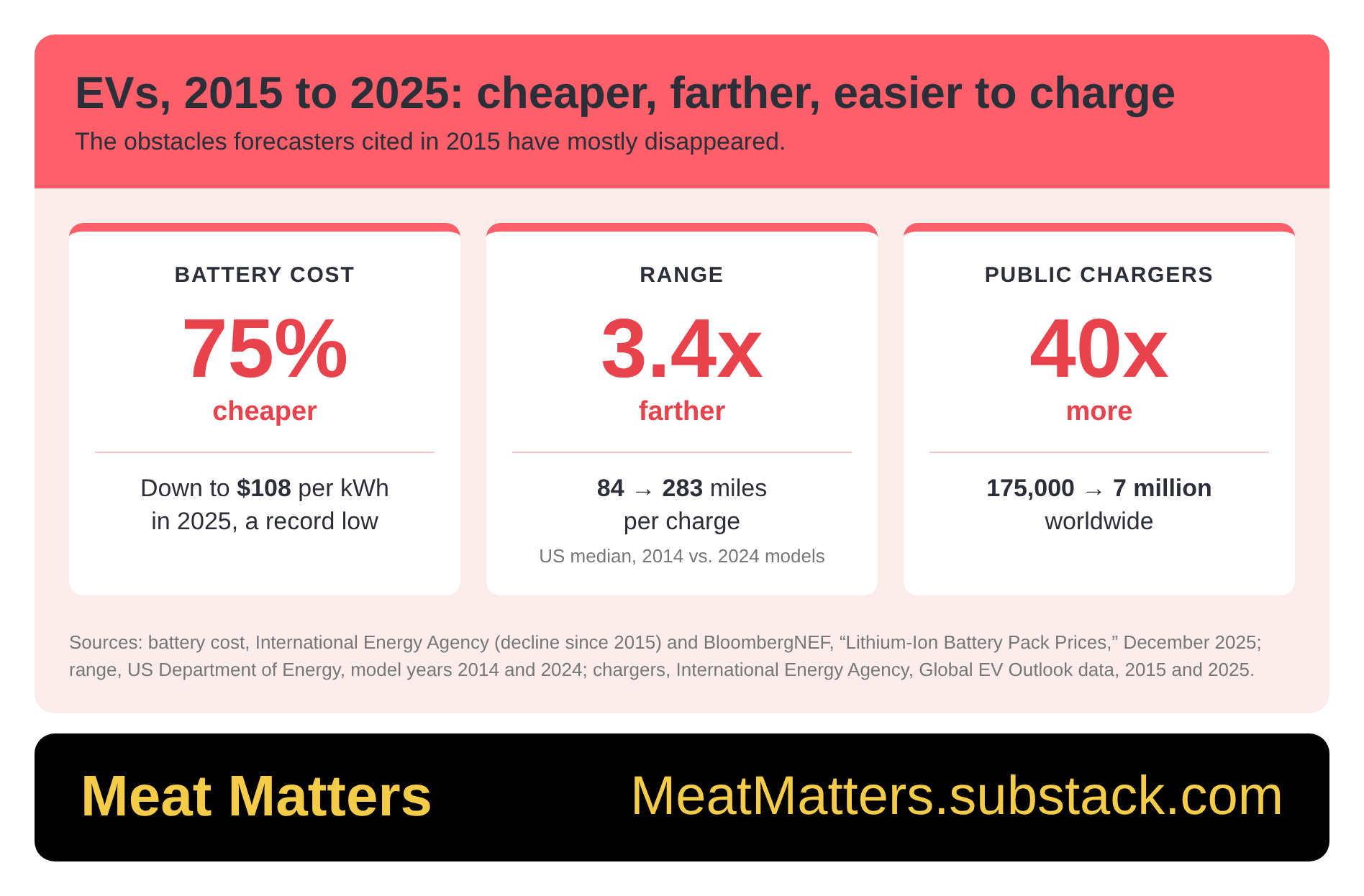
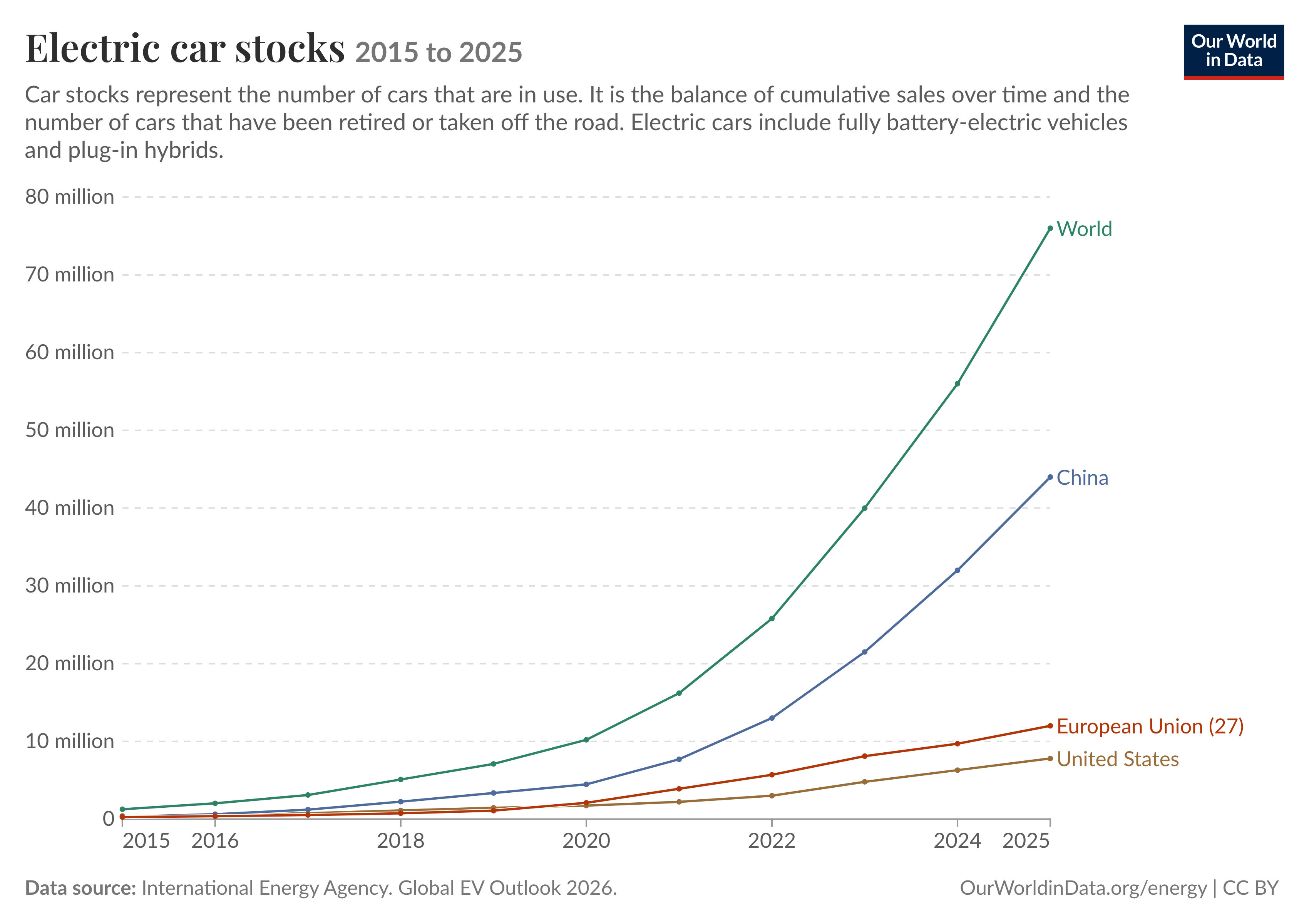
In 2015, the International Energy Agency expected electric vehicles to remain a small share of the global car fleet through at least 2040. Why? In the IEA’s words, “the cost of batteries, consumer caution and limited recharging infrastructure.” Yet in 2025, electric cars made up 25 percent of new car sales worldwide and almost 55 percent in China, up from less than 1 percent a decade earlier.
How did that happen? Government policies in Europe, China, and the United States drove down battery costs, improved range, and paid for charging networks. Since 2015, battery prices have fallen about 75 percent, typical range has more than tripled, and the world has built more than 7 million public chargers. And companies, starting with Tesla, built cars good enough to shatter stereotypes about EVs and the people who drive them.
Follow the chain back and you’ll find that dozens of people were instrumental, starting with Elon Musk, but also: the engineers at a tiny California company who showed Musk an electric sports car built on laptop batteries, the California regulators whose mandate gave Tesla billions in credits, everyone behind the controversial federal loan program that lent Tesla $465 million and saved the company from bankruptcy, the Chinese officials who helped Musk build a massive Tesla factory in 11 months (at a fraction of what it would have cost almost anywhere else), the three Nobel-winning chemists who made lithium-ion batteries possible, and so many more.
The same is true for solar energy, mRNA vaccines, penicillin, and the Human Genome Project, stories I tell in chapter 8 of Meat, whichRachel Bronson, former president and CEO of the Bulletin of the Atomic Scientists, wrote in the Bulletin "should be required reading for anyone interested in scientific progress."
In each case, hundreds of people (or more) took actions they easily could have skipped, and history would have turned out worse. And in the version of history where they failed, everyone would simply assume the naysayers had been right: that these breakthroughs were never possible.
Alternative proteins are at that stage now: promising but uncertain. If you’re an effective altruist deciding where to work or give, this field needs you: scientists and engineers, program managers, legislative staffers, policymakers, journalists, global health experts, philanthropists, and investors. Whoever decides to make this their life’s work could be the reason it succeeds.[14]
When asked which current practice future generations will see as deplorable, even committed meat eaters often name industrial animal farming. Examples include the late conservative pundit Charles Krauthammer, evolutionary biologist Richard Dawkins, and podcast host Sam Harris. It’s hard to imagine ending that practice unless we can produce the meat people love without farming and slaughtering animals.
I focus on land animals and finfish in this essay because the evidence that they can suffer, both physically and psychologically, is incontrovertible. Far more invertebrates are killed for food each year and, as Bentham’s Bulldog argues convincingly, there is plenty of reason to be concerned about them, too.
There have been three slight dips in the volume of land animal meat produced; those came in response to Mad Cow Disease, African Swine Fever, and Covid-19. Even in those years, the number of land animals slaughtered went up, as consumers shifted some of their consumption from beef or pork to poultry.
For EVs, that's the cost of the car, the car's overall appeal, and the convenience of driving it (mostly an issue of charging infrastructure and battery range). For solar and wind energy, that's cost and intermittency (the sun doesn't always shine, and the wind doesn't always blow). For alternative meats, that's taste and price.
I support education and diet change campaigns, just like I support efforts to improve energy efficiency and decrease car use. More efficient appliances, better-insulated buildings, and efforts to encourage people to use less air conditioning can temper energy demand. Better public transit, safer bike lanes, and efforts to encourage walking and carpooling can reduce demand for driving. All are worthwhile, but even combined, they haven’t bent the upward curves of energy demand and cars on the road. So we also need renewable energy and vehicles that don’t burn fossil fuels. Alternative proteins offer the same opportunity: meeting the world's undeniable and growing demand for meat by changing how we produce it.
And also without the contribution to antimicrobial resistance and pandemic risk, and with a tiny fraction of the contribution to climate change, biodiversity loss, and a host of other environmental harms. I discuss these topics in chapters 2 (climate change/our environment), 3 (AMR), and 4 (pandemic risk) of Meat.
Since 2015, solar prices have fallen from 74 cents/watt to less than 27 cents/watt. As a result, installed capacity has grown more than 10-fold in just 10 years, from 227 to 2,397 gigawatts. Solar isnow the cheapest way to produce electricity, which is why installed capacity has crushed the IEA's 2016 projections (it passed the agency's 24-year projection in just 8 years), as I discuss inMeat. In 2014, the Economistdeclared solar energy to be "by far the most expensive way of reducing carbon emissions.” Just 10 years later, an Economist cover story declared the “Dawn of the Solar Age.” Even the Wall Street Journalis now reporting that “the clean energy revolution is being driven by fundamental technological and economic forces that are too strong to stop.”
That 141 million tons includes molluscs, crustaceans, and aquatic plants. Counting only finfish, the world farmed about 66.26 million metric tons in 2024, according tothe most recent FAO figures. The United States farmed 207,813 metric tons and the EU 558,797, a combined 1.16 percent of the total.
I’m less optimistic about plant-based meat, mostly because I don’t think nearly enough effort is going toward achieving taste and price parity, both of which remain real challenges. In Meat, I make the point that you can’t solve problems you’re not trying to solve. In chapters 7 (on plant-based meat) and 11 (on timeframes), I discuss how few companies and scientists are focused on these challenges. Food Tank ran an excerpt from chapter 7 that covers some of this.
Electric vehicles could not meaningfully displace gas-powered car sales until they came down in price, gained battery range, and had charging infrastructure to support them. All three were required.
Solar energy could not meaningfully replace fossil fuels until prices fell and grids were integrated; both were required.
Similarly, plant-based and cultivated meat will not reach meaningful market penetration until they reach taste and price parity with conventional meat. Again, both are required.
To be clear, these are basic requirements, but that doesn't mean that solving these challenges is the end of the work. These requirements are necessary but not sufficient,as I discuss here. Meeting them creates the conditions for meaningful displacement; it doesn't finish the job.
According to results from the sensory testing initiative NECTAR (under the nonprofit Food System Innovations), no product has reached taste parity (a small handful come close). The beef products that come closest cost twice as much as their conventional counterparts at retail. The pork and chicken products cost even more.
Each agricultural revolution has moved farming away from nature: Roughly 12,000 years ago, farming animals moved them out of their natural state in the wild. Roughly 80 years ago, industrial animal farming moved them into mass confinement. Now, industrial chickens (99 percent of the flock in developed countries) are growing 6 times as quickly as they would naturally, and animals are fed massive amounts of drugs to keep them alive in conditions that would otherwise cause mass die-offs. In the US, regulations allow residues from 100 different drugs in meat (including ivermectin and ractopamine), as long as they don't go above a certain level. Alternative meats could eliminate all of that, creating much healthier and cleaner end products.
The conclusion toMeatreflects on some of the ways people can help accelerate the alternative meats trajectory. If you email me at brucef(at)gfi.org, I'm happy to send a PDF.
A few quick clarifications about what this article does and does not say:
What I am saying: Unless plant-based or cultivated meat reaches taste and price parity with conventional meat, the amount of farm animal suffering will grow, with no end in sight.
What I am not saying: This will definitely work. (If I thought it would definitely work, I wouldn't feel such a sense of urgency; whether it works our not is, I think, up to us.)
What I am also not saying: Alternative meats are the most important thing to work on. For all the reasons spelled out above, I think they're in the top tier. But there are quite a few cause areas and projects that share that top tier with them, including the range of farm animal welfare work.

First of all, brilliant title. :D I think you make a really strong case and I agree with most of it, especially the framing of taste and price as science and engineering problems that only need to be solved once and can then scale globally.
One addition: I'd argue nutrition belongs on the list of hard problems of alternative proteins alongside taste and price, especially if the goal is to replace most or all conventional meat and bring animal numbers down close to zero in the long term.
Today's plant-based and cultivated meats haven't reached nutritional parity with conventional meat. That may not matter much if people only swap in some of these products, but it does if they are meant to replace conventional meat entirely. For example, someone who mostly eats conventional meat and occasionally plant-based meat doesn't need the plant-based meat to provide B12, iron or zinc. Someone who replaces conventional meat with it does, and conventional meat provides many nutrients beyond these. Both adoption and retention depend on how nutritious these products are perceived to be and whether they actually provide the nutrients people need.
Nutrition also fits your framework well: it's a science and engineering problem that can be solved once and then scale. But it needs to be someone's explicit goal, just like taste and price.
Great comment - thank you. I agree with you.
Plant-based meat: In the book, I note that plant-based meat is already much healthier on the issues that are most important for people in developed countries: heart disease, cancer, obesity, diabetes, etc. All of the products that did well on NECTAR’s palatability tests are lower in fat and saturated fat, higher in fiber, lower in caloric density, and higher in protein (protein/energy).
My guess is that these benefits will be sufficient to keep people in developed economies coming back (once the products are at taste and price parity), though I agree that fortification with B12, zinc, and iron would be a great idea. It’s also a very easy thing to do, and Impossible already does it. As the products get better and come down in price (or even sooner), I could see a voluntary standard for this put in place (and I would add protein to that).
Cultivated meat: The two pioneers are both medical doctors (Uma Valeti, who founded the first cultivated meat company, Upside Foods; and Mark Post, who produced the first cultivated burger, back in 2013, with a $1 million grant from Sergey Brin); they’re also both committed to ensuring nutritional superiority for cultivated meat. I think that’s a universal view.
Developing economies: Your point is even more important in, e.g., India and other developing countries, where micronutrient deficiency is a big problem. In chapter 1 of Meat, I share my conversations with Sarah LaHaye from the Global Alliance for Improved Nutrition about this precise issue. I think fortified plant protein and mycoprotein could be a key tool in the toolkit of global development agencies and similar. There’s some great work happening in this regard, and I’ve had some excellent conversations with people at Harvest Plus (the folks that put biofortification on the map) and others about it. This is also central to GFI India’s strategy.
Thanks for commenting!