This is awesome! There are a number of factors that make sharing AI safety career opportunities feel particularly valuable to me right now:
AI safety roles are more abundant and lucrative now than ever before.
Salience of AI risks are higher now than ever before.
Concreteness of what people can be doing to help feels higher now than ever before (see the latest Holden Karnofsky 80k episode)
I think Jen’s approach is very impactful (and creative/cool!) For anyone reading this post: I think that reaching out directly to CS/ML people in your life (e.g, SWEs who have been laid off or are fearing layoffs) to make this case and share career infrastructure resources (80k, Bluedot, High Impact Professionals, ARENA, AI Safety Map etc) represents an enormously high-leverage opportunity for impact
Nice - very happy we were able to support this. So far we've received 5 course applications crediting your post (from what I can tell) - will update with admission results here.
On Friday, May 22, I posted a 'Plea to the Laid-off' on LinkedIn, leveraging my voice as a former Googler. With tremendous support from the community, I got 27 inbound calls in 24 hours & received a small Rapid Grant from BlueDot to fund the post as a Linkedin ad for 12 days.
Note: While I’ve been funded by Coefficient Giving for my EA SF efforts, this specific project was on my own accord and outside my grant period.
Some stats from the article (as of June 2, 12 days post)
2.2k views
423 social engagements (269 reactions)
118k Impressions (# of times content appears in front of a user’s screen)
105 saves & 8 sends
120 followers gained (and about that many connection requests)
Actual engagement
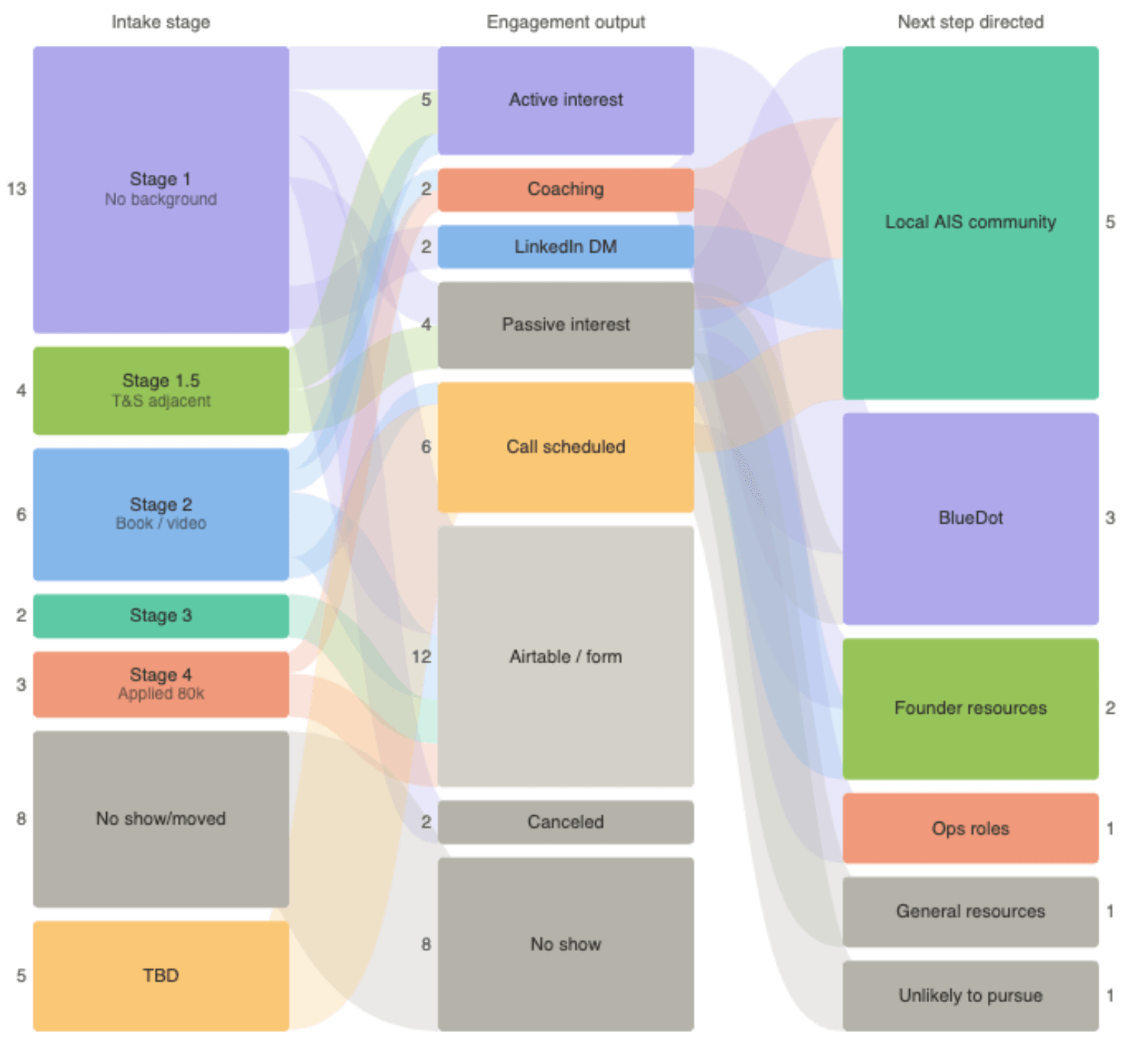
27 inbound calls
13 airtable intake submissions (after removing my calendar after Day 1)
~10 Linkedin messages w/ varying degrees of engagement
2 - Read an AIS book (The Alignment Problem, Superintelligence), 80k article, or video
3 - Applied to BlueDot
4- Applied to 80k roles
Due to no shows & cancellations & future calls, I have had ~11/27 calls so far. We’ll cap this as the pilot scope. 12/41 from the sankey are sitting in the Airtable intake form as my capacity calibrates.
Expectations vs Reality
I expected to be having conversations with people in Stage 2, people who are fully AIS-pilled. From here, I can work with their convictions and guide them to the next steps, weed out the good-fit signal from the noise: programs/fellowships to pursue, local community engagement, pathways discussions, or warm introductions.
Instead, many of the calls entailed introductions or calibrations to the AI Safety field overall.
Lesson: Intake forms sooner would have helped filter & sharpen my audience.
This became an experiment that took a different angle. I got to interact with people who haven't yet found an on-ramp through BlueDot, Successif, or SteadRise. People at varying stages of readiness for the AIS ecosystem, but people we desperately need to engage in order to influence policy and public will (i.e., the upcoming Alex Bores Democratic Primary in NYC).
High Impact Plug: Have you reached out to your friend in NYC to get their vote in a neck-and-neck race for June 23?
Observation 1: What even IS AI Safety?
Many people came into the call with either their own perspective on AI Safety or a general understanding that AI could cause harm.
Specifically, individuals from a T&S background came into calls with an understanding that was an extrapolation of T&S.
“AI safety is this — two lenses to that, right? How users would abuse AI, and how AI internally would generate content that is non-compliant…”
“For example, let's say I generate a creative and … somehow I have introduced some form of a resemblance to some satanic symbols... and motivating people towards some sort of a cult — then it could be a safety issue”
“I'm a dad, and…I had read about this story of a teenager committing suicide. And it broke my heart. So that being said, how can we do a better job to kind of capture the harms or failure modes that these models create?"
I think it’s hard to get someone AIS-pilled (to the level of conviction hiring organizations may want) without a longtermist/EA lens.
Making the case for GCR is really similar to making the case for EA cost-effectiveness. Asking someone to consider longer-term sci-fi-esque intangible outcomes as opposed to the issues that AI is posing now and soon (job displacement, T&S).
Observation 2: Paradox of Choice - AIS resource guides are too much for a low-context individual to navigate.
In my guide, I’ve linked resources; while walking a technical SWE through potential destinations in AIS, I pulled up the guide and realized that it is indeed too much information for a low-context individual to navigate without insight into what the journey actually looks like.
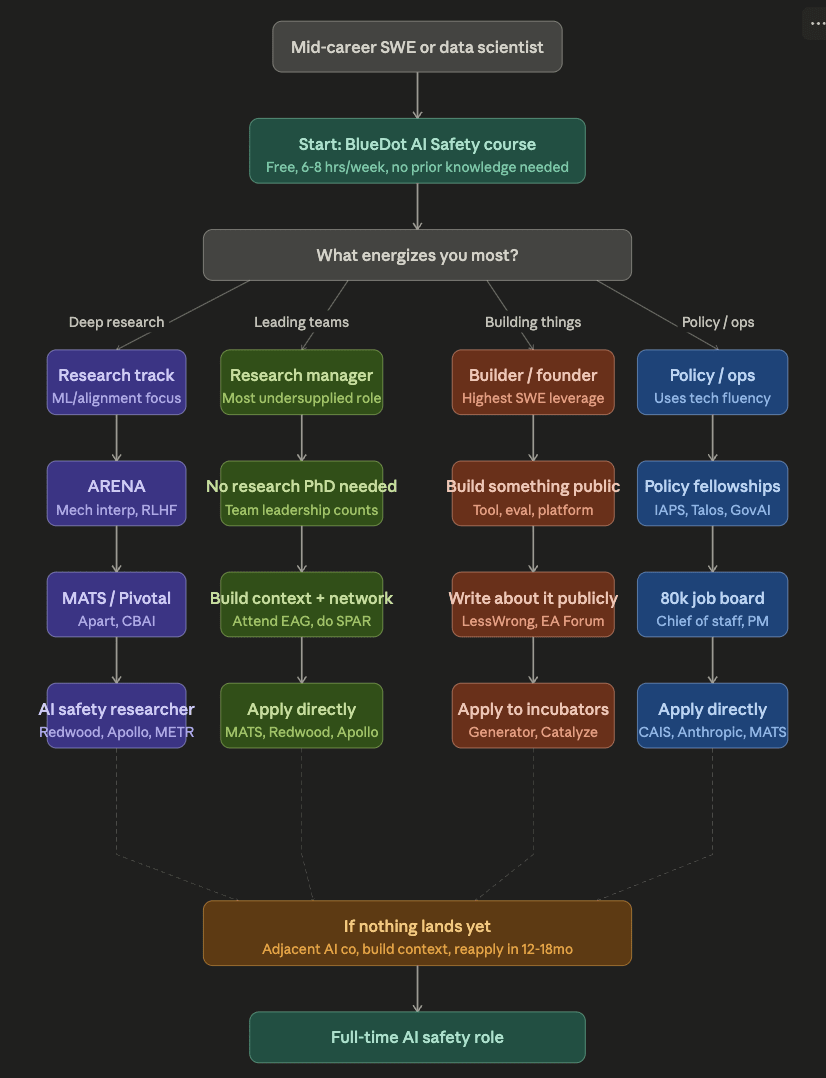
So, I ended up creating my own as a conversation piece/framework with the caveat that research is competitive but everything else is desperately needed!
On another call, I was talking to a senior Product professional on potential outcomes and navigated to the 80k job board, filtered by Seniority level, and realized that this is also difficult for a new individual to navigate and find relevant information/prospects.
Lesson: We can’t just send people guides or job boards: understanding the field & potential outcomes/destinations appears to require high-context guidance.
Outcomes & Impact
Like the value of an EAG, it only takes a few impactful ones to make it worth it.
From these calls, I came away with:
2 Bronze tier individuals: Keep in touch as opportunities arise.
One is a Business Systems early professional - a role I see openings for at MATS or Constellation somewhat consistently. I think there would be a lower bar to entry for them to find a role in the ecosystem.
One is a parent with a philosophy background working on their own AI evaluations. They could be an interesting candidate for AIS incubators.
1 Silver tier individual: Online check-in
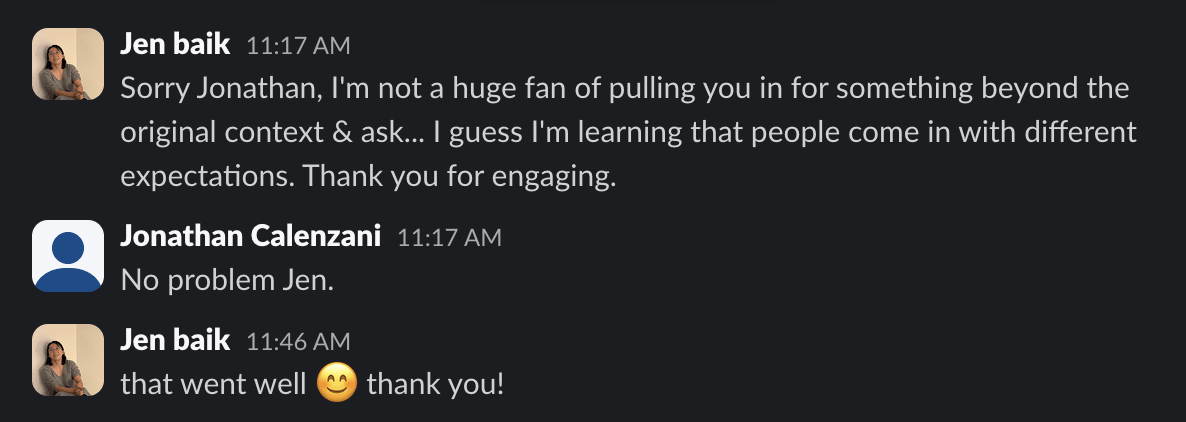
I had the gracious Jonathan Calenzani (EA NYC Organizer) included on the call for an NYC-based individual. This individual got plugged into events at the Collider. I may reach out to check in on how they’re doing next month.
"... money is not really the most important thing anymore. And I do want to do something that's a little bit more fulfilling, maybe doing something that's a little bit more for the common good, hopefully."
"I know obviously I have a pretty robust background in data science but I know this is a different kind of role too. So it doesn't kind of automatically make me qualified. I'm also thinking about how to sort of frame my experience."
2 Gold tier: Monthly check-ins and active coaching
My follow up emails.
To a Berkeley-based self-motivated Senior individual in Stage 2:
Here are the resources we discussed in order of priority:
Blue Dot courses - It seems like you have a lot of various educational inputs. Focusing here may be best.
Let's get your name into the ecosystem - apply for mid-career professional advising here
To understand the AI Safety research landscape, SPAR has a fantastic database to give you a flavor.
Follow up: I sent you a calendar invite for late June. Feel free to decline or move as the time approaches.
To a London-based individual in Stage 4:
What a great conversation! Here are some resources in order of priority:
1. Sign up for Coaching from EA UK - they will know best how to plug you in and get you into the ecosystem. Don't go on this journey alone!
2. After coaching, ask for advice on applying for a career transition grant. They may recommend you wait until you have a more concrete theory of change.
3. Engage with the AIS Community. Seeing that you are in London, these might be some fantastic ways to get plugged in:
Opportunity to support a pro-bono project or initiative >
Use this as an anchor for the career transition grant + applications >
Apply to roles/create your own organization/Fellowship acceptance
Some conclusions, hypotheses, and questions I don’t have answers to:
Mission Alignment & Longtermist Thinking
Resonating with EA principles significantly increases an individual’s likelihood of AIS mission alignment.
Alternative ways to attain mission alignment without resonating with EA: parenthood, self-motivated interest in AIS books.
In which roles is mission alignment absolutely critical vs in which roles is it a nice-to-have?
Ranking: Research - Policy - Program Management - Hard Ops/Systems
Interestingly, this ranking somewhat mirrors talent scarcity in each track.
If someone is highly skilled and generally cares, do they have to be GCR-pilled in order to have a place in the AIS ecosystem?
Value of 1-1 Conversations & Coaching
How valuable is it to have an AIS conversation with an individual where the outcome is passive interest/awareness?
Perhaps this sector should mainly be reached by scaled initiatives like Frame Fellowship content, not 1-1 conversations.
Is there a need for regular monthly coaching for people in-between fellowships and roles? Between BlueDot and tangible impact?
Successif, Steadrise, and other coaching outlets appear to be at limited capacity with specific intake criteria.
Talent ecosystem & user journey needs help
Generalists in the AIS ecosystem remain confused about where they fit.
Even technical individuals are confused. There is not a like-for-like for “here is what your job title was in Tech” & “here is what your job title is in AIS”.
First, there's the friction of getting up to speed on the field, then there's the separate friction of figuring out where you actually fit.
This is why existing local communities matter. a ton.
What indeed is the impactful place for an individual with a Trust & Safety background? These individuals are indeed mission-driven and close to the technology. Perhaps Policy?
Additional resources I’ve found helpful for understanding the talent ecosystem
As an active participant of Make-EA-Not-Emotionless movement, I'll share that this was a tough project at times:
being unsure if this was an impactful project (hint: if the counterfactual is zero, this is fine),
feeling like my time wasn't respected (multiple no shows, one weird call where the participant came in without recalling why they set up time with me in the first place while I would take the time to prepare for the conversations),
wishing there were a more connected EA city organizer community (Jonathan + an NYC individual landed well, I had a Boston-based individual who I didn't know how to get plugged into the local community).
When a call goes off the rails & then another goes super well!
Update (July 2026)
Some results within the month:
2 headhunt connections leading to speed running a potential candidate,
experienced professional partook in the Breaking Barriers Hackathon + introduced to EA UK,
~5+ new attributed applicants to BlueDot,
1 mid-career program lead accepted into Frontier Security Residency in Vegas
[unknown #] applicants to Successif, BlueDot advising, 80k advising, Steadrise, HIP, CEA Bootcamp
Ops candidate reached the late interview stages for a role - results tbd,
another sr. professional attended Manifest to network within AIS,
TL;DR
* GOAL 3 is a social enterprise that created IMPALA, a patient monitoring and digital platform system for low-resource settings. There is also a GOAL 3 foundation that raises funds to ensure underserved communities will be reached.
* A recently completed report from Rethink Priorities calculated IMPALA to have a cost per DALY averted of $7–17 in paediatr...
This month effective altruism has gotten lots of attention, including a cover story in The Economist. It feels pretty surreal to be on the receiving end of it. But I feel grateful these ideas have caught on, and even more grateful for the drive, earnestness, and compassion of so many people who took strange but well-argued ideas seriously and then actually acted on them....
Cross-posted from my Substack.
Epistemic status: I’ve puzzled over this for a long time but I’m not sure I came to the right answers. I'm sharing this partly because it might help others work on resource allocation, but mostly because some smarter reader might tell me how to do it better.
TL;DR:
* I he...

Thank you for writing this! This is extremely cool.