Comments
Consumer Adoption of Plant-Based and Cultivated Meat: The Case for Optimism

I recently posted my second “Meat Matters” Substack, which is about consumer adoption of plant-based and cultivated meat.
In the post, I make the case that:
I was inspired to write it by posts from a handful of EAs, mostly on this Forum, so I wanted to hop on here and address those posts explicitly. The posts in question seem to me to:
What follows are some thoughts on those three concerns.
Aidan Kankyoku wrote in August: “Not only are [consumers] not willing to pay a penny more for cultivated meat; if it cost the same, most of them would still choose 'natural' meat from animals. Many would choose to keep eating animals even if cultivated meat were substantially cheaper!”
Two things that I think Aidan and others on the Forum sometimes miss: First, consumer surveys are a snapshot of how people respond in the moment, when asked about a hypothetical product; for most respondents, these are not firmly held views.
Second, the surveys that exist are much more encouraging than this framing suggests, as I discuss in more depth on Substack, but here's the short version:
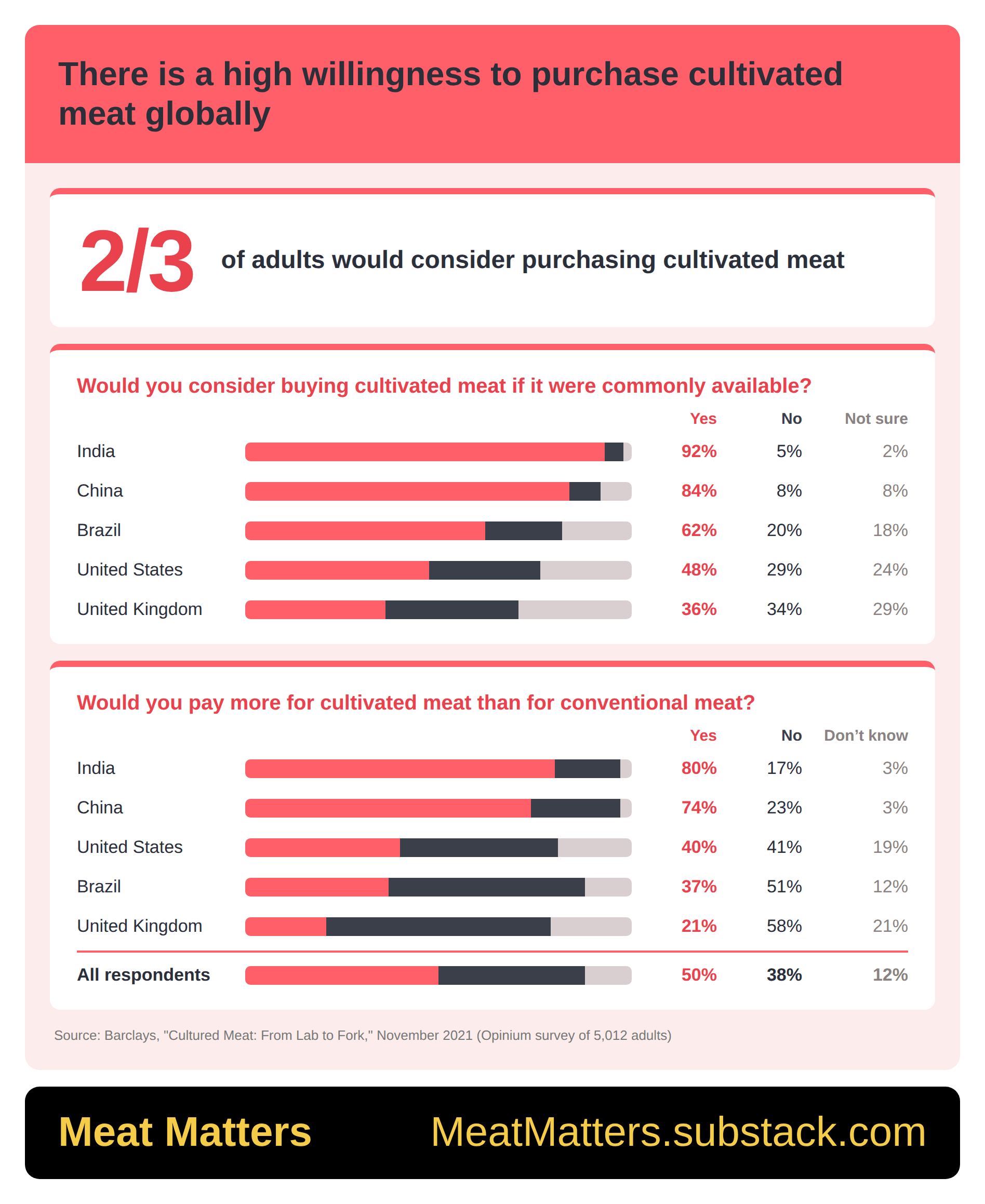
All of these observations bode well for products that satisfy the most important factors for consumers, which are taste and price.
This is not to say that progress happens by magic, of course. But once plant-based and/or cultivated meats reach taste and price parity with conventional meats, their other attributes will appeal to consumers in a way that they can't now, because taste and price appear to be threshold conditions. I explain how I see this going on Substack.
Several recent posts express doubts about consumer adoption of alt meats, relying on claims that I don’t think hold up:
In order:
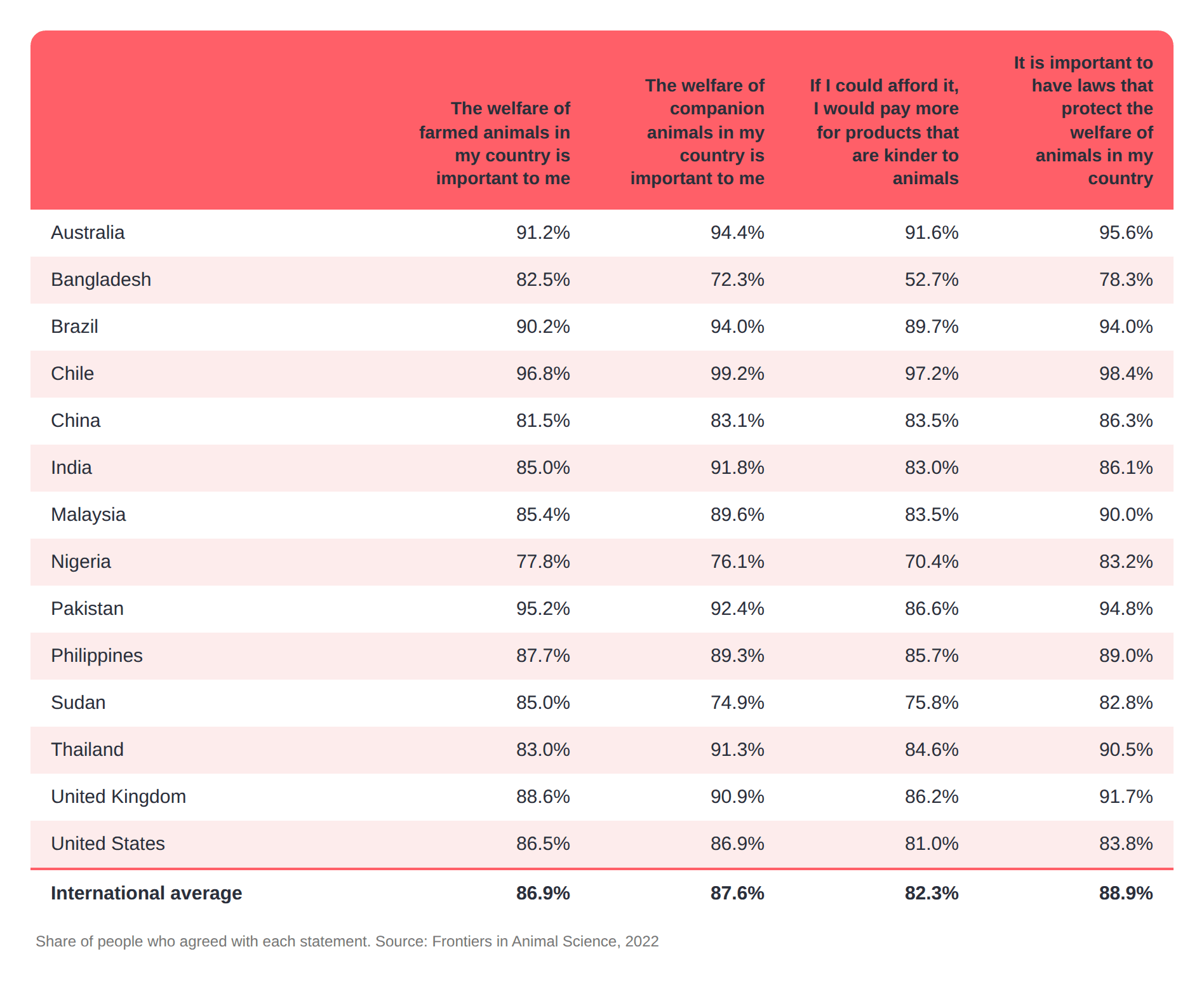
Most consumers care a lot about chickens, and in a bipartisan way. That’s why the EA farm animal movement has been so successful with welfare campaigns. Aidan makes this point himself later in the same essay, noting that consumers “would be willing to pay a premium for higher welfare meat” and that Vital Farms “has become the second largest egg brand in the United States by revenue by charging three to four times the cost of a typical battery cage egg.” That’s strong evidence that consumers care, and I offer more on Substack.
The state bans were driven by politics, not public contempt or fear. They were political posturing, or cronyism, or both, depending on the state. I’m not aware of a single one that reflected any significant segment of the state’s population expressing contempt or fear about cultivated meat. America’s two largest meat trade groups, the Meat Institute and the National Cattlemen’s Beef Association, both opposed the bans, as did the meat industry’s house organ, Meatingplace (very colorfully!), and a long list of conservative NGOs and media outlets.
People have plenty of reasons to prefer cultivated meat. We have lots of evidence that many millions of people will want cultivated meat more than conventional meat: See the polls and widespread consumer concern about food safety, climate, and animal protection that I cite in my post. And the global health community has its own reasons to get on board, from antibiotic resistance to pandemic risk. Once products satisfy the two things consumers care about most (taste and price), these secondary considerations can play a much bigger role in consumer decisions.
I agree with Bentham’s Bulldog that we’re living in “the most important time in history for farmed animals.” The decisions we make right now will determine whether industrial animal farming endures or ends.
The two principal interventions focused on decreasing the number of animals raised for food are: 1) diet change and nudge interventions; and 2) alternative meats.
I believe that diet change advocacy deserves more EA resources and creative thinking than it gets, but I’m not under the illusion that it can move fast. And scaling globally will be a huge challenge. (Those two things are also true of welfare reforms, which I also vigorously support.)
Plant-based and cultivated meat are different, though: Properly resourced, they can both move fast and scale globally. If someone cracks affordable cultivated meat in South Korea, Israel, China, or the US, that solution can spread to the whole world quickly.
The breakthrough could also happen at Anthropic, OpenAI, Google DeepMind, or SpaceXAI. I continue to hope that one of these companies will use their resources and the power of AI to create a science and engineering roadmap for cheap cultivated meat and then hand that roadmap to the world. I think I’ll call this “My Anthropic Dream.”
Alternative meats may still fail, of course. But if that happens, my best guess is that the cause will be insufficient resources or poor execution, not an insurmountable scientific or engineering barrier. That's because the science and engineering behind cultivated meat look increasingly promising, according to the scientists working most closely on the remaining challenges.
What success looks like
The number of animals raised and slaughtered for food every year is unfathomably large: Roughly 90 billion land animals and 130 billion finfish were farmed and then slaughtered in 2024 and 2022, respectively, the most recent years for which we have data.
And slaughter of both land animals and farmed finfish has climbed steadily for as long as anyone has tracked them. For example:
Alternative meats are the one thing that could eliminate industrial animal meat altogether, just like electric cars seem likely to eliminate gas-powered cars (albeit more slowly than we expected a few years ago).
Speed of progress toward that goal matters a lot: Each 1% unit of progress spares 900 million land animals and 1.3 billion farmed finfish from farms and slaughterhouses every year. So every moment of delay has real consequences.
Everyone reading can affect whether alternative meats succeed, and how fast.
What happens next depends on whether we can get costs down, taste right, and governments to fund the open-access research and scaling incentives that get us to taste and price parity.
Fortunately, we have incredibly strong incentives for governments to fund both research and infrastructure, as detailed in the Center for Strategic and International Studies' 5,000 word report, which argues that the US government should prioritize its alternative proteins industry, treating the economic potential as similar to “pharmaceuticals, clean energy technology, and advanced chips for artificial intelligence.”
Once we're there, vast numbers of consumers all over the world are ready right now to shift to plant-based and cultivated meat; those early adopters will save tens of billions of farmed vertebrates annually.
Over time, I predict that we'll get just about everyone.
Let's build it and find out.